Understanding the Growth in Medicare’s Home Health Expenditures

Published: Jun 29, 1997

Heavy Use Of Home Health Services By Sickest And Poorest Seniors Drives Sharply Rising Medicare Home Health Costs

For-profit Agencies Increased Medicare Home Health Expenditures by More Than $1 Billion in 1994

Embargoed for release until: 9 am, EST, Tuesday, July 1, 1997

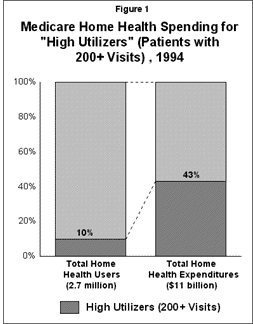
Washington, D.C. — As Congress looks to the Medicare home health benefit as a possible source ofsavings for the program, a new study prepared for the Kaiser Family Foundation by the Project HOPECenter for Health Affairs finds that the sickest Medicare beneficiaries–those who receive more than200 home health visits per year–have driven the recent expenditure increases in home health spending. These “high utilizers,” most of whom live at or near the poverty level, have more than doubled as ashare of total Medicare home health spending, increasing from 20% in 1991 to 43% of spending in1994, although they accounted for just 10% of home health users (Figure 1).

At the same time, the report finds that for-profit home health agencies generate higher Medicarespending–$1 billion in 1994–because they provide more visits to similar patients than non-profitagencies do.

1274-home1.gif

“Sharply rising costs make the Medicare home health benefit a natural target for budget cutting,” saysDrew Altman, President of Kaiser Family Foundation. “But this study shows that the home healthservices also meet real needs of very sick and low-income seniors. Curtailing services withoutendangering needed care will be a real challenge.”

High Utilizers

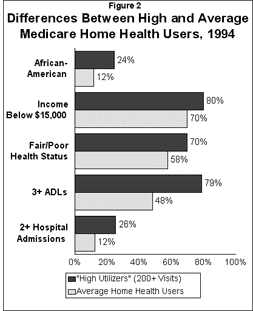
Compared to the average beneficiary who received home health services in 1994, those with 200 ormore visits per year were much more likely to have had serious medical problems, with one-quarterhaving two or more hospital admissions within a year. They also had greater long-term care needs,with nearly 80% reporting severe functional impairments, such as difficulty bathing.

1274-home2.gif

The study’s authors also point out that the majority (80%) of people who receive extensive home healthcare live close to or below the poverty level. They observe that adding a copayment for home healthservices for Medicare beneficiaries–part of the Senate bill that was passed last week–woulddisproportionately impact the near-poor who do not qualify for Medicaid but are unable to afford aprivate supplemental policy.

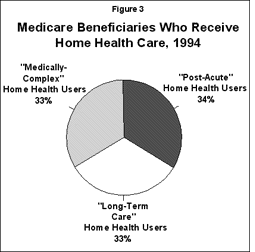
“While home health care was originally conceived as a short-term benefit to help seniors recover after ahospital stay, now only one-third of all home health patients receive this type of ‘post-acute’ care,”points out lead author Joel Leon, of the Project HOPE Center for Health Affairs (Figure 3).

1274-home3.gif

“Medicare’s home health benefit has evolved into a limited long-term care safety net, especially for’high utilizers,'” explains Tricia Neuman, director of the Kaiser Medicare Policy Project and a co-author of the report. “It has also become an important source of medical care for really sick seniorswho are in and out of hospitals several times a year.”

For-Profit Agencies

The report also finds a significant difference in the number of home health visits provided by for-profitagencies as compared to non-profit or government-run agencies. The average annual Medicare homehealth expenditure per beneficiary ($4,442 in 1994) was $1,064 higher for beneficiaries served by for-profit providers. The higher expenditures associated with care from for-profit agencies–which totaled$1 billion in 1994–could not be explained by the age, health, functional status, or other characteristicsof the patients they served.

“The differences in the level of care provided by home health agencies warrant a closer look,” saysLeon.

Medicare’s Home Health Benefit was originally designed to provide short-term care at home tohelp beneficiaries recover following an inpatient hospital stay. Legislative, administrative, and judicialreforms in the 1980s caused an increase in the number of people receiving home health services and theaverage number of visits per home health user. Home health services are funded primarily out ofMedicare’s Hospital Insurance (Part A) Trust Fund, which is financed mainly through payroll taxes. There are no copayments imposed on home health visits. Home health agencies are paid on a cost-reimbursement basis, which is subject to limits.

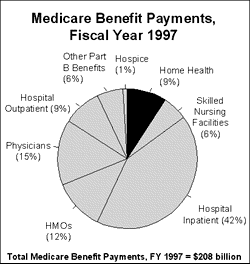
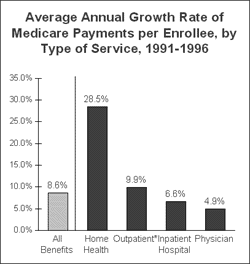
The home health benefit accounts for 9% of total Medicare spending, nearly $19 billion, in 1997. Between 1991 and 1996, home health spending per enrollee grew at an average annual rate of nearly29%, four times the rate of inpatient hospital and physician care.

1274-home4.gif
1274-home5.gif

SOURCE: Medicare Chart Book, The Kaiser Medicare Policy Project, June 1997.


Understanding the Growth in Medicare’s Home Health Expenditures was prepared by Joel Leon,Ph.D., and Stephen Parente, Ph.D., of Project HOPE Center for Health Affairs, and Tricia Neuman,Sc.D, of the Kaiser Family Foundation. The analysis was based upon data from the Medicare CurrentBeneficiary Survey and related Medicare home health claims. Copies of the report can be ordered bycalling the Foundation’s toll-free request line at 1-800/656-4KFF. Ask for report #1274.

The Kaiser Family Foundation, based in Menlo Park, California, is a non-profit, independent nationalhealth care philanthropy and is not associated with Kaiser Permanente or Kaiser Industries. TheFoundation’s work is focused on four main areas: health policy, reproductive health, AIDS/HIV, andhealth and development in South Africa. The Kasier Medicare Policy Project was established in 1995to provide a framework for the Foundation’s ongoing work related to health coverage for the elderlyand disabled.

Protection in Managed Care Plans: A Side-by-Side Comparison of Proposal Federal Legislation – Report

Published: Jun 29, 1997

Side-By-Side Comparison Of Proposed Federal Legislation For Consumer Protection In Managed Care Plans

Nicole Tapay, Karen Pollitz, Jalena Curtis

Institute for Health Care Research and Policy Georgetown University Medical Center

July 18, 1997

Issue Summary

Over the past decade, an increasing number of Americans have been receiving their health care coverage through HMOs, PPOs and other types of managed care entities. The growing influence of managed care, in turn, has led consumers and state and federal policy makers to raise questions about the appropriate roles and rights of consumers, providers, employers, purchasers, and insurers within this system. Areas of concern include: 1) whether plans provide sufficient access and choice for consumers; 2) what is the appropriate method to enable consumers to appeal plan decisions; and 3) what rights consumers have with respect to information about their health plans.

Most states have basic protections in place regulating HMOs and managed care plans that are subject to state law. In addition, there has been a surge of recent state legislative activity in this area which has augmented the sophistication and specificity of some of these laws. At the federal level, Medicare currently imposes certain requirements upon managed care plans contracting with the program. Federal standards for Medicaid managed care have been somewhat more general; as states move toward requiring managed care enrollment, federal legislation has been proposed to strengthen protections for Medicaid beneficiaries. Also at the federal level, ERISA, which governs self-funded employer plans, contains minimal requirements for such plans and virtually no protections specifically targeted at the managed care components of such plans.

In the 105th Congress, several bills of varying scope have been introduced to address an array of concerns relating to consumer and provider protections in health plans. In addition, Congressional Budget Reconciliation Bills suggest several changes in this area for Medicare and Medicaid. This document is a side-by-side comparison of many of the leading federal bills in these areas. It begins with the following brief description of the bills contained in the side-by-side comparison tables. The Medicare and Medicaid provisions of the House and Senate Budget Reconciliation Bills (House and Senate Budget Bills) are presented in Part I. The eight remaining bills discussed below, introduced in the House and/or Senate, are presented by topic in Part II.

Please note: This document includes certain acronyms; many of these are defined in the “Definitions” section at the end of the document.

H.R. 2015–House Budget Bill/Provisions Relating To Medicare Managed Care

The House Budget Bill would establish a new Medicare managed care program, MedicarePlus. Plan options include a variety of coordinated care plans. Importantly, this option does not preclude Medicare eligibles from choosing the traditional fee-for-service Medicare program. The House Budget Bill includes requirements relating to information disclosure, gag rules, grievance procedures, quality assurance, access to care, access to specialists, emergency services, continuity of care, privacy, provider protection, solvency standards for provider-sponsored organizations, and enforcement issues.

The House Budget Bill requires plans to disclose specified information to federal authorities and enrollees. It also includes a grievance/appeals system with internal and external mechanisms, including time limits and reviewer requirements for all grievances and appeals. Time frames are established for prior authorization determinations. Minimum requirements are established for internal quality assurance. The House Budget Bill requires plans to provide access to providers in service area within a reasonable time frame and to cover appropriate specialist treatment.

The House Budget Bill sets forth a process for provider-sponsored organizations (PSOs) to receive federal waivers from state laws that fall within specified categories. Solvency standards for PSOs will be set at the federal level. The House Budget Bill also sets forth open enrollment and information requirements to facilitate beneficiary choice and mobility among Medicare options.

Status: Passed by the House on June 25, 1997, and awaiting action by reconciliation conference committee. The House Budget Bill incorporates two separate proposals for Medicare, as passed by the committees of jurisdiction (Commerce and Ways and Means) with some slight variations.

S. 947–Senate Budget Bill/Provisions Relating To Medicare Managed Care

The Senate Budget Bill would establish a new Medicare managed care program, Medicare Choice. In general, the Senate Budget Bill is very similar to the House Budget Bill, with differences highlighted within the attached side-by-side chart. Plan options include a variety of coordinated care plans; Medicare eligibles can still choose the traditional fee-for-service program. The Senate Budget Bill includes requirements relating to information disclosure, gag rules, grievance procedures, quality assurance, access to care, access to specialists, emergency services, continuity of care, privacy, provider protection, solvency standards for provider-sponsored organizations, and enforcement issues.

The Senate Budget Bill requires plans to disclose specified information to federal authorities and enrollees. It also includes a grievance/appeals system with internal and external mechanisms, including time limits for all grievances and appeals and limited reviewer requirements. Time frames are established for prior authorization determinations. Minimum requirements are established for internal quality assurance. The Senate Budget Bill requires plans to provide access to providers in their service areas within a reasonable time frame and to cover appropriate specialist treatment.

The Senate Budget Bill sets forth a process for provider-sponsored organizations (PSOs) to receive waivers from state laws. Solvency standards for PSOs will be set at the federal level. The Senate Budget Bill also sets forth open enrollment and information requirements to facilitate beneficiary choice and mobility among Medicare options.

Status: Passed by the Senate on June 26, 1997, and awaiting action by reconciliation conference committee.

H.R. 2015–House Budget Bill/Provisions Relating To Medicaid Managed Care

The House Budget Bill incorporates selected consumer protection standards for Medicaid managed care enrollees. The House Budget Bill includes requirements relating to gag rules, grievance procedures, quality assurance, access to care, access to specialists, emergency services, and continuity of care. It requires plans to permit female enrollees access, without prior authorization, to obstetricians/gynecologists for routine care and to designate such physicians as their primary care providers. It requires plans to establish internal grievance procedures that meet federal standards, including timeliness of considerations. It requires plans to follow quality standards. The House Budget Bill also prohibits restrictions on medical communications between providers and patients.

Status: Passed by the House on June 25, 1997, and awaiting action by reconciliation conference committee.

S. 947–Senate Budget Bill/Provisions Relating To Medicaid Managed Care

The Senate Budget Bill sets forth protections for Medicaid beneficiaries enrolled in managed care plans. The Senate Budget Bill includes requirements relating to information disclosure, grievance procedures, quality assurance, utilization review, access to care, access to specialists, emergency services, protections relating to covered benefits, discrimination, continuity of care, and enforcement issues. It permits states to mandate enrollment in a managed care plan as a condition of receiving Medicaid coverage. Beneficiaries generally must be given a choice of at least two plans, though states may waive this rule in rural areas under certain circumstances. States may not mandate managed care enrollment for certain, more vulnerable Medicaid beneficiaries. The Senate Budget Bill establishes standards relating to information disclosure, access to care, access to specialists, and access to emergency services. It requires plans to establish grievance procedures, sets a general requirement of timeliness for prior authorization systems, and provides for quality assurance standards. It prohibits balance billing by plan contractors and subcontractors. It establishes standards for financial soundness of Medicaid managed care plans, and authorizes the Secretary to apply new sanctions against plans that do not comply with the Senate Budget Bill’s requirements.

Status: Passed by the Senate on June 26, 1997, and awaiting action by reconciliation conference committee.

S. 644–D’Amato/H.R. 1415–Norwood

This bill establishes consumer protection standards for managed care plans, both insured and self-insured. Standards address information disclosure, gag rules, grievance procedures, utilization review, quality assurance, access to care, access to specialists, emergency services, continuity of care, privacy, experimental therapies, provider protection, discrimination, minimum solvency, and enforcement issues. The bill requires plans to disclose specified information to enrollees, prospective enrollees, health professionals, and providers. Time limits and restrictions on reviewer qualifications are established for internal review of grievances and appeals; time limits are also specified for UR prior authorization determinations. The bill mandates internal quality improvement programs with specified components. Enrollees must have access to specialized treatment when necessary, and must receive continued coverage when provider changes could disrupt continuity of care. Plans must offer point-of-service options with fair and reasonable premiums. Emergency services must be covered and must be accessible at all times. States may impose more stringent requirements than those specified in the bill.

Status: Hearings were held in the Committee on Labor and Human Resources in May 1997. No committee or legislative actions have been taken; provisions similar to portions of this bill have been incorporated into the House and Senate Budget Bills. The House companion bill to S. 644 is H.R. 1415 (Norwood).

S. 373–Kennedy/ H.R. 820–Dingell

This bill sets forth consumer protection standards for managed care plans, both insured and self-insured. Standards address information disclosure, gag rules, grievance procedures, utilization review, quality assurance, access to care, access to specialists, emergency services, continuity of care, privacy, experimental therapies, provider protection, and enforcement issues. The bill requires plans to disclose specified information, updated monthly, to state authorities, enrollees, and the public. The bill also outlines a grievance/appeals system with internal and external mechanisms, including time limits and reviewer requirements for all grievances/appeals. Time frames are also established for UR prior authorization determinations. Minimum requirements for internal quality assurance are established, including a minimum uniform data set to be specified by the Secretary. The bill requires plans to cover treatment by specialists, and requires continuity of care for specified periods after providers are no longer participating. If emergency services are covered benefits, standards are set forth for coverage without prior authorization and without regard to whether the provider is participating. To assist consumers with coverage choice, filing complaints, and to investigate instances of poor treatment of enrollees, the bill requires the establishment of state health insurance Ombudsmen. States are permitted to impose more stringent requirements on plans than those outlined in the bill.

Status: Hearings on the subject of health care quality in commercial and public plans have been held by the Senate Labor and Human Resources Committee and the Senate Finance committee. No hearings have yet been held on this particular bill, nor has committee or legislative action been taken. A similar bill to S. 373 has been introduced in the House, H.R. 820 (Dingell). Unlike S. 373, H.R. 820 does not amend ERISA.

S. 346–Wellstone

This bill sets forth consumer protection standards for managed care plans, both insured and self-insured. Standards address information disclosure, gag rules, grievance procedures, utilization review, access to care, access to specialists, emergency services, privacy, provider protection, discrimination, minimum solvency, and enforcement issues. The bill requires plans to disclose specified information in standardized form to prospective covered individuals and UR information to state officials. The bill also establishes guidelines for internal, external/independent, and expedited reviews of grievances, which are to be further developed through federal regulation. Requirements for mandatory UR programs are described, and additional standards are to be developed for certification of UR programs. The bill sets forth standards for provider credentialing, and requires states to develop uniform credentialing requirements. “Meaningful” access to specialist treatment is required, and enrollees with chronic conditions must receive ongoing direct access to specialists as appropriate. Emergency services must be covered and must be accessible at all times. States are to establish Offices for Consumer Information, Counseling and Assistance with Health Care to educate and assist consumers with health insurance issues. States may pass laws with equal effect or stricter requirements than those in the bill.

Status: Hearings on the subject of health care quality in commercial and public plans have been held by the Senate Labor and Human Resources Committee and the Senate Finance committee. No hearings have yet been held on this particular bill, nor has committee or legislative action been taken.

S. 864–Chafee/Breaux

This bill sets forth protections for Medicaid beneficiaries enrolled in managed care plans. The bill permits states to mandate enrollment in a managed care plan as a condition of receiving Medicaid coverage. Beneficiaries generally must be given a choice of at least two plans, though states may waive this rule in rural areas under certain circumstances. States may not mandate managed care enrollment for certain, more vulnerable Medicaid beneficiaries. The bill establishes standards relating to information disclosure, access to care, access to specialists, and access to emergency services. It establishes specific standards for access to care provided by Ob-Gyns for women and care by specialists for patient with chronic conditions. The bill requires plans to establish grievance procedures, sets a general requirement of timeliness for prior authorization systems, and provides for external review of enrollee grievances and of quality assurance standards. It prohibits balance billing and restrictions on medical communications between providers and patients. It establishes standards for financial soundness of Medicaid managed care plans, and authorizes the Secretary to apply new sanctions against plans that do not comply with the bill’s requirements.

Status: Some portions of this bill appear in the Senate Budget Bill, and others appear in the House Budget Bill.

H.R. 586–Ganske

This bill establishes consumer protection standards in the area of medical communications for group and individual insurers, including group health plans. Standards address gag rules and enforcement issues. Although a similar bill, S. 449 (Kyl/Wyden), is not included as a separate bill in the side-by-side, the description of H.R. 586 highlights the main difference between H.R. 586 and S. 449. Both S. 449 and H.R. 586 prohibit plan restrictions on medical communications and establish monetary penalties for violation of this rule. In addition, H.R. 586 provides that while plans may not restrict such communications, entities operating plans may place limitations on services offered based on religious or moral convictions. S. 449 includes a somewhat different “conscience clause.”

Status: During the 104th Congress, hearings on this bill were held by the Health Subcommittee of the House Committee on Ways and Means. In addition, the Health and Environment Subcommittee of the House Commerce Committee also held a hearing which focused on the issue of gag rules in managed care plans and whether legislation was necessary to address the issue. In July 1996, the full Commerce Committee met in open markup session and ordered the bill reported to the House, as amended, by a voice vote. No further action was taken. During the 105th Congress, portions of this bill have been incorporated within the House Budget Reconciliation Bill. See above.

H.R. 815–Cardin

This bill establishes consumer protection standards in limited areas for group and individual insurers, group health plans, Medicare (HMOs and competitive medical plans), Medicaid, and Medicare Select plans. Standards address emergency services, information disclosure, and enforcement issues. The bill sets forth standards for coverage of emergency services without prior authorization and without regard to whether providers are participating. Time limits are established for authorization of post-stabilization care. States may establish standards relating to emergency services to the extent they do not prevent the application of requirements in the bill.

Status: No legislative or committee action. Similar provisions are incorporated within the House and Senate Budget Bills, as well as within S. 644, S. 373, and S. 346.

H.R.135–DeLauro

This bill establishes consumer protection standards in limited areas for group and individual insurers, including group health plans. Standards address protections relating to covered benefits, provider protection, and discrimination as they relate to treatment of breast cancer. The bill establishes minimum length of stay requirements for mastectomies and lymph node dissections for treatment of breast cancer if these services are covered benefits. In addition, the bill prohibits financial incentives to providers and enrollees for purposes of avoiding these requirements; however, doctors in conjunction with patients may decide upon shorter lengths of stay. States may pass laws requiring at least the same length of stay or requiring that length of stay decisions be left to doctors in consultation with patients.

Status: No legislative or committee action.

S. 795–Jeffords/Lieberman

This bill establishes consumer protection standards for federal health plan contractors, including the Federal Employees Health Benefits Program, Medicare, Medicaid, TRICARE, and Veterans Affairs. Standards developed pursuant to the bill address information disclosure, grievance procedures, quality assurance, and enforcement. The bill requires plans to disclose specified information in standardized form to prospective enrollees. The bill also establishes a Federal Health Plan Quality Council to evaluate plans, direct government participation in regional health care accountability initiatives, and advise the President and Congress on consumer protection and quality of participants’ health care. The Council must establish criteria for mandatory certification of plans by licensed certification entities, with minimum criteria requirements specified in the bill. The Council will pay plans to reward them for meeting or exceeding quality targets; to fund this program, all plans must allocate annual payments to the Council.

Status: Hearings on the subject of health care quality in commercial and public plans have been held by the Senate Labor and Human Resources Committee and the Senate Finance committee. No hearings have yet been held on this particular bill, nor has committee or legislative action been taken.

Return to top

Side-By-Side Comparison Of Proposed Federal Legislation For Consumer Protection In Managed Care Plans:

Side-By-Side Part One Part Two Part Three Part Four

Children’s Health Insurance: 1997 Budget Reconciliation Provisions – Report

Published: Jun 29, 1997

Children’s Health Insurance: 1997 Budget Reconciliation Provisions

(as of 07/14/1997)

Center of Health Policy Research and The George Washington University Medical Center

Current Law And StatusHouse BillSenate BillI.Status Recommendations transmitted 06/12/97 from Commerce Committee to Budget Committee. H.R. 2015 passed House 06/25/97. Recommendations transmitted 06/19/97 from Finance Cte to Budget Cte. H.R. 2015 (spending bill) and H.R. 2014 (tax bill) as passed by the Senate 06/25/97 and 06/27/97. II.General Approach No systematic approach to financing health coverage for children. Coverage is through employer-sponsored private insurance, publicly-subsidized private plans, and Medicaid.

In 1994 among children under age 18:

  • 14% (10 million) were uninsured;
  • 61% had private coverage; and
  • 18% had only Medicaid coverage.

The percentage of uninsured children varied by income, with no coverage among:

  • 22% of poor children (with family income below 100% FPL);
  • 45% of near-poor children (with family income between 100-200% FPL);
  • 9% of those with higher income.

Most uninsured children live in working families with incomes <250% FPL.

One third of uninsured children are eligible for Medicaid but not enrolled. Children’s Health Insurance

Child Health Assistance Program (CHAP) creates an entitlement in states, but not in individuals.

Entitles states to payments ($14 billion over five years) to cover uninsured, low income children using any or all of the following methods:

  1. provision of benefits under Medicaid;
  2. purchase of private (self-insured/insured group or individual) coverage;
  3. direct purchase of services;
  4. other methods as specified by the state.

Requires states to submit to HHS a plan describing use of funds, with approval of the plan triggering state eligibility for payments.

Requires state plans to follow federal framework on eligibility, benefits, cost-sharing, and other matters.

Effective October 1, 1997.

Number of children covered under CHAP = 500,000 previously uninsured children (CBO estimate).

Medicaid

Permits states to speed up the current mandatory phase-in of Medicaid coverage for children born after September 30, 1983 who are under age 19 and whose family income is below 100% FPL. Children covered = 125,000 (CBO estimate).

Allows states the option to provide 1 year of continuous coverage under Medicaid for children under 19 ($0.7 billion over five years). Children covered = 130,000 (CBO estimate).

Permits states to provide Medicaid during a presumptive eligibility period for children under 19 years old ($0.5 billion over five years). Children covered = 110,000 (CBO estimate).

Total number of children covered = 865,000 previously uninsured children (CBO estimate). Children’s Health Insurance

Children’s Health Insurance Initiatives creates an entitlement in states, but not in individuals.

Entitles states to payments ($16-$24 billion over five years) to cover uninsured, low income children using one of two methods:

  1. expansion of Medicaid; or
  2. purchase or provision of children’s health insurance through a grant program.

Requires states to carry out outreach activities to enroll children who are eligible for Medicaid and to encourage employers to provide health insurance coverage for children.

Requires states to submit to HHS a program outline identifying which one of the two options the state intends to use.

Effective October 1, 1997.

Medicaid

To qualify for new funds, states must speed up (by 2000) the current mandatory phasing-in of Medicaid coverage for children born after September 30, 1983 who have not reached the age of 19 and whose family income is below 100% FPL.

Allows states the option to provide 1 year of continuous coverage under Medicaid for children under age 19.

Total number of children covered = 1,670,000 previously uninsured children (CBO estimate). III.Coverage Rules Eligibility and coverage rules vary with type of plan (e.g., employer-based plan, Medicaid, state insurance program).

States have an option to extend Medicaid to all uninsured children. Five states cover children under age 18 or 19 in near-poor families with incomes up to 185% FPL or higher. Defines low income children as children who are under 19 years old and whose family income is below 300% FPL.

Further defines targeted low-income children as those who:

  1. are determined eligible for assistance under the program;
  2. have family income above the applicable Medicaid level in the state but not exceeding an income level that is 75% greater than the Medicaid applicable level, or, if higher, 133% FPL; and
  3. are not eligible for Medicaid or covered under a group plan or other private insurance.

Prohibits discrimination on the basis of diagnosis or denial of eligibility on the basis of a preexisting medical condition, although group health plans may continue to exclude coverage of preexisting conditions as under current law.

Permits states to establish coverage standards based on age, income, resources, disability status, duration of eligibility and geographic area. Within each category, states must give priority to children with lower family incomes.

Requires state plans to include a description of:

  1. the methods (including a methodology consistent with Section 1902(1)(3)(E)) to establish and continue eligibility and enrollment; and
  2. the procedures to screen for eligibility, coordinate coverage with Medicaid and other insurance programs, and avoid substitution of private coverage by the new assistance provided by the state.

Defines low income children as children who are under 19 years old and whose family income is below 200% FPL.

Permits states to establish coverage standards with priority to children with lower family incomes.

Requires program outlines to include a description of

  1. the standards and methodologies used to determine eligibility; and
  2. the procedures used to screen for eligibility, coordinate coverage with other programs, and avoid substitution of private coverage by the new assistance provided by the state.

IV.Premium Assistance Requires that, to the extent possible, states set individual premiums on a income-based, sliding scale, giving priority to children in lower income families.

Any state payments (in the form of cash or vouchers) would not be counted as income for purposes of determining eligibility for any means-tested federal or federally-assisted program (e.g., food stamps). Permits states to impose premiums on families with incomes above 150% FPL.

Imposes same limits on beneficiary costs as Medicaid for those below 150% FPL (i.e., no cost-sharing for mandated populations, but nominal cost-sharing for optional populations). V.Benefit Structure Medicaid’s EPSDT program covers comprehensive benefits for children, including: medical, dental, preventive, primary, hospital, specialty, developmental, and long term care services.

Employer plans vary in scope of benefits, with most including preventive, primary, and inpatient services and few covering developmental or long term care services.

Special state programs and private insurance plans for children vary in scope of benefits; most have preventive and primary care, but many do not include inpatient or long term care services. Requires states to cover at least four categories of services:

  1. inpatient and outpatient hospital services;
  2. physician surgical and medical services;
  3. laboratory and x-ray services; and
  4. well-baby and well-child care, including age-appropriate immunizations.

Requires states to specify:

  • amount, duration and scope of benefits;
  • level of cost-sharing, including premiums, deductibles, coinsurance and other cost-sharing;
  • delivery method (e.g., fee-for-service, managed care, direct service provision, vouchers); and
  • utilization control systems.

Group plans are exempt from covering the minimum categories of benefits if they provide the same coverage to children eligible for assistance as provided to other individuals covered by the group plan.

Prohibits states from using funds to pay for abortions or to assist in the purchase of benefits that include coverage of abortion except in cases of rape, incest, or danger to the mother. Requires states using the grant program to provide benefits at least equivalent to the Blue Cross/Blue Shield standard PPO option under Federal Employee Health Benefit Plan (FEHBP), including dental, vision and hearing. The Secretary of HHS will certify that plans are equivalent or better than this standard FEHBP benefit package.

Requires parity in mental health coverage if insurers offer such coverage.

Prohibits states from using funds to pay for abortions or to assist in the purchase of benefits that include coverage of abortion except in cases of rape, incest, or danger to the mother. VI.Cost-Sharing Prohibits states from imposing cost-sharing on preventive services. Permits states to impose cost-sharing requirements on families with incomes above 150% FPL. Imposes same limits on beneficiary costs as Medicaid for those below 150% FPL. VII.Insurance Reforms Prohibits states from permitting the use of any preexisting condition exclusion for covered benefits.

Group plans are exempt from preexisting conditions requirements so long as they are in compliance with the Health Insurance Portability and Accountability Act (HIPAA) of 1996. Not specified. VIII.Treatment of Medicaid Medicaid coverage mandated for:

  • persons who meet AFDC income rules as of 07/16/96;
  • children born after 09/31/83 with family income <100% FPL;
  • children below age 6 with income <133% FPL;
  • infants of mothers covered by Medicaid;
  • others (e.g., SSI, foster care).

Optional groups:

  • infants with family income <185% FPL;
  • children ages 13-21 with income <100% FPL;
  • other children under liberalized income eligibility criteria (1902 (r)(2)).

No cost-sharing for children’s services.

States have an option to extend Medicaid to all uninsured children. Five states cover children under age 18 or 19 in near-poor families with incomes up to 185% FPL or higher. Phase-In Of Poor Children

Permits states to speed up the current mandatory phase-in of Medicaid coverage for children born after September 30, 1983 who have reached age 6 and whose family income is below 100% FPL. (Under the current mandatory phase-in schedule, all poor children under 19 will be eligible for Medicaid by the year 2002).

Eligibility

Permits states to use new funds available under the child health assistance program with an enhanced federal match to expand Medicaid eligibility under the following conditions:

  • income and resource standards are not more restrictive than those applied as of 06/01/97;
  • reporting of information to HHS about expenditures and payments for the expansion is provided for; and
  • amount of increased payments does not exceed total amount of allotment not otherwise expended.

Outreach And Enrollment

Requires state plans to describe:

  • outreach efforts to inform eligible families about assistance under the new program or other public or private coverage and to assist them in the enrollment process; and
  • coordination strategies for the administration of the child health assistance program and other public and private insurance programs.

Continuous Coverage

Permits states to provide 12-month continuous coverage under Medicaid for children under 19.

Presumptive Eligibility

Permits states to provide Medicaid during a presumptive eligibility period for children under 19 years old; coverage financed through the state allotment for the child health assistance program.

Reductions In Federal Grant

Reduces federal grants to states based on costs related to presumptive eligibility. Phase-In Of Poor Children

To qualify for new funds, states must complete the phase-in of Medicaid to provide coverage for all children under age 19 whose family income is below 100% FPL by 2000. The phase-in can be staggered: under 17 by 1998 and under 19 by 2000.

Eligibility

Permits states to use new funds available under the child health assistance program to expand Medicaid with an enhanced federal match for children in eligibility expansion group.

Outreach And Enrollment

Funds set aside for states to carry out outreach activities, including:

  • identification and enrollment of Medicaid eligible children; and
  • conduct of public awareness campaigns to encourage employers to provide health insurance coverage.

Requires states to coordinate coverage with other programs (e.g., Medicaid).

Continuous Coverage

Permits states to provide 12-month continuous Medicaid coverage for children under age 19 for 1 year after eligibility is determined (option would trigger coverage of other Medicaid-eligible populations).

Maintenance Of Medicaid Effort

Requires state maintenance-of-effort according to which states must maintain:

  • children’s Medicaid eligibility rules in place as of 06/01/97; and
  • same amount of children’s health expenditures (i.e., Medicaid, Title V, school based services, etc.) as FY 96.

Reductions In Federal Grant

Reduces federal grants to states based on costs related to three aspects of Medicaid expansion:

  1. providing 12-month continuous eligibility;
  2. increased enrollment as a result of outreach; and
  3. accelerating phase-in of all poor children.

IX.Treatment of Employer-Based Coverage Permits states to deny benefits under the child health assistance program if other private coverage is available.

Exempts group plans from covering the minimum categories of benefits if they provide the same coverage to children eligible for assistance as provided to other individuals covered by the group plan. Permits group plans to impose preexisting condition exclusions so long as they are in compliance with HIPAA.

Requires HHS to establish rules for payment of family coverage under group plans. Permits payment if state demonstrates that purchase of that coverage is cost effective relative to the purchase of comparable coverage limited to targeted low income children. Provides FEHBP-equivalent coverage.

Requires states to avoid substitution of private coverage by the new assistance provided by the state. X.Children with Special Health Care Needs Requires states to ensure access to specialty care, including the use of a specialist as a primary care provider, for eligible children who have a chronic condition, a life-threatening condition, or a combination of conditions warranting such care. Provides for financial parity of mental health coverage if insurers offer such coverage. XI.State Role in Program Administration Multiple approaches to financing children’s health insurance.

States administer Medicaid. In general states determine the eligibility process, payment levels, providers, etc. State Medicaid programs use options and waivers to further modify program eligibility categories, benefits, payments, and provider types.

Over 30 states operate child health insurance initiatives including premium subsidy programs, insurance pools, and Medicaid optional expansions. States may choose to cover uninsured, low income children using any or all of the following methods:

  1. provision of benefits under Medicaid;
  2. purchase of private (self-insured/insured group or individual) coverage;
  3. direct purchase of services;
  4. other methods as specified by the state.

Requires states to prepare a plan in compliance with federal requirements and to submit it to HHS for approval.

Gives states the flexibility to design a child health assistance program within broad federal guidelines.

Requires states to set up a process to involve the public in the design and implementation of the plan as well as to ensure ongoing public involvement.

Mandates state spending to match federal allocation.

Requires states to collect data, maintain records and furnish reports to HHS for monitoring of administration and compliance as well as evaluation and comparison of state plan effectiveness.

Requires states to submit an evaluation to HHS by March 31, 2000 that would include:

  • assessment of the effectiveness of the state plan in increasing coverage;
  • description and analysis of the characteristics of children and families covered, the quality of coverage, the amount and level of assistance provided by the state, the plan service area, coverage time limits, choice of insurers, and sources of non-federal funding;
  • assessment of the effectiveness of other public and private programs in increasing coverage;
  • review of activities to coordinate the state plan with other programs, including Medicaid and maternal and child health services;
  • analysis of changes and trends that affect health insurance and health care for children in the state;
  • description of any activities to improve the availability of health insurance and care for children; and
  • recommendations for improving the child health assistance program.

Denies payments to states in the following cases:

  • if state modified income or assets standards or methodology in place as of 06/01/97;
  • if services were furnished by providers excluded from participation under Title V, XVIII, XX, or new Title XXI, except for emergency services other than hospital emergency room services;
  • if insurer that would have been obligated to provide assistance limited or excluded obligation in a provision of the insurance contract because of the child’s eligibility for assistance under the state plan;
  • if state plan is a secondary payer to other federally operated or financed health care insurance programs (with the exception of the Indian Health Service), which could have been expected to pay;
  • if state paid for abortions or assisted in the purchase of benefits that include coverage of abortion except in cases of rape, incest, or danger to the mother.

States may choose to cover uninsured, low income children using one of two methods:

  1. expansion of Medicaid; or
  2. purchase or provision of children’s health insurance through a grant program.

Requires states to prepare a program outline in compliance with federal requirements and to submit it to HHS for approval.

Gives states the flexibility to design a grant program within broad federal guidelines.

Mandates state spending to match federal allocation.

Requires states to submit annual progress reports to HHS.

Denies payments to states in the following cases:

  • if state modified income or assets standards or methodology in place as of 06/01/97; and
  • if states decreased amount of all types of children’s health expenditures below FY 96 levels.

Requires maintenance-of-effort according to which states must maintain

  • children’s Medicaid eligibility rules in place as of 06/01/97; and
  • same amount of children’s health expenditures (i.e., Medicaid, Title V, school based services, etc.) as FY 96.

XII.Allocation and Distribution of Funds to States Federal-state entitlement funding for Medicaid, in which a set federal contribution is made to states for each dollar spent – known as federal matching (FMAP).

Employers have tax deduction for contributing to employee health benefits. Typically, employees make a contribution to health benefit costs. Some employers “self-insure” under ERISA, (i.e. they assume the risk associated with health insurance rather than buying coverage from an insurance company). Federal Matching

For expanded coverage of children through Medicaid the Enhanced FMAP = FMAP + [30% x (100-FMAP)].

For expanded coverage of children through grant program, provides for quarterly payments by HHS not to exceed 80% of state expenditures.

Allocation Of Funds

Entitles each state to receive a yearly minimum allotment of $2 million (each territory: $100,000).

Ratio for allotments = (Number of uncovered low income children for a fiscal year in the state1 x State cost factor2)/(Sum of the products in numerator)

Reduces the allotment of states opting for the increased Medicaid matching option by the amount of additional payment made under Medicaid that is attributable to the increase in the federal medical assistance percentage.

Authorized Expenditures

Permits payments for:

  • child health assistance;
  • health services initiatives to improve the health of children;
  • outreach activities; and
  • other reasonable costs incurred to administer the program.

Caps payments for health services initiatives to improve the health of children, outreach activities, and other reasonable costs incurred to administer the program at 15% of total program expenditures.

Gives states three years to expend the money under the child health assistance program.

Reductions In Federal Grant

Reduces federal grants to states based on costs related to presumptive eligibility. Federal Matching

Defines bonus amount as:

  1. 5% of the cost of providing health insurance to the base year child population who are being covered at state option (paid out of the basic allotment pool); and
  2. 10% of the cost of providing health insurance to additional children who are being covered at state option (paid out of the coverage incentive pool).Provides for quarterly payments by HHS in an amount equal to the federal medical assistance percentage of the cost of providing coverage to low income children in the state through either option augmented by a bonus amount. Total amount paid to an eligible state should not exceed 85% of the total cost of the state program.

    Allocation Of Funds

    Entitles states to receive a base allotment.

    Allotment percentage = (Number of low-income children in the base period in the state3)/(Total number of low income children in the base period in all states)

    Creates two financing pools:

    • basic allotment pool (85% of funds after deduction for Medicaid outreach, continuous coverage and phase-in); and
    • coverage incentive pool (15% of funds after deduction for Medicaid outreach, continuous coverage and phase-in)

    Permits HHS to adjust the 85/15 split annually.

    Authorized Expenditures

    Permits payments for:

    • health insurance assistance for eligible children through Medicaid or grant program;
    • outreach activities; and
    • administrative costs (10% of total expenditures in FY 98-99; 7.5% in FY 2000; 5% in FY 2001).

    Prohibits use of funds for:

    • families of state public employees; or
    • children who are committed to a penal institution.

    Gives states three years to expend the money.

    Reductions In Federal Grant

    Reduces federal grants to states based on costs related to three aspects of Medicaid expansion:

    1. providing 12-month continuous eligibility;
    2. increased enrollment as a result of outreach; and
    3. accelerating phase-in of all poor children.

    XIII.Estimated Cost $16 billion over 5 years:

    • $14 billion over 5 years for child health assistance program; and
    • $2 billion over 5 years for Medicaid provisions.

    $16-$24 billion over 5 years for children’s health insurance initiatives, with $8 billion through 20 cents/pack increase in the cigarette tax. 1 Defined as the arithmetic average of the number of low income children (i.e., children whose family income is below 300% FPL) with no health insurance coverage as reported in the three most recent March supplements to the Current Population Survey before the beginning of the fiscal year.

    2 Defined as (.15) + [(.85) x (annual average wages per employee for the state for a fiscal year/annual average wages per employee for the 50 states and D.C.)].

    3 Defined as the average number of low income children in the state between 10/01/92 and 09/30/95 as reported in the March 1994, 1995, and 1996 supplements to the Current Population Survey.

    For easy printing of this document, download the pdf.gif PDF version of “Children’s Health Insurance: 1997 Budget Reconciliation Provisions” and adjust your printer setup for “landscape” printing.

    For more information on Medicare and Medicaid Provisions being reviewed by Congress, see:

    • Overview Of Selected Medicare Provisions: A Side-by-Side Comparison of Medicare Current Law with House and Senate Provisions to the Balanced Budget Act of 1997barrow.gif
    • A Comparison of the Medicaid Provisions in the House and Senate Versions of the Balanced Budget Act of 1997 (H.R. 2015/S. 947) with Current Lawbarrow.gif
    • Side-By-Side Comparison Of Proposed Federal Legislation For Consumer Protection In Managed Care Plansbarrow.gif

    Return to Top

Little Knowlege and Limited Practice: Emergency Contraceptive Pills

Published: Jun 29, 1997
  • Report: Little Knowledge and Limited Practice: Emergency Contraceptive Pills, the Public, and the Ob-Gyn

Protection in Managed Care Plans: A Side-by-Side Comparison of Proposal Federal Legislation

Published: Jun 29, 1997

Part I: Congressional Budget Reconciliation Proposals

A. Entities Regulated Issue H.R. 2015–House Budget Bill(Medicare) S. 947–Senate Budget Bill(Medicare) H.R. 2015–House Budget Bill(Medicaid) S. 947–Senate Budget Bill(Medicaid) Establishes new Medicare managed care program, “MedicarePlus;” MedicarePlus plan options include coordinated care plans (HMOs, PPOs), MSA plans (exceptions for MSA plans from some requirements). (Medicare eligibles can still choose the traditional fee-for-service program.) Medicare; established new “Medicare Choice” program. Medicare Choice plan options include fee-for-service, PPOs, point-of-service plans, PSOs, HMOs, MSAs, any other private plan for the delivery of health care items and services. (Medicare eligibles can still choose traditional fee-for-service program.) Medicaid managed care plans. State Medicaid programs and Medicaid managed care entities. B. Plan Choice/Enrollment Protections Issue H.R. 2015–House Budget Bill(Medicare) S. 947–Senate Budget Bill(Medicare) H.R. 2015–House Budget Bill(Medicaid) S. 947–Senate Budget Bill(Medicaid) 1. Point-Of-Service Requirement Point of service plans as well as closed-panel plans can be offered under Medicare Plus (Commerce Committee–see section 1852(m)). Traditional fee-for-service option would continue as well as a non-MedicarePlus option. Similar provision to House Budget Bill (Medicare). No provisions. No provisions. 2. Other Enrollment Provisions After transition period, enrollment changes without cause permitted during 90 day period after beneficiary first enrolls, and once annually thereafter. Annual coordinated enrollment period. Disenrollment for cause permitted at any time. No limit on number of enrollment changes. Annual coordinated enrollment period. Disenrollment for cause permitted at any time. No provisions. States may mandate enrollment in managed care. Choice of at least 2 plans must be available (other than in rural areas, where out-of-plan care must be permitted under certain circumstances). Managed care may not be required for special needs children, Medicare beneficiaries, or Indians.

Enrollment changes without cause permitted during 90 day period after beneficiary first enrolls, and once annually thereafter. Disenrollment for cause permitted at any time. C. Information Disclosure Issue H.R. 2015–House Budget Bill(Medicare) S. 947–Senate Budget Bill(Medicare) H.R. 2015–House Budget Bill(Medicaid) S. 947–Senate Budget Bill(Medicaid) 1. Covered And Excluded Benefits Required; must describe service area and out-of-area coverage. Similar provision to House Budget Bill (Medicare). Information standards to be developed under QA program. Required, including plan service area; plan also must disclose benefit carveouts. 2. Enrollee Financial Obligations Required, including liability for balance billing; MSA plans must provide comparison of cost sharing with other MedicarePlus plans. Ways and Means Committee also requires MSA plans requirements to compare balance billing with other MedicarePlus plans. Similar provision to House Budget Bill (Ways and Means Committee) (Medicare). No provisions. Required. 3. List Of Health Plan Providers Number, mix, and distribution of providers. Commerce Committee also requires listing of any point-of-service options. Similar provision to House Budget Bill (Medicare). No provisions. Required upon request. 4. Description Of Prior Authorization/UR Process And Requirements Required for prior authorization. Similar to House Budget Bill (Medicare). No provisions. Required upon request. 5. Description Of Grievance/Appeals And UR Process/Requirements Required. Similar provision to House (Medicare) on grievances; UR processes upon request. No provisions. Required. 6. Outcomes Of Grievance, Appeals, and UR Processes Required; performed by Secretary (Commerce Committee only). No provisions. No provisions. No provisions. 7. Quality Indicators Required to the extent available, including comparison with fee-for-service indicators. Similar provision to House Budget Bill (Medicare). No provisions. Required to the extent available. 8. Enrollee Satisfaction Data Required to the extent available. Similar provision to House Budget Bill (Medicare). No provisions. Required to the extent available. 9. Enrollee Utilization Data No provisions. No provisions. No provisions. Must be disclosed to state for beneficiaries under age 21. 10. Provider Financial Incentives/Payment Methods Extent to which organization provides benefits through DSH/teaching hospitals, and extent to which differences between payment rates reflect disproportionate share percentage of low-income patients and presence of medical residency training programs (to Secretary). No provisions. No provisions. Required. 11. Disclosure of UR Criteria/Algorithms No provisions. No provisions. No provisions. No provisions. 12. Data Standardization Requires specified information to be broadly disseminated to beneficiaries and prospective beneficiaries. Similar provision to House Budget Bill (Medicare). Must provide information to state using Medicare Risk (Sec. 1876) information set or alternative set.

Marketing materials must be approved by state and may not contain false or misleading information. Enrollment and informational materials must be easily understood by Medicaid beneficiaries and enable comparison of plans.

Similar provision to House Budget Bill (Medicaid). 13. Plan Loss Ratios No provisions. No provisions. No provisions. Required. 14. Other Information No provisions. No provisions. No provisions. Upon request, information on plan financial soundness.

Extent to which beneficiary may select provider of choice. D. Discrimination Issue H.R. 2015–House Budget Bill(Medicare) S. 947–Senate Budget Bill(Medicare) H.R. 2015–House Budget Bill(Medicaid) S. 947–Senate Budget Bill(Medicaid) 1. Anti-Discrimination Provisions Prohibits denial, limitation, or conditions upon coverage based on any health status-related factors outlined in HIPAA (medical condition, claims experience, receipt of health care, medical history, genetic information, evidence of insurability, or disability). Not required to enroll individuals with end-stage renal disease, but must continue to cover individuals who develop end-stage renal disease while enrolled in MedicarePlus plan. See also “Provider Protection.”

Must accept eligible individuals without restrictions (limited exceptions based on capacity). Same provision as House Budget Bill (Medicare). Plan must distribute marketing materials to entire service area. Prohibits discrimination in enrollment or disenrollment based on health status or anticipated need for health services.

Plan must distribute marketing materials to entire service area. E. Consumer Ombudsman Issue H.R. 2015–House Budget Bill(Medicare) S. 947–Senate Budget Bill(Medicare) H.R. 2015–House Budget Bill(Medicaid) S. 947–Senate Budget Bill(Medicaid) 1. Consumer Ombudsman, Functions HHS required to establish coordinated enrollment process, provide comparative plan information, and notice of coverage and enrollment rights to beneficiaries. Secretary must maintain toll-free number and Internet site to assist beneficiaries. Secretary may contract with outside entities to perform functions.

Beneficiary complaints may be taken to Social Security offices or directly to HCFA. Similar provision to House Budget Bill (Medicare). No provisions. Not required; states may use independent enrollment brokers to market plan enrollment to eligible beneficiaries. 2. Consumer Ombudsman, Financing No provisions. No provisions. No provisions. States may receive federal matching payments for eligible Medicaid managed care enrollment brokers. F. Access, Generally Issue H.R. 2015–House Budget Bill(Medicare) S. 947–Senate Budget Bill(Medicare) H.R. 2015–House Budget Bill(Medicaid) S. 947–Senate Budget Bill(Medicaid) 1. Access To Sufficient Number, Mix, Distribution Of Providers Must ensure access within service area with reasonable promptness (does not use number, mix, distribution requirement). Similar provision to House Budget Bill (Medicare). QA standards include access provisions. See QA requirements. Required to sufficiently assure same access as would be provided to non-Medicaid enrollees.

Adequate access to transportation and translation services.

Extended hours for primary care services.

Travel time standard for primary care services.

Services to be available and accessible with reasonable promptness in manner which assures continuity, and when medically necessary, 24 hours, 7 days/week.

HHS may impose additional access requirements. 2. Special Rules For Access In Rural/Underserved Areas No provisions. No provisions. No provisions. Rural Medicaid beneficiaries must be allowed to obtain care from providers outside plan in appropriate circumstances as established by HHS. 3. Enrollee Choice Of Primary Care Provider No provisions. No provisions. No provisions. If state requires enrollment with primary care case manager, beneficiary must have choice of 2 primary care case managers. 4. Emergency Care Access 24 hours, 7 days/week. Similar provision to House Budget Bill (Medicare). No provisions. 24 hours, 7 days/week. 5. Other Requirements Must cover service provided by nonparticipating provider if: (a) service was medically necessary and required immediately because of unforeseen illness, injury, or condition, and (b) it was unreasonable under the circumstances to obtain services through plan; must cover renal dialysis provided if enrollee temporarily out of service area. Similar provision to House Budget Bill (Medicare). No provisions. Plans can be sanctioned for substantially failing to provide medically necessary covered services.

States may not restrict choice of family planning providers. G. Access, Specialists Issue H.R. 2015–House Budget Bill(Medicare) S. 947–Senate Budget Bill(Medicare) H.R. 2015–House Budget Bill(Medicaid) S. 947–Senate Budget Bill(Medicaid) 1. Standard For Specialist Access Must provide access to appropriate credentialed specialists for:

Commerce Committee: treatment and services determined to be medically necessary by provider in consultation with individual;

Ways and Means Committee: for medically necessary services. Similar to House Budget Bill (Ways and Means Committee) (Medicare). No provisions. Must refer beneficiaries with sufficiently serious or complex conditions to available and accessible specialists.

Must refer children with special health needs to appropriate pediatric health care providers.

Must allow beneficiary access to religiously affiliated long-term care facilities if plan does not provide access to appropriate faith-based facilities. 2. Standard For Access To Specialists For Chronic Illness No provisions. No provisions. No provisions. No provisions. 3. Care by Ob-Gyn No provisions. No provisions. Requires plan to permit female enrollee to designate Ob-Gyn as PCP or, if enrollee has not designated such a provider as PCP, plan may not require prior authorization for coverage of Ob-Gyn services by participating professional. No provisions. H. Continuity Of Care Issue H.R. 2015–House Budget Bill(Medicare) S. 947–Senate Budget Bill(Medicare) H.R. 2015–House Budget Bill(Medicaid) S. 947–Senate Budget Bill(Medicaid) 1. Enrollee Protections When Provider Contract Changes No provisions. No provisions. QA requirements include standard for continuity of care. See QA requirements. No provisions. I. Experimental Treatment Issue H.R. 2015–House Budget Bill(Medicare) S. 947–Senate Budget Bill(Medicare) H.R. 2015–House Budget Bill(Medicaid) S. 947–Senate Budget Bill(Medicaid) 1. Coverage Of Experimental Treatment No provisions. No provisions. No provisions. No provisions. J. Emergency Services Issue H.R. 2015–House Budget Bill(Medicare) S. 947–Senate Budget Bill(Medicare) H.R. 2015–House Budget Bill(Medicaid) S. 947–Senate Budget Bill(Medicaid) 1. Coverage Of Evaluation And Treatment Without Prior Authorization, Regardless Of Whether Provider Non-Participating Required. Required. Required. Required. 2. Coverage Of Maintenance And Post-Stabilization Care Requires compliance with guidelines that may be established by Secretary to promote timely and efficient coordination of appropriate care. Similar provision to House Budget Bill (Medicare) except specifies components Secretary’s guidelines must include. Requires compliance with guidelines established for MedicarePlus program. Must follow HHS guidelines relating to efficient and timely coordination of appropriate maintenance and post-stabilization care.

If covered service, good faith effort to obtain prior approval required. 3. “Prudent Layperson” Standard For Determining Emergency Service2 Yes. Yes. Yes. Yes. 4. “Reasonable Payment” Standard For Participating And Non-Participating Providers No provisions. No provisions. No provisions. No provisions. 5. Prior Authorization Standard For Other ER Services No provisions. No provisions. No provisions. No provisions. 6. Other Requirements No provisions. No provisions. No provisions. No provisions. K. Grievances, Internal Issue H.R. 2015–House Budget Bill(Medicare) S. 947–Senate Budget Bill(Medicare) H.R. 2015–House Budget Bill(Medicaid) S. 947–Senate Budget Bill(Medicaid) 1. Internal Grievances Process Required for coverage denials. Required for coverage denials. Requires process for resolving grievances. Required for denial of coverage or payment for services. 2. Timeliness Standard Reconsideration of coverage denials within 30 days of receipt of medical information but no later than 60 days from date of determination.

Expedited process required upon request of physicians or enrollees when use of normal time frames could jeopardize life or health of enrollee or enrollee’s ability to regain maximum function; must notify of reconsideration as expeditiously as health condition requires but not later than 24 hours (longer if Secretary permits). Similar provision to House Budget Bill (Medicare).

Similar provision to House Budget Bill (Medicare). Requires resolution of oral or written complaints before board of appeals within 30 days.

Also requires expedited procedure for certain grievances. No provisions. 3. Professional Qualifications Of Grievance Reviewers Reconsideration of denials based on lack of medical necessity made only by physicians with appropriate expertise in field necessitating treatment (Commerce Committee only) and physician must not have been involved in initial determination. Similar provision to House Budget Bill (Ways and Means Committee) (Medicare). Board of appeals to include organization physician and nonphysician representatives, non-enrollee consumers; and providers with expertise in area necessitating treatments. No provisions. 4. Written Documentation Of Adverse Determinations Requires notice of coverage denials, including statement of reasons (Commerce Committee only). No provisions. Requires notice of coverage denials or termination or reduction of services, including statements of reasons, explanation of complaint process and other appeal rights and description of how to obtain supporting evidence. No provisions. 5. Maintain Internal Records Of Grievance Process/Actions Taken No provisions. No provisions. No provisions. No provisions. L. Grievances, External/Independent Issue H.R. 2015–House Budget Bill(Medicare) S. 947–Senate Budget Bill(Medicare) H.R. 2015–House Budget Bill(Medicaid) S. 947–Senate Budget Bill(Medicaid) 1. External Grievance Procedures If amount in controversy of appeal is $100 or more, enrollee entitled to administrative hearing before Secretary. If $1000 or more, entitled to judicial review of Secretary’s final decision.

Secretary must contract with independent, outside entity to review and resolve reconsiderations affirming denial of coverage. Commerce Committee specifies that resolution be timely. Similar provision to House Budget Bill (Medicare).

Similar provision to House Budget Bill (Ways and Means Committee) (Medicare). No provisions. No provisions. 2. Certification Of Reviewer Hearing before the Secretary. Similar provision to House Budget Bill (Medicare). No provisions. No provisions. 3. Binding Process Yes; administrative hearing (some subject to judicial review). Similar provision to House Budget Bill (Medicare). No provisions. No provisions. M. Utilization Review Issue H.R. 2015–House Budget Bill(Medicare) S. 947–Senate Budget Bill(Medicare) H.R. 2015–House Budget Bill(Medicaid) S. 947–Senate Budget Bill(Medicaid) 1. UR Program No provisions requiring UR program. No provisions requiring UR program. No provisions. No provisions. 2. Applicable Standards Mandatory UR standards set forth in bill. Similar to House Bill (Medicare). See “Quality Assurance Program” and “Grievances, Internal.” No provisions. 3. Enrollee Or Provider Input Physician input required on medical policies, quality, and medical management procedures.

Required for length of stay decisions (Commerce Committee). Similar provision to House Budget Bill (Medicare). No provisions. No provisions. 4. Reviewer Professional Standards No provisions. No provisions. No provisions. No provisions. 5. Timeliness Standard “Timely” standard (not defined), determined by urgency of situation, applies to prior authorization of nonemergency services. (Prior authorization not required for emergency services.)

Expedited process required upon request of physicians or enrollees when use of normal time frames could jeopardize life or health of enrollee or enrollee’s ability to regain maximum function; must notify of determination as expeditiously as health condition requires but not later than 72 hours from receipt of request or information3 (longer if Secretary permits). Similar provision to House Budget Bill (Medicare).

Similar provision to House Budget Bill (Medicare). No provisions. Plan may require prior authorization for services only if process provides for decisions to be made in a timely manner, depending on urgency of situation. 6. Consistency Standard No provisions. No provisions. No provisions. No provisions. 7. Notice Or Documentation Of UR Decisions Notice of any coverage denial required, including statement of reasons and description of grievance/appeals procedure (Commerce Committee). No provisions. No provisions. No provisions. 8. Other Patient Or Provider Protections No provisions. No provisions. No provisions. Child referred for treatment or permitted to seek treatment out of plan for special health care need shall be deemed to have obtained any prior authorization required. N. Quality Assurance Program Issue H.R. 2015–House Budget Bill(Medicare) S. 947–Senate Budget Bill(Medicare) H.R. 2015–House Budget Bill(Medicaid) S. 947–Senate Budget Bill(Medicaid) 1. Quality Assurance Requirements Mandatory program, subject to regulation. Must include data measuring health outcomes and other quality indices, UR protocols, review by physicians/other health professionals of process followed in provisions of health care, monitoring and evaluation of high volume and high risk services and care of acute/chronic conditions, evaluation of continuity and coordination of care, mechanisms to identify over/underutilization, action to improve quality with assessment of effectiveness, measures of consumer satisfaction. Must publish information on quality/outcomes to facilitate beneficiary comparison and choice (Secretary to establish form and guidelines). Similar provision to House Budget Bill (Medicare). States must develop and implement QA and QI standards, consistent with standards to be developed by the Secretary. Must require QA data to be provided to state and must use data and information set specified for Medicare risk contractors (Sec. 1876) or alternative set.

Regularly review scope and content of QI strategy.

Must include other aspects of care including grievance procedures, marketing and information standards, and adequately provide for financial reporting.

Must include access standards to assure availability within reasonable time frames and ensure continuity of care, adequate primary and specialist care, procedures for monitoring quality of care that reflect spectrum of populations.

Other aspects of care including grievance procedures and marketing and information standards. Required internal QA program; state contract with managed care entity must provide for state to develop and implement QA strategy with respect to access to care in reasonable time, adequate physician networks, and quality/ appropriateness of care.2. Independent Review Requires independent review through independent quality review and improvement organization approved by Secretary.

Accreditation: plans deemed to have met quality standards if accredited by private organization through process approved by Secretary. Standards must be no less stringent than standards in section 1856. Similar provision to House Budget Bill (Medicare). No requirement for independent review.

States may choose to have plans privately accredited; Secretary shall specify requirements for standards and process by which organizations shall be deemed in compliance.

Plan also deemed to have met QA standards if plan is current Medicare risk contractor (Sec. 1876) or MedicarePlus organization. Annual external independent review of quality outcomes, timeliness of and access to covered services, includes audit of sample medical records.

Managed care plans with Medicare contracts or accredited by private organization approved by HHS deemed in compliance and not subject to external quality review.

HHS will monitor state external quality review systems and will have “look-behind” authority to validate managed care plan compliance with quality standards. O. Privacy And Confidentiality Issue H.R. 2015–House Budget Bill(Medicare) S. 947–Senate Budget Bill(Medicare) H.R. 2015–House Budget Bill(Medicaid) S. 947–Senate Budget Bill(Medicaid) 1. Safeguards For Individually Identifiable Medical Information Must have procedures to safeguard privacy of such information, to maintain accurate and timely medical records and other health information for enrollees, and to assure timely access for enrollees to medical information. Similar provision to House Budget Bill (Medicare). No provisions. No provisions. P. Protections Relating To Covered Benefits Issue H.R. 2015–House Budget Bill(Medicare) S. 947–Senate Budget Bill(Medicare) H.R. 2015–House Budget Bill(Medicaid) S. 947–Senate Budget Bill(Medicaid) 1. Mandated Benefit Coverage Mandatory coverage for evaluation and treatment of emergency services. See also “Emergency Services.”

MedicarePlus plans must cover Medicare benefits for beneficiaries.

Length of inpatient hospital stay as determined by attending physician, in consultation with patient, to be medically appropriate (Commerce Committee only). Similar provision to House Budget Bill (Medicare), except for Commerce Committee provision on length of stay. No provisions. Medically necessary Medicaid covered services must be provided; plan can be sanctioned for “substantial failure” to provide medically necessary covered services.

Medically necessary shall not be construed as requiring coverage for abortion other than in cases of rape, incest, or if necessary to save life of mother. 2. Requirements If Covered Service See above. See above. No provisions. See above. 3. Balance Billing Limits On Out-Of-Network Services Prohibits balance billing for out-of-network services.

Commerce Committee exempts unrestricted fee-for-service MSA plans from these provisions. Similar provision to House (Medicare), except exempts MSA and unrestricted fee-for-service plans from this provision. No provisions. Prohibits balance billing by plan providers and subcontractors. Q. Anti-Gag Rule Issue H.R. 2015–House Budget Bill(Medicare) S. 947–Senate Budget Bill(Medicare) H.R. 2015–House Budget Bill(Medicaid) S. 947–Senate Budget Bill(Medicaid) 1. Medical Communications Between Providers And Patients No restrictions allowed on health care professionals’ communications about individual’s health status or medical care for individual’s condition, regardless of whether such care is covered under plan. No provisions. Similar provision to House Budget Bill (Medicare). No provisions. 2. Exceptions Based On Religious Or Moral Convictions Not required to provide, reimburse for, or cover counseling or referral service if organization objects to provision of such service on moral or religious grounds. Must make information available on policies regarding such service to prospective enrollees before or during enrollment and to enrollees within 90 days after organization adopts change in such policy. No provisions. Similar provision to House Budget Bill (Medicare). No provisions. R. Provider Protection Issue H.R. 2015–House Budget Bill(Medicare) S. 947–Senate Budget Bill(Medicare) H.R. 2015–House Budget Bill(Medicaid) S. 947–Senate Budget Bill(Medicaid) 1. Provider Incentive Plans4 Prohibited unless: not made as inducement to restrict medically necessary services; if plan puts provider at substantial financial risk, plan must provide stop-loss protection and conduct periodic customer satisfaction/access surveys; and plan must provide Secretary with sufficient information to determine if plan acceptable. Similar provision to House Budget Bill (Medicare). No provisions. Required to meet standard for Medicare plans. 2. Anti-Discrimination Prohibits discrimination in selecting health professionals for network based on race, origin, gender, age, disability (Commerce Committee).

May not deny participation, ability to participate in, or ability to be reimbursed for providing covered services based solely on license or certification (Commerce Committee). Similar provision to House Budget Bill (Commerce Committee) (Medicare), with clarification that plan not precluded from including providers only to extent necessary to meet enrollee’s needs nor does it preclude plan from implementing quality measures. No provisions. Similar provision to House Budget Bill (Medicare), and adds prohibition on discrimination in indemnification against health professional. 3. Provider Contracting Prohibits direct or indirect arrangements for providers to indemnify plans against any liability resulting from civil action brought for damage caused by plan denial of medically necessary care.

Once provider’s contractual obligations have ended, plan may not enforce contractual provisions preventing provider from joining or forming competing MedicarePlus organization that is a PSO in same area (Commerce Committee only). Similar provision to House Budget Bill (Ways and Means Committee) (Medicare).No provisions. No provisions. 4. Provider Application And Participation Requirements Must have procedures on physician participation including notice of rules, written notice of participation decisions adverse to physicians, and process for appealing adverse decisions with physician input. Commerce Committee excepts unrestricted fee-for-service MSA plans from this provision. Similar provision to House Budget Bill (Ways and Means Committee) (Medicare). No provisions. Managed care plan’s written participation requirements for any provider shall include terms and conditions that are no more restrictive than those included in agreements with other participating providers. 5. Payment Timeliness Standard No provisions. No provisions. No provisions. Required to meet general Medicaid requirements for timely payment unless alternative schedule is mutually agreed upon. 6. Other Payment Protections No provisions. No provisions. No provisions. Payments to RHCs and FQHCs: center or clinic that contracts with Medicaid managed care plan shall be able to elect payment under 1905(a)(2)(C) or 1902(a)(13)(E).

Payment adequacy for managed care organizations: states shall certify for Secretary that Medicaid payments to managed care entities are actuarially sufficient relative to cost of covered services. S. Provider Credentialing Issue H.R. 2015–House Budget Bill(Medicare) S. 947–Senate Budget Bill(Medicare) H.R. 2015–House Budget Bill(Medicaid) S. 947–Senate Budget Bill(Medicaid) 1. Provider Credentialing Requirements No provisions, but does require access to credentialed specialists. No provisions, but does require access to credentialed specialists. No provisions. No provisions. T. Minimum Solvency Requirements Issue H.R. 2015–House Budget Bill(Medicare) S. 947–Senate Budget Bill(Medicare) H.R. 2015–House Budget Bill(Medicaid) S. 947–Senate Budget Bill(Medicaid) 1. Minimum Solvency Provisions State solvency standards apply for Medicare Choice plans other than PSOs and to PSOs that do not have a waiver from the Secretary. (See “Enforcement;” federal solvency standards apply to PSOs that have obtained waivers.)5

Solvency standards for PSOs with waivers are to be developed through a negotiated rulemaking process. Secretary required to take into account, in developing the standards, delivery system assets and organization’s ability to provide services directly and alternative means of protecting against insolvency (examples provided). Same provision as House Budget Bill (Medicare) except also requires Secretary to take into account any NAIC standards for risk-based health delivery organizations in developing standards.6 Organization deemed to have met federal standards if meets state standards for private HMOs or other licensed risk-bearing entities unless the organization is not responsible for inpatient hospital service and physician services, or is a public entity, or solvency of organization is guaranteed by state or organization is controlled by one or more federally-qualified health centers and meets solvency standards established by state for such organization.

Effective 10/1/98 except that provides 3-year transition period for organizations that already have Medicaid contract. HHS will establish standard, including model contracting guidelines with contractors and subcontractors, to protect against risk of insolvency for Managed care plans.

Managed care plans shall report financial information to states annually.

States are required to annually audit at least 1 percent of in-state managed care plans operating.

Beneficiaries are protected from debts of providers and managed care plans due to insolvency. U. Enforcement Issue H.R. 2015–House Budget Bill(Medicare) S. 947–Senate Budget Bill(Medicare) H.R. 2015–House Budget Bill(Medicaid) S. 947–Senate Budget Bill(Medicaid) 1. Enforcement Provisions State enforcement of state requirements except with respect to PSOs with a waiver and state standards preempted by federal standards (See also “Preemption”).

No provision for agreement with state to enforce state non-solvency standards.

Secretarial certification process to ensure that PSOs meet federal solvency standards.

Secretarial approval process for waiver applications (includes explicit requirement that organizations have applied for state licensure); waiver supersedes state licensing standards that would prohibit organization from contracting with MedicarePlus. Commerce committee also states that waiver shall not supersede state quality and non-solvency consumer protection laws if imposed uniformly and generally applicable to entities engaged in substantially similar business.7 Similar provision to House Budget Bill (Medicare).

Secretary to enter into agreement with states with respect to PSOs with a waiver to ensure enforcement of state law non-solvency requirements for PSOs with waiver.

Similar provision to House (Medicare) on certification of PSO solvency standards.

Secretarial approval process of waiver applications; waiver supersedes any state law that would prohibit organization from contracting with Medicare Choice except that non-solvency state licensing provisions shall apply.8 Joint federal-state, as under current law. States must establish intermediate sanctions to enforce requirements on managed care plans. Secretary also may provide for application of sanctions against non-complying Medicaid managed care plan. V. Preemption Of State Law Issue H.R. 2015–House Budget Bill(Medicare) S. 947–Senate Budget Bill(Medicare) H.R. 2015–House Budget Bill(Medicaid) S. 947–Senate Budget Bill(Medicaid) 1. Preemption Provisions States may establish or enforce more stringent requirements on plans9 (section 1852(n) of Commerce Committee mark only).

Federal solvency standards preempt state solvency standards for PSOs with a waiver (waiver criteria include state solvency standards that differ from federal standards, other evidence of state’s differential treatment of entities engaged in substantially similar business).

Does not preempt state non-solvency requirements for all MedicarePlus plans (including PSOs) if :

Commerce Committee: state standards are applied on a uniform basis and are generally applicable to other entities engaged in substantially similar business and that provides consumer protections in addition to, or more stringent than, those developed by the Secretary.

Ways and Means Committee: state standards are not inconsistent with MedicarePlus standards. Preempts state solvency standards for PSOs with a waiver.

Preempts state non-solvency standards to extent they are inconsistent with the federal non-solvency standards developed by Secretary. No provisions. No provisions. Return to top

Side-By-Side Comparison Of Proposed Federal Legislation For Consumer Protection In Managed Care Plans:

Side-By-Side Part One Part Two Part Three Part Four

Contraception in the 90’s:  Which Methods Are Most Widely Used? And, Who Uses What?

Published: May 31, 1997

Contraception in the 90’s: Which Methods Are Most Widely Used? And, Who Uses What?

A fact sheet and resource list on new contraceptive use data from the 1995 National Survey of Family Growth (NSFG) from a briefing on the topic held in New York City on June 20, 1997. Contraception In The 90s: Which Methods Are Most Widely Used?And, Who Uses What? was co-sponsored by the Kaiser Family Foundation, the National Press Foundation and The Alan Guttmacher Institute, as part of an ongoing briefing series for journalists on reproductive health issues: Emerging Issues in Reproductive Health. The NSFG is based on interviews with more than 10,000 women across the country, and is the nation’s most comprehensive source of information on women’s reproductive and sexual health behavior, including sexual activity, pregnancy, infertility and contraceptive use.

Press Release Announcing the Selection of 1997 Kaiser Media Fellows

Published: May 30, 1997

1997 Kaiser Media Fellows Selected

For Immediate Release: June 5, 1997Contacts: Tina Hoff — (415) 854-9400 ext. 108

Menlo Park, California — Six journalists have been selected as 1997 Kaiser Media fellows, in the fifth year of an annual fellowship program for health reporters sponsored by the Kaiser Family Foundation. The journalists, whose selection was announced today, will start their fellowships projects in September 1997.

1997 Kaiser Media fellows:

Debra Gordon, medical writer, The Virginian-Pilot

    Project: Community coalitions–tracking grass root efforts to address child and maternal health problems

Jon Hamilton, freelance health policy writer

    Project: An in-depth look at states that have implemented experimental Medicaid managed care programs

Leslie Laurence, syndicated health columnist, and writer, Glamour magazine

    Project: The impact of urban hospital closings on local communities

Christopher Ringwald, demographics/mental health reporter, The (Albany) Times Union

    Project: The challenges and debate facing alcoholism and addiction treatment programs–what works, why, and how to measure results

Joanne Silberner, health policy correspondent, National Public Radio

    Project: How public health research becomes health policy–from academia to the streets

Tammie Smith, health reporter, The Tennessean

    Project: How the major black colleges in the U.S. are faring in a changing health care environment–focused on Howard, Meharry, Morehouse, and Drew

The Kaiser Media Fellowships Program provides health journalists with a highly flexible range of opportunities to pursue in-depth projects related to health policy, healthcare financing and public health issues. There is no obligation to be based at an academic institution, and no bar on fellows continuing to report for publication or TV/radio production during their fellowship.

The Program gives fellows time and travel opportunities to research specific topics, to broaden their perspectives, and deepen understanding of health policy, health financing and public health issues. The purpose is to help journalists improve the quality of the work they do–to enhance their ability to explain the complex ethical, economic, medical and political aspects involved in their reporting on health issues.

In addition to working on their individual projects, fellows meet as a group five times during the year and participate in a series of program seminars and site visits, in part designed by the fellows. These vary widely in focus, location and in the range of participants. In January 1997, the current fellows met for a three-day program on computer-assisted health reporting at the Poynter Institute, followed by a four-day sitevisit to Miami with briefings on various immigration and public health issues. The next fellowship site visit in August 1997 to Portland, Oregon, will focus on longterm care and end-of life issues.

Fellows are awarded a basic stipend of $45,000 for a twelve-month period, plus travel expenses. In 1998, six fellowships will again be awarded to print, television, and radio health reporters, commentators, editors and producers. Applications for 1998 will be available shortly, for submission by March 1998. For further information, or to apply for the 1998 awards, contact Penny Duckham, executive director of the fellowships program, at the Henry J. Kaiser Family Foundation, 2400 Sand Hill Road, Menlo Park, CA 94025 (Tel: 415-854-9400; fax: 415-854-4800; e-mail: pduckham@kff.org).

The Kaiser Family Foundation is an independent health care foundation and is not affiliated with Kaiser Permanente or Kaiser Industries.


Kaiser Media Fellows

Fellows are selected by a national advisory committee:

Hale Champion (chair)

    Kennedy School of Government, Harvard University

Paul Delaney

    Editorial Page Editor, Our World News

Anne Gudenkauf

    Senior Editor, Science Desk, National Public Radio

Timothy Johnson, M.D.

    Medical Editor, ABC News

Eileen Shanahan

    Washington Correspondent, New America News Service

1996 Media Fellows

Lisa Aliferis, producer, KPIX-TV (San Francisco)

    Project: Death and dying–focus includes hospice care, physician assisted suicide, and differences in cultural perspectives

Susan FitzGerald, medical writer, The Philadelphia Inquirer

    Project: Children’s health issues: growing up in the inner-city

Samuel Orozco, news/satellite director, Radio Bilingue

    Project: Mental health issues facing Latino immigrants in the U.S.

Eugene Richards, photo-journalist and author

    Project: The consequences of child abuse

Joseph P. Shapiro, senior editor, U.S. News & World Report

    Project: Long-term care–creating a system of care that is safe, appropriate, affordable, and maximizes independence

Mark Taylor, health reporter, Post-Tribune (Gary, Indiana)

    Project: The impact of state and federal legislation on healthcare for disadvantaged populations

1995 Media Fellows

Chris Adams, reporter, The Times-Picayune (New Orleans)

    Project: The impact of the for-profit hospital chains in the changing medical marketplace.

Leon Dash, reporter, The Washington Post

    Project: Six generations of underclass life in a family.

Jonathan Freedman, author, columnist; regular contributor, Los Angeles Times Commentary Page

    Project/s: Comprehensive child-development programs: a television documentary profiling families who overcome poverty; a book on prostate cancer

Judith Graham, business writer, The Denver Post

    Project: The restructuring of the health care industry

Lani Luciano, staff writer, Money magazine

    Project: Medical quality measures–how real, how useful, how welcome?

Patricia Neighmond, health policy correspondent, National Public Radio

    Project: Managed care–its implications for patients and their doctors

1994 Media Fellows

Jeanne Blake, documentary producer and author

    Project: Sexuality and the threat of HIV to young people

Janet Firshein, Editor, Medicine & Health

    Project: Training more primary care doctors–the challenge facing the nation’s medical schools and academic health centers

Carol Gentry, medical writer, St. Petersburg Times

    Project: Managed care and HMOs–the impact on the care doctors provide and patients receive

Angela Mitchell, freelance writer and author

    Project: African-Americans and the AIDS epidemic

Rita Rubin, associate editor, U.S. News & World Report

    Project: An examination of the appropriateness of care given to women

Steve Sternberg, freelance health policy writer

    Project: The implications–medical, legal and societal–of emerging infectious diseases

1993 Media Fellows

Lisa Belkin, healthcare reporter, The New York Times

    Project: Family practice in inner-cities–examining innovative strategies for recruiting and retaining family doctors in U.S. inner-cities

Mary Flannery, health/medical reporter, The Philadelphia Daily News

    Project: The provision of day treatment programs for adults with mental illness–primarily focused on the clubhouse model at Fountain House in New York, and its effectiveness as a treatment option for other U.S. cities

Julie Kosterlitz, Contributing Editor, The National Journal

    Project: The Clinton health reform plan–an in-depth analysis of the issues, the legislation, the political process, the results

Linda Roach Monroe, health and medicine reporter, The Miami Herald

    Project: Cultural barriers to medical care in the U.S., and the implications for medical providers and others (including the media), starting with Hispanic communities

Rebecca Perl, science desk, National Public Radio

    Project: Smoking and health–advertising, marketing and lobbying activities of the U.S. tobacco industry, nationally and internationally, and their impact and future implications for specific populations and target groups

Stuart Schear, health/science reporter, The MacNeil/Lehrer NewsHour

    Project: Issues in health reform beyond the legislative process: the implications of moving toward managed care and competition for patients, practitioners, administrators, and providers
Poll Finding

Kaiser/Harvard Health News Index June 1997

Published: May 30, 1997

The June 1997 edition of the Kaiser Family Foundation/Harvard Health News Index includes questions about major health issues covered in the news,including questions about Late-Term Abortions, Sexual Activity among Teens and the Tobacco Industry. The survey is based on a national random sample of 1,202 Americans conducted from April 28 – June 8, 1997 which measures public knowledge of health stories covered in the news media during the previous month. The Health News Index is designed to help the news media and people in the health field gain a better understanding of which health stories in the news Americans are following and what they understand about those health issues. Every two months, Kaiser/Harvard issues a new index report.

Preventing Unintended Pregnancies: The Cost-Effectiveness of Three Methods of Emergency Contraception

Published: May 30, 1997

Preventing Unintended Pregnancies: The Cost-Effectiveness of Three Methods of Emergency Contraception

  • Report: Preventing Unintended Pregnancy: The Cost-Effectiveness of Three Methods of Emergency Contraception