KFF designs, conducts and analyzes original public opinion and survey research on Americans’ attitudes, knowledge, and experiences with the health care system to help amplify the public’s voice in major national debates.
The State Children’s Health Insurance Program, enacted as part of the Balanced Budget Act of 1997, provides over $20 billion in federal funds over five years to cover low-income uninsured children. This policy brief examines how many children will participate and the public costs per covered child.
Medicare Beneficiaries & HMO’s: A Case Study of the Los Angeles Market
Note: This publication is no longer in circulation. However, a few copies may still exist in the Foundation’s internal library that could be xeroxed. Please email order@kff.org if you would like to pursue this option.
Native Americans and Medicaid:Coverage and Financing Issues
Medicaid as Medicare Premium Assistance
The Medicare program provides health insurance coverage for the nation’s elderly and disabled.16 To enroll in Medicare Part B, which offers coverage for physician and other outpatient care, individuals must be 65 or older or must be disabled, and must pay a monthly premium. This monthly premium, which is generally deducted from an individual’s Social Security check, is $43.80 per month in 1997. The Balanced Budget Act of 1997 raises the Part B premium to $67.00 per month by 2002. To protect low-income Medicare beneficiaries against these monthly premium costs, all state Medicaid programs are required to pay the entire Part B premium amounts on behalf of certain groups of Medicare beneficiaries, including Native American Medicare beneficiaries:
Dual Eligibles. These are elderly or disabled individuals who are eligible for both Medicare and Medicaid benefits. State Medicaid programs are required to pay on behalf of these individuals the entire Medicare Part B monthly premium as well as Medicare deductibles and co-insurance requirements. Dual eligibles are also entitled to coverage of nursing home care, prescription drugs, and other Medicaid benefits that are not covered by Medicare.
QMBs. Qualified Medicare beneficiaries, or QMBs, are Medicare beneficiaries who are not also eligible for Medicaid benefits but who have incomes at or below 100 percent of the poverty line ($7,890 for an individual, $9,870 for a couple in 1997) and countable resources no greater than $4,000. Like dual eligibles, QMBs are entitled to have payment made by Medicaid on their behalf for the entire Medicare Part B monthly premium as well as Medicare deductibles and co-insurance requirements. Unlike dual eligibles, QMBs are not eligible for full Medicaid benefits and are not entitled to Medicaid coverage of nursing home care or prescription drugs.
SLIMBs. Specified Low-income Medicare Beneficiaries, or SLIMBs, are Medicare beneficiaries with income between 100 and 120 percent of the poverty line (up to $9,468 for an individual and $12,732 for a couple) and countable resources no greater than $4,000. SLIMBs are entitled to have payment made on their behalf by state Medicaid programs for the cost of the monthly Medicare Part B premium. Unlike QMBs, SLIMBs are not entitled to Medicaid payment of their Medicare deductible or coinsurance requirements. Unlike dual eligibles, SLIMBs are not entitled to Medicaid payment of nursing home care, prescription drugs, or other services that Medicaid covers.
Under the Balanced Budget Act of 1997, states are required to pay some or all of the Medicare Part B premium on behalf of Medicare beneficiaries with incomes between 120 and 135 percent of the poverty line. A fixed amount of federal funding for this premium assistance is provided to each state for each of the next 5 years; no state is required to contribute any of its own funding. Unlike SLIMBs, these individuals are not entitled to premium assistance; states are required only to select individuals from qualified applicants on a first-come, first-served basis, up to the amount of federal funding available. Because the statute does not require that states notify near-poor Medicare beneficiaries of their potential eligibility for this assistance, the IHS and the tribes will, as a practical matter, frequently be the only source of information about this benefit for Native American Medicare beneficiaries.
Medicaid as a Source of Long-Term Care Coverage
Medicaid is the nation’s single largest purchaser of nursing home care. More than half of all nursing home revenues come from Medicaid. The program also covers a wide range of home- and community-based (HCBS) services for frail elderly and chronically ill disabled individuals who are at risk of nursing home care. The transition to managed care that is occurring in Medicaid’s purchase of acute care services has generally not reached the long-term care sector. Most Medicaid nursing home and HCBS services are still paid for on a fee-for-service basis.
Because nursing home care costs on average $40,000 per year, the availability of Medicaid coverage for nursing home and other long-term care services is a major source of financial protection for low- and moderate-income families. It is particularly important to Native American families because few IHS or tribally-operated facilities offer comprehensive long-term care services.17 Yet it is precisely the high cost of these services that has lead many states to impose restrictive income and resource eligibility requirements on elderly and disabled individuals and their spouses. In addition, federal law requires that states seek to recover the costs of Medicaid nursing home care from the estates of deceased beneficiaries and authorizes the states to impose liens in certain circumstances in order to carry out such recoveries. These restrictive eligibility and estate recovery rules have reportedly discouraged many otherwise eligible Native Americans from establishing eligibility for Medicaid nursing home coverage.
The Medicaid program’s historic shift from fee-for-service to managed care presents critical policy issues for the IHS, for tribes and their health programs, and for urban Indian health programs. Because state Medicaid programs differ from one another, and because local circumstances vary considerably, these issues will take different forms in different communities. Many of the issues raised by Medicaid’s shift to managed care are not unique to eligible Native Americans but affect all Medicaid beneficiaries.18 There are, however, some issues unique to Native Americans that are also common to all state Medicaid programs:
Preserving Choice for Medicaid-Eligible Native Americans. The Balanced Budget Act of 1997 overrides the right to freedom of choice of provider for most Medicaid beneficiaries by giving the states express authority to require Medicaid beneficiaries to enroll in MCOs or PCCMs. However, states under this authority may only force eligible American Indians and Alaska Natives to enroll in MCOs or PCCMs if these managed care entities are operated by the IHS, by a “638” tribe, or by an urban Indian organization. The purpose of this limitation on state flexibility is not so much to assure that Native American Medicaid beneficiaries have choice of providers; they will generally have a choice because IHS and tribal providers cannot refuse to treat Indians who are eligible for their services. Instead, the purpose of this provision is to assure that, when these beneficiaries obtain care from IHS or tribal providers, the providers, rather than MCOs or PCCMs unaffiliated with the IHS or the tribes, receive Medicaid reimbursement for the covered services they deliver. The provision does not bar Medicaid-eligible Indians from voluntarily enrolling in an MCO or PCCM that is not affiliated with the IHS or a tribe.
For many Native American Medicaid beneficiaries, the issue of choice of provider is more theoretical than practical, especially in sparsely-populated rural areas with few physicians or clinics or hospitals. Medicaid coverage that allows beneficiaries to choose from among all participating providers means little in underserved areas that have few providers of any kind, much less providers that participate in Medicaid. The movement toward Medicaid managed care has the potential to improve these circumstances and give Native American beneficiaries more choices. For example, if states opt to enroll all rural Medicaid beneficiaries in one MCO or PCCM, the resulting Medicaid market could potentially attract established, reputable managed care firms and give them an incentive to bring primary care physicians and other providers into these areas in order to be able to offer the necessary provider networks.
However, the availability of more provider choices for Native American beneficiaries has potentially adverse consequences for traditional Native American delivery systems, whether operated by the IHS or by “638” tribes. If significant numbers of Native American beneficiaries elect to enroll in an MCO or PCCM unaffiliated with the IHS or a tribal facility, the Medicaid revenues of the IHS or tribal facilities will likely decline, undermining their capacity to deliver quality care to their remaining patients. The current law provision – prohibiting states from enrolling Indian beneficiaries in MCOs or PCCMs that are not operated by the IHS or tribal “638” contractors – is not a sufficient protection against this result. If the MCO or PCCM with which the state contracts does not in turn contract with the IHS or tribally-operated facilities in the area, the Indian beneficiaries who do not choose to enroll in the MCO or PCCM would continue to receive care on a fee-for-service basis from the IHS or tribal facility. This would tend to isolate both the Indian beneficiaries and the IHS or tribal facilities from the Medicaid patients and providers in the rest of the area – not necessarily a desirable outcome. This result could be avoided if MCOs or PCCMs that receive the Medicaid franchise for the rural area were required to allow any IHS or tribally-operated facility in the area meeting the entity’s quality standards to participate – if the facility so chooses – on terms at least as favorable as those offered to other facilities. In addition, the Secretary of HHS should consider not granting waivers that would allow states to require Native American beneficiaries to enroll in MCOs or PCCMs that have not incorporated IHS or tribal facilities into their provider networks.
Protecting IHS, Tribal, and Urban Indian Providers. Medicaid revenues can make the difference between a financially viable hospital or health clinic and a facility that must reduce the services it offers or close altogether. To the extent that Medicaid-eligible Indians enroll (or under waivers are enrolled by the state) in MCOs or PCCMs, the funding to pay for the provision of covered services to these patients will flow to the MCO or PCCM. Unless the IHS or tribal or urban Indian facility is affiliated with the MCO, either as an owner or as a subcontractor, or unless the facility has an arrangement with the state under which it will be reimbursed for treating Indian MCO enrollees who go “out of network,” the facility will lose some or all of the Medicaid revenues associated with these patients. The loss of these revenues can in turn undermine the capacity of the facility to deliver quality care to the Indian population that it is responsible for serving as well as any non-Indian patients it undertakes to serve.
The federal government has a strong interest in the financial viability of IHS, tribal, and urban Indian health care providers. These providers enable the federal government to discharge in part its legal obligation to cover the cost of basic health care to Native Americans and to promote tribal self-determination. In addition, these providers are frequently the only practical source of health care for Indians and other Americans living in underserved rural areas. Because the federal government, on average, pays 57 percent of the cost of the Medicaid program, it also has an interest in assuring that Medicaid payment policies support rather than undercut the IHS, tribal, and urban health care programs that it funds with appropriated dollars.
State Medicaid programs have a strong financial incentive to facilitate the use of IHS or “638” tribally-operated health facilities by Medicaid beneficiaries who are Native Americans. As noted above, under federal statute and a HCFA-IHS Memorandum of Agreement (MOA), the federal matching rate for state expenditures in such cases is 100 percent; the state is not required to contribute any of its own funds. However, if the beneficiary receives covered services from a non-IHS or non-tribal provider, the state must assume between 20 and 50 percent of the cost. If states are aware of their financial interest and take advantage of it, they will be seeking to work with IHS and tribal providers to maximize the use of those facilities by Native American beneficiaries, and the Medicaid revenues associated with those beneficiaries should improve the fiscal position of those facilities.
The need to sustain an IHS and tribally-run health care infrastructure has a number of policy implications. It means that Medicaid fee-for-service payments made directly to Indian hospitals and clinics must be adequate to cover the costs of care. (The recent amendment phasing out cost-based payments to federally-qualified health centers (FQHCs) runs counter to this). Similarly, Medicaid payments to MCOs should be conditioned on the affiliation of MCOs with IHS, tribal, and urban health care programs that meet the MCO’s quality standards. State payment rates to MCOs for eligible Native American enrollees should be adequate to enable the MCOs to pay subcontracting programs their costs of treating Indian beneficiaries, and the MCOs should be required to pay the subcontractors at an adequate level in a timely fashion. Finally, the federal government (through the IHS or through a tribally-accountable entity subcontracting with the IHS) should make start-up capital and technical assistance available to tribal programs (or IHS facilities) that seek to become MCOs or PCCMs and contract with their state Medicaid programs to enroll Medicaid beneficiaries residing in their service areas.
Program Data. To date, the transition toward managed care has led to a decline in the quality of Medicaid program data available to the federal government and the tribes, among others.19 However, this transition has the potential of significantly improving the data available to tribes, to the IHS, and to federal and state policy-makers regarding the impact of Medicaid coverage on the use of health services by, and the health status of, Native Americans. To realize this potential, however, current reporting requirements will need to be significantly strengthened. Currently, neither the IHS nor the Health Care Financing Administration (HCFA) have reliable data on how many American Indians or Alaska Natives in each state are enrolled in Medicaid; how many of these individuals are enrolled in a Medicaid MCO or PCCM; and the average cost of covering these beneficiaries through fee-for-service or through managed care. As a condition of receipt of federal Medicaid funds, states could be required to report this data on a quarterly basis, broken down by category (non-disabled child under 19, disabled individual, aged individual, and non-disabled, non-elderly adult). In addition, MCOs or PCCMs contracting with state Medicaid programs should be required to report to the State Medicaid agencies encounter data with respect to Native American enrollees, including encounter data sufficient to monitor compliance with the early and periodic screening, diagnostic, and treatment (EPSDT) program for children. The State Medicaid agencies, in turn, should make this information (without individual patient identifiers) available to tribes and IHS available on request.
Conclusion
In the coming years, the IHS, Medicaid, and state welfare programs will continue to evolve in response to changes in the economy, changes in the health care system, and changes in budgetary and regulatory policy at the state and federal level. These changes will have profound implications for tribes and their health care programs and, ultimately, for the health status of Native Americans. In all likelihood, these changes will intensify the challenges described in this Policy Brief and create new ones. It is crucial that these developments be carefully monitored to identify problems as they arise and to give the tribes and the IHS the information they need to improve the access of Native Americans to quality health care services.
1. See Medicaid Facts: Medicaid Program at a Glance, November 1997; Medicaid Facts: Medicaid and Managed Care, November 1997; Medicaid Facts: Medicaid’s Role for Children, November 1997; Policy Brief: Restructuring Medicaid — Key Elements and Issues in Section 1115 Demonstration Waivers, May 1997.
2. For a general overview of these provisions, see Andy Schneider, Overview of Medicaid Provisions in the Balanced Budget Act of 1997, P.L. 105-33, Center on Budget and Policy Priorities, September 3, 1997, http://www.cbpp.org.
3. See Kaiser Family Foundation, A Forum on the Implications of Changes in the Health Care Environment for Native American Health Care (1997).
4. U.S. Department of Health and Human Services, Indian Health Service, Regional Differences in Indian Health 1996.
5. These figures were reached by a CBPP analysis of unpublished data from March 1997 CPS, Bureau of the Census. The percentages sum to more than 100 percent because some Native Americans had multiple sources of insurance coverage.
6. Indian Health Service, IHS Medicare and Medicaid Eligibility Data Current as of August 12, 1997, compiled September 23, 1997.
7. At its Winter, 1996 meeting, the National Governors’ Association adopted the following policy: “States do not have treaty-based trust responsibilities to provide health care to Native American peoples and, consequently, have no proper role in the financial support or operation of Indian Health Service facilities.”
8. “Indians and other native Americans are entitled under the Fifth and Fourteenth Amendments to the Constitution of the United States, and title VI of the Civil Rights Act for 1964, to equal access to State, local, and Federal programs to which other citizens are entitled.” Department of Health, Education and Welfare (HEW), Memorandum of Agreement, January 7, 1975.
9. In a case involving a dispute over the entitlement of Indians living off the reservation to federal benefits, the Supreme Court in Morton v. Ruiz, 415 U.S. 199 (1974) recognized that “[an Indian thus is entitled to social security and state welfare benefits equally with other citizens of the State.” Id. at 209, n. 11 (citing State ex rel. Williams v. Kamp, 106 Mont. 444, 449, 78 P.2d 585, 587 (1938); U.S. Dept. of the Interior, Federal Indian Law 287, 516 (1958)).
10. In Morton, the Supreme Court also noted that “[a]ny Indian, whether living on a reservation or elsewhere, may be eligible for benefits under the various social security programs in which his State participates and no limitation may be placed on social security benefits because of an Indian claimant’s residence on a reservation.” Morton, 415 U.S. at 209.
11. Under section 1115 of the Social Security Act, the Secretary of Health and Human Services is authorized to waive many of the requirements of federal Medicaid law to enable states to receive federal Medicaid matching funds for carrying out demonstration projects that in the Secretary’s judgment, “is likely to assist in promoting the objectives of [the Medicaid program].” See Kaiser Medicaid Commission Policy Brief, Medicaid: Key Elements and Issues in Section 1115 Demonstration Waivers (May 1997).
12. Peter J. Cunningham, “Health Care Utilization, Expenditures, and Insurance Coverage for American Indians and Alaska Natives Eligible for the Indian Health Service,” Changing Numbers, Changing Needs: American Indian Demography and Public Health, National Research Council, 1996, at 291.
13. A further complication occurs if an MCO or PCCM is not owned or operated by the IHS or by a tribe or tribal organization, but subcontracts with IHS or tribal facilities or programs to deliver services covered under Medicaid risk contract with the state. It is not clear if the capitation payments to the MCO on behalf of Indian beneficiaries are subject to 100 percent matching if the beneficiary uses the IHS or tribal subcontractor.
14. This and the following examples of current arrangements are described in Mim Dixon, Case Studies of Managed Care in Indian Health, National Indian Health Board. February, 1997. pp. 28-40.
15. See Sara Rosenbaum and Ann Zuvekas, Integrating Indian Health Programs into Medicaid Managed Care Systems: A Round Table Sponsored by the Indian Health Service, Final Summary Report, April 25, 1996.
16. For an overview of Medicare, see Harriet Komisar, James A. Reuter, Judith Feder, and Patricia Neuman, Medicare Chart Book, The Kaiser Medicare Policy Project, June, 1997. For a study of issues affecting low-income Medicare beneficiaries, see Patricia B. Nemore, Variations in State Medicaid Buy-in Practices for Low-Income Medicare Beneficiaries, Henry J. Kaiser Family Foundation, November, 1997. For a summary of these issues, see Medicaid’s Financial Protections for Medicare’s Poor and Near-Poor, Henry J. Kaiser Family Foundation, November 1997.
17. Indian Health Service. National Resource Directory for American Indian and Alaska Native Elders. June 1996.
18. For more information on Medicaid and managed care, see Medicaid Facts: Medicaid and Managed Care, Kaiser Commission on the Future of Medicaid, November 1997. Schneider, et al, Background Paper: Medicaid and Managed Care, Henry J. Kaiser Family Foundation, December 1997.
19. David Liska et al., Medicaid Expenditures and Beneficiaries, National and State Profiles and Trends, 1990-1995, Kaiser Commission on the Future of Medicaid, November, 1997, Authors’ Note, p. xiii. Return to top
En encuestas anteriores, la atencion se ha concentrando en captar las impresiones de la poblacion general, incluyendo sus opiniones sobre la epidemia; su preocupacion personal en cuanto a infectarse con el VIH; sus conocimientos sobre la transmision, curso y tratamiento del VIH y el SIDA; sus experiencias con la prueba de anticuerpos; su punto de vista sobre los esfuerzos nacionales y locales para detener la epidemia; y sus fuentes de informacion sobre el VIH/SIDA. En este informe, presentamos en primer lugar los hallazgos de la muestra general de encuestas a latinos, para despues considerar en detalle a varios subgrupos de latinos.La Encuesta de Kaiser Family Foundation sobre Latinos y el VIH/SIDA esta concebida para informar y estimular un mayor dialogo acerca del VIH/SIDA en las comunidades latinas para proporcionar una mejor comprension de las perspectivas que los latinos tienen en cuanto al VIH/SIDA y a todos aquellos que trabajan para reducir los costes sociales, economicos e individuales de la epidemia del SIDA.
Report: Encuesta Nacional sobre los Latinos y el VIH/SIDA
Medicaid plays several different roles of significance to Native Americans. Through its purchase of managed care products, Medicaid is reshaping the health care delivery system for many Native Americans and other underserved low-income populations. Medicaid also assists low-income elderly and disabled Indians who are eligible for Medicare in meeting their premium and cost-sharing obligations. Finally, Medicaid offers coverage for nursing home care and other long-term care services needed by frail elderly and disabled Native Americans. This report provides an overview of Medicaid from the standpoint of Native Americans with an emphasis on Medicaid as an insurance program and a purchaser of managed care
Choices Under The New State Child Health Insurance Program: What Factors Shape Cost And Coverage?
January 1998
The State Children’s Health Insurance Program (CHIP), enacted as part of the Balanced Budget Act of 1997, provides over $20 billion in federal funds over five years to cover low-income uninsured children. This program gives states considerable flexibility in designing expanded health insurance coverage for children. The way states design their programs — use of Medicaid or a separate program, scope of benefits, how much families are charged in premiums — will make a considerable difference both to how many children the expansions actually cover and to the costs states incur. States’ design choices will, in turn, be influenced by how they expect various factors to affect both the number (and insurance status) of children that participate and the public costs for each participating child–the two components of an expansion’s total public costs. The purpose of this paper is to lay out these factors — first, those that affect participation; then, those that affect cost per participating child. The goal is to assist state decision-makers in evaluating their options and to enable the broader community to participate in the decision-making process.
How Many Children Will Participate?
Analysis of experience with private and public health insurance programs suggests that a number of design features will influence both how many and what kind (uninsured vs. previously insured, higher income vs. lower income) of children are likely to participate in a new public insurance program.
The income level a state chooses as the basis for eligibility defines the total number (or overall pool) of uninsured children in any state who may participate in the program. But not all children in this pool will choose to participate; some will not sign up and will remain uncovered. Similarly, and simultaneously, eligibility levels will define a pool of currently insured children with incomes below that level who may participate in newly available coverage. Here too, some, but not all, of these currently insured children will substitute the newly available coverage for their existing coverage — that is, the new public program will, to some extent, “crowd out” or substitute for private coverage. In addition, public attention and outreach related to a new program may encourage some children eligible for, but not participating in Medicaid to sign up for coverage.
How much families will have to pay, how easy it will be for them to enroll, and how valuable they perceive the benefits are all factors that will influence how many children actually enroll.
Premium Costs
The extent to which families take advantage of newly available subsidies for insurance will depend in large part on whether and how much they are expected to pay. Under CHIP, whether or not a state can charge depends on whether it relies on Medicaid to expand coverage or creates a new insurance program. If a state chooses a Medicaid approach, it cannot in most cases charge cost-sharing and premiums for children (consistent with current Medicaid law). If the state instead creates a new program, it may charge premiums subject to specific rules. For children with family incomes at or below 150% of poverty they may charge about $15.00 to $19.00 per month per family. They may charge higher premiums for people with incomes above 150% of poverty: up to a maximum of 5% of income for premiums and cost sharing combined. For example, if premiums were the only charge, the family cost would be just over $100 per month for a family of three with income of twice the poverty level, or $26,000.
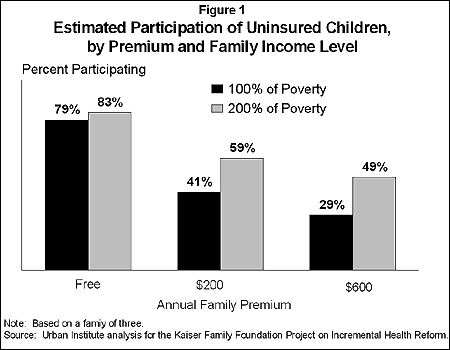
Analysis of participation in Medicaid and private health insurance programs suggests that the cost of coverage to a family is an important determinant of whether or not they will enroll for coverage. Although higher premiums reduce participation across the income spectrum, the impact is likely to be greatest for families with the lowest incomes, where higher prices absorb a larger share of family income. When coverage is free, participation is similar regardless of income. Once there is a cost attached to coverage, participation drops off substantially, regardless of the uninsured families’ income level.
As shown in Figure 1, estimates are that if coverage is free and easy to obtain, an estimated 79% to 83% of uninsured children with incomes from poverty ($13,000 for a family of three) to twice the poverty level ($26,000) would participate. Even with what appears to be a relatively modest premium — about $17 per month or $200 per year (as allowed for children with incomes at or below 150% percent of poverty) — participation drops by an estimated 24 to 38 percentage points, depending upon the income group. Only 41% of the uninsured at poverty and 59% of those with incomes at twice the poverty level are expected to enroll, if the premiums for coverage is $200. At $600, participation for poor children is only expected to be 29%. Not surprisingly, higher premiums — over $50 per month or $600 per year (as allowed under a new program for children with incomes above 150% of the poverty level) — mean even lower rates of participation.
An additional analysis by the Urban Institute of state health insurance programs in Minnesota, Hawaii and Washington similarly found that higher premiums (measured as a share of income) significantly reduced the likelihood of participation. The higher the share of income required to pay the premium, the lower the participation for people eligible for coverage. While just over half (57%) of the eligible uninsured participated with premiums at 1% of income, only 18% participated with premiums requiring 5% of income.
CHIP allows (but does not require) states to impose premiums if they create a new insurance program. A premium will reduce participation, and the reduction will be greatest for the lowest income uninsured. The higher the premium, the greater these impacts will be.
Ease of/Barriers to Participation.
Even if a new program is free, the likelihood that families will participate will depend on how easy or hard it is to enroll in the program. The Urban Institute estimates that 83 percent of all people eligible for Medicaid participate in the program, with a substantially higher rate of participation for people receiving cash assistance. For children eligible only for Medicaid, participation rates have been significantly lower. Non-participation is generally attributed to the complexity or intrusiveness of the eligibility process — having to enroll in person at a welfare office (particularly when not eligible for cash assistance) and having to provide detailed documentation of income and resources.
Analysts think that families will be more likely to enroll in a new insurance program than in Medicaid, in part because of Medicaid’s historical tie to welfare and the complex eligibility determination process in most states. That outcome is more likely if the enrollment process for the separate program is simple (e.g., relying on mail rather than in-person application) and relatively uncomplicated (e.g., relying on modest rather than extensive documentation of resources). However, as many states have already demonstrated, the Medicaid eligibility process can be simplified, potentially overcoming historical reluctance to participate. Regardless of approach, a key factor in estimating participation is how simple or burdensome the enrollment process actually is.
Value of the Coverage.
Families’ willingness to participate in a new insurance program will depend in part on their perceptions of the value of the insurance being offered. Simply lowering the price of a policy is unlikely to enhance participation if the lower price is associated with lower value. “Value” may be understood as a function of the scope of benefits, level of cost-sharing, and the quality of participating providers.
Medicaid has a broad scope of benefits and limited cost-sharing, features which enhance its perceived value. However, to the extent that Medicaid pays providers and plans low rates and does not provide “mainstream” care, its value is likely to be discounted.
A new insurance program contracting with “mainstream” plans may be perceived as attractive relative to Medicaid, thereby promoting participation. However, this enticement to participation may be offset if the plan’s benefits are limited or, alternatively, its cost-sharing high. Similarly, Medicaid may look more attractive if it relies on “mainstream” plans that offer comprehensive benefits.
Crowd-out of Private Coverage.
Families with insurance, as well as families without insurance, will fall within the income eligibility levels that states establish. Among families with incomes below the poverty level, fewer than 20% have employer-sponsored insurance and only about three percent purchase non-group insurance.
By contrast, in families with incomes between 133% and 185% of the poverty level, just over half have employer-sponsored insurance and about five percent have non-group coverage. For these insured families, as for uninsured families, interest in participation will depend upon cost, barriers, and perceived value. However, currently insured families will make judgments about these factors on a relative basis — comparing what they are paying for and getting from their current insurance plans to what they can get under the new programs.
If the new coverage looks relatively attractive or is easy to get, currently insured families become more likely to substitute the newly available coverage for the coverage they have. For example, low-income families paying a substantial share of premiums in an employer-sponsored plan may find themselves able to obtain coverage at substantially lower out-of-pocket cost in the new program. This financial advantage, however, could be offset if participation in a new program entails a burdensome or intrusive eligibility process or requires a switch to plans perceived as offering lower quality care. Alternatively, if these families find that the new subsidies are easy to get and can be applied toward their employers’ plans, a substantial proportion of the currently insured population is likely to enroll in the new program. This would result in a shift in coverage and costs from private insurance to the new public program, with no increase in the number of children insured.
It is not entirely clear whether “crowd-out” is a good or bad thing. On the one hand, it is important to recognize that currently insured low income families who choose to take advantage of new coverage opportunities do so because it gives them financial relief or better coverage. This relief seems at least as legitimate as the relief recent legislation has provided self-employed families through tax preferences (with no evidence of expanded coverage). Further, denying one group of low income families a benefit awarded to others of similar income seems unfair, especially if the insurance coverage they have entails substantial financial sacrifice.
On the other hand, if dollars are limited, the more that subsidies are used by people who already have coverage, the less they are available to people who lack coverage, impeding achievement of CHIP’s major goal of expanding coverage of children. Even more important, if choices are made that make participation particularly attractive and easy for the already covered population (for example, by allowing the use of subsidies for employer-provided coverage), participation may be skewed in favor of this population and away from the uninsured. Particularly if premiums are charged, the already insured may participate at much higher rates than the uninsured, reducing the likelihood that CHIP will expand coverage for children.
The Urban Institute has estimated that almost two-thirds of the children participating in CHIP will be newly insured, with the other third replacing their previous coverage with coverage under the new legislation. These estimates assumed that subsidies could not be applied to employer-based coverage (which may be possible with a waiver under CHIP). Estimates allowing the use of subsidies toward employer coverage (as in the House-passed version of children’s coverage) dramatically reduced the proportion of covered children who were newly insured.
States may make rules that will affect whether people with insurance will be able to participate (e.g., a requirement that a child be uninsured for a period of time before being eligible for CHIP). Rules will also determine whether the new subsidies can be used for employer plans. Both decisions — along with decisions about premiums, ease of enrollment, and value of coverage — will affect the degree to which “crowd-out” occurs.
Outreach.
The extent of effort at making people aware of the new program will also affect participation. Analysts generally believe that efforts to publicize the program and promote enrollment (particularly by reducing barriers through policies like presumptive eligibility) can enhance participation. Further, they believe that participation will be enhanced not only for newly eligible families, but also for families who are already eligible for Medicaid but not participating. An estimated two to three million uninsured children are believed to fall into this category.
States expanding children’s coverage under CHIP may, therefore, see increases in Medicaid participation for the poorest children at the same time they are pursuing expansions for children who are less poor. How much Medicaid participation rises will undoubtedly be a function of how aggressively and to whom the new program is marketed.
Capped Program Versus an Entitlement.
While the factors described above will affect the number of children who want to participate in a program of expanded health coverage, the amount of federal and state resources available will determine the number of children who can participate. States choosing to expand coverage through a new program may place a cap on the number of participants in the program, while those using Medicaid must provide coverage to any child who is determined to be eligible (i.e., an individual entitlement).
For a state, developing a capped program provides greater predictability in expenses over time. However, it also means that if needs are greater than expected (e.g., the number of uninsured children rises), the resources may not be there to deal with those needs. Under Medicaid or a stand-alone program, the federal government will match state payments under CHIP at a higher rate than they do today under Medicaid, up to a fixed allotment per state. However, under a Medicaid expansion, the federal government would continue to match state expenses — at the normal Medicaid matching rate — even after a state’s allotment of federal CHIP funds were exhausted.
If a program is capped, it may also be important to pay extra attention to issues of crowd out and outreach, in order to assure that limited dollars and coverage are targeted to those with the greatest needs (e.g., children who are uninsured and lowest income).
Estimating Participation.
Predicting how many children, newly insured and previously insured, will actually participate as states expand coverage requires judgments or assumptions about how much impact these various factors will have and how they will interact. For families without insurance, estimators start with a schedule of participation rates (based on observed experience) showing the probability of participation for families without insurance, given premiums as a share of income. These rates are then adjusted to reflect program barriers to participation (for example, enrollment at a welfare office is assumed likely to reduce participation) and the value of coverage (for example, Medicaid-only providers or high deductibles will likely reduce participation). For families with insurance, estimates of who will participate are based on the degree to which families’ enrollment in the new program would lower their out-of-pocket premium costs. If families can get these benefits and stay in their current plans, e.g., by getting a voucher, most are assumed likely to participate. If not, only a modest share is assumed likely to shift to subsidized plans.
What Are The Public Costs Per Covered Child?
As with participation, the question of costs per covered child will be answered differently depending on the choices states make. First and foremost, each state faces the choice of relying on its pre-existing Medicaid program or creating a new program to provide coverage. Imbedded in this choice are decisions about benefits, payments to providers or plans, and administrative investments and expenses. Although, in theory, a state could build its coverage expansion on Medicaid and label it a new program, in practice a new program is likely to reflect a desire to do things differently. Hence, the choices and the cost experience are likely to be different.
Actuarial analysis illustrates both the way various factors will affect costs per covered child in a Medicaid approach as compared to a new program, and how such costs should be estimated.
Benefits.
Under a Medicaid expansion approach for covering uninsured children, federal rules specify that the benefits must be the same as those provided to other Medicaid beneficiaries. Under a separate state program, the federal rules specify that the benefits must be at least as generous as one of three “benchmark” private insurance packages described in the law: the standard Blue Cross/Blue Shield package provided to federal employees, a plan offered to state employees, or the most common benefits package offered by an HMO in the state.
Although there may be variation across states, in general it is likely that the benefits provided through Medicaid are more comprehensive than those in the “benchmark” private packages. For example, Medicaid programs are required to provide Early and Periodic Screening, Diagnosis and Treatment (EPSDT) services, some of which are uncommon in private insurance packages. EPSDT provides a wide range of screening and preventive services, as well as other care identified by a screening exam as necessary.
In choosing Medicaid rather than a new program, then, states are opting for a more expansive and expensive benefit package (all else being equal).
Payment Rates for Providers and Health Plans.
Although somewhat constrained by federal requirements, states have historically established Medicaid fee-for-service and capitation rates on a “take it or leave it basis.” State Medicaid programs have generally been able to attract providers and plans at below-market rates because they are such large purchasers (though in some cases beneficiaries may not have access to a full range of mainstream providers because they are unwilling to participate). Flexibility in setting rates has been enhanced by the Balanced Budget Act, so states will likely be able to continue to pay below-market rates to providers.
In theory, a state could employ a similar approach to a new insurance program for children — using the same plans Medicaid uses and dictating rates. However, if states choose a new program, implicit in that choice may be a decision to use an alternative approach. And, since a stand-alone program will cover fewer people than Medicaid, the state’s purchasing leverage will be more constrained. Under the private insurance approach adopted by California, for example, health plans are free to submit premium bids. This approach would presumably lead to premium levels more similar to those found in the private insurance market, and therefore higher per capita costs than under an expanded Medicaid program.
Administrative Costs.
Regardless of whether a state chooses to rely on Medicaid or develop a new program, administrative costs are likely to be a significant portion of overall program costs. That is because medical service costs for children are significantly lower than the costs for an adult population, while administrative costs per enrollee are similar. For example, if the administrative costs for an adult insurance policy were 15% of the overall premium and the cost of health services for a child were one-third of the cost for an adult, then administrative costs for a child-only insurance policy could be as high as 35% of the overall premium.
Administrative costs will vary with a state’s approach. Because Medicaid has an existing administrative infrastructure in each state, there should be minimal start-up expense for expanding coverage under that program. In addition, extra administrative costs should be on a “marginal” rather than “average” cost basis. In other words, while certain costs associated with processing more applications and claims may go up (e.g., more eligibility workers may be needed), many fixed costs should remain the same. In an analysis of the cost of covering uninsured children in California commissioned by the Kaiser Family Foundation, the Actuarial Research Corporation estimated that the Medicaid administrative cost for each newly covered child would be 60% of the current per child administrative cost (plus a small additional amount for new functions to be performed by the state).
The administrative costs of a new state program will likely be higher than under Medicaid. Significantly, the costs would be on an “average” rather than “marginal” cost basis, since there is no existing infrastructure on which to build. The administrative costs associated with non-group insurance (i.e., where insurance is sold directly to individuals or families rather than through employers) are generally in the range of 15 to 20% of benefits for adults and families (and could be two to three times higher than this for children-only insurance policies). While much of these expenses are for marketing — which could be reduced if a state used a purchasing pool structure that eliminated direct marketing, as under a recently-enacted program in California — it is also quite expensive to collect monthly premium payments from individual families (if they are required).
Adverse Selection.
Under either a Medicaid or a private insurance approach, costs per capita will be higher if families whose children are sick and more likely to need coverage, comprise a relatively large proportion of participants. This is often referred to as “adverse selection.” If all eligible children enroll in the program, then there will be, by definition, no adverse selection. Therefore, the extent of adverse selection will depend on how attractive the new program is and how easy it is to enroll.
No matter how unattractive a program is, the sickest children will likely enroll because coverage of any kind is very important to them. But, if enrollment in the program is difficult, the sicker children may not be joined by a large number of relatively healthy and less expensive children. This low participation rate of healthier children will lead to higher costs per covered child.
Estimating the Costs Per Capita.
It is reasonable to estimate the per capita cost of alternative approaches to covering uninsured children based on the current costs of Medicaid and private insurance, respectively. However, because the cost of covering currently uninsured children may differ from the costs found in existing programs, certain adjustments may be required.
Medicaid currently covers a broad range of children, many of whom have health needs that are very different from those children who are currently uninsured. For example, some children become eligible for Medicaid because they are sick and have incurred high medical expenses. The per capita costs of these children are not likely to be reflective of the costs of the currently uninsured, who are believed to be of roughly “average” health.
Instead, the population of children receiving Medicaid and welfare cash assistance together are likely to be the group most similar to children eligible for an expanded program, since they are not necessarily receiving assistance because they are sick. Similarly, it may be appropriate to exclude the cost of expensive conditions found in infants (e.g., for neonatal intensive care), since most low-income infants with expensive health conditions are probably already being covered through Medicaid.
By contrast, when using the cost of existing private insurance programs to estimate the per capita cost under a new program for children, an upward (rather than downward) adjustment may be necessary. For example, some health plans now offer child-only insurance policies on a non-group basis, but in most states that coverage is subject to “underwriting,” meaning that plans may charge higher premiums to children who are sick or exclude them from coverage altogether. Since federal rules do not permit such underwriting under CHIP, these current private sector premiums would have to be adjusted upward to reflect the cost under a new state program.
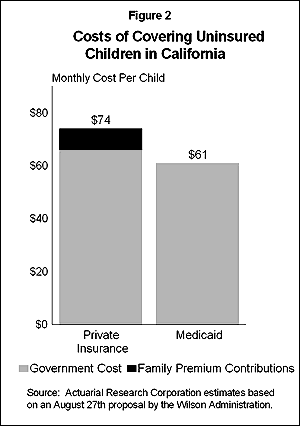
In an analysis prepared for the Kaiser Family Foundation, the Actuarial Research Corporation estimated how the cost per child under a Medicaid expansion would compare with a stand-alone private insurance program for uninsured children in California (Figure 2).
The analysis found that creating a new private insurance program to cover all of the estimated 580,000 low-income uninsured children in California — assuming no adverse selection — would cost $74.39 per month (including an average per family premium contribution of $8.00). Covering uninsured children through Medicaid would cost 18% less than the private insurance approach ($60.65 per child).
Conclusion
The cost of a new health coverage program for children will depend on a variety of factors, influencing both how many children participate and the cost of coverage per child. Thoughtful assessments of costs require a clear articulation of what these factors are, a review of the evidence on their likely effects, and, in light of this evidence, judgments about their impact. Even careful estimates, well-grounded in evidence, cannot give us certainty about results. But they allow us to compare and evaluate how the effects of different policy choices will vary. The better all parties understand the dynamics of cost estimates, the greater the likelihood that decisions will be based on informed analysis rather than predispositions.
Methodology
This policy brief was prepared for for the Kaiser Commission on the Future of Medicaid by Judith Feder from Georgetown University and Larry Levitt from the Kaiser Family Foundation. The information in this policy brief draws heavily from analysis by researchers at Georgetown University and The Urban Institute for the Kaiser Family Foundation’s Incremental Health Reform Project. It also draws from the Actuarial Research Corporation’s estimates of costs of covering uninsured children in California, commissioned by the Foundation. For additional information on the State Children’s Health Insurance Program or other Kaiser Family Foundation publications, please call the publications request line at (800) 656-4KFF.
The January/February 1998 edition of the Kaiser Family Foundation/Harvard Health News Index includes questions about major health issues covered in the news, including questions on Abortion, Medicare and Health Care Costs. The survey was based on a national random sample of 1,209 Americans conducted February 13-17, 1998 which measures public knowledge of health stories covered by the news media during the previous month. The Health News Index is designed to help the news media and people in the health field gain a better understanding of which health stories in the news Americans are following and what they understand about those health issues. Every two months, Kaiser/Harvard issues a new index report.