Medicaid Spending Growth: Results from a 2002 Survey
The report presents the findings of a 50 state survey of Medicaid directors, identifying state Medicaid spending trends and how states are responding to them for FY 2003 budgets.
The independent source for health policy research, polling, and news.
The report presents the findings of a 50 state survey of Medicaid directors, identifying state Medicaid spending trends and how states are responding to them for FY 2003 budgets.
Medicaid is a joint federal-state program in which Federal Medicaid matching payments are projected to be $147 billion FY 2002, while state spending is estimated at about $100 billion.
Because Medicaid is such a large part of state budgets and states are struggling with their overall fiscal situations, the Kaiser Commission on Medicaid and the Uninsured continues to follow developments in Medicaid progams related to state budgets. Below are the most recent publications on this important topic.
About 5 million Americans under age 65 qualify for Medicare coverage because they are totally and permanently disabled. They are more likely than the elderly to live in poverty, to be in poor health, and to experience difficulties living independently and performing basic daily tasks. A new study from The Commonwealth Fund and the Henry J. Kaiser Family Foundation, reports that the disabled have few options other than Medicaid for obtaining prescription coverage. In , Becky Briesacher, Bruce Stuart, Jalpa Doshi, and Sachin Kamal-Bahl of the University of Maryland, and Dennis Shea of the Pennsylvania State University, conclude that a Medicare drug benefit designed for the elderly will not suffice for the disabled unless their particular needs are assessed and addressed.
Thirty-five percent of all California Medicare beneficiaries are enrolled in a M+C plan, far in excess of the 14 percent rate nationwide. This report seeks to identify what lessons for the nation can be drawn from the California M+C experience, as Congress debates the implications of major withdrawals from the M+C program and potential policy changes aimed at reversing this trend. The report is based largely on analysis of M+C data on plan participation, withdrawals, and enrollment by county from year-end 1997 (when M+C was enacted) through 2001, including reported withdrawals in 2002.
NPR/Kaiser/Kennedy School Poll: 2002 Civil Liberties Update
According to a new poll by NPR, the Kaiser Family Foundation, and Harvard s Kennedy School of Government, the nation is evenly divided on the question of tradeoffs between civil liberties and security. However, a small but statistically significant number of Americans have shifted toward the civil liberties side of the issue since last year, although majorities still support some government actions that could be seen as curtailing such liberties.
loveLife: The Foundation’s Largest Initiative Ever Aims To Curb HIV Infection Among South African Youth
loveLife’s Y-Centres
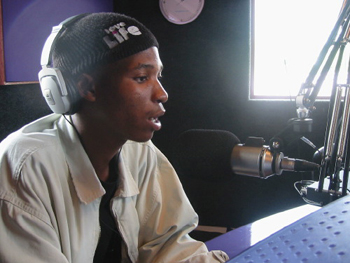
The Radio Studio at the Hibberdene Y-Center in Kwa-Zulu Natal. The loveLife Y-Centres are multi-purpose facilities for young people, providing a range of entertainment, sports and educational opportunities.”Learn more about the Y-Centres…



loveTrain
The work of loveLife is supported by the loveTrain a sexual health education center and clinic on rails and the loveTours a mobile radio broadcast unit.Learn more about the loveTrain…





Former Presidents Clinton and Mandela Appeal for Increased Effort to Combat HIV Infection Among Young People
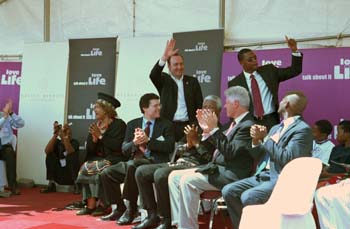
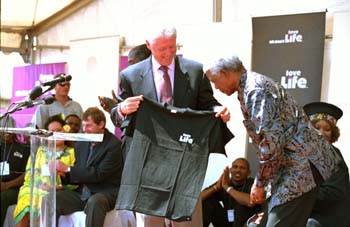
Two of the world’s most prominent elder statesmen have made a joint appearance in support of loveLife, South Africa’s national HIV prevention program for youth, hailing loveLife as the model for HIV prevention among youth globally.






According to a new poll by NPR, the Kaiser Family Foundation, and Harvard s Kennedy School of Government, the nation is evenly divided on the question of tradeoffs between civil liberties and security. However, a small but statistically significant number of Americans have shifted toward the civil liberties side of the issue since last year, although majorities still support some government actions that could be seen as curtailing such liberties.
This background report explores the insurance trends for the latter half of the 1990s and examines why the number of uninsured nonelderly Americans fell in 2000 for the second straight year.
Some of the key findings include:
— Between 1999 and 2000, the number of uninsured declined by 570,000; uninsured children actually declined by 700,000 while the number of uninsured adults increased by 130,000. Expansions in Medicaid and the State Children’s Health Insurance Program (SCHIP) led to the reduction in the uninsured rate for children. Employer coverage also increased for adults but public coverage did not and the result was an increase in the number of uninsured adults.
— There was a small increase in the rate of employer sponsored coverage among those living in families with at least one full time worker. However, the main reason for the increase in the rate of employer coverage in the non-elderly population was the huge increase in the number of people living in working families (18.5 million between 1994 and 2000).
— Another reason for the increase in employer sponsored insurance was the increase in employment in larger firms (1,000+ workers) where the likelihood of employer sponsored coverage was higher. Large firms employed 38.4 percent of workers in 1994 but accounted for 63 percent of the job growth between 1994 and 2000.
— Despite the recent gain in coverage for children, the trends in health insurance remain bleak. Between 1994 and 2000, a period of great economic prosperity, the uninsured rate was essentially unchanged from 17.3 percent in 1994 and 17.2 percent in 2000. While employer health coverage grew over this six year period, largely due to the movement of people up the income scale into jobs with health coverage, these gains were offset by declines in Medicaid and private individual coverage.
— Between 1994 and 1998, Medicaid coverage declined due to the loss of coverage following welfare reform and the expanding economy resulting in an increase in the number of uninsured. After 1998, increased enrollment in Medicaid and SCHIP of children combined with an increase in employer coverage contributed to the decline in the uninsured population. For adults, employer coverage increased for adults between 1994 and 2000, but Medicaid and private non-group coverage both fell with an increase in the uninsured rate over the period.
— From 1994 to 2000, the number of uninsured white Americans declined by 900,000 while the number of uninsured blacks increased by 500,000 and uninsured Hispanics by 1.9 million. Each group benefited from the strong growth in employer-sponsored coverage, but blacks and Hispanics were particularly adversely affected by the declines in Medicaid coverage.
This policy brief describes the current federal staffing requirements and how states separately regulate staffing levels in nursing homes. It also presents data showing actual staffing levels in over half of this country’s nursing homes exceed the levels that states and the federal government require.
This policy brief describes the resources, staffing, and performance of state licensing and certification agencies based on findings from a survey of state survey agency officials.