KFF designs, conducts and analyzes original public opinion and survey research on Americans’ attitudes, knowledge, and experiences with the health care system to help amplify the public’s voice in major national debates.
In August 2004, the Centers for Medicare and Medicaid Services published a proposed rule to implement the Medicare Prescription Drug Benefit (Title I of the Medicare Modernization Act). Given the high level of interest in the proposed rules for implementing the Medicare drug benefit, the Kaiser Family Foundation commissioned Health Policy Alternatives, Inc. to prepare this summary of the proposed regulations.
Current Trends and Future Outlook for Retiree Health Benefits: Findings from the Kaiser/Hewitt 2004 Survey on Retiree Health Benefits
A new survey of large employers finds businesses and retirees experienced double-digit increase in retiree health costs, with further increases expected in 2005. The survey also includes an early look at employers’ responses to the new Medicare drug law.
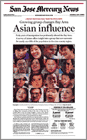
This survey explores the attitudes and experiences of the Asian community in the Bay Area, which has the largest Asian population in the country. The Kaiser Family Foundation and San Jose Mercury News collaborated on the survey.
The Bay Area is home to the largest Asian population in the continental United States. In 2002, the census estimated that roughly one in five Bay Area adults was of Asian decent. Recognizing the importance and impact of this population in our community, the San Jose Mercury News and the Kaiser Family Foundation joined forces to explore the attitudes and experiences of the Asian community.
The Bay Area Asian community includes people from many countries with different cultures, languages and religions. Most Asian adults in the Bay Area were not born in the United States, though many were. The survey involved nearly 1,100 Asians from various backgrounds, and examines their experiences with and attitudes about different aspects of their lives in the Bay Area, such as community, politics and government, the workplace, and the education of their children.
The summary and chartpack highlights key findings from a survey exploring the attitudes and experiences of the Asian community in the Bay Area, which has the largest Asian population in the country. The Kaiser Family Foundation and San Jose Mercury News collaborated on the survey.
This document includes the toplines from a survey exploring the attitudes and experiences of the Asian community in the Bay Area, which has the largest Asian population in the country. The Kaiser Family Foundation and San Jose Mercury News collaborated on the survey.
Waiting lists are a reality of state AIDS Drug Assistance Programs (ADAPs), which rely on specific federal appropriations, or capped funding, each year. Capped funding determines ADAP’s income eligibility criteria, the number of drugs in the formulary, and the number of people who can be served. This fact sheet provides an overview of ADAP waiting lists based on an analysis of data collected by the National ADAP Monitoring Project between July 2002 and November 2004, which includes the implementation of the $20 million ADAP Initiative.
Two recent articles have been published on the impact of direct-to-consumer advertising (DTCA) on the use of antidepressants, based on research by researchers at Harvard University and the Massachusetts Institute of Technology, and funded in part by the Kaiser Family Foundation. These articles include:
“Effects of Direct-to-Consumer Advertising on Medication Choice: the Case of Antidepressants,”Journal of Public Policy and Marketing, 23(2):115-127, Fall 2004 (J.M. Donohue and E.R. Berndt). This research found that DTCA for antidepressants has little impact on drug choice, while detailing (promotional visits to physicians) has a substantial impact. The researchers cite other studies that found that DTCA motivates individuals to visit their physicians for previously untreated conditions. The researchers conclude that DTCA appears to affect whether someone receives medication, while detailing affects which medication they receive.
“Effects of Pharmaceutical Promotion on Adherence to the Treatment Guidelines for Depression,”Medical Care, 42(12):1176-1185, December 2004 (J.M. Donohue, E.R. Berndt, M. Rosenthal, A.M. Epstein, R.G. Frank). This research found that DTCA for antidepressants was associated with an increase in the number of people diagnosed with depression who initiated medication therapy, and a small increase in the number of individuals treated with antidepressants who received the appropriate duration of therapy. Promotion to physicians was not associated with either initiation of treatment or duration of therapy. See the special issue devoted to Mental Health in the December 2004 issue of Medical Care.
This fact sheet updates the current fiscal situation facing states, the impact the recent downturn in the economy had on Medicaid growth, and the cost containment actions being taken by states to curb Medicaid spending.
The Impact of Cost-Sharing on Appropriate Utilization and Health Status: A Review of the Literature on Seniors
This article provides a review of research that has addressed the impact of patient cost-sharing on the use of health care services and subsequent health status for those ages 65 and older. Twenty-two studies are reviewed — 16 focusing on cost-sharing for prescription drugs and 6 on cost-sharing for medical services. The article concludes that most studies examined show increased cost-sharing reduces either or both the utilization and health status of seniors.
Health Insurance Coverage in America: 2003 Data Update
This chartbook provides 2003 data on health insurance coverage, with special attention to the uninsured. It includes trends and major shifts in coverage and a profile of the uninsured population.