KFF designs, conducts and analyzes original public opinion and survey research on Americans’ attitudes, knowledge, and experiences with the health care system to help amplify the public’s voice in major national debates.
This March 2007 issue brief, commissioned by the Kaiser Family Foundation, examines changes between 2006 and 2007 in the availability of and enrollment in Medicare Advantage and Medicare prescription drug plans overall and in urban and rural areas. It also focuses on the firms that are offering various types of Medicare plans. Marsha Gold of Mathematica Policy Research, Inc., prepared the brief.
Together, Medicare and Medicaid provide health coverage to about 90 million Americans. To help explain the two programs, the Kaiser Family Foundation issued a new primer on the Medicare program and an updated version of its primer on the Medicaid program. Prepared by Kaiser staff, the primers provide an overview of the programs, who they serve, how the programs work and how they are financed.
A study in the March/April 2007 issue of Health Affairs analyzes the impact of state tort reforms on physician malpractice claims. The study finds that the tort law changes have had a measurable but limited impact on physician malpractice claims, depending on the type and strength of the tort reform.
Commissioned by Kaiser, the study was authored by Teresa M. Waters of the University of Tennessee, and Peter P. Budetti of the University of Oklahoma, and Gary Claxton and Janet P. Lundy of the Kaiser Family Foundation.
Health Affairs Article: “Impact of State Tort Reforms on Physician Malpractice Payments” (Free access)
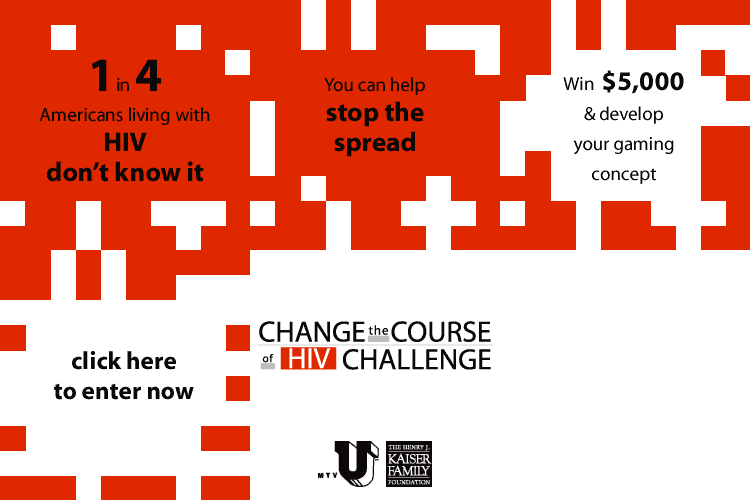
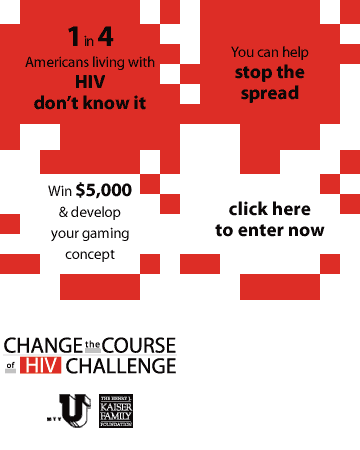
Help us spread the word about the “Change the Course of HIV Challenge” by hosting an online Public Service Announcement on your website. Together with mtvU, MTV’s 24-hour college network, we have launched this competition for college students to develop a game that informs other young people about HIV/AIDS.
Gamers, activists or anyone with a great idea is invited to submit a viral video game concept that will help inform other young people about HIV/AIDS in the U.S. and promote personal action in response.
Featuring an ad on your site will help raise awareness about this exciting new initiative.
Considerable attention has been paid in recent years to the rapid growth of health insurance premiums and its impact on coverage affordability. Premium growth has far outpaced growth in workers earnings, which means that workers have to spend more of their income each year on health care to maintain current coverage levels.
Less attention has been given to the disconnection between the growing cost of health insurance and eligibility for health care subsidies in public programs. It is clear that lower income people cannot afford health insurance without some assistance, and various federal and state programs exist to provide or subsidize health insurance for people with limited means. In many cases eligibility for subsidized coverage is based on the relationship of a person’s or family’s income to the federal poverty level (FPL). For example, children in families with incomes below 200 percent of FPL are generally eligible for subsidized coverage through state Medicaid or SCHIP programs. Another example is a new program in Massachusetts, which requires people to purchase health insurance. The program provides free coverage to adults with family incomes under poverty and subsidizes a portion of premiums (a declining share as income rises) for adults with family incomes between 100 and 300 percent of FPL.1 People in families with incomes of more than 300 percent of FPL generally are expected to pay the full cost of health insurance.
Ideally, the eligibility and subsidy structure in a public program should relate the amount of assistance that a person receives to their ability to afford the good being subsidized (in this case, health insurance). When policymakers in Massachusetts, for example, provide partial premium subsidies to families with incomes at 200 percent of FPL and no subsidies for families with incomes over 300 percent of FPL, they are saying, at least implicitly, that the families at 200 percent of FPL generally have enough income to afford to pay a share of the premium and that the families at 300 percent of FPL generally can afford health insurance without financial assistance. This subsidy arrangement tells us how policymakers view the affordability of health insurance for people with different incomes. Unfortunately, if the cost of health insurance rises faster than the eligibility thresholds for subsidies over a sustained period, the subsidy arrangement may not maintain a consistent level of financial protection.
Figure 1 shows the cumulative increases in private health insurance premiums and the FPL over a nine-year period (1996 to 2004).2
Figure 1Cumulative Change in Single and Family HealthInsurance Premiums and Federal Poverty Level, 1996 – 2004
Source: Premium data from Agency for Healthcare Research and Quality, Medical Expenditure Panel Survey, 1996-2004, at http://www.meps.ahrq.gov/mepsweb/; Federal Poverty Level based on HHS Federal Poverty Guidelines (1996 through 2004) at http://aspe.hhs.gov/poverty/figures-fed-reg.shtml. Rate of growth based on change for one person (change for 4 person family would be 20.8% rather than 20.3% over the period).
Private premiums for family coverage doubled and premiums for single coverage increased by 86% during the period, while the FPL increased only about 20%. This dynamic matters very little for people who receive full subsidies for health insurance, because the amount that they have to pay does not change. For a family whose income is just over the eligibility threshold, however, the share of family income required to purchase health insurance would rise over the period by about 55% for single coverage and by about 68% for family coverage.3 Take as an example a single person with income at 300 percent of FPL, which was about $23,220 in 1996 and about $27,930 in 2004. A health insurance plan that cost the person $1,200 in 1996 would consume just 5.2% of income. With premium inflation, that plan would cost over $2,230 in 2004, or about 8.0% of income for a person with income at 300 percent of FPL. This share of income going to health insurance would continue to rise over time as long as health insurance premiums rise faster than FPL.4
This dynamic has important implications for policymakers. As long as health insurance premiums continue to rise more quickly than the costs of other goods and services,5 eligibility thresholds tied to FPL (or a multiple of FPL) will not maintain a consistent level of financial protection against rising health insurance costs. If policymakers want to protect low and moderate income families from spending too high a percentage of their income on health insurance, they will need to consider subsidy structures that reach an expanding income range over time. Options might include increasing income thresholds for subsidies at the same rate as the cost of health insurance or making periodic adjustments in thresholds to account for the rapid growth in health insurance premiums relative to incomes and other costs.
Notes:
1. Children in families with income up to 300% of FPL are covered through Medicaid.
2. Premium increases are the year-to-year change in average premiums for single and family coverage for employer-sponsored health insurance reported in the Medical Expenditure Panel Survey. Federal Poverty Level increases are the year-to-year change in the Federal Poverty Level as measured by the U.S. Department of Health and Human Services Poverty Guidelines. Seehttp://aspe.hhs.gov/poverty/figures-fed-reg.shtml. The growth in FPL is based on the change in federal poverty guideline for a single person. Because of rounding, the annual changes for a family of four would differ slightly, with the cumulative growth between 1996 and 2004 being 20.8% rather than 20.3%.
3. The calculation for a person with a partial premium subsidy depends on how the subsidy program is structured. If, for example, a program is designed to subsidize a percentage of the premium (e.g., 25% subsidy for people with incomes of 275% of FPL), then a person at that level of poverty will have to pay a greater share of their income each year toward the 75% of the premium that they are required to pay. If, however, the premium subsidy is designed as a percentage of income that the person must pay (e.g., no more than 4% of income at 250% of FPL), then the program bears the increasing cost of insurance relative to FPL.)
4. A person could reduce the share of income going to health insurance by buying a health plan with less coverage. This example assumes the average rate of increase for employer-sponsored single coverage over the period, which implicitly includes any coverage changes that occurred on average in the market.
5. The HHS federal poverty guidelines are a simplified version of the federal poverty threshold determined by the U.S. Census Bureau. Annual increases in the Census poverty thresholds are based on increases in general inflation. See http://www.census.gov/hhes/www/poverty/povdef.html.
Survey of African Americans About HIV/AIDS Media Campaigns
A new national survey of African Americans reviews aspects of the Rap It Up and KNOW HIV/AIDS campaigns, which are ongoing HIV/AIDS public education partnerships conducted by the Kaiser Family Foundation with Black Entertainment Television (BET) and Viacom, Inc., respectively. The survey seeks to look at the reach and impact of the campaigns. Rap It Up is the single largest public education effort on HIV/AIDS and related issues directed toward the African American community.
The fact sheet summarizes the health coverage of low-income parents, including recent trends, and discusses the current policy challenges related to expanding care for this population.
The Kaiser Family Foundation’s updated version of Key Facts: Race, Ethnicity and Medical Care, 2007 Update, serves as a quick reference source on health disparities, presenting the best available data and analysis.
This report includes data on the uninsured and access to care by race/ethnicity as well as information about the disproportionate effect that specific conditions such as diabetes, HIV/AIDS, and asthma have on racial and ethnic minority populations in the U.S. New in the 2007 Key Facts are demographic data on the racial/ethnic minority population in each state and the U.S. territories. This edition of Key Facts also includes data from the National Healthcare Disparities Report, examining changes in health care disparities over time.
This brief analyzes health coverage data and determines that 25% of the nation’s uninsured population is eligible for either Medicaid or SCHIP. The brief goes on to describe the characteristics of the population.
How to Link to the Children’s Health Insurance Timeline
The Kaiser Family Foundation encourages non-profit organizations, government agencies, academic institutions, and other organizations to link to its online information. To link to the timeline, please use the following graphic, title and url.