KFF designs, conducts and analyzes original public opinion and survey research on Americans’ attitudes, knowledge, and experiences with the health care system to help amplify the public’s voice in major national debates.
This report compares out-of-pocket costs of maternity care under 12 consumer-driven health plans (CDHP) from the group and individual markets to a traditional health insurance plan. CDHPs typically have lower premiums but higher deductible levels than traditional health plans, shifting more of the financial responsibility for the costs of medical care to patients to promote more cost-conscious health care choices. In some cases, out-of-pocket costs under CDHPs may be reduced through tax-preferred contributions by employers or individuals to Health Savings Accounts.
The study, Maternity Care and Consumer-Driven Health Plans, prepared by researchers at the Georgetown Health Policy Institute and Kaiser, found great variation among CDHPs compared to traditional health plans in the amount of potential out-of-pocket expenses a family could face. Since the cost of maternity care varies by the type and nature of the delivery, cost estimates were developed for three different birth scenarios based on recommended clinical practice guidelines. The study also explored other factors that affect family costs including coverage for prenatal care, transparency and limits in health care coverage, and predictability of costs.
The study was released at a policy forum co-hosted by the March of Dimes on Tuesday, June 12, 2007, at the Foundation’s Barbara Jordan Conference Center in Washingon, D.C.
Children’s Exposure to Food Advertising on Television: A Side-by-Side Comparison of Results from Recent Studies by the Federal Trade Commission and the Kaiser Family Foundation
Children’s Exposure to Food Advertising on Television: A Side-by-Side Comparison of Results from Recent Studies by the Federal Trade Commission and the Kaiser Family Foundation
In recent months, two significant new studies have been released about food advertising to children on television: one in March 2007 from the Kaiser Family Foundation, and the other in June 2007 from the Federal Trade Commission. While the two studies are similar, this analysis documents how they compare, both in terms of findings and methodology.
African Americans in New Orleans Face Much Heavier Burdens and Are Much More Skeptical Than Whites of Fairness of Recovery Efforts
But Most Residents See Progress in Rebuilding and Are Generally Hopeful; Only a Small Number Plan to Leave
A new house-to-house survey of people living in Orleans, Jefferson, Plaquemines and St. Bernard Parishes documents the devastating impact Hurricane Katrina and the failure to respond quickly and effectively to it has had on the economic well-being, physical and mental health, and personal lives of the people of the New Orleans area. The survey provides a portrait of the enormous needs of the population, to inform recovery efforts and policy debate in Washington. Future Kaiser surveys planned in 18 months and 36 months will monitor progress and changes.
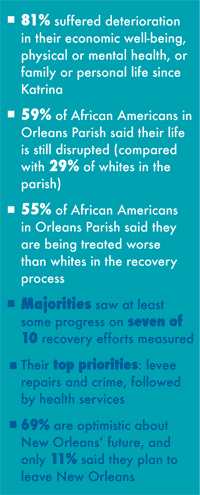
This Kaiser Family Foundation study found that in the aftermath of Katrina, the vast majority (81%) of those now living in Greater New Orleans have seen their quality of life deteriorate in at least one of seven critical aspects of their lives. More than half (55%) reported problems in two or more areas, including 67% in Orleans Parish, which is the city itself.
Residents were most likely to face financial setbacks, with 52% in the four-parish area (and 66% in Orleans) reporting deterioration in their economic well-being in Katrina’s wake. The second most common impact (affecting 37% of area residents) was a severe disruption to personal life, such as being forced out of their homes for a substantial period of time or losing a loved one. The storm also reduced access to health care for many residents (36%). Smaller but significant shares reported that Katrina-related stress affected their marriages, relationships or alcohol use (23%); that their physical health has declined (19%); that they lost a job or had a lower-paying job than they did pre-Katrina (17%); or that their mental health deteriorated (16%).
Overall, impacts were substantially more severe in Orleans. For example, 50% of Orleans residents reported that their housing costs went up “a lot,” compared with 26% in Jefferson Parish. In Orleans, 5% of residents said that their marriage or serious relationship ended in part because of Katrina.
“The people of New Orleans today have suffered powerful shocks in almost all aspects of their lives, but they are also showing extraordinary resilience in the face of great adversity,” said Kaiser Family Foundation President and CEO Drew E. Altman, Ph.D. “While debate continues at all levels of government about funding and how to rebuild the city, this survey underscores a simple message: There remains a need for accelerated recovery efforts.”
Big racial divide in experiences and views: The survey also found a sharp divide in the way that African Americans and whites in the New Orleans area experienced the storm and perceive the recovery efforts, especially in hard-hit Orleans Parish. Twice as many African Americans as whites in Orleans (59% vs. 29%) reported that their lives are still “very” or “somewhat” disrupted. African Americans within Orleans were significantly more likely than Orleans whites (58% vs. 34%) to live in areas that experienced heavy flooding.
In addition, seven in 10 African Americans in Orleans Parish (72%) reported a problem accessing health care, more than twice the rate reported by whites in the parish (32%). African Americans in the city also reported more often than their white neighbors that their financial situation had gotten worse, that they had no job or earned too little, or that they had a child facing a health care-related problem. For example, 46% of African Americans reported that they had inadequate wages or no job, compared with 17% among whites.
There were also striking differences in the ways that blacks and whites in Orleans Parish view the recovery efforts. More than half (55%) of blacks in the parish said that they face worse treatment and opportunities than whites as part of the rebuilding process; among white Orleans residents, only 19% said blacks are being treated worse.
On a range of questions, African Americans are substantially more worried than their white counterparts – for example, that another hurricane will cause a similar or worse event (52% compared to 36% say they are “very worried”); that they won’t have enough income to meet their needs (51% to 24%); that they won’t be able to get health care (51% to 30%); or that pollutants will make them sick (37% to 18%).
“The Katrina fiasco shows the need for a national relief strategy and ongoing recovery capability that can respond much more effectively to major disasters in the future, whether they are natural disasters or man-made ones like a nuclear event,” Dr. Altman said. “What our survey shows is that the impacts on people and cities can build cumulatively and cut across almost all dimensions of residents’ lives, from their economic well-being to their physical and mental health to race relations, if they are not dealt with early and decisively.”
Hope and progress: Despite all the challenges they face today, area residents also exhibited real hope for the future: Most (69%) are optimistic about the future of the city, with only a modest 11% saying they plan to leave or are seriously considering leaving New Orleans. The majority of residents see at least some progress being made on seven of 10 recovery efforts measured in the survey, including repairing the levee system, reopening schools, getting businesses to return, and getting medical facilities up and running. On three other key recovery measures – controlling crime, rebuilding destroyed neighborhoods and expanding affordable housing – a majority of residents reported little or no progress.
Lingering problems and ongoing challenges: In addition to documenting the impact of Katrina, the survey provides a portrait of the continuing problems facing New Orleans area residents. Three in four residents (77%) said they face a serious problem in at least one key aspect of their lives – including access to health care and coverage, physical or mental health challenges, lacking a job or having inadequate wages, or having a child who was troubled, ill or not getting needed care. More than four in ten (44%) said they are facing a serious life problem in more than one of these critical areas; in Orleans, 52% reported problems in two or more areas. While many of these needs may have predated the storm, Katrina did much to make an already challenging situation more difficult, and debate continues in Louisiana and Washington about policy and funding responses.
In the storm’s aftermath, getting and affording quality health care stands out as a particularly widespread challenge, with 49% of area residents saying they are facing a significant obstacle to getting needed care. Nearly as many (43%) reported that they are in fair or poor health or have a chronic health condition, while nearly one in five (18%) reported some type of mental health challenge.
Priorities for reconstruction: Not surprisingly, the need to prepare for the next storm tops the list of the public’s priorities for the recovery effort – with more than half (54%) of area residents saying that “repairing the levees, pumps, and floodwalls” should be one of the top priorities for the rebuilding effort. Nearly as many (48%) said they want to see a focus on controlling crime and assuring public safety, a persistent issue since the storm.
After those expected top priorities, the next highest priority was “getting medical facilities and services up and running,” picked by 41%, followed by restoring basic services such as electricity and water (36%); getting schools up and running (31%) and rebuilding destroyed neighborhoods (31%). When asked about specific priorities for rebuilding the health care system, reopening hospitals (43%) and bringing in more doctors and other health professionals (37%) ranked at the top, followed by increasing emergency care services (32%), opening more community clinics (30%) and making mental health services more availability (24%). Ninety-three percent said they favored building a new hospital to replace Charity Hospital, which served many low-income and uninsured patients from the area.
Worries about future hurricanes: As the nation prepares for the June 1 start of this year’s hurricane season, residents feel particularly vulnerable. Seventy-eight percent are at least somewhat worried that another major storm will hit the New Orleans area, and 86% are worried that the levees won’t be rebuilt with enough strength to protect their neighborhood. While more than half of residents (53%) said that they are personally “very prepared” to deal with the next big hurricane, few thought that federal officials (9%) or state and local officials (8%) are similarly prepared. In Orleans Parish, 59% of the people said they believe rebuilding New Orleans is “not a priority for the Congress or the President,” while 37% said that they believe it is a priority.
The study is unique not only due to the difficulty of conducting a scientific survey in this damaged city, but also because it assesses residents’ quality of life across such a wide variety of areas. To conduct the study, a team of 41 interviewers visited 456 randomly selected census areas, documented the physical condition of nearly 17,000 housing locations and completed interviews with 1,504 randomly chosen adults living in the four parishes between September and November 2006. The survey’s margin of sampling error is plus or minus four percentage points.
The full survey, “Giving Voice to the People of New Orleans: The Kaiser Post-Katrina Baseline Survey,” and audio interviews with Dr. Altman and Mollyann Brodie, Ph.D., Kaiser vice president and director of Public Opinion and Media Research, are available online.
# # #
The Kaiser Family Foundation is a non-profit, private operating foundation dedicated to providing information and analysis on health care issues to policymakers, the media, the health care community and the general public. The Foundation is not associated with Kaiser Permanente or Kaiser Industries.
METHODOLOGY BOX
The Kaiser Post-Katrina Baseline Survey of the New Orleans Area was designed and analyzed by researchers at the Kaiser Family Foundation. This in-person survey was conducted door-to-door from September 12 to November 13, 2006. Interviews were completed in English and Spanish among 1,504 randomly selected adults ages 18 and older residing in Orleans, Jefferson, Plaquemines, and St. Bernard parishes. These four neighboring parishes make up Region 1 as defined by Louisiana’s Department of Health and Hospitals, an administrative region used for recovery planning. The sample design was a stratified area probability sample, with 456 sampling points distributed proportionate to expected population size in each of the four parishes, and in each of fourteen Census tract defined neighborhoods in Orleans Parish. An oversample was drawn in Orleans to allow for more detailed analysis of this area; final results have been weighted so that each parish reflects its estimated share of the area’s population. The margin of sampling error for the full sample is plus or minus 4 percentage points; for results based on Orleans Parish or Jefferson Parish it is plus or minus 5 percentage points. For results based on other subsets of respondents the margin of sampling error may be larger. ICR/International Communications Research collaborated with Kaiser researchers on sample design and weighting, and supervised the fieldwork.
Fact Sheets Summarize President’s Budget Proposals for Health Insurance Coverage, Including Medicaid and SCHIP
The President’s fiscal year 2008 budget proposal includes changes to Medicaid, provisions for the reauthorization of SCHIP, and the health coverage initiative, Affordable Choices. These fact sheets provide an overview of President Bush’s policy plans on these health coverage issues.
The President’s Affordable Choices initiative would permit states to redirect funds paid to hospitals and other health care institutions to initiatives that would provide the uninsured with private insurance. This fact sheet provides an overview of the fiscal year 2008 budget initiative.
This May 2007 Kaiser Family Foundation report is the first of several that will track the progress and challenges facing people living in the New Orleans area in the aftermath of Hurricane Katrina. To conduct the study, a team of 41 interviewers visited 456 randomly selected census areas, documented the physical condition of nearly 17,000 housing locations and completed interviews with 1,504 randomly chosen adults living in the four parishes between September and November 2006. The survey’s margin of sampling error is plus or minus four percentage points.
This chartpack provides key findings from a May 2007 Kaiser Family Foundation report on a major house-to-house survey on the experiences and challenges facing residents of the New Orleans area.
Individuals with incomes exceeding thresholds for regular Medicaid eligibility may qualify under state medically needy programs by spending down excess income on healthcare services. For the vulnerable population of Medicare beneficiaries who spend down to Medicaid, the Part D transition has added additional complexities that may result in disruptions in pharmacy coverage and add financial burdens.
This paper explores the inter-relationship of Medicare prescription drug coverage and Medicaid spend-down for the medically needy. It describes Part D impacts for spend-down individuals and the resulting effects on their eligibility both for Medicaid and the Medicare Low-Income Subsidy assistance.
In 2006, low-income individuals receiving health coverage through both the Medicaid and Medicare programs, “dual eligibles,” experienced a change in their prescription drug benefit when their Medicaid prescription coverage was replaced by the Medicare prescription drug program known as Medicare Part D. This study provides information on the ongoing successes and challenges that dual eligibles faced in the first eight months of Part D and how different state approaches may affect dual eligibles’ ability to access prescription medications.
It was conducted in three states that adopted different approaches to helping dual eligibles with their Part D expenses: Connecticut, Washington and Florida. Connecticut offers substantial assistance, paying co-payments and providing a “wraparound” to Part D that covers prescription drugs that are not on a dual eligible’s Part D plan formulary. Washington pays dual eligibles’ co-payments but does not cover non-formulary medications. Florida offers neither type of assistance to dual eligibles. In addition, all three states cover certain drugs excluded from Medicare Part D through their Medicaid programs.
This house-to-house survey of people living in the New Orleans area examines the ongoing struggles of residents seeking to recover from the Hurricane Katrina disaster, including a detailed look at differences in views and experiences by race. Designed and analyzed by researchers at the Kaiser Family Foundation, the survey provides a portrait of the enormous needs of the population in order to inform recovery efforts and policy development on the Gulf Coast and in Washington.
The survey of people living in Orleans, Jefferson, Plaquemines and St. Bernard Parishes documents the devastating impact that Hurricane Katrina and the failure to respond quickly and effectively to it has had on the economic well-being, physical and mental health, and personal lives of the people of the New Orleans area. The survey also found a sharp divide in the way that African Americans and whites in the New Orleans area experienced the storm and perceive the recovery efforts, especially in hard-hit Orleans Parish. Future Kaiser surveys are planned in 18 months and 36 months to monitor progress and changes.
The study is unique not only due to the difficulty of conducting a scientific survey in the recovering New Orleans area, but also because it assesses residents’ quality of life across such a wide variety of areas. To conduct the study, a team of 41 interviewers visited 456 randomly selected census areas, documented the physical condition of nearly 17,000 housing locations and completed interviews with 1,504 randomly chosen adults living in the four parishes between September and November 2006. The survey’s margin of sampling error is plus or minus four percentage points.