KFF designs, conducts and analyzes original public opinion and survey research on Americans’ attitudes, knowledge, and experiences with the health care system to help amplify the public’s voice in major national debates.
International Health Journalism Fellowship Project: Kaiser/CNN Awards for Excellence in HIV Reporting in Africa
About The Award Since 2006, The Henry J. Kaiser Family Foundation and CNN/MultiChoice have teamed up to offer the Kaiser/CNN Award for Excellence in HIV/AIDS Reporting in Africa. The award, presented as part of the prestigious CNN/MultiChoice African Journalist Awards, is part of the Kaiser Family Foundation’s global effort to increase and sustain media coverage of the HIV/AIDS epidemic, to improve the breadth and quality of HIV/AIDS reporting, and to increase access by journalists worldwide to the most current information on HIV/AIDS. It recognizes reporting by and African journalist on HIV/AIDS in Africa that illuminates the broad impact of the epidemic on individuals, communities and nations, and the resilience of the African response to the epidemic. In advance of the awards ceremony each year, Kaiser organizes an intensive workshop on covering HIV/AIDS for the 15 finalists.
Who Is Eligible?
The competition is open to African professional journalists (including, but not limited to, African freelancers) working on the continent for African media organizations that are headquartered within the continent of Africa and produce a printed publication or electronic medium (television broadcaster, radio station or website) primarily targeted at and received by an African audience. This category is open to journalists from English, French and Portuguese speaking territories.
How To Apply
Applications are due in February of each year. When the 2009 application becomes available, it will be posted here. You can also find information on the CNN/MultiChoice African Journalist Awards Website.
Learn about the Previous Winners and see their winning work:
In 2007, 45 million nonelderly people in the United States lacked health coverage
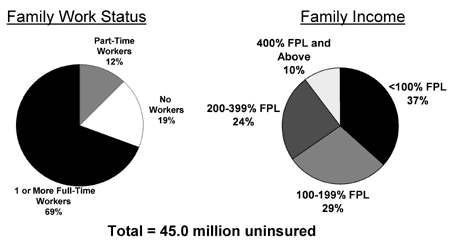
More than eight in ten uninsured people (81%) come from working families
About two-thirds of the nonelderly uninsured are from low-income families (income below 200% of poverty, about $42,400 for a family of 4 in 2007)
More than one in three people (35%) living in poverty are uninsured, compared with one in twenty people (5%) with family incomes at or above four times the poverty level
Adults age 19-54 make up the majority (71%) of the nonelderly uninsured, but nearly 9 million children lacked health coverage in 2007
Since 2000 the number of nonelderly uninsured has grown by 8 million—with the only decline in the number of uninsured occurring in 2007, largely driven by an increase in public coverage
Uninsured adults are five times as likely as the privately insured to lack a usual source of care (54% vs. 10%) and four times as likely to postpone care due to cost (26% vs. 6%)
Fully half of the uninsured report paying for health care and health insurance is a serious problem
Forty-five million people in the U.S., including nearly nine million children, lacked health insurance in 2007. Not having insurance affects people of all ages, races and ethnicities, and income levels and impacts their access to health care, their overall health, and their financial security. While no consensus on a solution has yet emerged, the 2008 presidential and congressional campaigns offer a forum for a vigorous debate on the issue.
Health Coverage and the Uninsured
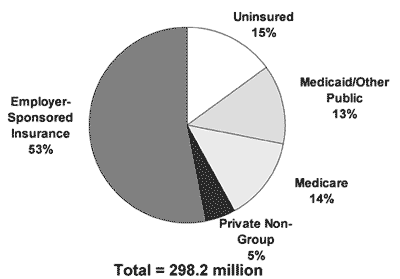
Americans obtain health care coverage through a complex system of private and public sources. While Medicare covers virtually everyone age 65 and older, the majority of people under the age of 65 receive health insurance through their employer. For those who are low-income and without access to affordable private coverage, Medicaid and the State Children’s Health Insurance Program (SCHIP) may be available, though their reach is limited, covering mostly children. The gaps in the existing system leave one in six (17%) of those under age 65 without health insurance (Figure 1).
Figure 1Health Insurance Coverage of the Total Population, 2007
* Medicaid/Other Public includes Medicaid, SCHIP, other state programs, and military-related coverage. NOTE: Those enrolled in both Medicare and Medicaid (1.7% of total population) are shown as Medicare beneficiaries. SOURCE: KCMU/Urban Institute analysis of March 2008 CPS.
More than 80% of the uninsured come from working families. Uninsured workers are more likely to work for small firms and in industries (such as construction, agriculture and services) where fewer employers offer coverage. Despite strong ties to the workforce, about two-thirds of the uninsured are from families with incomes below twice the poverty level ($42,406 a year for a family of four in 2007) (Figure 2). Without an offer of coverage from their employer, private insurance is generally unaffordable for these individuals.
Figure 2Characteristics of Nonelderly Uninsured, 2007
The federal poverty level was $21,203 for a family of four in 2007. SOURCE: KCMU/Urban Institute analysis of March 2008 CPS
Aside from the elderly, who are almost all covered by Medicare, the uninsured come from all age groups. Working age adults are the most likely to be uninsured, particularly those who are younger and working in low-wage jobs. Although public coverage for children is broader than for adults, one in five uninsured is under age 19.
Why are they uninsured?
Most Americans get health insurance through their jobs; however, employers are not required to offer coverage and since 2000 the percentage of firms that offer coverage has declined. This decline has been driven, in part, by increasing health care premiums. The average cost for a family premium in 2008 was $12,680, nearly double what it cost in 2000. Poor and near poor workers are less likely to be offered insurance by their employers, but even when offered coverage, they are at greater risk of losing that coverage.2
With enrollment reaching nearly 60 million, public programs are an important source of coverage for low-income families and people with disabilities who do not have job-based insurance, but they do not cover all people who are low-income nor do they reach all of those who are currently eligible. Medicaid and SCHIP together aim to cover nearly all low-income children, but eligibility for adults is more restricted. As a result, most adults who are not parents are ineligible for public programs even if they have incomes below the poverty level.
Why is being uninsured a problem?
Health care is unaffordable for many. Families carefully weigh the costs of medical care against often equally essential needs—knowing that medical bills for even minor problems can be more than they can afford. The uninsured are especially vulnerable because they mostly come from low-income families and they are far more likely to have problems paying for food and housing than those who have health coverage.
High health care costs and fear of medical debt result in the uninsured going without care. The uninsured pay for more than one-third of their care out-of-pocket and are often charged higher amounts for their care than the insured pay.3 These bills can quickly translate into unaffordable levels of medical debt since most of the uninsured have low or moderate incomes and have little, if any, savings.
Without insurance to cover health care costs, access to health care suffers. Having health insurance makes a difference in whether, when, and where people get needed care, and ultimately, how healthy they are. The uninsured are much more likely to postpone or forgo care due to cost than those with coverage.4 More than half of uninsured adults do not have a place where they regularly go when they are sick. 5 As a result, they are often also less likely to receive preventive care and even standard treatment for chronic conditions. In addition, the uninsured are more likely to be hospitalized for health problems that could have been avoided. When hospitalized, they are less likely to receive services to diagnose and treat their conditions and are more likely to die in the hospital than insured patients. 67 It has been estimated that 22,000 people died in 2006 because they were uninsured. 8
Options for Covering the Uninsured
Health care has emerged as one of the top priorities for the public in the 2008 election, and the campaigns provide a forum for fostering a national debate over this issue. While interest in reducing the number of uninsured remains high, there is little consensus on the solution. Some advocate incremental changes to the existing health care system while others favor more significant changes to how people obtain coverage.
The solutions currently being debated offer broader approaches to addressing not only the problem of the uninsured, but other problems plaguing the health care system, such as rising health care costs and the need to improve quality and efficiency. The approaches summarized below also reflect different visions for how the health care system should be structured.
Build on the current system
One approach to reforming the health care system is to build on and strengthen the current mechanisms for providing individuals and families with coverage, which include employer-based coverage and public programs. This approach would also create new avenues to coverage for those who are uninsured.
Strengthen the employer-based system. Proposals aimed at increasing coverage through the workplace combine “pay or play” requirements for larger employers with incentives for small employers. “Pay or play” mandates require employers either to provide health coverage or pay into a pool to help finance the cost of coverage for their employees. Tax incentives, in the form of tax credits or direct subsidies designed to lower premium costs, would be used to encourage small employers to offer coverage to their employees.
Expand public coverage by building on Medicaid and SCHIP. The Medicaid and SCHIP programs can provide a foundation for expanding coverage, particularly to low and modest income individuals and families. Proposals would extend coverage to all poor adults and would also expand SCHIP to cover children with family incomes up to 300% of the federal poverty level.
Create new group insurance options for individuals and businesses. For those without coverage options, a new national purchasing pool would be created, modeled after the Federal Employee Health Benefits Program and offering a range of health plan options that could be purchased by businesses for their employees or by individuals.
Revise the sponsorship and financing of health coverage through the tax system
Our current system promotes employer-based coverage by not counting the value of the health care benefit as taxable income for the employee; however, this tax benefit is not available to those who purchase insurance on their own. Reforming the tax code to eliminate the tax preference for employer-based coverage provides an alternative to employment-linked coverage. This approach would replace the current tax exclusion for employer-based insurance with a refundable tax credit for individuals and families to be used to purchase insurance. Individuals could obtain coverage through an employer if offered, but would be encouraged to purchase health insurance on their own through the individual insurance market.
Adopt a single-payer plan
To fully address the inefficiencies and gaps in the current system, some argue that it is necessary to replace the way we finance and deliver health care with a government financed and organized plan. One approach is Medicare for All, under which the government would contract directly with private providers and possibly insurance companies to provide services to beneficiaries, much like it does today for seniors enrolled in Medicare. While the government would finance the coverage through income and other taxes, the health care delivery system would remain largely private.
Assessing the Candidates’ Positions
Reflecting the public’s interest in health care this election season, the two major party candidates have proposed broad reform plans. However, the goals of the plans and their approaches to expanding coverage differ in key ways. Senator Obama has proposed a plan that aims to achieve near-universal coverage by building on the existing employer-based system, expanding public programs, and providing new coverage options through the creation of a National Insurance Exchange. Senator McCain’s plan emphasizes strategies to control rising health care costs, but would also replace the existing tax preference for employer-based coverage with a refundable tax credit as a way to expand coverage.
Included below are a series of questions to help evaluate the candidates’ proposals.
How many uninsured would be covered as a result of the proposal?
Would the proposal reorganize the health care system in significant ways or would it make incremental changes that build on the existing structure?
How would the proposal affect those who already have health insurance?
What role would public programs like Medicaid, SCHIP, and Medicare play under the proposal? Would these programs be expanded or altered in significant ways?
Does the proposal provide financial assistance to help people purchase private or public insurance? If so, is the subsidy adequate to make coverage affordable?
Does the proposal provide a mechanism for holding in check premium costs and medical expenses? Are there limits on out-of-pocket spending?
How does the proposal define health insurance coverage? Does it establish minimum benefits that must be covered?
Does the proposal address the challenges people with health problems face in obtaining affordable health insurance?
How much would the proposal cost, and how would it be financed?
1 KCMU/Urban Institute analysis of March 2008 CPS.
2 Clemens-Cope, L and B Garrett. 2006. Changes in Employer-Sponsored Health Insurance Sponsorship, Eligibility, and Participation: 2001-2005. Kaiser Commission on Medicaid and the Uninsured: Washington, DC.
3 Hadley, J. et al. 2008. “Covering the Uninsured in 2008: Current Costs, Sources of Payments, and Incremental Costs,” Health Affairs 27(5). W399 (published online 25 August 2008) and Anderson, G. 2007. “From ‘Soak the Rich’ to ‘Soak the Poor’: Recent Trends in Hospital Pricing,” Health Affairs 26(4): 780-789.
4 National Center for Health Statistics. 2007. Summary Health Statistics for the U.S. Population: National Health Interview Survey, 2005.
6 Hadley J. 2003. “Sicker and Poorer – The Consequences of Being Uninsured.” MCRR. 60(2): 3-76.
7 Dorn, S. 2008. Uninsured and Dying Because of It: Updating the Institute of Medicine Analysis on the Impact of Uninsurance on Mortality. The Urban Institute: Washington, DC.
8 Dorn, S. 2008. Uninsured and Dying Because of It: Updating the Institute of Medicine Analysis on the Impact of Uninsurance on Mortality. The Urban Institute: Washington, DC.
Television as a Health Educator: A Case Study of Grey’s Anatomy
In order to document how well viewers learn health information from entertainment television, the Foundation worked with writers at Grey’s Anatomy to embed a health message in an episode, and then surveyed viewers on the topic before and after the episode aired. The study included three national random-digit-dial telephone surveys of regular viewers of the show, conducted one week before, one week after, and – to test retention of the information – six weeks after the target episode aired.
As the marketing period for 2009 Medicare plans nears, the Kaiser Family Foundation Kaiser Family Foundation issued a report analyzing the content and frequency of television, print and radio advertisement for private Medicare plans that ran nationally or in one of three local media markets (Miami/Fort Lauderdale, Fla.; Phoenix, Ariz.; and Greensboro, N.C) during the marketing and enrollment period for 2008 plan offerings.
The study finds that insurers last year placed three times more advertisements to promote Medicare Advantage plans than they did to promote stand-alone Medicare drug plans. The ads for Medicare Advantage plans (which provide all Medicare benefits and often additional benefits) were estimated to cost more than twice as much than for stand-alone drug plan ads.
The majority of Medicare Advantage ad occurrences explicitly identified whether they were promoting a Medicare HMO, PPO, private fee-for-service or other specific type of plan. The one in five that did not specify a type of Medicare Advantage plan could leave people on Medicare and their families unaware of the plan’s potential restrictions on choice of physicians and other providers. The Medicare Improvements for Patients and Providers Act of 2008 includes a provision to address this concern, requiring insurers to include the type of plan by Jan. 1, 2010.
In Medicare Advantage print ads, two thirds of all occurrences included a general statement indicating restrictions and limitations may apply — but always in the fine print. None of the HMO print ads included language describing provider network restrictions, as suggested in the Centers for Medicare & Medicaid Services’ (CMS) marketing guidelines.
In addition, a separate policy brief, commissioned by the Foundation, explains the Centers for Medicare & Medicaid Services’ legal authority to regulate advertising and other information issued by the private companies that contract with the government to provide Medicare benefits. The brief also suggests additional steps the agency could take to enhance consumer protections with respect to advertising and marketing practices under its current authority.
This Kaiser Family Foundation report analyzes the content and frequency of television, print and radio advertisement for private Medicare plans that ran nationally or in one of three local media markets (Miami/Fort Lauderdale, Fla.; Phoenix, Ariz.; and Greensboro, N.C.) during the marketing and enrollment period for 2008 plan offerings. All ads were identified by VMS, a media monitoring service.
The study finds that insurers last year placed three times more advertisements to promote Medicare Advantage plans than they did to promote stand-alone Medicare drug plans. The ads for Medicare Advantage plans (which provide all Medicare benefits and often additional benefits) were estimated to cost more than twice as much than for stand-alone drug plan ads.
The majority of Medicare Advantage ad occurrences explicitly identified whether they were promoting a Medicare HMO, PPO, private fee-for-service or other specific type of plan. The one in five that did not specify a type of Medicare Advantage plan could leave people on Medicare and their families unaware of the plan’s potential restrictions on choice of physicians and other providers. The Medicare Improvements for Patients and Providers Act of 2008 includes a provision to address this concern, requiring insurers to include the type of plan by Jan. 1, 2010.
In Medicare Advantage print ads, two thirds of all occurrences included a general statement indicating restrictions and limitations may apply – but always in the fine print. None of the HMO print ads included language describing provider network restrictions, as suggested in the Centers for Medicare & Medicaid Services’ (CMS) marketing guidelines.
was authored by Xiaomei Cai, Gary Kreps, Jim McAuley, and Xiaoquan Zhao, of George Mason University, and Michelle Kitchman Strollo, Tricia Neuman, and Kim Boortz, of the Kaiser Family Foundation.
This policy brief, prepared for the Kaiser Family Foundation by Vicky Gottlich at the Center for Medicare Advocacy, explains the Centers for Medicare & Medicaid Services’ legal authority to regulate advertising and other information issued by the private companies that contract with the government to provide Medicare benefits. The brief also suggests additional steps the agency could take to enhance consumer protections with respect to advertising and marketing practices under its current authority.
The 2005 Kaiser Low-Income Coverage and Access Survey: Survey Methods and Baseline Tables
This document details the methods used to develop the 2005 Kaiser Low-Income Coverage and Access Survey dataset and presents baseline tables on population demographics, overall and by health coverage. The Kaiser Family Foundation conducted this national survey to examine health insurance coverage, access to care and the impact of health costs on the low-income population. The majority of the uninsured are low-income, and this survey of more than 5,000 low-income adults provides detailed data that can be used to inform the ongoing debate on reforming the U.S. health care system.
Spotlight on Low-Income Uninsured Young Adults: Causes and Consequences
This brief is the latest in a series using data from the 2005 Kaiser Low-Income Coverage and Access Survey to examine health coverage, access, and financial burdens associated with health care for young adults ages 19 to 29 in low-income families. The findings demonstrate that many low-income uninsured young adults experience problems gaining access to needed health care, with adverse consequences for both their health and financial well-being.
The Foundation and the USC Annenberg Norman Lear Center’s Hollywood, Health & Society examined three seasons (2004-2006) of top-ten-rated prime time scripted shows to measure the prevalence of health content on entertainment shows and to categorize the type of health content on prime time television. The analysis reveals that an average of six out of ten episodes (59%) had at least one health storyline.