KFF designs, conducts and analyzes original public opinion and survey research on Americans’ attitudes, knowledge, and experiences with the health care system to help amplify the public’s voice in major national debates.
This policy brief provides an overview of health reform efforts in the United States over much of the last century, from New Deal-era calls for government-subsidized health coverage to the creation of Medicare and Medicaid in the 1960s and the failed attempt at universal coverage in the early 1990s.
For many years, Section 1115 waivers have been used in the Medicaid program, and to a lesser degree in the Children’s Health Insurance Program, to provide states an avenue to test and implement coverage approaches that do not meet federal program rules. While these waivers have facilitated important program evolutions over time, some have also raised issues. This brief reviews the experience of Section 1115 Medicaid and CHIP waivers and discusses issues for the Obama administration to consider about the role of future waivers.
This article examines the political and legislative history of the Children’s Health Insurance Program and analyzes the lessons for policymakers who are contemplating broader health care reform.
It was published online in the journal Health Affairs and was authored by Jonathan Oberlander, an associate professor, social medicine and health policy and management, at the University of North Carolina at Chapel Hill, and Barbara Lyons, a vice president of the Kaiser Family Foundation and deputy director of the foundation’s Commission on Medicaid and the Uninsured.
A survey of members of the Association of Health Care Journalists about the future of health care journalism reports the tremendous turmoil and huge cutbacks that are roiling the news business have created increasingly challenging conditions with staff cutbacks, less time for reporting, fewer resources for training, and more pressure to produce short, quick-hit stories. But even in the face of these difficult circumstances, AHCJ members have a cautiously optimistic view of the direction in which health journalism is headed.
This report provides a snapshot of the current state of health journalism in the U.S. today. It is based on a literature review of more than 100 published pieces of research on health journalism; on a survey of members of the Association of Health Care Journalists (AHCJ), conducted by the Foundation and AHCJ; and on informal one-on-one interviews conducted by the author of this report with more than 50 journalists who work (or worked) for newspapers, radio and TV stations, magazines, and Web sites in small and large markets.
This report by Kaiser Family Foundation researchers shows that Medicare beneficiaries’ out-of-pocket health care costs comprise a significant share of their household expenses.
In 2006, out-of-pocket health care spending accounted for 14.1 percent of all expenditures for Medicare households — less than housing but about the same as transportation and food. And, one in four Medicare households devotes more than one quarter of total household expenditures to health care. This group includes a disproportionate share of Medicare households that are low- and middle-income, have older members and are living in rural areas.
The report is based on analysis of data from the 2006 Consumer Expenditure Survey. An updated analysis can be found here.
Since 2006, Medicare beneficiaries have had the opportunity to choose from among dozens of plans to get the Part D prescription drug benefit, facing wide variation in benefits, premiums and cost-sharing. The array of choices, with more than 50 stand-alone drug plans in many states, could allow beneficiaries to select a plan that provides the best value for their individual medical and economic needs.
This study uses actual pharmacy claims experiences, and premium and cost-sharing information about Medicare prescription drug plans, to look at whether seniors chose the lowest-cost plan for them, based on their drug claims for 2005. The analysis models the approach seniors were advised to follow in choosing a plan based on their current medication regimen and finds that most Part D enrollees did not choose one of the lowest-cost drug plans offered in their area in 2006.
The study was written by Massachusetts Institute of Technology economist Jonathan Gruber on behalf of Foundation. It examines retail pharmacy claims from 2005 and 2006 for Part D enrollees ages 65 and older, gathered by the Wolters Kluwer company. In addition to examining 2006 plan choice based on 2005 claim experience, the study also examined the seniors’ choices assuming “perfect foresight” in predicting their 2006 prescription needs, and in a hybrid methodology that evaluated the lowest-cost plans under either model.
This issue brief provides an overview of stand-alone Voluntary Employees’ Beneficiary Association trusts, through which employers have been able to rid themselves of future obligations to pay retiree health benefits in exchange for making a significant payment to designed to approximate the projected cost of these benefits. The paper include three case studies, including the VEBAs at the Big Three automakers.
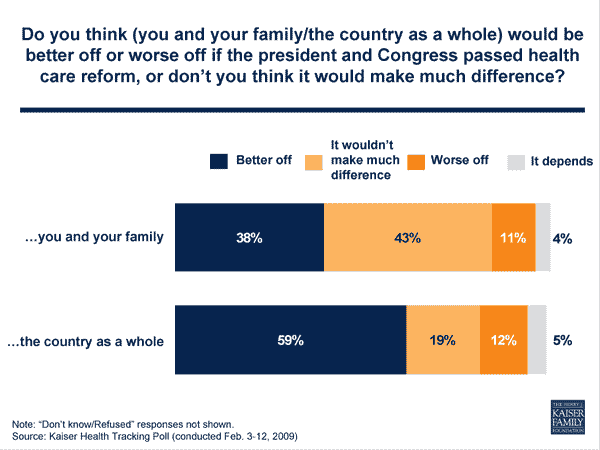
There is one poll number that may be more important to watch than any other if we have a big debate about health reform: The percentage of Americans who think that they or their families would be better off if the president and the Congress enacted major health reform legislation. It’s a number that signals whether people think that health reform legislation will actually help them with the problems they are having in the current health care system. Or, whether critics of health reform are successfully playing on the public’s underlying fears — fairly or unfairly, depending on your perspective — as they did in the last health reform debate in the early 1990s.
According to our latest tracking poll just out this week, 38% of the American people think that health reform would make them or their family better off and 11% think they would be worse off. Democrats, younger people, and lower income people are much more likely to think they would benefit. Forty-three percent of the American people think health reform will have no impact on them. Of those who think they will be unaffected, 38% are Democrats and more likely to be pro reform in general based on our polling; 24% are Republicans, who are less likely to favor reform; and 30% are independents.
A poll conducted by Time/CNN/Yankelovich in September 1993 — just before the Clinton health plan was formally introduced — found the public much more conflicted than today, with 20% saying they thought the plan would make them and their family better off, 21% saying they would be worse off, and 57% believing they would be unaffected. By that point, many interest groups had already started to mobilize against the plan. As the debate over the Clinton plan intensified, support for the plan fell as more people grew to believe — rightly or wrongly — that they would end up worse off. In less than a year the percentage of people who said the plan would make them worse off rose from a low of 21% in one poll to 37% in another. Observers often point to the fact that people feared the Clinton proposal might force them out of their current health care arrangements. That was undoubtedly a factor in undermining the plan.
The percentage of Americans believing that health reform will benefit them needs to go up and cannot go down if there is to be a public environment conducive to a comprehensive reform effort. Any major reform will require sacrifice or change by some. And, interest groups and opinion leaders who decide to oppose a reform plan — whether out of ideology or because it is harmful to their interests — will likely frame their opposition in terms of how the public at large will be affected. This is especially true in a deep recession, which both elevates public concern about the affordability of health care but also understandably makes people reluctant to want to spend more or make other sacrifices.
Answering the question “What will health reform do for me?” is more than a communications challenge. There are multiple agendas in health reform — to expand coverage for the uninsured, to reduce people’s health care bills, to begin the process of long-term reform of the health care delivery system, and to help balance the federal budget and rein in entitlement spending, just to name a few — and it is not unfair for people being battered on multiple fronts in a recession to want to cut through the clutter and ask “Will this help me?” The number of people answering yes to this question will be a critical barometer to watch.