Public Education Partnerships: MTV: Get Yourself Tested: PSAs

Published: Mar 20, 2009
GYT-Get-Yourself-Tested-GYTNOW-org.jpg
clear.gif

Public Service Announcements

2011/12 PSAs

2010/11 PSAs

2009/10 PSAs

Trends in Health Care Costs and Spending

Published: Mar 19, 2009

This fact sheet on health care costs presents key statistics about the growth, level and impact of rising U.S. health care costs. It covers spending on various medical services, sources of health spending, employer-sponsored health coverage and the impact on businesses and people.

Fact Sheet (.pdf)

News Release

William H. Frist and Gerald Rosberg Appointed to Kaiser Family Foundation Board of Trustees

Published: Mar 17, 2009

Menlo Park, Calif. – The Kaiser Family Foundation announced today that former U.S. Senate Majority Leader William H. Frist, M.D. and Gerald Rosberg, J.D. have been appointed as members of its Board of Trustees.

William H. Frist, M.D., is a licensed and board certified heart and lung transplant surgeon. Frist is a Vanderbilt University Distinguished Professor of Medicine and Business and teaches a health policy course at Princeton University. He also serves as the chairman of the nonprofit charitable foundation Hope Through Healing Hands, which promotes quality of life for citizens and communities around the world using health as a currency for peace. Frist served as a U.S. Senator from 1995 to 2007 and as Senate Majority Leader from 2003 to 2007.

Gerald Rosberg, J.D. is a senior vice president of planning and development for The Washington Post Company. Rosberg previously served as a member of the Foundation’s Board of Trustees from 1997 to 2005 and as the chair from 2001 to 2005. He also served as the Foundation’s counsel from 1987 to 1997. Rosberg has previously served as counselor on international law in the Office of the Legal Adviser of the U.S. Department of State. He was a clerk to Chief Judge David L. Bazelon of the U.S. Court of Appeals for the District of Columbia Circuit and then to Justice William J. Brennan, Jr. of the U.S. Supreme Court.

The Kaiser Family Foundation is a non-profit private operating foundation, based in Menlo Park, California, dedicated to producing and communicating the best possible information, research and analysis on health issues. More information about the Foundation and its Trustees is available at www.kff.org/about.

# # #

Pulling It Together: Jobs, A Reason to Fast Track Coverage

Published: Mar 13, 2009

The two big topics in Washington right now are the economy and health care.  I’ve written before about how the two are linked, and in particular about how among the everyday economic problems people are having, paying for health care is a big one.

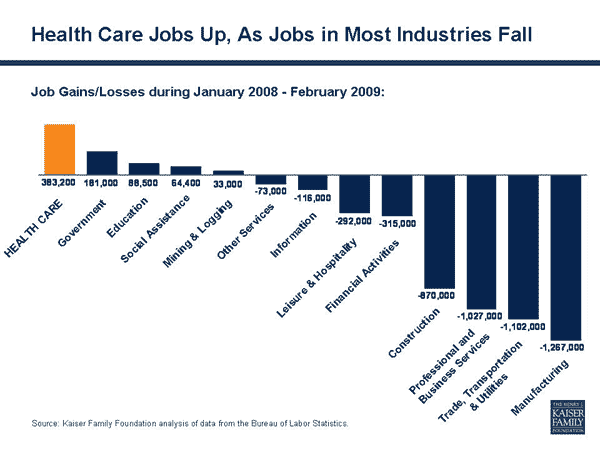
But the latest numbers out from the Bureau of Labor Statistics show there is another link: Health care is one of the few relatively healthy parts of our unhealthy economy right now. Since January 2008, the economy has lost 4.3 million non-farm jobs. Virtually all major industries have shed jobs. What went up? Well, mining and logging companies added modestly to their payrolls. Government and education employment is up somewhat, along with social assistance (not too surprising given our economic circumstances). But where did employment go up the most since January of last year? You guessed it: Health care, which added 383,200 jobs.

pti031709_2.gif

These numbers underscore a similar point made recently by my friend Uwe Reinhardt. Cutting back on health care spending is tricky right now because health care is one of the few things fueling our economy, which desperately needs a boost.

At the same time, we can’t forget that more health care jobs generally mean higher health care costs. In fact, the actuaries at Centers for Medicare and Medicaid Services just released projections showing that in 2009 health care as a share of the economy will grow faster than it ever has, with health spending growing by 5.5% as GDP shrinks. Over the next decade, they forecast that annual increases in health care spending will eclipse GDP by 2.1 percentage points.

This presents a bit of a conundrum. As our surveys continue to document, people are struggling with health care bills.  And, as the Obama Administration has emphasized recently, a primary aim of health care reform is to slow the growth in health costs in the future. Virtually everyone agrees health care costs pose a serious problem we need to confront, but for the next year or two, the country needs those health sector jobs even more than it needs to control health care costs.

A way out may be to think differently about the long run and the short run. Over the long term, it is certainly the case that we need to weed out unnecessary care, get the best value we can for our health care dollar, and rein in the rate of increase in health spending. In the short term, if policymakers can act quickly to expand coverage and assist families with their health care expenses, they can both provide immediate help to people and stimulate the economy with added jobs.

We need to do both coverage and cost containment in health reform, but what the job numbers suggest is that the coverage elements in health reform should kick in as rapidly as possible — to create more jobs, free up other money in family budgets people can put back into the economy, and help fuel the recovery.

American Recovery and Reinvestment Act (ARRA): Medicaid and Health Care Provisions

Published: Mar 4, 2009

This fact sheet examines the assistance for Medicaid programs and key health provisions in the American Recovery and Reinvestment Act (ARRA) that President Obama signed into law on February 17, 2009. Subjects covered include the temporary increase in federal matching money for state Medicaid programs, subsidies for COBRA health coverage for laid off workers and funding for health information technology. It includes a breakdown of additional federal allocations to states for Medicaid costs under the act.

Fact Sheet (.pdf)

Community Health Centers in an Era of Health System Reform and Economic Downturn: Prospects and Challenges

Published: Mar 1, 2009

This issue brief reviews the role of community health centers in the nation’s health care safety net. The centers provided comprehensive primary care to 16.1 million patients in 2007, many of them from lower-income families and medically underserved communities. The role of the centers is even more critical during an economic recession when families are more vulnerable to economic loss and unmet health needs.

Issue Brief (.pdf)

Resources on Community Health Centers

Published: Mar 1, 2009

The Kaiser Family Foundation has issued three new resources that examine the role of community health centers as key components of the U.S. health care system, providing primary care to more than 16 million patients nationwide in 2007.

The documents, produced for the Kaiser Commission on Medicaid and the Uninsured, include a fact sheet on community health centers, an updated issue brief on their role in the health system and a report on how such centers fared in the wake of health reform in Massachusetts.

Report: How is the Primary Care Safety Net Faring in Massachusetts? Community Health Centers in the Midst of Health ReformFact Sheet: Community Health Centers

Issue Brief: Community Health Centers in an Era of Health System Reform and Economic Downturn

Health Care and Medicaid — Weathering the Recession

Published: Mar 1, 2009

Rising unemployment is leaving millions more Americans without health insurance, creating challenges for those seeking to stabilize coverage and shore up the nation’s health safety net.

In this Perspective article, published March 26 in the New England Journal of Medicine, Diane Rowland, executive vice president of the Kaiser Family Foundation and executive director of the Kaiser Commission on Medicaid and the Uninsured, examines the ongoing recession’s impact on health coverage and state Medicaid programs, which face growing demand and enrollment at the same time that states are confronting severe budget crises.

Despite the recent federal approval of $87 billion in extra help for state Medicaid efforts, many people who have lost their jobs and health coverage will remain ineligible and uninsured.

Journal Article (free access)

Community Health Centers

Published: Mar 1, 2009

This fact sheet provides a basic overview of community health centers, covering issues such as the patients they serve, the services they provide and the financing they receive. Community health centers provided comprehensive primary care to 16.1 million patients in 2007.

Fact Sheet (.pdf)

How Is The Primary Care Safety Net Faring in Massachusetts? Community Health Centers In The Midst of Health Reform

Published: Mar 1, 2009

This report examines how community health centers, which provide comprehensive primary care for low-income and uninsured patients, have fared under Massachusetts’ health reform law. Community health centers saw a significant increase in patient load amid the state’s efforts to improve health coverage by expanding public programs and making private insurance more affordable.

That experience shows that community health centers play a critical role in caring for newly insured patients while continuing to serve as the primary care safety net for those who remain uninsured.

Report (.pdf)