Money Follows the Person: An Early Implementation Snapshot

Published: Jun 19, 2009

This issue brief examines the early successes and challenges of the Money Follows the Person Demonstration (MFP), a Medicaid initiative enacted into law in 2006 that gives states enhanced federal support to balance their Medicaid long-term care programs by providing more services in the community and fewer in institutional settings. A 2008 Kaiser Commission on Medicaid and the Uninsured survey of 29 states receiving MFP grants turned up several key findings, including that several hundred people have moved from institutional to community settings; that states are providing a broad range of services to facilitate transition; that housing issues for MFP participants are a major challenge for states; and that the severe economic downturn had not yet prompted states to scale back their efforts.

Issue Brief (.pdf)

Pulling it Together: The Sleeper in Health Reform

Published: Jun 16, 2009

The health reform legislation currently being crafted on Capitol Hill is undeniably complex.  To oversimplify slightly it can be boiled down into four parts: coverage (subsidies for private coverage and Medicaid expansions); delivery and payment reforms; insurance market reforms and regulations; and prevention, with each broad category containing a range of specific policy proposals and ideas.

There’s been a lot of discussion so far about coverage expansions and how to pay for them, as well as delivery and payment reforms aimed at “bending the curve” of health care costs over time, including a hot debate lately about whether or not a public insurance plan should compete with private plans.  But the idea of making the health insurance market work more fairly, particularly for sicker and older consumers, has not received commensurate attention.  Steps currently being discussed include:

  • Requiring insurers to take everyone, including those with pre-existing health conditions.
  • Eliminating premium markups based on health status.
  • Minimizing premium variations based on age.
  • Capping how much insurance companies can spend on administration and profits.
  • Standardizing coverage at different levels and ensuring that all plans cover a range of benefits, making it easier for consumers to compare plans.

These changes would all apply to people buying insurance on their own in so-called “exchanges,” and possibly to small businesses buying coverage for their workers as well.

Insurance market reforms are quite possibly the least controversial of all the issues in health reform, which is maybe why they’ve gotten less attention.  But, they may also be the sleeper in the debate, at least for the public.  Why is that?

First, they directly address some of the biggest insecurities people have about health care, particularly in the current economy with millions losing their jobs and likely their health coverage as well.  The predominant source of health coverage today, and likely after reform too, is through employers.  But, a surprising number of people have, at some point in their lives, shopped for insurance directly from an insurer — 41% of all adults in a survey we did last year. Depending on how a new system is set up, 40 million or more people could end up getting insurance through exchanges and be protected by new insurance market rules, and many more over time as people cycle in and out of different parts of the insurance system.

More than any other single factor, it is the problems the insured have paying for health care and their worries that these problems will worsen that have put health on the agenda with new political traction.  In a study we did with the American Cancer Society, for example, we found that even having private insurance didn’t protect cancer patients from high out-of-pocket costs, leading in some cases to bankruptcy and delayed or foregone care.

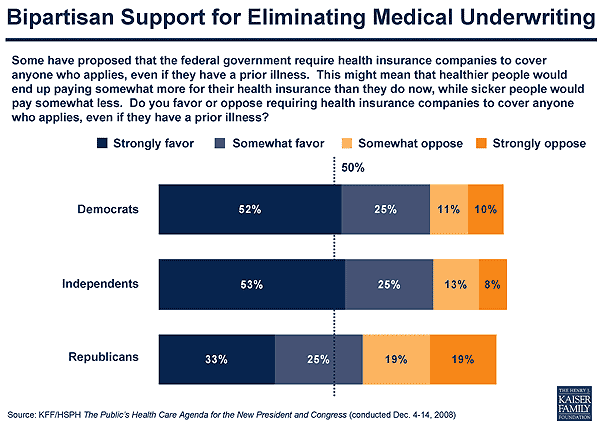
Second, changes such as eliminating medical underwriting have appeal across the political spectrum.  We poll on all kinds of policy options at Kaiser, and this is one of the few that garners majority support from Democrats, Independents, and Republicans.  And, in the example of eliminating underwriting, it maintains broad support even after we tell respondents that healthier people may end up paying somewhat more so that sicker people can pay less.

June09PITgif_1.gif

Third, there is one special attribute insurance market reforms have: they have almost no impact on the federal budget. With paying for health reform looming as perhaps the biggest challenge, this is a feature worth its weight in gold.  (Though before anyone gets the idea that doing insurance market changes and establishing exchanges is a simple incremental step, it’s important to remember that these reforms are tough to make work without adequate subsidies and a requirement that everyone be covered.)

I offer no judgment in this short column about the individual insurance market reforms now being proposed.  They are not all equally meritorious, and some involve tradeoffs.  By the same token, others not on the table now could also be considered; for example, requiring health insurance companies to be more transparent about their premium increases and to justify them, in writing, to their customers (employers and individuals). Even without limits on premium increases, which were proposed in the Clinton health reform plan but are not on the table now, greater public accountability and transparency could go a long way.

What is clear is that when people with insurance now struggling to pay their health care bills see health reform legislation and ask “How will this help me and my family?” there will be nothing else that so quickly and understandably addresses people’s concerns about security and peace of mind than one of the least discussed elements of the legislation  —  insurance market reforms. Policymakers might consider doing more in this area and finding ways to communicate about it more effectively.  Is there an Insurance Bill of Rights lurking inside today’s health reform legislation?

Medicare’s Role for Women

Published: Jun 11, 2009

Medicare’s Role for Women

This fact sheet highlights Medicare’s important role in providing women with health care coverage. It examines the demographic profile of women on Medicare, including their health and income status, the program’s benefits and cost-sharing requirements, and the prevalence of supplemental coverage to fill gaps in Medicare’s coverage.

Fact Sheet (.pdf)

Pulling it Together: On Health Reform, Will All Roads Meet in the Middle?

Published: Jun 4, 2009

A few weeks ago a small group of upset single-payer advocates followed Senator Baucus into the parking garage of our D.C. building as he was arriving to do one of our health reform newsmaker breakfasts, cosponsored by Families USA and the National Federation of Independent Business. They were angry because they feel that single payer is not receiving enough attention in the current debate, and it is true that it is not getting a lot of attention. But it could equally have been a group of upset conservatives in the garage that day; their favorite consumer-driven market-based solutions, advanced with great fervor in the Bush administration just a few years ago, are largely off the table.

It has been clear for some time that if there is to be a deal on health reform in this Congress it will be a centrist deal, one that neither purists on the left nor the right will be truly enthusiastic about.  It will build on the current system of employment-based insurance and public programs, contain a heavy dose of private insurance and market mechanisms and lots of delivery and payment reforms aimed at achieving future savings, and allow people to keep their current doctors, hospitals and insurance coverage if they want to. The Democratic majority in the Congress has little interest in the directions championed in the Bush years, but by the same token conservative Democrats and deficit hawks will be leery of a larger government role and will try to minimize future spending obligations. And many Democrats will not want to be vulnerable to being tarred as big-government, big-spending liberals in the next campaign when they go after independent voters to win reelection. Ultimately, political leaders will balance optimal policy as they see it and political needs as the election gets closer.

Much of the jockeying we are seeing can be viewed as the fine tuning of a centrist compromise with elements both the right and the left will not like. Putting together such a centrist bargain on health reform is precisely what my home state of Massachusetts did, although it bears noting that while states have their politics, politics at the state level are more pragmatic and less driven by ideological differences than politics in Washington are. Here are some possible elements of a health reform bargain the right and left may not like:

Some Things The Left Would Not Like:

  • It’s not single payer
  • No public plan or a watered down public plan
  • Weaker regulation of insurance than many on the left want
  • A cheaper plan with subsidies that may not go as high up the income ladder as they want
  • Capping the tax preference (mainly labor opposition)

Some Things The Right Would Not Like:

  • Mandates, especially employer mandates
  • A new expensive coverage “entitlement”
  • Any form of public plan
  • Expanded government regulation of the health insurance industry and health insurance benefits

It is certainly not the time for groups to stop fighting for positions and ideas they believe in. It is too early in the process and the push and pull from all sides is how our system works. But it is also true that the voices on the edges tend to be stronger, and their beliefs more strongly held than those in the middle who are trying to craft a compromise rather than advance deeply held positions. In the end, however, if legislation passes, the American people will not think about it as liberal, or centrist, or conservative, and they do not have an expert position on what constitutes optimum policy. They will view it through their own more pragmatic lens and ask: will my health care be more affordable now than it was before? The question is not whether the public will go for a deal in the middle, it is whether Washington and Congress as currently structured can, while at the same time satisfying enough of the public that they will come out ahead and holding the remainder of the population harmless.

Survey Brief: Views and Experiences with HIV Testing in the U.S.

Published: Jun 1, 2009

This survey brief, based on the 2009 Survey of Americans on HIV/AIDS, takes a deeper look at the U.S. public’s attitudes towards and reported experiences with HIV testing, including which groups are most likely to report being tested for HIV, reasons for being tested or not being tested, communications with doctors and partners about HIV/AIDS, information needs related to testing, and perceptions of testing-related stigma.

Survey Brief (.pdf)

Survey Brief: Views and Experiences with HIV Testing Among African Americans in the U.S.

Published: Jun 1, 2009

This survey brief, based on the 2009 Survey of Americans on HIV/AIDS, examines African Americans’ reported views and experiences with HIV testing. The U.S. AIDS epidemic has disproportionately affected African Americans, who account for nearly half of new infections, while representing just 12 percent of the U.S. population. The brief highlights trends and differences among African Americans by age and gender when noteworthy.

Survey Brief (.pdf)

News Release

Kaiser Family Foundation Launches New Non-Profit Health Policy News Service

Published: Jun 1, 2009

Kaiser Health News Will Provide In-Depth Reporting on Major Health Policy Issues

Menlo Park, CA — In the midst of a major federal health reform debate and the ongoing financial turmoil in the media industry, the Kaiser Family Foundation officially launched Kaiser Health News (KHN) today to provide a new source of in-depth reporting on major health issues. KHN is staffed by experienced health policy journalists and editors, and will feature contributions from a wide array of leading health policy commentators and independent journalists.

KHN will distribute in-depth stories, news summaries, interviews and multimedia content through its Web site, www.kffhealthnews.org, and through partnerships with leading news organizations, including The Washington Post, The Philadelphia Inquirer, NPR News and The New Republic.

“Our mission and our challenge with Kaiser Health News is to do in-depth coverage of health policy that informs and explains and that increasingly cannot be done in the mainstream news business,” said Kaiser President and CEO Drew Altman.

KHN is a major program of the Kaiser Family Foundation, a non-partisan, non-profit, private operating foundation dedicated to producing and communicating the best possible analysis and information on health issues. All KHN content is available to other news organizations and the public free of charge.

KHN is headed by Executive Editors Laurie McGinley, formerly of The Wall Street Journal, and Peggy Girshman, previously of Congressional Quarterly and NPR. They will have responsibility for all editorial decisions about news content. KHN will begin with a team of 18, including newly-hired journalists and staff from the Foundation’s health information service, kaisernetwork.org, which has been integrated with KHN. KHN staff journalists include some of the most knowledgeable health policy journalists in the country: Julie Appleby, MPH, former health care industry and policy reporter for USA Today; Mary Agnes Carey, former associate editor for CQ HealthBeat; Jordan Rau, former political and health policy reporter in the Sacramento bureau of The Los Angeles Times; and Phil Galewitz, medical writer for The Palm Beach Post and a former health industry reporter for the Associated Press. John Fairhall, who is KHN’s senior editor, was an assistant managing editor at The Baltimore Sun for projects and health and science coverage. Well-known health policy journalist Julie Rovner will also be a contributor as part of a partnership between KHN and NPR.

Matt James, the Foundation’s senior vice president for media and public education, will oversee the operation of KHN.

“With action on health care reform heating up, this is an exciting time to launch Kaiser Health News. Health issues are always fascinating and a challenge to explain well, so we’ll do our best to provide high-quality coverage to interested news outlets and our Web site readers,” said Laurie McGinley, executive editor, news, of KHN.

“With the multimedia resources of KHN and the Foundation, we hope to provide video, audio, graphics and text that will enhance public understanding of these complex issues,” said Peggy Girshman, executive editor, online, of KHN.

At the heart of KHN will be in-depth, explanatory stories about complex health policy issues and major developments in Washington, D.C., and around the country in the health care marketplace and health care delivery system. The news service will cover policy stories like health care reform, developments in major public health coverage programs like Medicare and Medicaid, and complicated ongoing policy challenges like the financing of long-term care, and it will examine the nation’s health care system from a consumer perspective. KHN will also provide a synthesis of health policy news coverage through a daily health policy report, original programming from Kaiser’s broadcast studio, and regular columns from contributing writers and experts. Jonathan Cohn, senior editor of The New Republic, and Howard Gleckman, senior research associate at the Urban Institute and former senior correspondent at Business Week, will be writing bi-weekly columns. Among others who will contribute occasional columns are: Michael Cannon of the Cato Institute, Jim Capretta of the Ethics and Public Policy Center, Judy Feder of the Center for American Progress, and Mark Pauly of the Wharton School at the University of Pennsylvania.

KHN has a distinguished National Advisory Committee of prominent journalists to provide guidance on important issues including the trends in journalism, which stories KHN should be producing, and how the stories should be distributed. The advisory committee is led by Leonard Downie, Jr., vice president at large, The Washington Post, and former executive editor of the Post, and also includes: Alberto Ibargüen, president and CEO of the John S. and James L. Knight Foundation; Karen Dunlap, president and trustee of the Poynter Institute; Kevin Klose, dean of the University of Maryland’s Philip Merrill College of Journalism, and former president of National Public Radio, Inc.; Bill Kovach, founding chairman, Committee of Concerned Journalists; Charles R. Lewis, distinguished journalist in residence at American University, and a former producer for CBS’s 60 Minutes and co-founder of the Center for Public Integrity, an investigative news site; Diana Mason, Rudin professor of nursing at Hunter College-Bellevue School of Nursing, City University of New York, and director of the Center for Health Media and Policy; Arlene Morgan, associate dean, Columbia Graduate School of Journalism; and Cathy Trost, director of exhibit development, Newseum.

“The timing is just right for Kaiser Health News. At a time when Americans want and need more health policy news than ever, the American news media are in crisis and having difficulty providing resources for this coverage,” said Leonard Downie, Jr., chair of KHN’s National Advisory Committee. “Kaiser Health News is an important initiative in non-profit news reporting, which will be closely watched in the search for new models for in-depth, public service journalism.”

The primary funding for KHN is built into Kaiser’s ongoing budget drawn from its endowment which it manages itself. Additionally, The SCAN Foundation has provided a three-year grant to Kaiser so that KHN can provide in-depth coverage of health care issues of concern to America’s senior population.

Other KHN staff include:Senior Web Editor Jill Balderas, MPH, was formerly a senior producer and correspondent for Reuters Health Television and kaisernetworkWeb Editor Stephanie Stapleton spent 12 years as an editor and reporter for American Medical NewsAssistant Editor Kate Steadman worked on kaisernetwork before transitioning to KHNSenior Web Producer Beth Liu joined KHN from kaisernetwork where she was a senior web writerWeb Reporter Jennifer Evans formerly wrote for The Scientist and The Times-PicayuneWeb Reporter Jenny Gold previously worked for NPR and CBSWeb Reporter Jessica Marcy was a health reporter for The Roanoke TimesWeb Reporter Jaclyn Schiff covered global health issues for The Advisory BoardWeb Reporter Andrew Villegas was a political reporter at The Greeley Tribune in ColoradoWeb Reporter Chris Weaver previously worked at ProPublica and Part B NewsOutreach Coordinator Kristen Carriker joined KHN after being a producer for the Foundation’s health08.org Web site.

The Kaiser Family Foundation is a non-profit private operating foundation, based in Menlo Park, California, dedicated to producing and communicating the best possible analysis and information on health issues.