KFF designs, conducts and analyzes original public opinion and survey research on Americans’ attitudes, knowledge, and experiences with the health care system to help amplify the public’s voice in major national debates.
Medicaid plays a major role in covering more of the uninsured under the new health reform law. The new law includes a significant expansion of Medicaid, an individual requirement to obtain health insurance, and subsidies to help low-income individuals buy coverage through newly established Health Benefit Exchanges. This brief explains the how Medicaid works today and answers some key questions about Medicaid’s role in health reform.
Many Provisions That Take Effect in 2010 Are Popular and Have Bipartisan Support
Cable News Tops List of the Public’s “Most Important” Information Sources
MENLO PARK, Calif. –The first Kaiser Health Tracking Poll fielded since the passage of health reform last month finds that 8 in 10 Americans know that President Obama signed the legislation into law. But 55 percent say they are confused about the law and more than half (56%) say they don’t yet have enough information to understand how it will affect them personally.
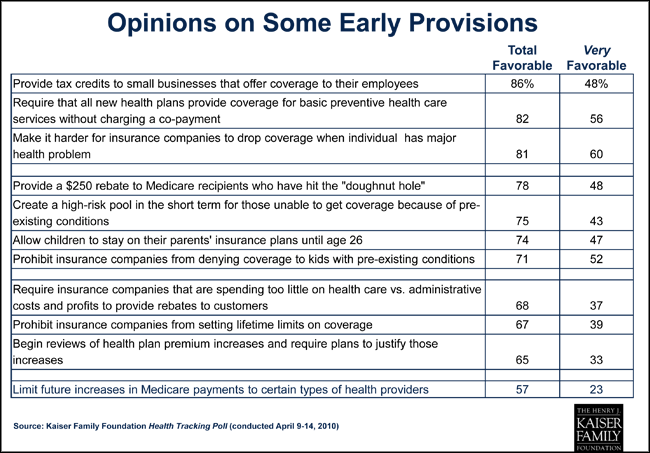
The April poll finds that the public supports many of the provisions of health reform that are set to be implemented in the short term. When asked about 11 specific provisions scheduled to take effect this year, in each case a majority of Americans viewed them favorably, often with bipartisan support.
Still, the public remains divided on the law overall, with 46 percent viewing it favorably, 40 percent unfavorably and 14 percent undecided. Similarly, 31 percent of Americans say they expect personally to be better off because of the law, while 32 percent say they will be worse off and 30 percent say they don’t expect to be affected.
“People are struggling to understand how the law will affect them and their families and to separate fact from political spin,” said Kaiser President and CEO Drew Altman.
Many Reform Provisions That Take Effect in 2010 Are Popular With Bipartisan Support
The new law was constructed to include some provisions that take effect in the first year so that the public would feel tangible results in the short term. The poll tested the popularity of many of these early measures and finds widespread support for them across the political spectrum, including among Republicans and independents
Nearly 9 in 10 Americans favor providing tax credits to small businesses that want to provide coverage for their workers, for instance. And roughly 8 in 10 have favorable views of provisions that would offer access to basic preventive care with no copayments, provide financial help to seniors who hit the gap in Medicare drug coverage known as the “doughnut hole,” and end insurance companies’ practice of dropping coverage if a person has a major health problem.
In each of these cases, at least two-thirds of Republicans and independents join most Democrats in viewing the provisions favorably.
Americans Are More Confused Than Angry About Health Reform
Although anger grabs the headlines, the only emotion shared by more than half of the public when it comes to the health reform law is confusion. Overall, 55 percent say they are confused, an emotion more deeply rooted among those who feel unfavorably toward reform (61% of whom feel confused) than among those who favor it (44% of whom feel confused).
Minorities of Americans report feeling other emotions, including 45 percent each who say they are “pleased” or “disappointed,” 42 percent who are “anxious,” and 40 percent who are “relieved.” Anger is at the bottom of the list, a feeling reported by 30 percent of the public, including 16 percent who say they are “very angry.” Asked what about health reform made them angry, that 30 percent divided as follows: 9 percent did not like the way the policymaking process worked, 7 percent did not like the final content, and 12 percent did not approve of either.
Cable TV News Is The “Most Important” Source of Information About Reform Law
Americans of all political leanings pointed to cable television news more than any other source when they were asked to choose their most important source of news and information about the law. More than a third (36%) cited cable TV news stations and their websites as their most important outlet, followed by network news (16%), newspapers (12%), friends and family (10%) and the radio (9%).
There were some differences along party lines, however. Republicans were more likely to name cable TV as their most important news source, with 45 percent saying so compared to 30 percent of Democrats. On the other hand, Democrats were twice as likely as Republicans and independents to say that they got most of their information from network news (23% of Democrats compared to 12% of the other two groups).
Overall sentiment about the new law still breaks sharply along partisan lines. Nearly 8 in 10 Democrats (77%) favor the new law, while about as many Republicans (79%) view it unfavorably, a mix very similar to that seen before the bill’s passage in March. Political independents tilt against the law (46 percent opposed compared to 37 percent in favor), while self-described moderates favor the measure 55 percent to 31 percent.
Methodology
This Kaiser Health Tracking Poll was designed and analyzed by public opinion researchers at the Kaiser Family Foundation. The survey was conducted April 9 through April 14, 2010, among a nationally representative random sample of 1,208 adults ages 18 and older. Telephone interviews conducted by landline (801) and cell phone (407, including 171 who had no landline telephone) were carried out in English and Spanish. The margin of sampling error for the total sample is plus or minus 3 percentage points. For results based on subgroups, the margin of sampling error may be higher. The full question wording, results, charts and a brief on the poll can be viewed online at http://www.kff.org/kaiserpolls.
The Kaiser Family Foundation is a non-profit private operating foundation, based in Menlo Park, California, dedicated to producing and communicating the best possible information and analysis on health issues.
With the nation’s unemployment rate rising to its highest levels in decades as a result of the recession, many families have lost their employer-sponsored health coverage or are at risk of doing so. In an effort to help people maintain coverage after a layoff, the stimulus legislation known as the American Recovery and Reinvestment Act of 2009 provides temporary subsidies to some workers so that they can maintain their previous employer-sponsored coverage through COBRA after losing their job.
This issue brief examines the COBRA provisions of the legislation and answers key questions about how the subsidy works and who might benefit. It also explains how the provisions interact with other laws and programs designed to help people obtain and maintain health coverage, and it discusses other coverage options for the unemployed. Congress and President Obama have repeatedly extended both the eligibility period and the duration of the COBRA subsidy. It now lasts for up to 15 months. An updated fact sheet answers key questions about the subsidy extension.
This timeline highlights the implementation dates for provisions in the new health reform law that are related to Medicaid and the Children’s Health Insurance Program. While major expansions of Medicaid are set to occur in 2014, many other key provisions in the health reform law become effective between 2010 and 2014.
This brief compares the Medicaid and Children’s Health Insurance Program provisions in the new health reform law with pre-reform law governing those programs. The analysis focuses on Medicaid coverage and financing changes; how Medicaid and CHIP will interface with a new health insurance exchange and other Medicaid benefits and access changes. Overall, the new law includes an individual requirement to obtain health insurance, a significant Medicaid expansion and subsidies to help low-income individuals buy coverage through newly established Health Benefit Exchanges.
Now that historic health reform legislation is law, everyone is rightfully focused on implementation. There are two very different ways to look at implementation. One is the more legalistic worm’s eye view, which sees implementation largely as the process of putting into effect what was written in the law. In the worm’s eye view implementation proceeds in a linear fashion from legislation, to regulations specifying what the statute calls for in greater detail, to operations in the field.
The other perspective on implementation is the bird’s eye view. It sees implementation as adaptive and somewhat unpredictable; a function of real world developments, politics, the number of players and decision points and the time period involved in implementing a law. In the case of health reform, implementation would depend not only on what is written in the law, but also on how the political and economic landscape shifts, how governors and states respond to health reform, how the private sector responds, how health care institutions and health professionals filter the intent of the legislation on the front lines, what the media does, and most of all, what the public’s reaction to health reform is over the next several years.
Both perspectives are equally applicable to the health reform law. The statute and the real world will come together in unknowable proportions to shape what actually happens. There are many challenges ahead, but in this column I address two that I see as especially important: explaining the law to the American people and implementation in the states.
EXPLAINING THE LAW TO THE AMERICAN PEOPLE
For over a year health reform has been the focus of an intense, emotional, and heavily politicized debate that has been as much about deeper issues and raw nerves in American politics as it has been about the substance of health reform itself. The heavy political messaging will continue at least through the midterm elections and polls will continue to elicit reactions from the public about the law (mixed), the policymaking process (sharply negative) and the benefits the law provides (very positive). But now that health reform is the law of the land all you have to do is turn on the car radio or the TV or talk to a taxi driver to see that the American people have flipped a switch in their heads. They will continue to have opinions about the law but what they are desperately trying to figure out now is what the law means for them.
I was getting a ride to a speech on health reform at Claremont McKenna College recently called The Athanaeum Lecture from a gentleman and his wife. They were both 58 years old. He was healthy, she had hypertension. They had no health insurance and they were making a real effort to understand the law. They knew that her hypertension would no longer exclude her from coverage. They very clearly understood that they would have to pay a penalty if they did not buy insurance by 2014. They had heard there would be subsidies provided under the law but were unclear how they would work. They knew why I was visiting the campus and wanted to talk about health reform. We discussed their employment plans, their likely income in 2014, who qualifies for tax credits under the law, the exchanges and the kinds of policies they would be able to get. By the time we arrived at our destination they had concluded that they could get substantial help buying a policy in the exchange in 2014 that would give them health coverage before their Medicare kicked in a few years later. They must have been reassured (or just smart), because after they dropped me off they attended a talk on campus by Sandra Day O’Connor, not my health reform talk. Similar discussions are occurring across the country and almost everybody has a special circumstance or situation and they are hungry for answers to their own specific questions. Answering those questions in a way that is consumer friendly and responsive to people’s individual circumstances is a big challenge and will be critical to establishing a positive climate for implementation and to the success of the law.
The major benefits of the law — the coverage expansions, subsidies, and insurance market reforms — do not kick in until 2014. To compensate for that, the architects of the legislation built in a long list of early deliverables so the public would see tangible and understandable benefits right away — from allowing dependent children to stay on family policies until age 26, to beginning to eliminate the prescription drug donut hole for seniors. But, these early deliverables will likely help only a modest number of people and, of course, people’s premiums and out of pocket costs will continue to rise at a faster rate than their wages will. So, on the one hand, the law might not provide the kind of help people are expecting in the first few years. On the other hand, the sky will not immediately fall, as many people seem to believe it might. In fact most people will see little or no change to their health care arrangements. If the benefits and timetable for the law are communicated effectively the expectations gap should be manageable, and over time the benefits the law provides will be highly-valued by the American people, but it will be crucial to develop mechanisms to answer people’s questions and link them to the benefits the law provides.
THE STATES
There are substantial implementation challenges to be met at HHS and some at other Federal agencies, but by far the biggest challenges will unfold in the states. Among the major responsibilities states have are: setting up the insurance exchanges for small business and individuals; enforcing the new insurance reforms; and overseeing the new Medicaid expansion that for the first time provides coverage to all low income people whether or not they have children, but brings with it new administrative challenges such as outreach and enrollment of new populations, integrating Medicaid with the new exchanges, and applying new income eligibility standards established under the law. Every state legislature will need to act for states to move forward. States will need to implement all of this at the same time as they face an estimated $375 billion in budget deficits over the next two years and thirty seven governorships will be up for election. In short, states will need to gear up for health reform at a time when they are cutting back and do it in a fluid political environment in many states. There is new financial assistance in the law to help in establishing exchanges, but none for other tasks other than the normal federal-state split for administrative costs under Medicaid. As a former head of a state umbrella agency with responsibility for a good deal of this territory, I can say from experience that states will need a lot of help and their performance will be variable. Some states will be real pacesetters, others will lag behind, and most will fall somewhere in the middle.
There is a huge job ahead to assist in the overall implementation challenge: to establish the facts about what the law does and does not do; to provide detailed information to the public about how different groups will be affected by the law and help people take advantage of the benefits it provides; to provide technical assistance to states; to help advocacy groups at the state and local level gear up to represent the interests of those who have the least information and influence themselves; and to track implementation and assess the impact of health reform on access, costs and care. Different organizations will make different choices about the roles they play and the pieces of the implementation challenge they take on. At Kaiser we will focus on clearly establishing the facts about the new law; what people understand and do not understand about it and how they are reacting to it; and most of all on its impact on people, which is always the organizing theme for our work. We will be launching a new website which we hope will be a go- to resource for analysis and information on health reform implementation.
In the end, however, it is the media that always is the public’s main source of information on health issues and that will be the case for health reform implementation as well. That is why we have long had such a strong commitment to health journalism at Kaiser and to being a resource on health policy for journalists and news organizations, and it is why we established Kaiser Health News, with its mission of producing in-depth coverage of health policy issues and providing its content for free to major news organizations and the public. The media’s big challenge will be to explain the law to people, and then to examine its impact and to cover the implementation of health reform beyond the Beltway as the story moves to the states and the marketplace. With shrinking budgets news organizations will be stretched thin to follow the story beyond Washington. Regional media can fill the void to some degree, but their budgets have been cut even more. And with the mid-term elections looming, providing balanced coverage of the electoral politics and the policy substance – with an emphasis on explaining what the law means to people – will be a challenge for a media increasingly drawn to controversy. It is especially a challenge for cable news. Media has a capacity to inform and to tell the story of how health reform is affecting people that goes beyond anything polling or health policy research can do, but it also can too easily become just an echo chamber for the political process itself.
Experience in every other developed nation teaches us that reforming health care is not like fixing a problem with your car. You don’t find the problem, identify a solution and then it is fixed. After passing their form of comprehensive national health reform legislation, every other nation continued to make corrections and improvements and to struggle with the tension between ever more expensive medical care and limited resources. The new health reform law in the U.S. marks a milestone in health and domestic policy of enormous importance, both in the directions it sets and the policy objectives it achieves. All of the elements of the new law are scheduled to be in place by 2018. But, like other nations we will always be reforming our health care system. In that broader sense, implementation is forever.
The first Kaiser Health Tracking Poll fielded since the passage of health reform last month finds that 8 in 10 Americans know that President Obama signed the legislation into law. But 55 percent say they are confused about the law and more than half (56%) say they don’t yet have enough information to understand how it will affect them personally.
The poll finds that the public supports many of the provisions of health reform that are set to be implemented in the short term. When asked about 11 specific provisions scheduled to take effect this year, in each case a majority of Americans viewed them favorably, often with bipartisan support.
Still, the public remains divided on the law overall, with 46 percent viewing it favorably, 40 percent unfavorably and 14 percent undecided. Similarly, 31 percent of Americans say they expect personally to be better off because of the law, while 32 percent say they will be worse off and 30 percent say they don’t expect to be affected.
The Patient Protection and Affordable Care Act (PPACA), signed into law in March 2010, made broad changes to the way health insurance will be provided and paid for in the United States. PPACA created a new mechanism for purchasing coverage called Exchanges, which are entities that will be set up in states to create a more organized and competitive market for health insurance by offering a choice of health plans, establishing common rules regarding the offering and pricing of insurance, and providing information to help consumers better understand the options available to them. Initially Exchanges will serve primarily individuals purchasing insurance on their own and smaller employers; states will have the option of opening Exchanges to larger employers a few years after implementation.
This summary provides responses to questions about the purpose and function of Exchanges and how they relate to regulation of the insurance market.
The health reform law relies on a large expansion of Medicaid to reach many low-income uninsured people, many of them adults. This fact sheet summarizes Medicaid beneficiaries’ experience in obtaining access to care, a subject that is of keen interest in view of the planned expansion of the program.
Medicaid and the Children’s Health Insurance Program have substantially increased coverage among low-income Americans, especially children. Research shows that Medicaid compares favorably with private coverage in connecting low-income children and adults with primary and preventive care. At the same time, physician shortages, especially in primary care, have left growing access gaps, both in Medicaid and in the health care system as a whole.
One year after the federal government intervened to aid the automakers, the Foundation along with The Washington Post and Harvard School of Public Health surveyed the residents of the tri-county Detroit area of Macomb, Oakland, and Wayne Counties to ask about their views and experiences in the midst of the area’s economic meltdown. Using data from the comprehensive survey and other publicly available information, this data note provides an overview of the current economic and health care challenges facing the Detroit area.
The overall survey, released in January 2010, is part of an ongoing three-way partnership between The Washington Post, the Kaiser Family Foundation and Harvard University.