KFF designs, conducts and analyzes original public opinion and survey research on Americans’ attitudes, knowledge, and experiences with the health care system to help amplify the public’s voice in major national debates.
The start of summer finds Americans remain divided on the health reform law, but favorable views of the new law increased seven percentage points over the past month to 48 percent, compared to 41 percent who have “generally unfavorable” views and 10 percent who have yet to make up their minds, according to the Kaiser Family Foundation’s newly released June Health Tracking Poll.
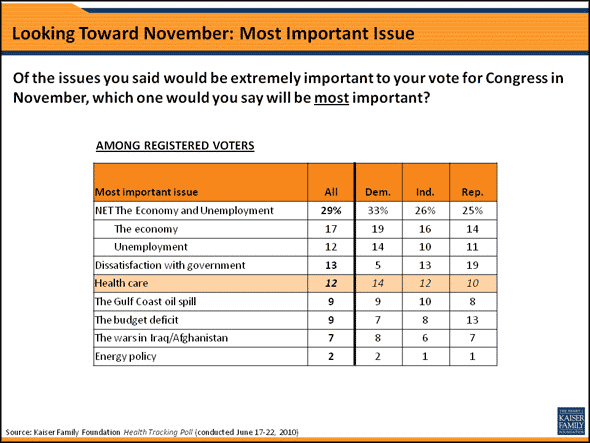
With four months remaining until the midterm congressional elections, an early look suggests that the contests could be impacted by a number of different issues, with the economy in the lead but health care also in the mix. When voters were pressed to choose the one issue that would be most important to their vote, economic concerns came out on top, with 29 percent naming either the economy or unemployment. In the next tier, 13 percent mentioned dissatisfaction with government, 12 percent mentioned health care, 9 percent each mentioned the Gulf Coast oil spill and the budget deficit, and 7 percent mentioned the wars in Iraq or Afghanistan.
For further information contact:Craig Palosky, (202) 347-5270 or cpalosky@kff.orgRakesh Singh, (650) 854-9400 or rsingh@kff.org
Recent Premium Increases Imposed by Insurers Averaged 20% for People Who Buy Their Own Health Insurance, Kaiser Survey Finds
Facing Such Increases, Some Enrollees Switched To Lower-Cost Coverage
People With Pre-Existing Conditions Much More Likely To Report Problems
MENLO PARK, CA — People who buy their own insurance report that their insurers most recently requested premium increases averaging 20 percent, according to a new Kaiser survey examining the experiences and views of people who buy health coverage in the non-group or individual market.
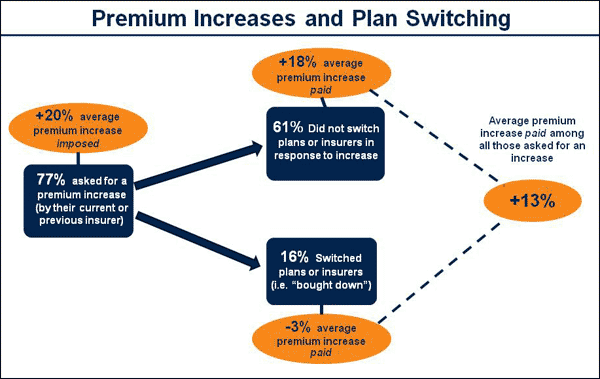
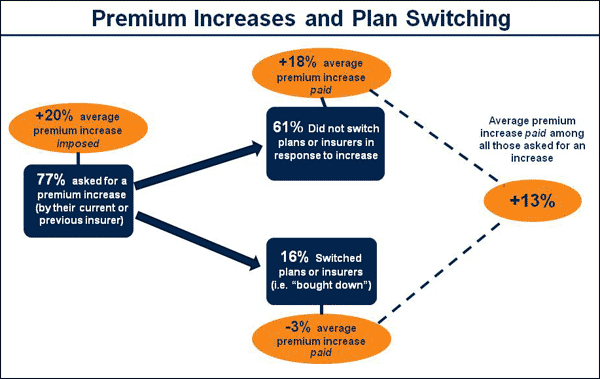
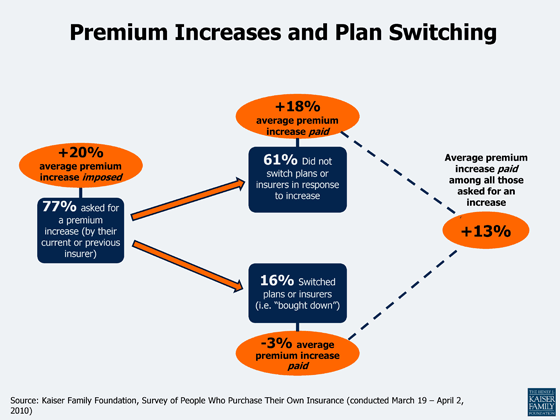
Overall roughly three in four people (77 percent) with non-group coverage report facing a premium increase with a current or previous insurer. Most say they paid the increase, but 16 percent of all policyholders say they switched plans, either buying a less expensive policy from their current insurer or switching companies altogether. After these so-called “buy downs” are taken into account, people who faced a premium increase ended up paying 13 percent more than before.
Many of those facing a premium increase who switched to a cheaper policy are now getting less comprehensive coverage than they were before. The survey found that those who switched are more than four times as likely to say their new plan offers worse benefits than their previous plan (49 percent) as they are to say their new plan’s benefits are better (11 percent).
“With people in the individual market being hit with average increases of 20%, the survey shows that the steep increases we have been reading about over the last several months are not just extreme cases,” Kaiser Family Foundation President and CEO Drew Altman said.
While most people in the U.S. get health insurance through their employer, about 14 million people under age 65 have coverage through the non-group or individual market, which has faced scrutiny recently in news reports about some insurers’ steep rate increases and in the market reforms in the new health reform law that will take effect in 2014. Kaiser’s Survey of People Who Purchase Their Own Insurance provides insight into the current state of the non-group market. It is based on a nationally representative random sample of 1,038 people ages 18-64 who purchase their own health coverage and was conducted between March 19 and April 2, during the final congressional debate and enactment of health reform legislation.
Premiums and deductiblesMore than half (57 percent) of those with non-group insurance say that they are the only ones covered by their policy. This group reports average annual premiums of $3,606, less than the average $4,824 premium reported in 2009 for employer-sponsored coverage (which typically provides more comprehensive insurance). Among those whose policies cover not only themselves but also other family members, the average annual premiums are $7,102. With insurers generally varying premiums by age in the non-group market, older people report paying higher premiums than younger people, both for individual policies and for family policies.
Many people report being in plans with high deductibles, including one in four (26 percent) with an annual deductible of $5,000 or more and 6 percent with a deductible of $10,000 or more.
Overall, the average deductible reported for single coverage is $2,498, almost four times the $634 deductible reported on average for employer-sponsored PPO coverage. Those with family coverage whose deductibles must be met on a per-person basis report an average deductible of $2,959, while those with a family deductible (the total spending required across the entire family before coverage kicks in) report an average of $5,149.
Cost concerns among policyholders
Those who purchase their own coverage are much more likely to worry about being able to pay for health care than those with employer coverage.
For example, 40 percent of those who buy their own coverage say they are “not too confident” or “not at all confident” that they will be able to pay their usual medical bills, twice the share of those with employer coverage who said so in another Kaiser survey. Only 17 percent say they are “very confident” they could pay these usual bills, compared to 36 percent of those with employer coverage.
A similar disparity exists when asked about their ability to pay for a major illness or injury that requires hospitalization. Half (51 percent) of those who purchase their own coverage say they are “not confident” they could pay their bills in such circumstances, compared with a quarter (26 percent) of those with employer coverage.
This lack of confidence may reflect real problems policyholders have experienced. More than one in five (22 percent) say over the past year they or a family member covered by their plan did not get needed medical care because of the cost, and a similar share (20 percent) say they skipped filling a prescription due to cost. Those who report a pre-existing condition are twice as likely as those without to report skipping needed medical care because of the cost (31 percent vs. 15 percent) or not filling a prescription because of the cost (28 percent vs. 14 percent).
Nearly four in ten policyholders (38 percent) report at least one problem getting their insurer to pay a bill, either because the plan paid less than they expected (31 percent), the plan would not pay anything for a bill they thought was covered (22 percent), or they reached the limit of what the plan would pay for a specific illness or injury (7 percent).
Pre-existing conditions
Nearly half (47 percent) of those in non-group plans say that they or someone covered by their policy have what could be considered a pre-existing condition. This group is more likely than other policyholders to report difficulty in finding a plan that met their needs (49 percent vs. 27 percent) and are more likely to worry about losing that coverage if they become seriously ill (62 percent vs. 48 percent). These findings do not reflect the experiences of people with pre-existing conditions who could not find affordable coverage on their own at all — as the survey only captures the experiences of current policyholders.
Within this group, nearly half (49 percent) say they have had at least one problem getting their insurer to pay bills and one in five (21 percent) of those in the pre-existing group report that an insurance company denied them coverage in the past, compared to just 3 percent of other policyholders. The group is also more likely to say they are worried about the future stability of their insurance coverage.
Who buys individual coverage?
The survey finds that people who buy their own insurance on average are somewhat older than those with employer-sponsored coverage, but with similar incomes and health status.
When asked why they buy their own health coverage, nearly half (45 percent) say it is because they are self-employed and small business owners. One in four (25 percent) say they or their spouse work for an employer, but the employer either does not offer coverage or they are not eligible for, or cannot afford, the employer coverage.
When purchasing their current policy, eight in ten (79 percent) say they shopped around at different insurance companies — though fewer than half ended up applying to more than one insurer: 13 percent say they applied to two insurers, 28 percent to three or four, and 7 percent to 5 or more. Fifteen percent of those who shopped around (accounting for 12 percent of all those who purchase their own insurance) say that at least one insurance company refused to offer them a policy.
The vast majority (74 percent) of those who buy their own insurance say they’re likely to keep purchasing coverage on their own one year from now. Just over half (54 percent) think it would be difficult for them to switch plans if they wanted to. The most common reasons people think it would be difficult to switch is that they or someone else on their plan has a pre-existing condition (42 percent of those who say it would be difficult), they wouldn’t be able to find a price as low as they have now (26 percent), and it would be too complicated to look for a new plan (18 percent).
Methodology
The Survey of People Who Purchase Their Own Insurance was designed, analyzed, and conducted by researchers at the Kaiser Family Foundation. In order to identify people who purchase their own insurance, screening interviews were completed with a nationally representative sample of 8,499 people ages 18-64. Respondents were drawn from the Knowledge Networks Panel, a large-randomly drawn representative national panel of households recruited by telephone and mail. A web-based survey among the 1,038 randomly selected individuals was conducted between March 19 and April 2, 2010. The margin of sampling error for results based on the full sample is plus or minus 4 percentage points. The full question wording, results, charts and a brief on the poll can be viewed online.
The Kaiser Family Foundation is a non-profit private operating foundation, based in Menlo Park, California, dedicated to producing and communicating the best possible analysis and information on health issues.
Facing Such Increases, Some Enrollees Switched To Lower-Cost Coverage
People With Pre-Existing Conditions Much More Likely To Report Problems
MENLO PARK, CA — People who buy their own insurance report that their insurers most recently requested premium increases averaging 20 percent, according to a new Kaiser survey examining the experiences and views of people who buy health coverage in the non-group or individual market.
Overall roughly three in four people (77 percent) with non-group coverage report facing a premium increase with a current or previous insurer. Most say they paid the increase, but 16 percent of all policyholders say they switched plans, either buying a less expensive policy from their current insurer or switching companies altogether. After these so-called “buy downs” are taken into account, people who faced a premium increase ended up paying 13 percent more than before.
Many of those facing a premium increase who switched to a cheaper policy are now getting less comprehensive coverage than they were before. The survey found that those who switched are more than four times as likely to say their new plan offers worse benefits than their previous plan (49 percent) as they are to say their new plan’s benefits are better (11 percent).
“With people in the individual market being hit with average increases of 20%, the survey shows that the steep increases we have been reading about over the last several months are not just extreme cases,” Kaiser Family Foundation President and CEO Drew Altman said.
While most people in the U.S. get health insurance through their employer, about 14 million people under age 65 have coverage through the non-group or individual market, which has faced scrutiny recently in news reports about some insurers’ steep rate increases and in the market reforms in the new health reform law that will take effect in 2014. Kaiser’s Survey of People Who Purchase Their Own Insurance provides insight into the current state of the non-group market. It is based on a nationally representative random sample of 1,038 people ages 18-64 who purchase their own health coverage and was conducted between March 19 and April 2, during the final congressional debate and enactment of health reform legislation.
Premiums and deductiblesMore than half (57 percent) of those with non-group insurance say that they are the only ones covered by their policy. This group reports average annual premiums of $3,606, less than the average $4,824 premium reported in 2009 for employer-sponsored coverage (which typically provides more comprehensive insurance). Among those whose policies cover not only themselves but also other family members, the average annual premiums are $7,102. With insurers generally varying premiums by age in the non-group market, older people report paying higher premiums than younger people, both for individual policies and for family policies.
Many people report being in plans with high deductibles, including one in four (26 percent) with an annual deductible of $5,000 or more and 6 percent with a deductible of $10,000 or more.
Overall, the average deductible reported for single coverage is $2,498, almost four times the $634 deductible reported on average for employer-sponsored PPO coverage. Those with family coverage whose deductibles must be met on a per-person basis report an average deductible of $2,959, while those with a family deductible (the total spending required across the entire family before coverage kicks in) report an average of $5,149.
Cost concerns among policyholders
Those who purchase their own coverage are much more likely to worry about being able to pay for health care than those with employer coverage.
For example, 40 percent of those who buy their own coverage say they are “not too confident” or “not at all confident” that they will be able to pay their usual medical bills, twice the share of those with employer coverage who said so in another Kaiser survey. Only 17 percent say they are “very confident” they could pay these usual bills, compared to 36 percent of those with employer coverage.
A similar disparity exists when asked about their ability to pay for a major illness or injury that requires hospitalization. Half (51 percent) of those who purchase their own coverage say they are “not confident” they could pay their bills in such circumstances, compared with a quarter (26 percent) of those with employer coverage.
This lack of confidence may reflect real problems policyholders have experienced. More than one in five (22 percent) say over the past year they or a family member covered by their plan did not get needed medical care because of the cost, and a similar share (20 percent) say they skipped filling a prescription due to cost. Those who report a pre-existing condition are twice as likely as those without to report skipping needed medical care because of the cost (31 percent vs. 15 percent) or not filling a prescription because of the cost (28 percent vs. 14 percent).
Nearly four in ten policyholders (38 percent) report at least one problem getting their insurer to pay a bill, either because the plan paid less than they expected (31 percent), the plan would not pay anything for a bill they thought was covered (22 percent), or they reached the limit of what the plan would pay for a specific illness or injury (7 percent).
Pre-existing conditions
Nearly half (47 percent) of those in non-group plans say that they or someone covered by their policy have what could be considered a pre-existing condition. This group is more likely than other policyholders to report difficulty in finding a plan that met their needs (49 percent vs. 27 percent) and are more likely to worry about losing that coverage if they become seriously ill (62 percent vs. 48 percent). These findings do not reflect the experiences of people with pre-existing conditions who could not find affordable coverage on their own at all — as the survey only captures the experiences of current policyholders.
Within this group, nearly half (49 percent) say they have had at least one problem getting their insurer to pay bills and one in five (21 percent) of those in the pre-existing group report that an insurance company denied them coverage in the past, compared to just 3 percent of other policyholders. The group is also more likely to say they are worried about the future stability of their insurance coverage.
Who buys individual coverage?
The survey finds that people who buy their own insurance on average are somewhat older than those with employer-sponsored coverage, but with similar incomes and health status.
When asked why they buy their own health coverage, nearly half (45 percent) say it is because they are self-employed and small business owners. One in four (25 percent) say they or their spouse work for an employer, but the employer either does not offer coverage or they are not eligible for, or cannot afford, the employer coverage.
When purchasing their current policy, eight in ten (79 percent) say they shopped around at different insurance companies — though fewer than half ended up applying to more than one insurer: 13 percent say they applied to two insurers, 28 percent to three or four, and 7 percent to 5 or more. Fifteen percent of those who shopped around (accounting for 12 percent of all those who purchase their own insurance) say that at least one insurance company refused to offer them a policy.
The vast majority (74 percent) of those who buy their own insurance say they’re likely to keep purchasing coverage on their own one year from now. Just over half (54 percent) think it would be difficult for them to switch plans if they wanted to. The most common reasons people think it would be difficult to switch is that they or someone else on their plan has a pre-existing condition (42 percent of those who say it would be difficult), they wouldn’t be able to find a price as low as they have now (26 percent), and it would be too complicated to look for a new plan (18 percent).
Methodology
The Survey of People Who Purchase Their Own Insurance was designed, analyzed, and conducted by researchers at the Kaiser Family Foundation. In order to identify people who purchase their own insurance, screening interviews were completed with a nationally representative sample of 8,499 people ages 18-64. Respondents were drawn from the Knowledge Networks Panel, a large-randomly drawn representative national panel of households recruited by telephone and mail. A web-based survey among the 1,038 randomly selected individuals was conducted between March 19 and April 2, 2010. The margin of sampling error for results based on the full sample is plus or minus 4 percentage points. The full question wording, results, charts and a brief on the poll can be viewed online.
The Kaiser Family Foundation is a non-profit private operating foundation, based in Menlo Park, California, dedicated to producing and communicating the best possible analysis and information on health issues.
People who buy their own insurance report that their insurers most recently requested premium increases averaging 20 percent, according to a new Kaiser survey examining the experiences and views of people who buy health coverage in the non-group or individual market. Overall roughly three in four people (77 percent) with non-group coverage report facing a premium increase with a current or previous insurer. Most say they paid the increase, but 16 percent of all policyholders say they switched plans, either buying a less expensive policy from their current insurer or switching companies altogether. After these so-called “buy downs” are taken into account, people who faced a premium increase ended up paying 13 percent more than before.
This fact sheet provides a brief overview of Wisconsin’s BadgerCare Plus Program, a three-year-old initiative that merged the state’s three distinct Medicaid programs for children, parents and pregnant women into a single comprehensive health coverage program. It also expanded eligibility to provide near-universal coverage for children and greater coverage for parents and childless adults. As of April 2010, the program provided coverage to 770,000 state residents, including 445,000 children.
Ciara, Kelly Rowland, MTV’s Sway Calloway and New Boyz Join Effort to Help Get Out the Word about HIV and STD Testing
New York, NY, June 16, 2010 — The first Be Greater Than AIDS: Get Yourself Tested Week will kick off on June 19th, calling on Americans, especially young people, to get tested for HIV and other sexually transmitted diseases (STDs) in the week leading up to National HIV Testing Day (June 27th). The campaign will spotlight 10 cities — Atlanta, Chicago, Cleveland, Dallas, Houston, Los Angeles, Miami, Newark, New York, and Washington D.C. –where free testing is available and other special events are taking place.
According to the U.S. Centers for Disease Control & Prevention (CDC), one in five of the more than one million Americans living with HIV aren’t aware that they have it. HIV and other more common STDs often show no symptoms and thus frequently go undiagnosed. Testing and treatment can save lives and reduce the further spread of HIV and other STDs.
The special week long promotion brings together GYT: Get Yourself Tested, a year-round campaign spearheaded by MTV, the Kaiser Family Foundation, the CDC and Planned Parenthood to increase testing for STDs, including HIV, among young people, and Greater Than AIDS, a national movement launched last year by Kaiser and the Black AIDS Institute to respond to the domestic AIDS crisis, in particular the disproportionate epidemic facing Black Americans. Gilead Sciences, Inc. provided financial resources to support the promotion.
“Testing is about community. We will never get the HIV epidemic under control until everyone understands that we are all in this together,” said Frank Oldham, Jr., President and CEO of the National Association of People With AIDS. “Getting tested should be part of every American’s routine health care, from adolescence through senior years, and no one should be stopped from getting tested by fear or shame.”
Elements of Be Greater than AIDS: Get Yourself Tested Week include:
Free HIV Testing and events in 10 Cities: Young people can log on to http://www.GYTNOW.org to find locations offering free HIV testing during the week. Additionally, Planned Parenthood health centers in select cities will open their doors to offer free and low cost HIV testing on select days during the week. Counseling on other STDs will also be provided. Select Walgreens stores in Chicago will also offer free HIV testing on June 25th and will support the effort with in-store promotions. For more information about locations and times, visit: http://www.GYTnow.org
Celebs Talk Testing: Ciara, Kelly Rowland, MTV News Correspondent Sway Calloway, New Boyz and other celebrities will urge young people to take action to know their status in a series of new TV and radio public service ads (PSAs) produced by MTV and in some local market interviews and events.
Media Partners: A cross-section of media partners, including MTV, Clear Channel Radio, CBS Radio, and Radio One, among others are providing significant airtime for the campaign’s PSAs. Some other ways the media partners are helping to get out the message include:
Clear Channel Radio will debut on June 19 “I Am Greater Than AIDS,” a half hour special radio show hosted by renowned entertainer, author and radio personality Steve Harvey.
In Atlanta, HOT 107.9 (Radio One) will kick off the week at its annual Birthday Bash, June 19th, with an on-stage call out by talent and promotions throughout the Birthday Bash arena.
In Washington, DC, WPGC — 95.5 (CBS Radio) DJ, Anji Corely will get tested on air as part of the promotion.
New Mobile App: MTV will unveil a new iPhone application based on Pos or Not, an interactive game initially launched online with the Kaiser Family Foundation that challenges stereotypes and breaks down the barriers that may prevent people from talking openly about HIV/AIDS, getting tested, and using protection. People from across the U.S. — half of whom are living with HIV and half who are not — share parts of their lives for “Pos or Not” by divulging their HIV status to help dispel myths and misconceptions about HIV and AIDS. Players confront their own HIV stereotypes as they guess whether a profiled participant is positive or negative based only on a photo and a few personal details, such as what they do on the weekends or their favorite kind of music. To date, the game has been played 10.1 million times online.
Targeted Online Resources: In addition, a customized web page at http://www.GYTNOW.org provides information about free testing and events in each city as well as other informational and community resources. Beyond the 10 cities, users can use the site’s testing location finder to identify local resources anywhere in the country by simply entering a zip code. The site also offers a multitude of resources including facts about STDs and talking tips on how to discuss STD testing with partners, parents, and health care providers.
Be Greater Than AIDS: Get Yourself Tested Week is supported by the National Association of People With AIDS (NAPWA), which launched the first National HIV Testing Day in 1995, along the National Alliance of State & Territorial AIDS Directors (NASTAD) and the National Coalition of STD Directors (NCSD). State and local health departments identified free testing locations and are helping to support the effort with additional outreach and special events.
For more information about Be Greater Than AIDS: Get Yourself Tested Week, visit http://www.GYTNOW.org.
The June 2010 issue of the journal Health Affairs is dedicated to health reform, and “begins to tackle the hundreds of implementation issues inherent in health reform and offers prescriptions for averting trouble,” according to Editor-in-Chief Susan Dentzer. The issue features an article by Kaiser researchers examining past and present polling related to reform and showing how a surprisingly stable public opinion tracked with historic patterns, even if the contentious public debate suggested a volatile public mood in 2009 and 2010.
This issue brief examines new opportunities under the health reform law for states to balance their Medicaid long-term care delivery systems by expanding access to Medicaid home and community-based services (HCBS) programs. The brief outlines key provisions of the new law that expand HCBS benefit options, broaden financial and functional eligibility criteria, and provide additional financial incentives for states to further shift their Medicaid long-term services budgets to non-institutional settings.
The start of summer finds Americans remain divided on the health reform law, but favorable views of the new law increased seven percentage points over the past month to 48 percent, compared to 41 percent who have “generally unfavorable” views and 10 percent who have yet to make up their minds.
With four months remaining until the midterm congressional elections, an early look suggests that the contests could be impacted by a number of different issues, with the economy in the lead but health care also in the mix.
Roughly a third (35%) of registered voters say that a candidate who voted for the health reform law will be more likely to get their vote, a third (32%) say such a candidate would be less likely to get their vote, and a third (31%) say the candidate’s vote for the law would not matter either way. The results vary greatly by party identification.
Across political party lines, most Americans believe that the disagreements between candidates of both political parties on the merits of the health reform law stem more from efforts to gain political advantage (65%) than from genuine policy differences (29%).
Support for individual elements of the law reported in earlier tracking polls has not slipped; many remain very popular, including on a bipartisan basis. Those with support from strong, bipartisan majorities of Americans include the health insurance exchange (94% of Democrats (D) have a favorable view, 88% of independents (I), and 77% of Republicans (R)), tax credits to small business (89% D, 79% I, 79% R), assistance with the Medicare doughnut hole (96% D, 77% I, 71% R), high-risk pool for those with pre-existing conditions (85% D, 78% I, 67% R), and insurance subsidies for individuals (90% D, 73% I, 63% R). By far the least popular element asked about is the individual mandate, which is viewed favorably by about a third (34%) of Americans.
This data spotlight examines at enrollment trends in Medicare Advantage plans, including Health Maintenance Organizations (HMOs), Preferred Provider Organizations (PPOs) and Private Fee-for-Service (PFFS) plans. These plans are paid by the government to provide Medicare-covered benefits to those who choose to enroll in them.
As of March 2010, a record 11.1 million people – nearly one in four of all Medicare beneficiaries – were enrolled in private Medicare Advantage plans, up from 10.5 million in March 2009. The gain in enrollment occurred even though the total number of Medicare Advantage plans declined between 2009 and 2010. Notably, while most Medicare beneficiaries have dozens of private Medicare Advantage plans available in their community, enrollment is highly concentrated among a small number of firms in nearly all states.
This spotlight is one in a series looking at the 2010 Medicare Advantage plan options and trends around the Medicare Advantage plan. These spotlights were prepared by a team of researchers at Mathematica Policy Research Inc. and the Kaiser Family Foundation.