KFF designs, conducts and analyzes original public opinion and survey research on Americans’ attitudes, knowledge, and experiences with the health care system to help amplify the public’s voice in major national debates.
This fact sheet provides a brief overview of racial disparities in health access and utilization among men of different races in the United States. It draws findings from the report, Putting Men’s Health Care Disparities On the Map, which uses national data sources from multiple years to generate state-level estimates on a range of indicators of health status, access, and well-being for men of different racial and ethnic backgrounds. Men and women use health care differently. In some cases, men and women use different types of care and in others, services are utilized at different rates. Men generally use health care at lower rates than women. This is largely due to lower rates of chronic illness among men as well as women’s reproductive health care needs. In addition to gender differences, men of different racial and ethnic backgrounds access and utilize care differently.
This fact sheet provides a brief overview of racial disparities in health status among men of different races in the United States. It draws findings from the report, Putting Men’s Health Care Disparities On the Map, which uses national data sources from multiple years to generate state-level estimates on a range of indicators of health status, access, and well-being for men of different racial and ethnic backgrounds. Women and men of different races and ethnicities not only have distinct health-related experiences, but these experiences can differ by geography. Despite the striking variation in the health status and chronic condition rates found in cross-state comparisons that stratify by race and gender, these analyses are often difficult to find.
The Kaiser Family Foundation has issued this collection of analyses related to the Medicare Part D stand-alone drug plan options available to seniors in 2012.
These spotlights focuses on key aspects of the drug plan choices available and relevant trends since the Medicare drug benefit took effect in 2006. They were prepared by a team of researchers at Georgetown University, NORC at the University of Chicago and the Kaiser Family Foundation.
This Kaiser Family Foundation report finds that men of color in almost every state continue to fare worse than white men on a variety of measures of health, health care access and other social determinants of health. It documents the persistence of such disparities between white men and men of color — and among different groups within men of color — on 22 indicators of health and well-being, including rates of diseases such as AIDS, cancer, heart disease and diabetes, as well as insurance coverage and health screenings. It also catalogues disparities in factors that influence health and access to care such as income and education. This new analysis complements an earlier study for women and provides state-level data for men of many racial and ethnic populations that have not been available before.
Beginning in 2014, the Affordable Care Act ACA provides for a significant Medicaid expansion uninsured, low-income adults. Given their low incomes and high uninsured rate, individuals experiencing homelessness could significantly benefit from this expansion. However, it will be important to address the barriers they face to enrolling in coverage and accessing needed care. This report, based on eight focus group discussions with administrators and frontline workers serving the homeless population in four cities, identifies enrollment and access barriers, strategies to overcome these barriers, and considerations for the Medicaid expansion.
This brief highlights data from a survey of coverage of 42 recommended preventive services for adults in Medicaid fee-for-service programs as of October 2010. Medicaid programs must cover preventive services for children as part of the Early Periodic Screening, Diagnosis and Treatment (EPSDT) benefit, but generally are not required to cover such services for adults. The Affordable Care Act (ACA) provides states the opportunity to earn a one percentage point increase in their federal matching rate starting January 1, 2013 if they cover recommended immunizations and preventive services without charging beneficiaries cost-sharing for these services. The survey, fielded by KCMU and Health Management Associates, found that preventive services were generally well-covered by state Medicaid programs in 2010. While there was some variation in which services were covered, each preventive service was covered by at least half if not two-thirds of states.
The latest partnership poll from The Washington Post and the Kaiser Family Foundation explores attitudes towards Medicare among registered voters in three swing states — Florida, Virginia, and Ohio. While the economy remains the top issue, in each state about four in ten voters say Medicare is an extremely important issue to their vote. As of mid-September, majorities of voters in these states say they would prefer to keep Medicare as it is rather than change it into a premium support system, a view shared by an even higher share—seven in ten— of seniors.
This survey is the 26th in a series of surveys dating back to 1995 that have been conducted as part of The Washington Post/Kaiser Family Foundation Survey Project.
The Foundation has created a package of resources, including a comprehensive report, fact sheets and other materials, that document the persistence of disparities on 22 indicators between white men and men of color, including rates of diseases such as diabetes, heart disease, AIDS and cancer, and access to health insurance and health screenings.
The resources provide a rare look at state-level variations, quantifying where disparities are greatest. Also available are state-level data for men of many racial and ethnic populations that are often difficult to obtain.
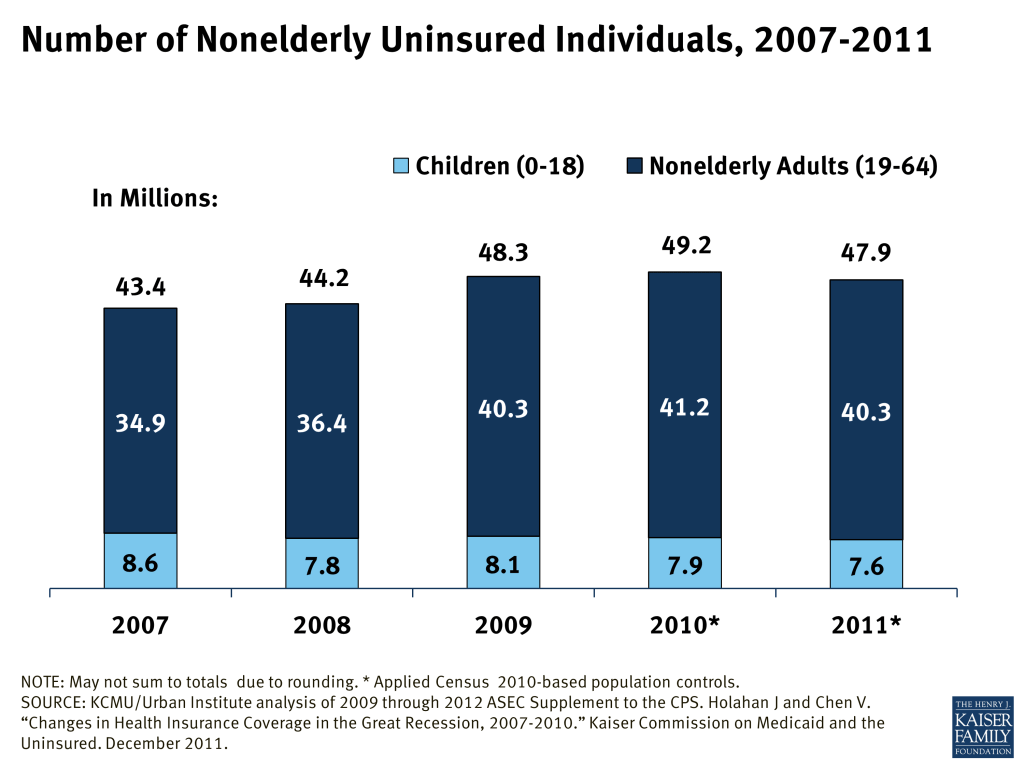
In 2011, almost 48 million nonelderly Americans were uninsured, amidst a slow economic recovery (Fig. 1). While public insurance covers many who would otherwise be uninsured, Medicaid and the Children’s Health Insurance Program (CHIP) do not reach all of those who cannot afford insurance. The 2010 Affordable Care Act (ACA) seeks to address the gaps in our private-public insurance system by expanding Medicaid, providing subsidized private coverage for individuals with incomes up to 400% of poverty, and reforming the health insurance marketplace.
Figure 1: Number of Nonelderly Uninsured Individuals, 2007-2011
During the recession that began in 2007, millions of people—primarily adults—lost insurance coverage and joined the ranks of the uninsured. The number of uninsured declined in 2011, the first decrease in four years. Still, 18% of the nonelderly population was uninsured in 2011, which puts their health and financial security at risk.
Why Are So Many Americans Uninsured?
Health insurance is expensive, and few people can afford to buy it on their own. Most Americans obtain health insurance coverage through an employer. However, not all workers have access to employer-sponsored coverage. Low-income workers—those at greatest risk of being uninsured—are less likely to be offered job-based coverage and less able to afford their share of the premiums than workers with higher incomes. The ACA includes additional employer incentives to provide affordable coverage.
Medicaid covers many low-income children, but coverage for adults is currently more limited. Parent income eligibility levels remain very low in many states, and unless they qualify through a disability eligibility pathway, adults without dependent children are not eligible for coverage in most states, regardless of their income. The ACA provides for an expansion of Medicaid for adults with incomes at or below 138% of poverty ($35,038 for a family of three in 2012). If all states implement the Medicaid expansion, eligibility would increase in nearly 40 states for parents and in nearly every state for other adults. If a state does not expand Medicaid, poor adult residents will be left out of coverage.
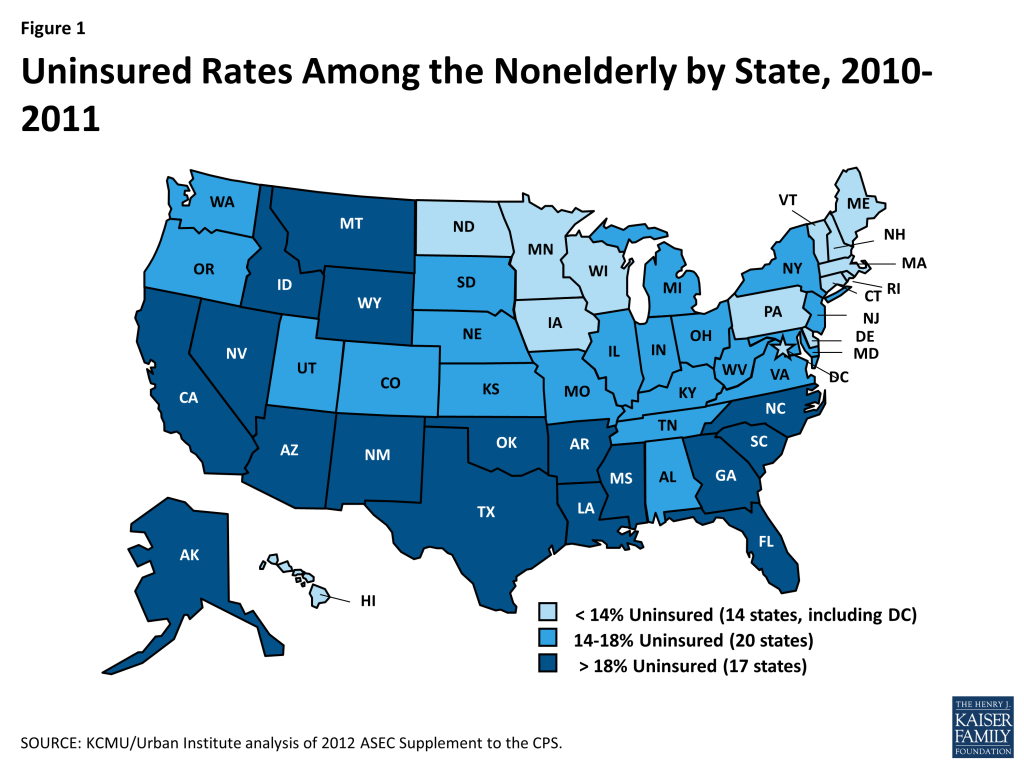
Figure 2: Uninsured Rates Among the Nonelderly by State, 2010-2011
The likelihood of being uninsured varies by state because of differences in employment, income, and public insurance programs’ eligibility levels (Fig. 2). Uninsured rates vary more than four-fold across states (ranging from 5% in Massachusetts to 27% in Texas), with states in the South and West having some of the highest uninsured rates.
What Explains the Trend in the Uninsured?
The recent recession and ongoing weak job market led to a steep rise in the uninsured between 2007 and 2010. This trend was driven by a decline in employer-sponsored coverage that resulted from the high jobless rate. In January 2011, the unemployment rate was 9.1%, close to double the rate in December 2007 when the recession began. Throughout 2011, the unemployment rate improved slightly. In the same year, the uninsured rate declined slightly, in part due to stability in employer-sponsored coverage.
Medicaid and CHIP have been crucial to preventing steeper drops in insurance coverage, as many Americans became newly eligible for these programs when their family income declined during the recession. These programs now cover 17.6% of the population under age 65 and have been key to protecting children from the full effects of the weak economy. The continued availability of public coverage amid these difficult fiscal times reflected provisions related to federal assistance that were continued in the ACA for states to maintain their Medicaid and CHIP eligibility levels until the broader coverage expansions go into effect.
Who Are the Uninsured?
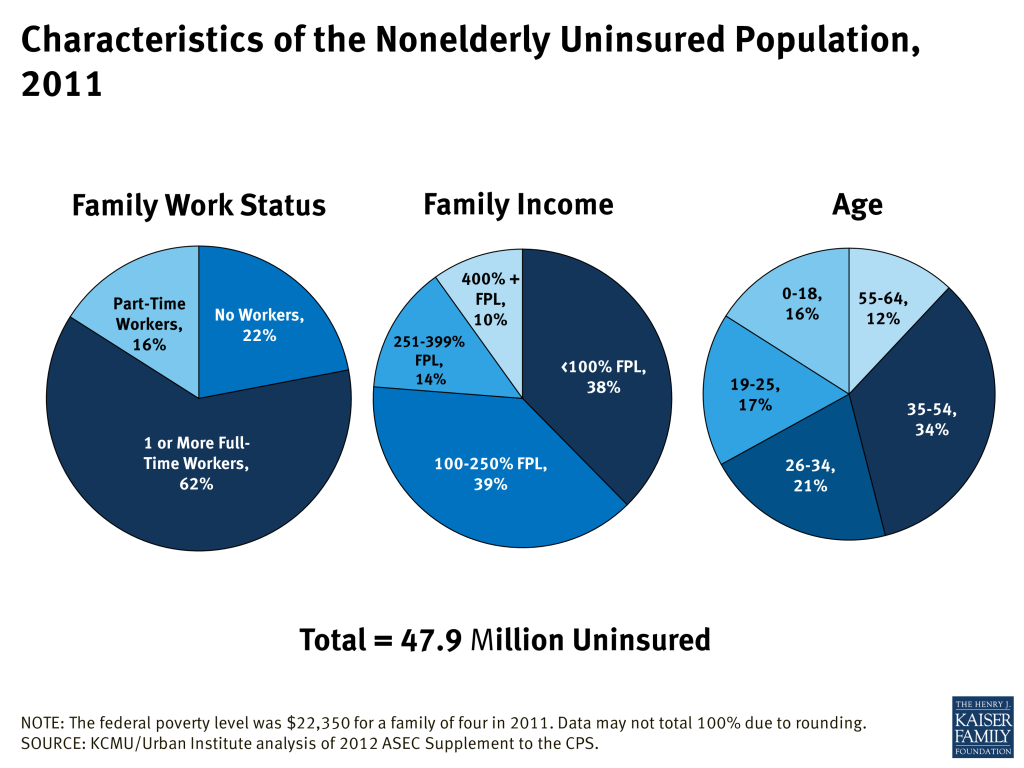
The majority of the uninsured are in working families. About six in ten of the uninsured have at least one full-time worker in their family and 16% have only part-time workers (Fig. 3). Uninsured workers are more likely than insured workers to have low-wage or blue-collar jobs and to work for small firms or in service industries.
Figure 3: Characteristics of the Nonelderly Uninsured Population, 2011
Low-income individuals make up a disproportionately large share of the uninsured. Close to 40% of the uninsured have family incomes below the federal poverty level ($22,350 a year for a family of four in 2011). Nine in ten of the uninsured have family incomes below 400% of poverty and could receive Medicaid or subsidized coverage under the ACA.
Aside from the elderly, who are almost all covered by Medicare, the uninsured population is composed of all age groups. Recently, the uninsured rate among young adults has improved slightly due in part to the ACA provision allowing them to remain on a parent’s private health plan until age 26. However, young adults continue to have one of the highest uninsured rates among the age groups. Children have the lowest uninsured rate, and nearly two-thirds of uninsured children are eligible for Medicaid or CHIP.
What Difference Does Health Insurance Make?
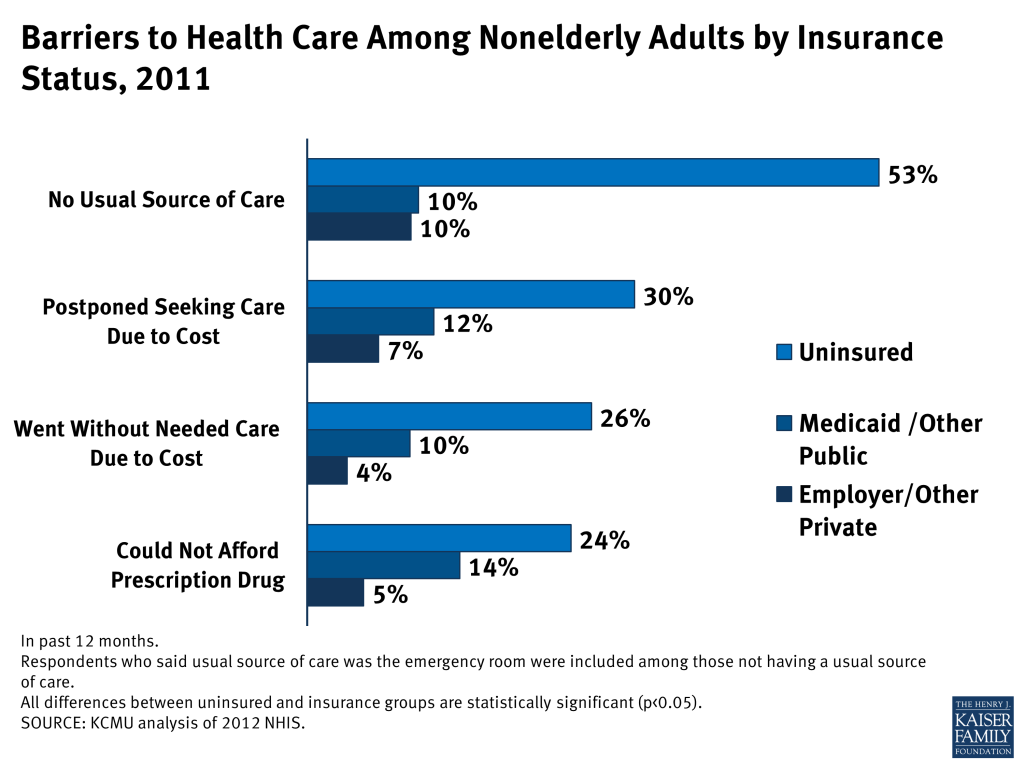
Health insurance affects access to health care as well as a person’s financial well-being. Over half of uninsured adults have no regular source of health care to go to when they are sick. Worried about high medical bills, they are more than twice as likely to delay or forgo needed care as the insured (Fig. 4).
Figure 4: Barriers to Health Care Among Nonelderly Adults by Insurance 2011
The safety net of community clinics and public hospitals is unable to fully substitute for the access to care that insurance provides. Research has established that extending coverage to the uninsured improves physical and mental health, reduces mortality rates, and ameliorates financial strain associated with health care costs.
Delaying or forgoing needed care can lead to health problems, making the uninsured more likely to be hospitalized for avoidable conditions. The uninsured are less likely than those with insurance to receive preventive care and services for major health conditions and chronic diseases—and as a result, many suffer serious consequences.
The cost of health care has grown in the past decade, but represents a particular challenge for those without insurance. Medical bills can put great strain on the uninsured and threaten their physical and financial well-being. Almost half of uninsured individuals reported having trouble paying medical bills, compared to less than one in four individuals with coverage. In addition, the uninsured are three times more likely than the insured to be unable to pay for basic necessities because of their medical bills.
The Uninsured and Health Reform
The ACA addresses barriers to acquiring insurance coverage through expanded access to Medicaid, subsidies for private insurance, and health insurance market reforms. The majority of the coverage expansions in the ACA will take effect in 2014, at which point, there will be a requirement that individuals have health insurance coverage. The law will also prevent insurers from rejecting individuals or charging higher premiums based on health status. By 2016, the ACA is estimated to decrease the number of uninsured by nearly half, leaving far fewer individuals facing the health and financial risks that come with being uninsured.
This poll, conducted as the GOP prepares for its national convention, finds that the Affordable Care Act is not the top health care priority among Republicans. While jobs are still the number one issue for Republicans, when asked about the health care issues that will impact their vote this fall, Republicans’ top concern was the cost of health care and insurance, named by two-thirds (67%) as either “extremely” or “very important” to their vote in Kaiser’s August Health Tracking Poll. Next on the list was Medicare, cited by six in ten Republicans (61%) as being important to their vote, while the 2010 health care law ranked third, at 54 percent. Most interviews in the August 7-12 poll were conducted before Governor Mitt Romney announced Representative Paul Ryan as his running mate on August 11th, which has led to a greater focus on Medicare in the news.
When it comes to Medicare, another recent Kaiser survey, conducted in partnership with The Washington Post and fielded from July 25 to August 5, finds that among Republicans a majority (55%) prefer the idea of keeping Medicare as it is rather than changing to a system in which seniors are guaranteed a fixed amount of money that could be used to purchase coverage “either from traditional Medicare or from a list of private plans.” Both Romney and Ryan have proposed converting Medicare into a premium support program, with the House Republican budget plan spearheaded by Ryan calling for such a change to begin in 2023.
Even though more than four in ten Republicans (44%) say they don’t yet have a “basic understanding” of what Governor Romney is proposing to do on health care if elected president, a majority (79%) believe his approach to health care would be different than that of President Barack Obama. And 80 percent of Republicans say they trust Romney to make the “right decisions” about the future of the ACA.
The August poll is the latest in a series designed and analyzed by the Foundation’s public opinion research team.