KFF designs, conducts and analyzes original public opinion and survey research on Americans’ attitudes, knowledge, and experiences with the health care system to help amplify the public’s voice in major national debates.
Seniors' Knowledge and Experience With Medicare's Open Enrollment Period and Choosing a Plan: Key Findings from the Kaiser Family Foundation 2012 National Survey of Seniors
These key findings from the Foundation’s 2012 National Survey of Seniors relate to seniors’ knowledge and experience with Medicare’s open enrollment period and choosing a plan.
The survey finds one in four seniors say they are unaware of this annual opportunity to review and change their Medicare coverage, with even larger shares who say they are unaware of Medicare’s open enrollment period among blacks and Hispanics and those seniors in fair or poor health, with low incomes, and without a high-school diploma.
Medicare’s 2013 open enrollment period runs from October 15 through December 7. During this time, the Medicare program encourages beneficiaries to review their benefits and coverage options, including traditional Medicare, private Medicare Advantage plans, and Medicare Part D prescription drug plans.
Designed and analyzed by Foundation researchers, the survey was conducted this summer among a nationally representative, non-institutionalized sample of 2,031 seniors, with a margin of error of plus or minor 3 percentage points for results based on the full sample.
Insurers pursue multiple strategies to reduce the cost of covering enrollees with pre-existing conditions, or medical conditions and health problems that existed before the individual enrolled in a health plan. One strategy, the pre-existing condition exclusion, allows insurers to refuse to cover any costs associated with care for a pre-existing condition permanently or over a period of time.
Beginning January 1, 2014, insurers in the individual and group markets will be prohibited from imposing pre-existing condition exclusions under the Affordable Care Act. This new fact sheet provides an overview of how pre-existing condition exclusions are regulated under current law, and how the ACA will change those regulations in 2014, enabling consumers to access necessary benefits and services beginning from their first day of coverage.
The October Health Tracking Poll finds, one week before the presidential election, the economy remains the primary concern on voters’ minds, but health policy issues remain in the mix.
The new survey finds that roughly a third of likely voters name the Affordable Care Act (37%), Medicare (36%), and Medicaid (30%) as “extremely important” to their vote, compared to half (52%) who say the same about the economy and jobs. But separate health care issues stand out for different groups. For Democratic voters, Medicare (43%), Medicaid (43%), and the ACA (41%) all share the top spot with the economy (43%). The economy is the winner (67%) for Republican voters, with the most important health issue, the ACA (49%), ranking third behind the deficit (58%). And senior voters prioritize Medicare (50%), coming in a close second to the economy (54%).
Six in ten likely voters (61%) continue to oppose the idea of changing Medicare to a premium support system, in which the government would guarantee each senior a fixed amount of money to help them purchase coverage either from traditional Medicare or from private insurers. Senior voters are the most likely to oppose switching to premium support: 72 percent prefer keeping Medicare as is, compared to 58 percent of likely voters under 65.
Yet opinion against the Medicare premium support idea – which GOP nominee Governor Mitt Romney backs and President Barack Obama opposes – does not appear to have translated into an advantage with seniors for the president when it comes to Medicare. The poll finds that senior voters are just as likely to pick Governor Romney as President Obama when asked which candidate “would do a better job of determining the future of the Medicare program” (48% Governor Romney, 43% President Obama, a difference that is not statistically significant).
As the election approaches, President Obama’s edge on several key health issues appears to be narrowing, following the general tightening in the polls. While the president continues to hold a large advantage on women’s health, his double digit lead in September on the ACA, health costs and Medicaid is now in the single digits (in the range of 7 to 8 percentage points) and his edge on Medicare is now a draw, with 46 percent of likely voters saying they trust President Obama on Medicare and 41 percent Governor Romney.
Meanwhile, the public’s views on the Affordable Care Act continue to be deeply divided, with 38 percent of Americans having a favorable view of the law and 43 percent an unfavorable one. The law appears to be motivating opponents and supporters about equally: Likely voters with favorable views are just as likely as those with unfavorable views to say the ACA will be “extremely important” in their vote choice (39% and 38%, respectively).
The October poll is the latest in a series designed and analyzed by the Foundation’s public opinion research team.
This analysis of the House Budget Plan that was passed in 2012 finds that repealing the Affordable Care Act (ACA) and converting Medicaid to a block grant would trigger significant decreases in federal Medicaid spending and could result in substantial reductions in enrollment and payments to providers compared to current projections. The analysis, conducted by the Urban Institute for the Kaiser Family Foundation’s Commission on Medicaid and the Uninsured, updates a similar study from May 2011, which analyzed the House Budget Plan that passed that year. The new analysis provides national and state-by-state estimates of the impact of the 2012 House plan on federal spending, enrollment, states and providers. The reductions in federal spending for Medicaid would likely lead to increases in the number of Americans without health insurance and strain the safety net, even with additional flexibility for states to administer their programs.
Medicaid Today; Preparing for Tomorrow: A Look at State Medicaid Program Spending, Enrollment and Policy Trends Results from a 50-State Medicaid Budget Survey for State Fiscal Years 2012 and 2013
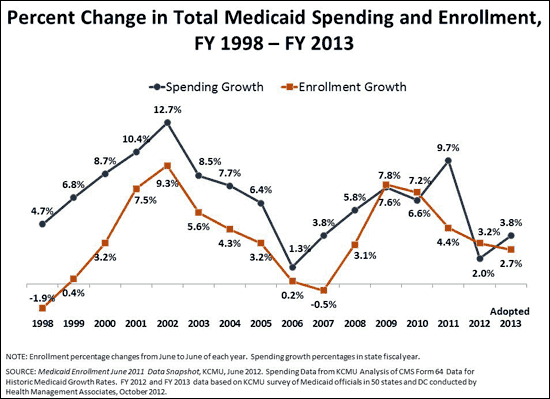
After the worst economic downturn since the Great Depression, state policy makers were finally beginning to see signs of economic recovery at the end of state fiscal year (FY) 2012 and heading into FY 2013. Growth in total Medicaid spending and enrollment slowed substantially in FY 2012 as the economy began to improve. Relatively slow spending and enrollment growth are expected to continue in FY 2013.
Cost pressure and cost containment were still dominant themes, but states were also able to consider program changes, payment and delivery system reforms and continue efforts to re-orient long-term care programs to community-based care models. Eligibility rules for Medicaid remained stable due to the maintenance of eligibility (MOE) protections that were part of health reform legislation, and a number of states adopted targeted eligibility expansions or simplified enrollment procedures.
States are also preparing for the new role for Medicaid in the implementation of the Affordable Care Act (ACA). Under the June 2012 Supreme Court ruling, the Secretary’s authority to enforce the ACA Medicaid expansion requirement is limited, and state policy makers will decide whether or when to implement the Medicaid expansion.
The findings in this report are drawn from the 12th consecutive year of the Kaiser Commission on Medicaid and the Uninsured (KCMU) and Health Management Associates (HMA) budget survey of Medicaid officials in all 50 states and the District of Columbia. This survey reports on trends in Medicaid spending, enrollment and policy initiatives for FY 2012 and FY 2013. The report describes policy changes in reimbursement, eligibility, benefits, delivery systems and long-term care, as well as detailed appendices with state-by-state information, and a more in-depth look through four state-specific case studies of the Medicaid budget and policy decisions in Massachusetts, Ohio, Oregon and Texas.
This report from the Kaiser Family Foundation analyzes the effect of government efforts to ensure that insurance premium increases are justifiable and provide value to consumers and small businesses. Rate review programs require insurers in the small group and individual markets to submit proposed rate increase requests to state or federal regulators, who determine if the requests are reasonable. The report finds that one out of every five requests submitted to states in 2011 resulted in a lower rate increase or no increase at all. On average, approved rate increases were 1.4 percentage points lower than insurers initially requested, a reduction of about one-fifth.
Under the Affordable Care Act (ACA), all insurers requesting rate increases of 10% or more are subject to rate review programs as of September 1, 2011. If a state does not have an effective rate review program, the federal government conducts the reviews, though it does not have the authority to prevent insurers from implementing “unreasonable” rates. While many states had rate review programs in place before the ACA passed in 2010, early evidence suggests that insurers have made fewer requests to raise rates by 10% or more after the health reform law’s rate review provisions went into effect.
Women’s health has been a key issue in the 2012 election with the candidates, President Barack Obama and former Massachusetts Governor Mitt Romney, having different views on women’s health care. This brief discusses two major health care issues that are important to women – health coverage and reproductive health care – and summarizes the presidential candidates’ stated positions on these topics.
Massachusetts is the first state to finalize a memorandum of understanding (MOU) with the Centers for Medicare and Medicaid Services (CMS) to test CMS’s capitated financial alignment model for beneficiaries who are dually eligible for Medicare and Medicaid, with enrollment beginning on April 1, 2013. Starting in 2013, CMS will implement a three-year multi-state demonstration to test new service delivery and payment models for people who are eligible for both federal health programs. Massachusetts’ demonstration is unique among the state proposals for its focus on full dual eligible beneficiaries ages 21 to 64 and its required Independent Living-Long Term Services and Support (LTSS) Coordinators from community-based organizations independent of the demonstration health plans. This policy brief summarizes the MOU terms in the several key areas, including enrollment, care delivery model, benefits, financing, beneficiary protections and monitoring and evaluation.
Washington, D.C. – Growth in total Medicaid spending and enrollment slowed substantially in state fiscal year 2012 as the economy began to improve and states continued to work to control costs. Relatively slow spending and enrollment growth are expected to continue in FY 2013, according to the 12th annual 50-state Medicaid budget survey by the Kaiser Family Foundation’s Commission on Medicaid and the Uninsured, conducted with Health Management Associates.
Total Medicaid spending increased 2 percent on average across all states in FY 2012, down from 9.7 percent in FY 2011 and among the lowest rates of spending growth ever recorded (in 2006, spending grew by 1.3 percent). A slowly improving economy helped to moderate growth in Medicaid enrollment, which grew at an average 3.2 percent rate across states, down from 4.4 percent a year earlier. State responses to the increase in the state share of Medicaid spending with the end of enhanced federal funding through the American Recovery and Reinvestment Act (ARRA) in June 2011 likely contributed to the spending slowdown as states stepped up cost control efforts.
“After several economically depressed years in which high demand for public programs and slumping tax revenue created intense pressure on state Medicaid programs, last year saw total Medicaid spending growth hit a near record low,” said Diane Rowland, Executive Vice President of the Kaiser Family Foundation and Executive Director of the Foundation’s Commission on Medicaid and the Uninsured. “Reining in costs remains the dominant theme, but the improving economy has offered states more leeway to move forward on delivery system reforms and implementation of the Affordable Care Act.”
For FY 2013, states expect Medicaid enrollment to grow at an even slower rate than this year, 2.7 percent on average, the survey finds. Legislatures have authorized total Medicaid spending growth, including both state and federal shares, of 3.8 percent on average across states for FY 2013. While higher than this year, that would still represent one of the lowest rates of growth in Medicaid spending. State-only Medicaid spending is expected to grow by 2.3 percent in FY 2013, slower than total Medicaid spending growth, and much more slowly than in FY 2012, when states confronted the end of the enhanced federal funds under ARRA.
Other key survey findings include:
Curbing costs remains a strong focus. In FY 2012, 48 states implemented at least one new policy to control Medicaid costs, and 47 planned to do so in FY 2013. Provider rate restrictions were the most commonly reported cost containment strategy. However, with some improvement in the economy, some states were able to restore cuts or make targeted efforts in FY 2013 to boost provider rates and benefits. States also continue to expand community-based long term care through both traditional programs and also new options in the Affordable Care Act (ACA).
Medicaid programs are engaged in a range of delivery system changes. Twenty states reported expanding their use of managed care in FY 2012, and over two-thirds of states plan to do so in FY 2013. In addition to managed care, states are moving ahead with care coordination strategies for persons with chronic conditions, including those dually eligible for Medicare and Medicaid, using health homes, patient-centered medical homes and other ways to improve care and outcomes.
States continue to move ahead with efforts to implement the ACA. Nearly every state is in the process of upgrading eligibility systems. States are also making decisions about what type of Health Insurance Exchange will operate in their state as well as how to proceed with the Medicaid expansion. The recent Supreme Court decision effectively made the ACA’s Medicaid expansion optional for states, and for many states decisions about the expansion will hinge on the outcome of the elections in November as well as evaluations of the fiscal, political and health coverage impact of undertaking the expansion. States will also be watching to see if debate about federal deficit reduction results in reductions in federal financing or major structural changes to Medicaid.
The new survey, Medicaid Today; Preparing for Tomorrow: A Look at State Medicaid Program Spending, Enrollment and Policy Trends: Results from a 50-State Medicaid Budget Survey for State Fiscal Years 2012 and 2013, is available online.
The Kaiser Family Foundation, a leader in health policy analysis, health journalism and communication, is dedicated to filling the need for trusted, independent information on the major health issues facing our nation and its people. The Foundation is a non-profit private operating foundation, based in Menlo Park, California.The Kaiser Commission on Medicaid and the Uninsured provides information and analysis on health care coverage and access for the low-income population, with a special focus on Medicaid’s role and coverage of the uninsured. Begun in 1991 and based in the Kaiser Family Foundation’s Washington, D.C. office, the Commission is the largest operating program of the Foundation. The Commission’s work is conducted by Foundation staff under the guidance of a bipartisan group of national leaders and experts in health care and public policy.
This data note reviews years of polling dating to 1995 to gauge public opinion on proposals to change Medicare to a premium support system, an idea embraced by GOP presidential nominee Governor Mitt Romney and rejected by President Obama. Under the proposed change, the federal government would provide people on Medicare a fixed amount of money that could be applied toward the cost of health insurance purchased either from private insurers or the traditional Medicare program. The data note outlines historical trends in public opinion on the issue, reviews recent results and examines possible reasons for variation in the findings of different polls.