Kaiser Health Tracking Poll: February 2013
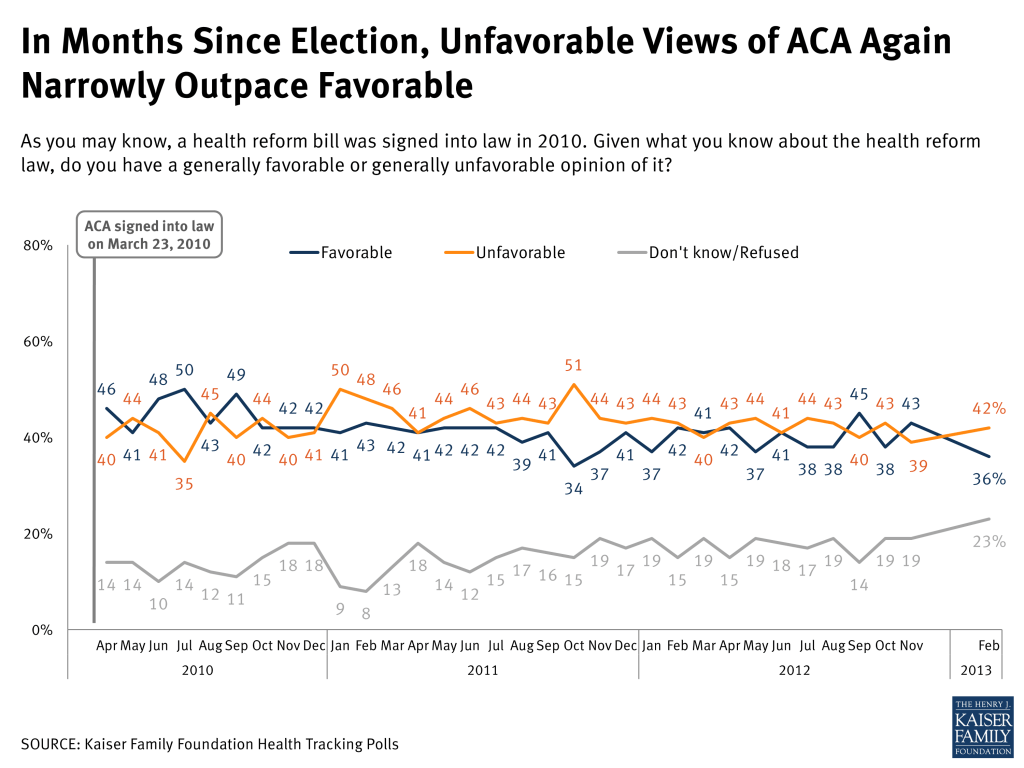
The February Kaiser Health Tracking Poll focuses on some of the health policy implications of this winter’s national debate over gun violence, gun control and the adequacy of the nation’s response to the needs of those living with serious mental illness. The survey finds that one in five Americans have some connection to a victim of gun violence, a share that doubles to 42 percent among blacks. Worry about becoming a victim is even more widespread among the public (four in ten are at least somewhat worried) and again is strikingly high among members of minority groups (62 percent of blacks express concern, as do 75 percent of Hispanics). When it comes to mental health issues, most Americans perceive that those with serious mental illness experience at least some discrimination or prejudice in U.S. society, even as many say they themselves would be uncomfortable living or working near someone with severe mental health issues. The majority of the public backs the idea having equal benefits for mental health coverage; fewer than half (38 percent) recognize mental health parity is already law. With one in four adults estimated1 to suffer from a mental health problem, the poll finds that just shy of one in ten Americans report having had trouble getting access to the mental health services they need. Finally, the February survey checked in on opinion toward the Affordable Care Act (ACA), which tilted negative in this poll: 42 percent unfavorable, 36 percent favorable, and 23 percent with no opinion, the latter a new high in Kaiser polling. As the national debate on immigration reform picks up speed, the survey finds four in ten Americans wrongly believe that the ACA offers benefits to undocumented immigrants, and another quarter are not sure how undocumented immigrants are treated under the law. The majority of the public says that if lawmakers did pass a law allowing some undocumented immigrants to apply for provisional legal status, those who obtain this status should have full access health coverage options provided by the ACA. However, it is worth noting that, today, many lawfully present immigrants face restrictions that limit their eligibility for health coverage.
ACA Update: Public Opinion Back to a Negative Title in Early 2013
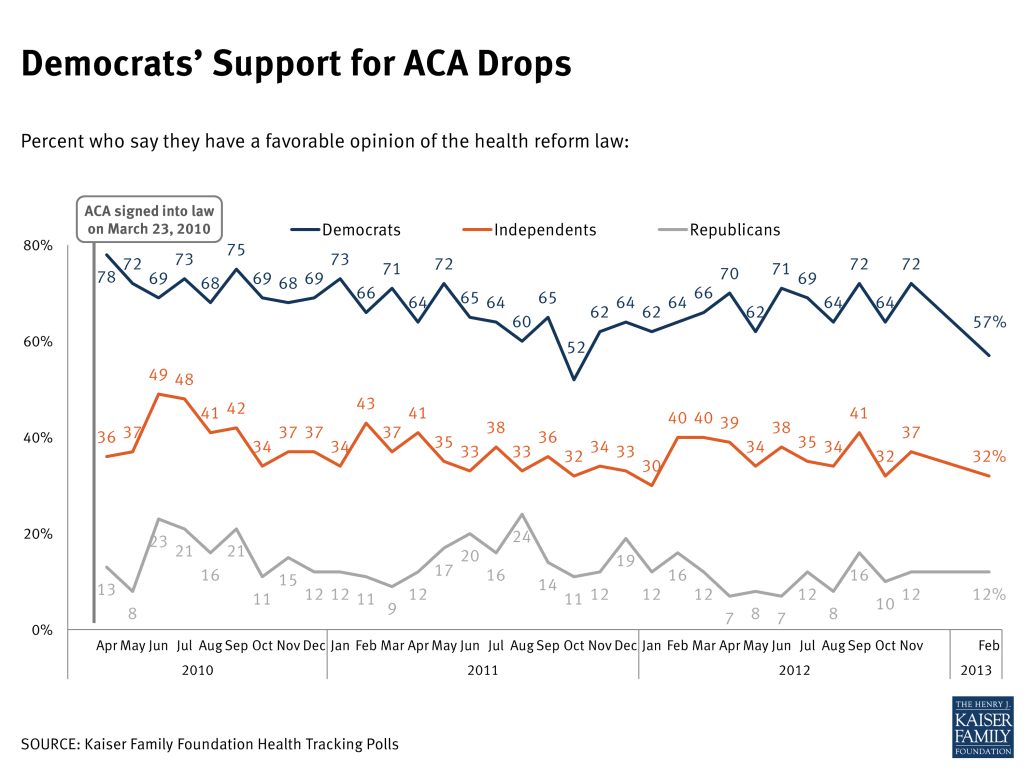
The February Kaiser Health Tracking Poll finds the public leaning negative on the Affordable Care Act (ACA), with 42 percent holding unfavorable views and 36 percent favorable, a seven percentage point drop in favorability driven primarily by a post-election fade in support among Democrats. With the presidential election in the rearview mirror and the ACA largely out of the national political spotlight, the share of Democrats backing the law dropped from 72 percent in November to 57 percent, closer to October levels. Democrats’ support for the law, like the public’s overall, wobbles up and down within a relatively narrow band month by month, and it’s difficult to say whether this downward drop will last. Support seems to have shifted to the no opinion category, up to nearly a quarter (23 percent), a new high in Kaiser polling.
How does the public form their opinion of the ACA? The plurality of Americans (45 percent) say they have based their impression of the law mainly on what they’ve seen in the media. Two in ten (22 percent) say their own experience has been the primary driver of opinion and 14 percent say their views are primarily based on what they’ve learned from friends and family.
As Immigration Debate Gains the Spotlight, Four in Ten Americans Believe the ACA Provides Benefits to Undocumented Immigrants
Over the nearly three years of its existence as law, there have been a number of hard-to-dispel misimpressions about the ACA, and as Congress’ attention turns to immigration reform, the February tracking poll returned to one of these regarding undocumented immigrants. The survey finds that four in ten Americans – including more than half of Republicans – wrongly believe undocumented immigrants will have access to benefits under the health law and another quarter say they aren’t sure whether this is fact or fiction.
| FIGURE 3: HOW MANY AMERICANS RECOGNIZE ACA DOESN’T COVER UNDOCUMENTED IMMIGRANTS? | ||||
| By Party ID | ||||
| To the best of your knowledge, would you say the health care law does or does not… | Total | Dem | Ind | Rep |
| …allow undocumented immigrants to receive financial help from the government to buy insurance | ||||
| Yes | 42% | 31% | 46% | 54% |
| No (correct answer) | 35 | 46 | 32 | 27 |
| Don’t know/Refused | 23 | 23 | 23 | 19 |
| …allow undocumented immigrants to enroll in Medicaid program | ||||
| Yes | 42% | 35% | 43% | 52% |
| No (correct answer) | 35 | 43 | 36 | 24 |
| Don’t know/Refused | 23 | 22 | 22 | 23 |
The onset of the immigration debate has also spurred policy discussions over whether undocumented immigrants that could potentially obtain some new form of provisional legal status through immigration reform legislation would be eligible for health coverage options under the ACA. Current immigration reform proposals suggest that individuals granted this provisional lawful status may not be eligible for federal benefits, including health coverage. At first blush, at least, the majority of Americans hold a different opinion: six in ten say that undocumented immigrants who obtain provisional legal status should be able to enroll in Medicaid if their income is low enough to qualify (63 percent) or receive subsidies to purchase insurance in the exchanges if they don’t get affordable insurance through their employer (59 percent). However, it is worth noting that, under current law, many lawfully present immigrants are subject to eligibility restrictions for health coverage, including Medicaid and the Children’s Health Insurance Program (CHIP), that remain in place under the ACA.2
| FIGURE 4: MAJORITY SAY IF UNDOCUMENTED IMMIGRANTS OBTAIN PROVISIONAL LEGAL STATUS, THEY SHOULD BE ELIGIBLE FOR ACA BENEFITS | |||||||
| By Party ID | By Race | ||||||
| Do you think undocumented immigrants who obtain provisional legal status should be eligible to… | Total | Dem | Ind | Rep | White | Black | Hispanic |
| …enroll in the Medicaid program if their income is low enough to qualify | |||||||
| Yes, should be eligible | 63% | 77% | 60% | 45% | 56% | 77% | 86% |
| No, should not be eligible | 33 | 21 | 36 | 51 | 41 | 21 | 10 |
| …receive financial help from the government to buy health insurance if they don’t get it through their job | |||||||
| Yes, should be eligible | 59% | 75% | 55% | 41% | 50% | 78% | 83% |
| No, should not be eligible | 38 | 23 | 41 | 56 | 47 | 21 | 13 |
Support for extending access to health coverage options does differ by party, with majorities of Democrats and independents saying they are in favor of providing this group with coverage options available to citizens under the ACA, while Republicans tilt negative on the proposal. Majorities in each major racial and ethnic group support the extension of benefits, with a larger degree of support among Hispanics and blacks.
One In Five Americans Know A Victim Of Gun Violence; Worry Reaches Even More Broadly
Spurred by the tragic mass shootings in Newtown, CT and Aurora, CO in 2012, gun control has also emerged as a political hot topic this year. While a number of polls have measured the public’s attitudes towards the policy options being put on the table, this month’s Health Tracking Poll measures the public’s personal experiences with, and worries about, gun violence.
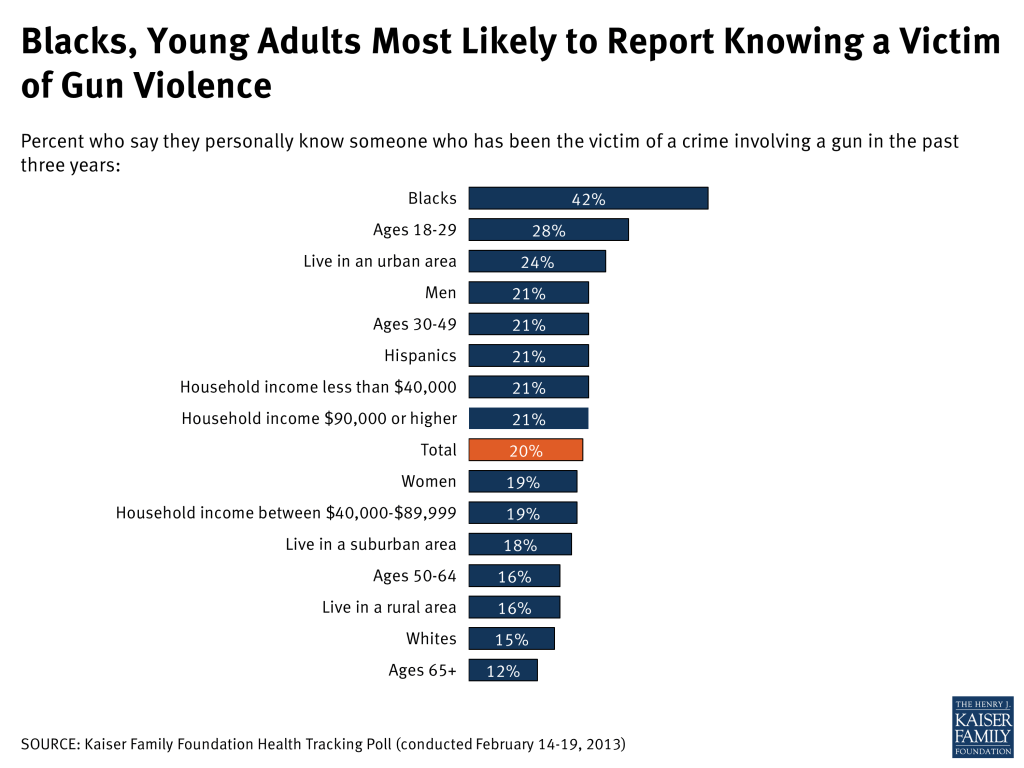
One in five Americans say they personally know someone who was a victim of gun violence in the last three years, and for most of these individuals the connection is close. Among those who know a victim, a majority (62 percent) say these were good friends or family members, and some were even a victim themselves.Blacks stand out as the group most likely to know someone who was affected (42 percent do), followed by younger Americans (28 percent of those aged 18 to 29).
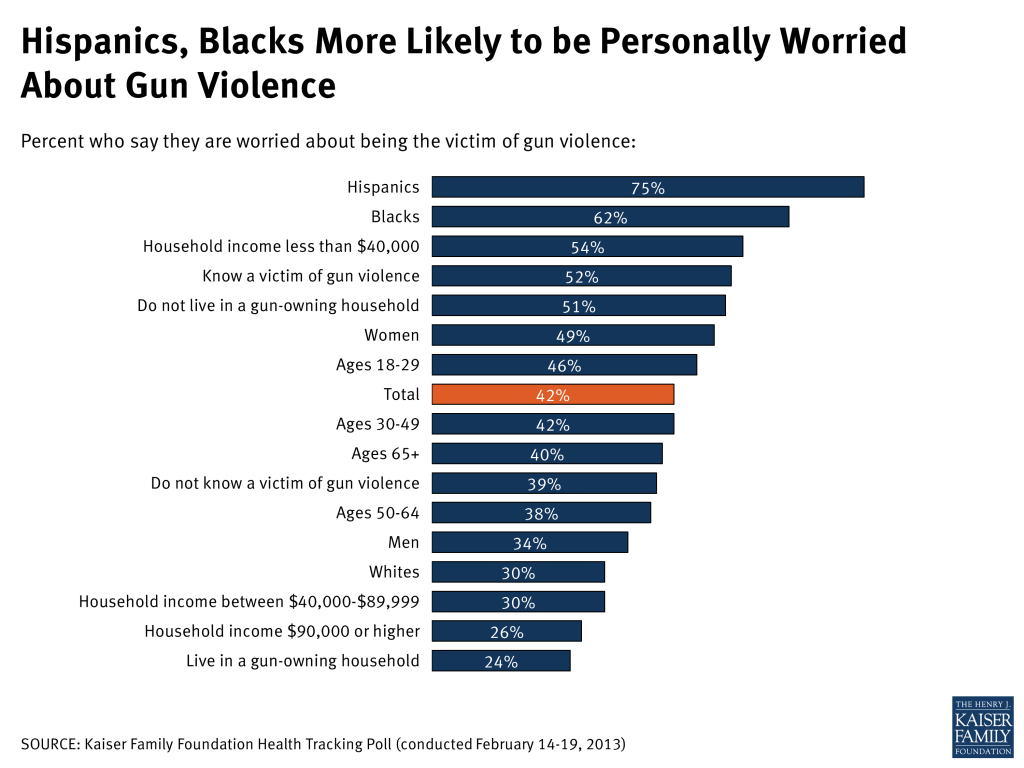
Worry about gun violence reaches even more broadly, encompassing many who have not personally been touched by a gun-related crime. Overall, four in ten Americans (42 percent) say they are at least somewhat worried about being the victim of gun violence. Again, members of minority groups are particularly likely to report concern. Also disproportionately likely to be harboring worries are individuals with lower incomes, those who know a victim of gun violence, and those whose households do not have a gun. Least likely to be worrying about gun violence: individuals who live in a gun-owning household.
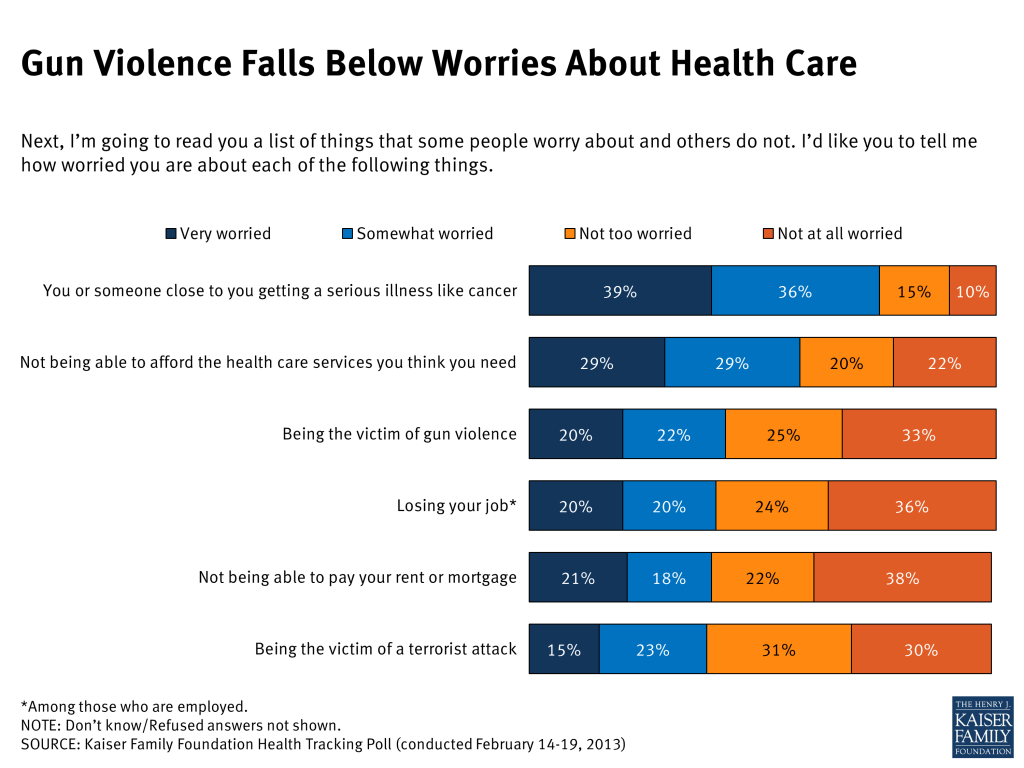
To keep this concern in context, it’s worth noting that other health-related worries do outstrip those about being a victim of gun violence. Considerably more, for example, are worried about someone close to them getting seriously ill (75 percent) or affording necessary health care (58 percent). But this ranking is driven by gun violence being a significantly lower concern among whites. Among both blacks and Hispanics, concern about gun violence ranks a clear and close second, behind only concerns about becoming seriously ill, and evenly tied with concerns about affordability of health care.
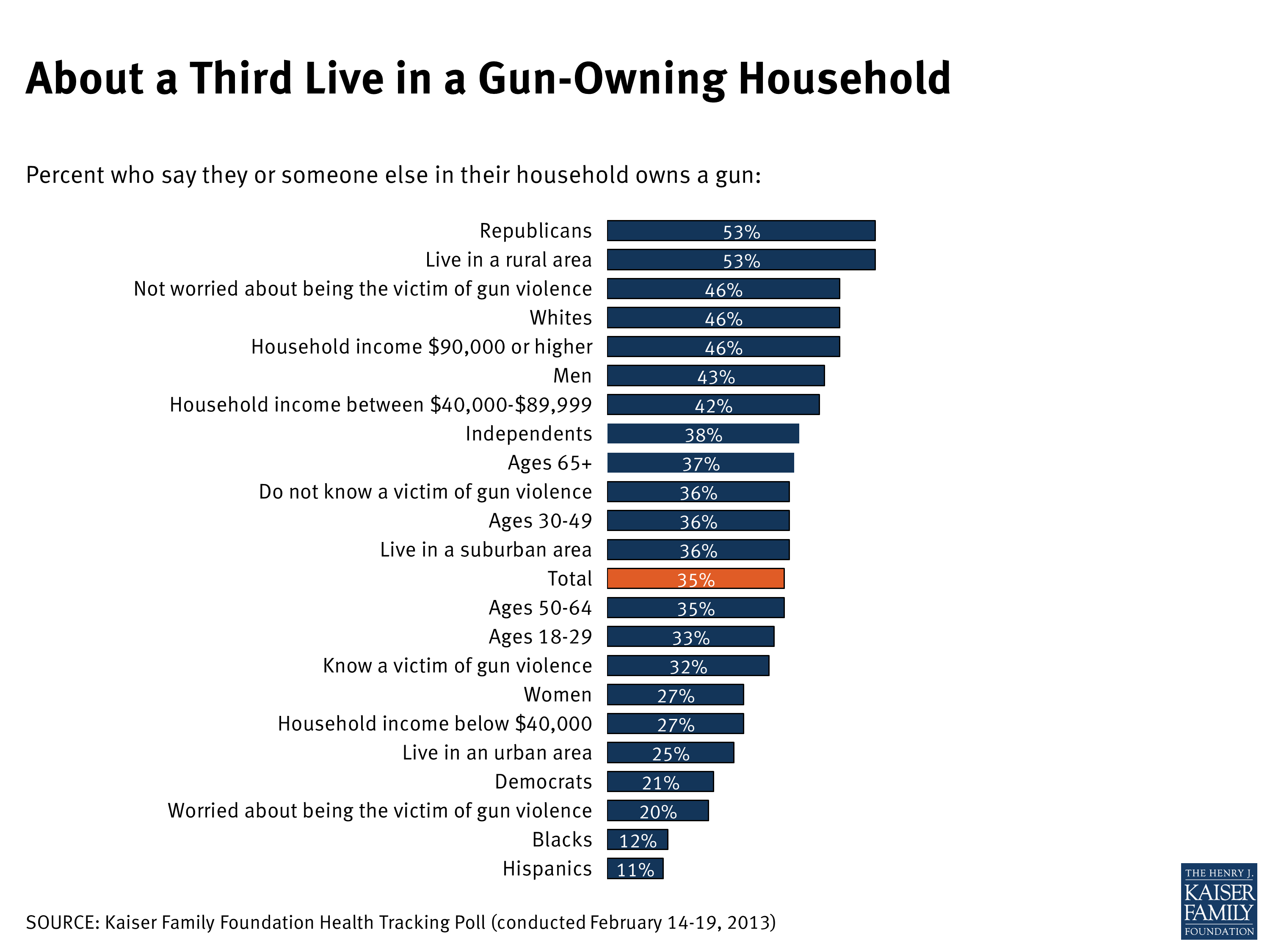
A THIRD REPORT HAVING GUNS IN THEIR HOUSEHOLDA third of Americans (35 percent) say they live in a household that has a gun. This number is higher among Republicans and those who live in rural areas, of whom half live in a gun-owning household (53 percent). Whites and those with high- incomes are also more likely to report living in a gun-owning household (46 percent).
Guns Still An Important Aspect Of American Life
Despite experience with, and worries about, gun violence, guns remain a widespread aspect of American life, for some a way to feel safer in a society where such violence is a daily event. Overall, about a third of adults say they live in a gun-owning household [see pull-out section above], and as noted above, this group is less likely than non-gun owners to worry about being a victim of a gun-related crime. When those living in non-gun households are asked whether they would feel safer if they owned a gun, the majority say a gun wouldn’t make much difference to their feelings of safety, either inside or outside the home. But more than one in five in this group say that a gun would make them feel safer, while one in six say it would make them feel less safe. Most non-gun owners whose lives have been touched by gun violence report that the experience did not cause them to consider buying a gun.
| FIGURE 8: MAJORITY OF NON-GUN OWNERS SAY OWNING FIREARM WOULD MAKE NO DIFFERENCE TO FEELINGS OF SAFETY | |||
| AMONG THOSE LIVING IN NON-GUN HOUSEHOLDS: Do you think owning a gun would make you feel safer, less safe, or make no difference in how safe you feel… | Safer | Less safe | No difference |
| …at home | 25% | 16% | 58% |
| …outside of your home | 22 | 14 | 62 |
A Majority Of Americans Unaware Law Requires Mental Health Parity
The mass shooting at Sandy Hook Elementary School perpetrated by a disturbed 20-year old man has also increased the national dialogue surrounding the role of the mental health care system in averting similar tragedies. In light of this, we took a closer look at Americans’ experience accessing mental health care, their views on mental health parity, and the extent to which they perceive discrimination against those with serious mental illnesses.
| FIGURE 9: MAJORITY OF DEMOCRATS AND REPUBLICANS FAVOR EQUIVALENT BENEFITS FOR MENTAL HEALTH SERVICES | ||||||
| By Insurance Status (among those under age 65) | By Party ID | |||||
| Do you favor or oppose the federal government requiring insurance companies to offer benefits for mental health and substance abuse services that are equivalent to benefits for other medical services? | Total | Insured | Uninsured | Dem | Ind | Rep |
| Favor | 75% | 77% | 79% | 83% | 75% | 64% |
| Oppose | 21 | 20 | 19 | 12 | 22 | 31 |
Overall, most Americans (75 percent) say they favor “requiring insurance companies to offer benefits for mental health and substance abuse services that are equivalent to benefits for other medical services.” And this idea is widely popular, with majority support across age, race, insurance status, and even political party. At the same time, fewer than four in ten Americans (38 percent) are aware that there is a federal requirement (as part of the Mental Health Parity and Addiction Equity Act of 20083 that certain health plans providing mental health benefits have the same rules regarding copays, deductibles and coverage limits for those benefits as for other medical services. Just as many Americans (40 percent) currently believe insurance plans can have separate rules for mental health benefits, and another 22 percent aren’t sure of what the status is.
Uninsured More Likely To Report Problems Getting Mental Health Care, Most Common Reason Being Cost
Overall, roughly one in ten Americans (8 percent) say someone in their household has had problems getting needed mental health care in the last year, a proportion that rises to two in ten (20 percent) among those currently without health insurance. The most common barrier among those who reported having problems getting mental health care was cost, followed by insurance coverage issues and confusion over where to go for such care. Least commonly expressed reasons were that people were afraid or embarrassed to seek help. Among households that have had experience in the mental health care system, a quarter (25 percent) report that they’ve faced problems getting needed services.
| FIGURE 10: PROBLEMS ACCESSING MENTAL HEALTH CARE | |||
| In the past 12 months, have you or another family member living in your household had problems getting mental health care, or not? Was each of the following a reason you or your family member had problems getting mental health care, or not? | Total | Among those who live in a household where someone received mental health care | Among those under age 65 and uninsured |
| Yes, had problems getting mental health care | 8% | 25% | 20% |
| Because you couldn’t afford the cost | 6 | 18 | 17 |
| Because your insurance wouldn’t cover it | 4 | 13 | 9 |
| Because you or your family member didn’t know where to go to get care | 3 | 10 | 5 |
| Because you or your family member were afraid or embarrassed to seek care for a mental health problem | 1 | 3 | 2 |
| No, have not had problems getting mental health care | 91 | 75 | 80 |
Public Says Discrimination Against People With Serious Mental Illness Is Common, Many Hold Potentially Stigmatizing Attitudes
A large majority of Americans believe that people with serious mental health issues experience discrimination. Overall, 76 percent say these individuals experience at least some prejudice or discrimination, higher than the share who say the same for minorities, women, and people with disabilities. Immigrants are the only group towards which Americans perceive more discrimination.
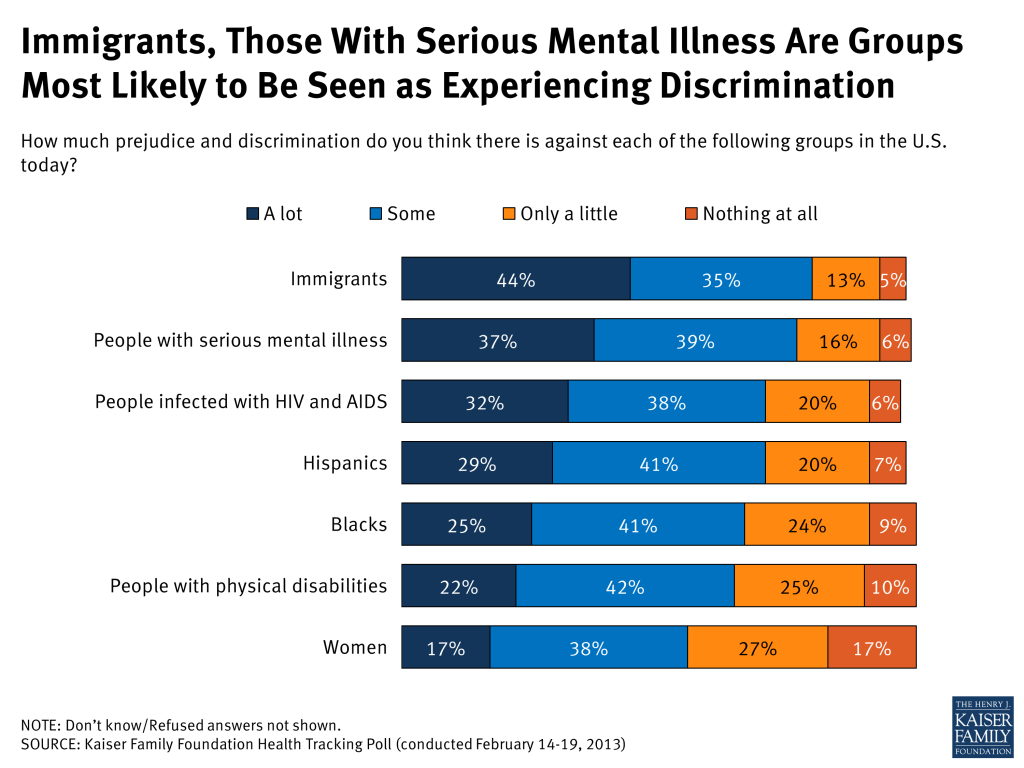
Those who live in households with direct experience with the mental health care system are somewhat more likely to perceive discrimination against people with serious mental illness than others: 45 percent see a lot of prejudice, versus 35 percent of those who have not dealt with mental health issues in their household.
| FIGURE 12: EXPERIENCE WITH MENTAL HEALTH SYSTEM AND VIEWS OF DISCRIMINATION AGAINST THOSE WITH SERIOUS MENTAL ILLNESS | |||
| Among those who live in a household where someone… | |||
| How much prejudice and discrimination do you think there is against people with serious mental illness in the U.S. today? | Total | …received mental health care | …did not receive mental health care |
| A lot | 37% | 45% | 35% |
| Some | 39 | 40 | 39 |
| Only a little | 16 | 11 | 17 |
| None at all | 6 | 3 | 7 |
The February poll suggests that many Americans are themselves uncomfortable with the idea of interacting with people who have a serious mental illness as a general category. For example, two-thirds of parents say they would not feel comfortable having “a person with a serious mental illness” work in their child’s school, and nearly half the public (47 percent) would feel at least somewhat uncomfortable living next door to such a person. Overall, four in ten express discomfort at the idea of having a coworker with a serious mental illness. It is impossible to know the extent to which relatively rare incidents like the one at Sandy Hook Elementary School create a backlash against innocent people with serious mental health issues, and the current survey does not suggest what kind of “serious mental illness” people are thinking of when they respond with “discomfort”.
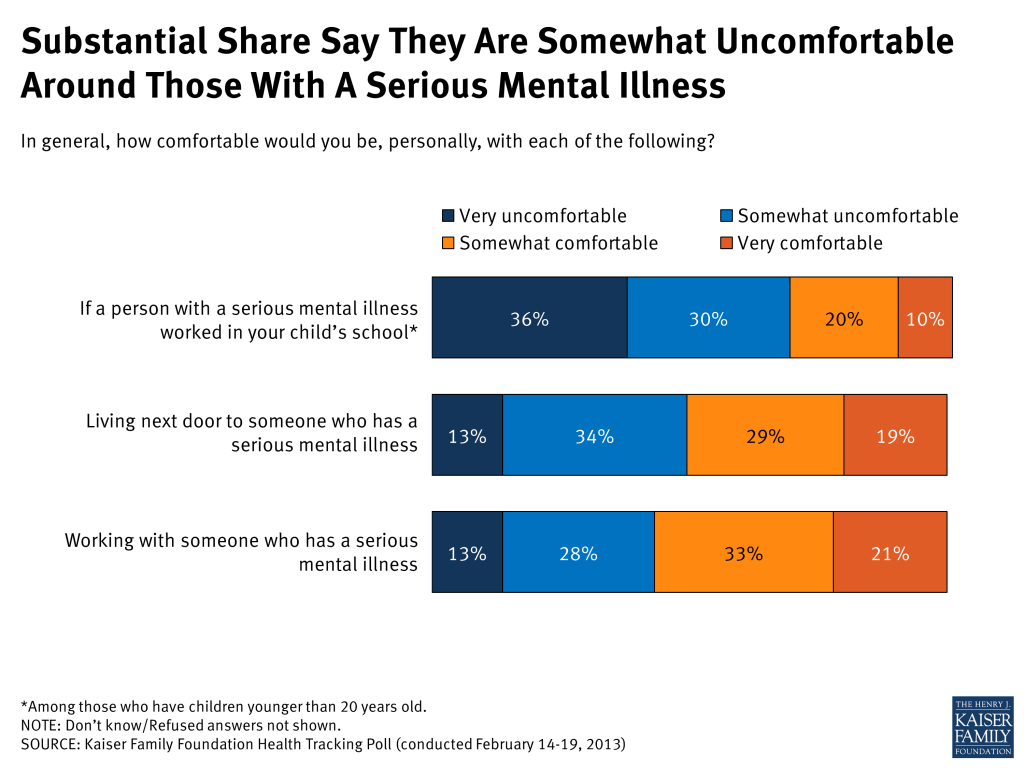
In a sign of generational differences in views toward mental health, those under age thirty are less likely than older Americans – particularly senior citizens—to say they would be uncomfortable being in consistent proximity to those with serious mental health issues. For example, about six in ten of those under age 30 say they would be at least somewhat comfortable having a neighbor who was seriously mentally ill, while a similar share of those aged 65 and up say they would be at least somewhat uncomfortable. Concerns are also somewhat attenuated among those who’ve had experience with the mental health care system. Those who have experience with mental health issues in their family are much less likely to say they would feel uncomfortable living next door or working with someone who has a serious mental illness. But, possibly showing evidence of Sandy Hook’s lasting influence, even two-thirds of these individuals report discomfort if someone with a serious mental illness worked at their child’s school.
| FIGURE 14: THOSE WITH EXPERIENCE IN THE MENTAL HEALTH SYSTEM LESS LIKELY TO FEEL UNCOMFORTABLE WITH PEOPLE WITH SERIOUS MENTAL ILLNESS, EXCEPT WHEN IT COMES TO THEIR CHILDREN | |||
| Among those who live in a household where someone… | |||
| Percent who say they personally would be uncomfortable with each of the following | Total | …received mental health care | …did not receive mental health care |
| If a person with a serious mental illness worked in your child’s school* | 66% | 64% | 67% |
| Living next door to someone who has a serious mental illness | 47 | 38 | 50 |
| Working with someone who has a serious mental illness | 41 | 30 | 44 |
| *Among parents with children under the age of 20 | |||
This Kaiser Health Tracking Poll was designed and analyzed by public opinion researchers at the Kaiser Family Foundation led by Mollyann Brodie, Ph.D., including Liz Hamel, Claudia Deane, Sarah Cho, Bianca DiJulio, and Becky Hanna. The survey was conducted February 14-19, 2013, among a nationally representative random digit dial telephone sample of 1,209 adults ages 18 and older, living in the United States, including Alaska and Hawaii (note: persons without a telephone could not be included in the random selection process). Computer-assisted telephone interviews conducted by landline (602) and cell phone (607, including 321 who had no landline telephone) were carried out in English and Spanish by Princeton Data Source under the direction of Princeton Survey Research Associates International (PSRAI). Both the landline and cell phone samples were provided by Survey Sampling International, LLC. For the landline sample, respondents were selected by asking for the youngest adult male or female currently at home based on a random rotation. If no one of that gender was available, interviewers asked to speak with the youngest adult of the opposite gender. For the cell phone sample, interviews were conducted with the person who answered the phone.
The combined landline and cell phone sample was weighted to balance the sample demographics to match estimates for the national population data from the Census Bureau’s 2011 American Community Survey (ACS) on sex, age, education, race, Hispanic origin, nativity (for Hispanics only), and region along with data from the 2010 Census on population density. The sample was also weighted to match current patterns of telephone use using data from the January-June 2012 National Health Interview Survey. The weight takes into account the fact that respondents with both a landline and cell phone have a higher probability of selection in the combined sample and also adjusts for the household size for the landline sample. All statistical tests of significance account for the effect of weighting. Weighted and unweighted values for key demographic variables are shown in the table below.
| Sample Demographics | ||
| Unweighted | Weighted | |
| Gender | ||
| Male | 49.0% | 48.6% |
| Female | 51.0% | 51.4% |
| Age | ||
| 18-24 | 7.2% | 12.8% |
| 25-34 | 11.8% | 16.8% |
| 35-44 | 12.2% | 17.2% |
| 45-54 | 19.1% | 19.0% |
| 55-64 | 21.8% | 16.5% |
| 65+ | 27.9% | 17.7% |
| Education | ||
| HS Graduate or Less | 33.0% | 41.6% |
| Some College/Assoc. Degree | 28.9% | 30.9% |
| College Grad. | 38.1% | 27.5% |
| Race/Ethnicity | ||
| White/not Hispanic | 74.9% | 67.5% |
| Black/not Hispanic | 9.3% | 11.6% |
| Hisp – US born | 6.5% | 7.3% |
| Hisp – born outside | 5.0% | 7.3% |
| Other/not Hispanic | 4.1% | 6.3% |
| Party Identification | ||
| Democrat | 34.6% | 34.6% |
| Independent | 29.6% | 30.1% |
| Republican | 25.3% | 23.1% |
| Other | 6.8% | 7.8% |
The margin of sampling error including the design effect for the full sample is plus or minus 3 percentage points. For results based on subgroups, the margin of sampling error may be higher. Sample sizes and margin of sampling errors for other subgroups are available by request. Note that sampling error is only one of many potential sources of error in this or any other public opinion poll.
The response rate calculated based on the American Association of Public Opinion Research’s Response Rate 3 formula was 10 percent for the landline sample and 8 percent for the cell phone sample.
Endnotes
- See, for example, the Centers for Disease Control and Prevention (CDC) Morbidity and Mortality Weekly Report, Sept. 2, 2011, 60(03);1-32, “Mental Illness Surveillance Among Adults in the United States”, http://www.cdc.gov/mmwr/preview/mmwrhtml/su6003a1.htm?s_cid=su6003a1_w ↩︎
- For more, see “Immigration Reform and Access to Health Coverage: Key Issues to Consider,” February 2013, Kaiser Family Foundation, http://modern.kff.org/uninsured/8420.cfm ↩︎
- The Mental Health Parity and Addiction Equity Act (MHPAEA) of 2008 applies to large group plans and requires cost sharing to be the same for mental health and substance abuse treatments as for other types of health care. It does not, however, require employers or health plans to offer mental health or substance abuse benefits. Beginning in 2014, as part of the essential health benefits provisions, the Affordable Care Act requires that health insurance plans offered in the individual market and most small group plans include coverage for mental health and substance abuse and comply with parity laws. For more information on the MHPAEA, see a description of the law by the Centers for Medicare and Medicaid Services, available at http://cciio.cms.gov/programs/protections/mhpaea/mhpaea_factsheet.html. For more information on how the ACA extends coverage for mental health and substance abuse services, see http://aspe.hhs.gov/health/reports/2013/mental/rb_mental.cfm. ↩︎