News Release

Walgreens and Greater Than AIDS Team with Health Departments and Local AIDS Service Organizations to Offer Free HIV Testing in More Than 150 Cities

Published: Jun 18, 2015

HIV Testing Events Scheduled at Select Walgreens Locations Over Three Days in Lead Up to  National HIV Testing Day, June 27

DEERFIELD, Ill. and MENLO PARK, Calif., June 18, 2015– In the lead up to National HIV Testing Day on June 27, Walgreens and Greater Than AIDS, a leading national public information response to the domestic HIV/AIDS epidemic, are teaming with more than 180 health departments and local AIDS service organizations (ASOs) in 150 cities across the country to offer free HIV testing. National organizations including NAACP and Black AIDS Institute will support the events by encouraging community members to know their HIV status and take advantage of free HIV testing.

State and local health departments and ASOs will provide trained counselors to conduct the testing and will provide results on-site within minutes.  Free tests, including those donated by Alere North America, BioLytical Laboratories and The D.I.V.A. Foundation, will be available at the testing sites located at select Walgreens in Atlanta, Chicago, Houston, Los Angeles, Miami, New Orleans, New York, St. Louis and San Francisco, among other cities during a three-day period:

  • Thursday, June 25 from 3 p.m. to 7 p.m.
  • Friday, June 26 from 3 p.m. to 7 p.m.
  • Saturday, June 27 from 10 a.m. to 2 p.m.

While the Centers for Disease Control and Prevention (CDC) advises that all Americans be screened for HIV as a routine part of medical care[1], many Americans have never been tested or are not being tested as often as recommended, according to national surveys by the Kaiser Family Foundation.  Of the more than 1.2 million people living with HIV in the U.S., an estimated one in seven do not know that they are infected and only three in 10 are in ongoing care and treatment.[2]

“Walgreens is committed to being a part of the solution to end AIDS, and National HIV Testing Day provides a great opportunity to help share critical health information and encourage HIV testing,” said Glen Pietrandoni, senior director of virology, specialty products and services at Walgreens. “Working in collaboration with Greater Than AIDS and various community partners during the past four years, we have helped nearly 20,000 people access free testing.  We are pleased to be able to continue to help make it easier for those in the communities that we serve to know their status.”

“We have come so far in our understanding of HIV,” said Tina Hoff, senior vice president and director of health communication and media partnerships at the Kaiser Family Foundation. “Today, there are very effective treatments that not only help people with HIV to enjoy long, healthy lives but also significantly reduce the chances of passing the virus to others.[3]  Knowing one’s status is a crucial first step.”

I Got Tested: What’s Next?, a new 8-page informational guide from Greater Than AIDS and Walgreens will be distributed at the testing events in June. For a complete list of participating Walgreen locations and supporting partners, as well as more information about HIV testing, visit www.greaterthan.org/walgreens.

About Walgreens

Walgreens (www.walgreens.com), the nation’s largest drugstore chain, constitutes the Retail Pharmacy USA Division of Walgreens Boots Alliance, Inc. (Nasdaq: WBA), the first global pharmacy-led, health and wellbeing enterprise. More than 8 million customers interact with Walgreens each day in communities across America, using the most convenient, multichannel access to consumer goods and services and trusted, cost-effective pharmacy, health and wellness services and advice. Walgreens operates 8,232 drugstores with a presence in all 50 states, the District of Columbia, Puerto Rico and the U.S. Virgin Islands. Walgreens digital business includes Walgreens.com, drugstore.com, Beauty.com, SkinStore.com and VisionDirect.com. Walgreens also manages more than 400 Healthcare Clinic and provider practice locations around the country.

About Greater Than AIDS

Greater Than AIDS is a leading national public information response focused on the U.S. domestic epidemic. Launched in 2009 by the Kaiser Family Foundation together with the Black AIDS Institute, it is supported today by a broad coalition of public and private sector partners, including: major media and other business leaders; Federal, state and local health agencies and departments; national leadership groups; AIDS service and other community organizations; and foundations, among others. Through targeted media messages and community outreach, Greater Than AIDS works to increase knowledge, reduce stigma and promote actions to stem the spread of the disease. While national in scope, Greater Than AIDS focuses on communities most affected.

#  #  # #  #


[1] Branson BM, Handsfield HH, Lampe MA, et al. Centers for Disease Control and Prevention. Revised recommendations for HIV testing of adults, adolescents, and pregnant women in health-care settings. MMWR. 2006;55(RR14):1-17.

[2] CDC. HIV Surveillance Supplemental Report, Vol. 19, No. 3; November 2014. Data are estimates and do not include U.S. dependent areas.

[3] Cohen MS, Chen YQ, McCauley M, et al. Prevention of HIV-1 infection with early antiretroviral therapy. N Engl J Med. 2011;365(6):493-505.

News Release

Kaiser–Commonwealth Fund Survey: Most Primary Care Providers Report Seeing More Medicaid or Newly Insured Patients Since January 2014, But Little Change in Ability to Provide Quality Care

Published: Jun 18, 2015

As with the Public, Physicians’ Views on Affordable Care Act Split Along Party Lines

The first in a series of reports on a comprehensive new survey finds most primary care doctors, nurse practitioners, and physician assistants report an increase in Medicaid or newly insured patients since the Affordable Care Act’s (ACA) major coverage provisions took effect, yet little change in their ability to provide high-quality care.

Overall, 59 percent of physicians and 64 percent of nurse practitioners and physician assistants say that since January 2014, they have seen a higher number of patients who were previously uninsured, and now have coverage or are currently covered by Medicaid.  Providers working in community clinics, and those in states that expanded their Medicaid programs, are more likely to report such increases.  Nearly half of physicians (44%) and more than half of nurse practitioners and physician assistants (54%) report an increase in the total number of patients they see.

Designed and analyzed jointly by the Kaiser Family Foundation and The Commonwealth Fund, the 2015 National Survey of Primary Care Providers provides a detailed assessment of frontline providers’ experiences with, and views of, the Affordable Care Act and other changes occurring in health care delivery and payment, as well as their perspectives on the future of primary care.  This first report focuses on the ACA.  Survey results dealing with primary care providers’ reactions to changes in the health system generally are still to come.

“Physicians are highly trained professionals, but when it comes to the Affordable Care Act, they turn into partisans, the same way the general public does,” Kaiser Family Foundation President and CEO Drew Altman said. “The survey finds that physicians who are Republicans are much more likely to perceive negative effects from the law, while those who are Democrats are far more likely to see positive ones.”

“Millions of Americans have gained coverage since the Affordable Care Act took effect, and previous surveys have shown that most have been able to find doctors and get the health care they need,” said Commonwealth Fund President David Blumenthal, M.D. “This study provides evidence that primary care providers have been able to maintain quality of care for all of their patients, including those with Medicaid and new coverage.”

The survey finds that one year into the ACA coverage expansions, most providers do not report any overall change in quality of care or patient satisfaction.  This is true even among those who reported increases in newly insured or Medicaid patients.  A few details:

primary_care_release_06182015
  • Majorities of doctors (59%) and nurse practitioners and physician assistants (63%) report no change in their ability to provide high-quality care to all patients since January 2014.  About one in five in each group says care has improved, and similar shares say it has gotten worse.
  • Most doctors (61%) and other practitioners (63%) say their patients’ satisfaction and care experiences have not changed since January 2014.  Equal shares of doctors say satisfaction has improved and gotten worse, while nurse practitioners and physician assistants are somewhat more likely to say it improved.
  • About four in 10 primary care physicians (42%) say that almost all their patients who request a same- or next-day appointment can get one, and another quarter say that most of their patients can.  These rates are similar to those measured in 2009 and 2012 by previous Commonwealth Fund surveys of primary care physicians.
  • Primary care physicians who have seen an increase in Medicaid or newly insured patients are less likely to say almost all their patients can access a same- or next-day appointment (36% vs. 50% for those who haven’t seen an increase).  This may stem in part from preexisting differences in capacity; for instance, those seeing more newly insured patients are more likely to work in community clinics, few of which provide same- or next-day appointments to all patients.
  • The survey finds 83 percent of primary care physicians continue to accept new patients, down slightly from 89 percent in 2012.  The share accepting new Medicaid patients, 50 percent, is essentially unchanged.
  • Many physicians (40%) say that the time they can spend with each patient has gotten worse since January 2014.  About three in 10 physicians (29%) say they are “somewhat” or “very” dissatisfied with the amount of time they are able to spend with patients.  Such concerns predate the ACA, as even larger shares of physicians reported being dissatisfied in 2006 (42%) and 2012 (44%).

The survey also finds primary care providers nearly evenly divided in their overall view of the ACA.  Among physicians, 52 percent express an unfavorable view of the law and 48 percent a favorable one.  As with the public at large, opinion is largely driven by partisan identification, with 87 percent of Republican physicians viewing it unfavorably and 87 percent of Democratic physicians viewing it favorably.  Patterns of partisan response are similar among nurse practitioners and physician assistants.

Partisanship also drives providers’ opinions on how they feel the ACA has affected their medical practice.  Overall, 23 percent of physicians say the law has had a positive impact, 36 percent say it has been negative, and 31 percent say there has been no impact.  At the same time, physicians who are Democrats are more likely to report a positive rather than negative impact by a three-to-one margin, and physicians who are Republicans lean in the opposite direction by seven-to-one.  Similarly, while large shares of physicians say the ACA has not impacted their patients’ quality of care or their ability to meet patient demand, Republicans are more likely to report a negative impact and Democrats a positive one.

The survey finds that a large majority of primary care providers, regardless of party affiliation, say they are satisfied with their medical practice.  Satisfaction levels among physicians have increased from 68 percent in 2012 to 83 percent in 2015.  Still, a sense of pessimism exists among physicians, with nearly half (49%) saying they would not advise a young person to pursue a career in primary care.  Nurse practitioners and physician assistants are more optimistic, with the vast majority (85%) saying they would make such a recommendation.

Attitudes and Experiences of Primary Care Providers Under the First Year of ACA Coverage Expansion is available online.

METHODOLOGY

The Kaiser/Commonwealth Fund 2015 National Survey of Primary Care Providers, conducted by mail and online from January 5 through March 30, 2015, is based on a nationally representative sample of 1,624 primary care physicians, along with a separate nationally representative sample of 525 nurse practitioners and physician assistants in primary-care practices.  The margin of sampling error is plus or minus 3 percentage points for physicians and 5 percentage points for nurse practitioners and physician assistants.  For results based on subgroups, the margin of sampling error is higher.

The Commonwealth Fund is a private foundation supporting independent research on health policy reform and a high performance health system.

Poll Finding

Experiences And Attitudes Of Primary Care Providers Under The First Year Of ACA Coverage Expansion

Published: Jun 18, 2015

A new survey from The Kaiser Family Foundation and The Commonwealth Fund asked primary care providers—physicians, nurse practitioners, and physician assistants—about their views of and experiences with the Affordable Care Act (ACA) and other changes in health care delivery and payment, as well as their thoughts on the future of primary care. In this first brief based on the survey, many providers reported seeing an increased number of patients since the coverage expansions went into effect, but not an accompanying compromise in quality of care. A large majority of primary care providers are satisfied with their medical practice, but a substantial percentage of physicians expressed pessimism about the future of primary care. Similar to the population overall, providers’ views of the ACA are divided along party lines. A second brief will report on providers’ reactions to other changes occurring in primary care delivery and payment. An additional data note looks at reported acceptance of Medicare patients among non-pediatric primary care physicians.

Report (PDF)

Poll Finding

Data Note: Predictors Of Positive And Negative Attitudes Towards The ACA Among Non-Group Insurance Enrollees

Authors: Liz Hamel, Mira Norton, and Mollyann Brodie
Published: Jun 17, 2015

One of the groups perhaps most affected by changes brought about by the Affordable Care Act (ACA) are people who purchase their own health insurance in the non-group market. In this Data Note, we examine data from the Kaiser Family Foundation Wave 2 Survey of Non-Group Health Insurance Enrollees to explore the characteristics of non-group enrollees that are associated with positive and negative attitudes towards the ACA, including feeling personally benefited or negatively affected by the law.1  To do this, we use a statistical technique called logistic regression analysis that allows us to isolate associations between a given attitude and one characteristic (such as age or political party identification) while holding other factors constant.

Results

Nongroup w2 Data Note text box

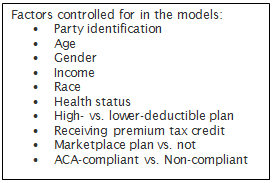
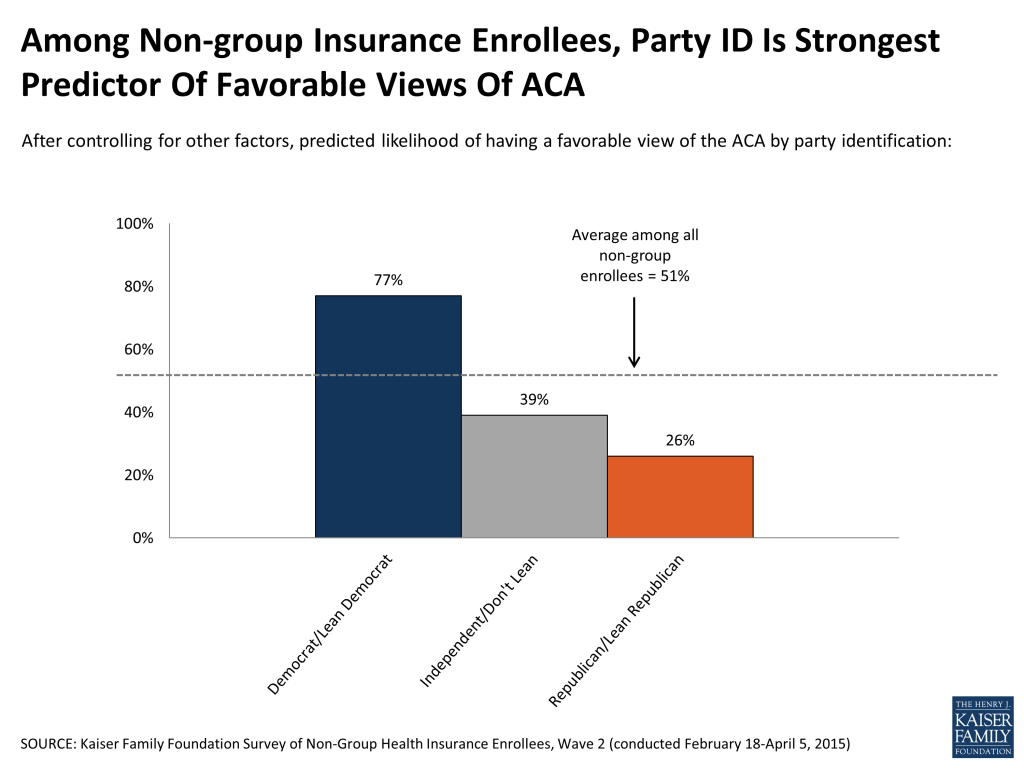
Overall, the survey found that about half of non-group enrollees (51 percent) report a favorable view of the ACA, while 43 percent have an unfavorable view. As is true among the public overall, partisanship is the biggest driver of this opinion. Even after controlling for demographics and other factors (see sidebar for full list), a person with non-group insurance who is a Democrat or Democratic-leaning independent has a predicted likelihood of having a favorable view of the law of 77 percent, compared with 39 percent for a “pure” independent (one who doesn’t lean toward either major party) and 26 percent for a Republican or Republican-leaning independent. Other demographic factors in the model, including gender, income, race, health status, and type of health plan, were not significant predictors of favorable views. Age had a small effect, with those ages 35-54 being slightly more likely to express a favorable view when controlling for other factors, but the size of the age effect was much smaller than the effect of party identification.

Figure 1

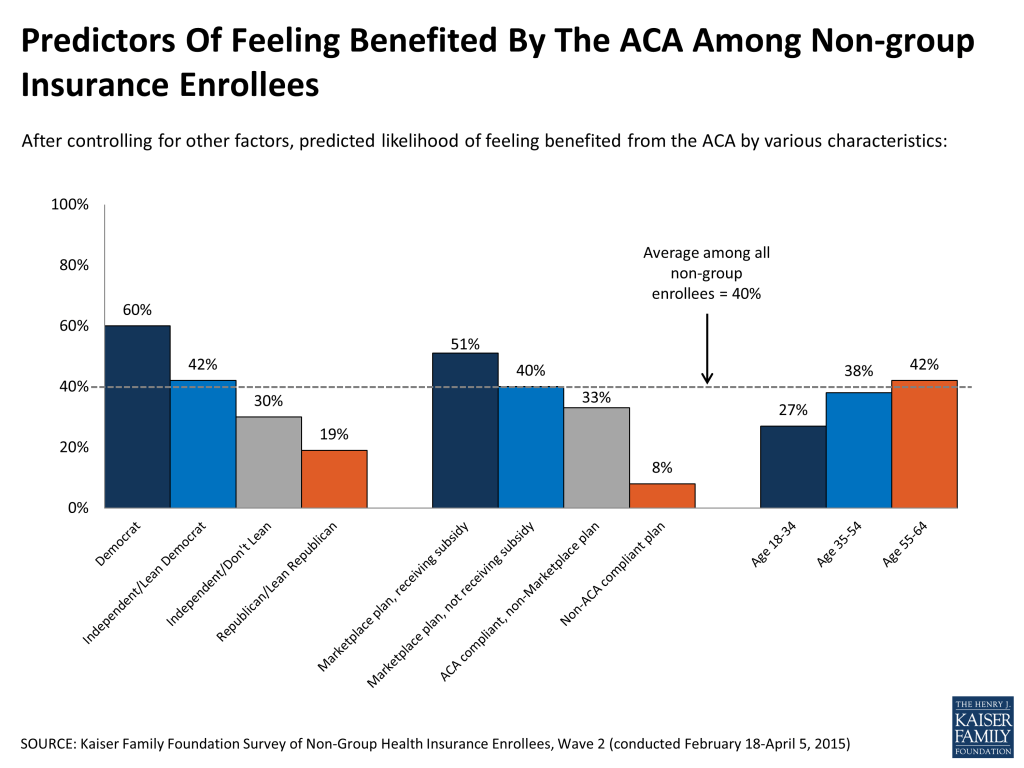
When examining factors associated with saying one has personally benefited or been negatively affected by the law, partisanship remains the strongest predictor, but other factors play a role as well. For instance, after controlling for other factors, individuals with Marketplace plans who are receiving premium tax credits have a predicted likelihood of feeling benefited by the law of 51 percent, compared with 40 percent for those in Marketplace plans who are not getting a tax credit and just 8 percent for those in pre-ACA, non-compliant plans.2  Age also plays a factor, with non-group enrollees ages 18-34 having a predicted likelihood of feeling helped by the law of 27 percent, compared with 38 percent for those ages 35-54 and 42 percent for those ages 55-64. Partisanship remains one of the strongest predictors: after controlling for other factors, the “average” Democrat enrolled in a non-group plan has a predicted likelihood of feeling the ACA has benefited them of 60 percent – three times the likelihood for a Republican or Republican-leaning independent (19 percent).

Figure 2

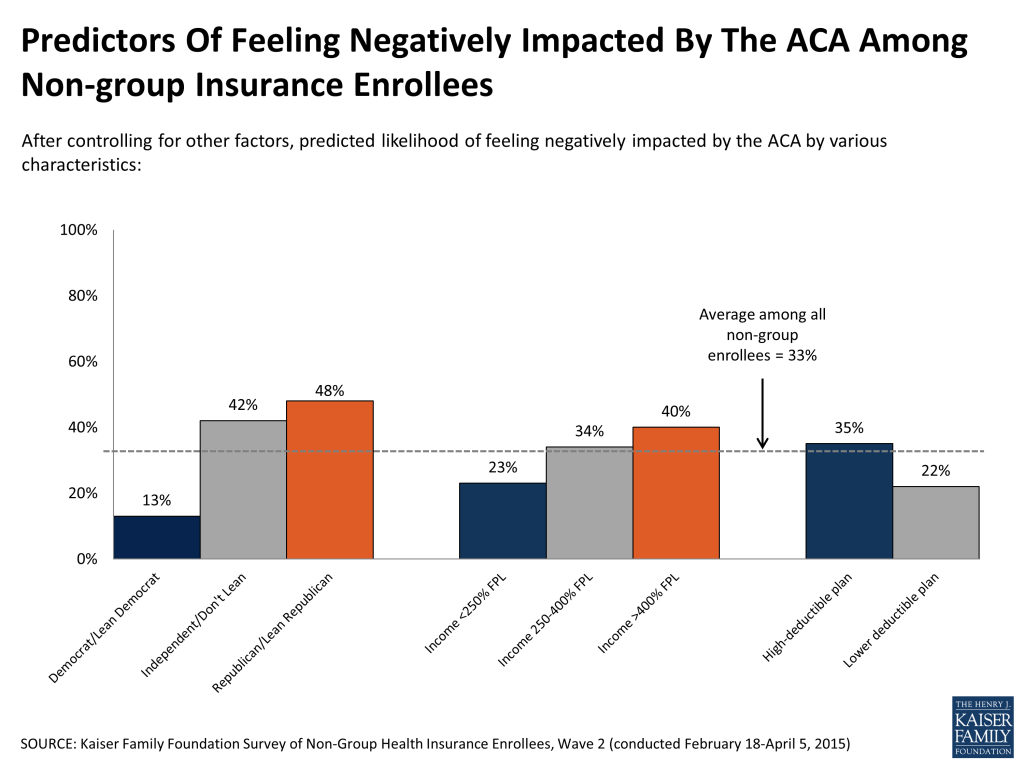
A somewhat different set of predictors emerges when looking at who feels the ACA has had a negative effect on their families. Again, partisanship is a strong predictor; controlling for other factors, a Republican or Republican-leaner with non-group insurance has a 48 percent likelihood of saying they have been negatively affected by the law, compared with just 13 percent for a Democrat or Democratic-leaner. Non-group enrollees with higher incomes are also more likely to feel harmed by the law, even after controlling for other factors. The predicted likelihood that the “average” non-group enrollee will say the law has negatively impacted them is 40 percent for those with incomes above 400 percent of the federal poverty level (FPL) compared with 23 percent for those with incomes less than 250 percent FPL. The deductible of a person’s health plan is also a significant predictor. Controlling for other factors, those in non-group plans with high deductibles (defined as $1500 or more for an individual or $3000 or more for a family)  have a 35 percent predicted likelihood of feeling negatively affected, compared with 22 percent for those in plans with lower deductibles.

Figure 3

Discussion

Given the deep partisan divide over the ACA in the country overall, it comes as no surprise that party identification is the biggest factor associated with overall views of the law among individuals who purchase their own insurance. Beyond their general views, our analysis reveals that within the non-group market, people’s perceptions of whether the ACA has benefited or negatively impacted them are also strongly associated with their partisan identification. However, other factors beyond partisanship also emerge as significant predictors. Even when controlling for party and other demographics, older non-group enrollees and those receiving government tax credits are more likely to feel the law has helped them, while those with higher incomes and those in high-deductible plans are more likely to feel they’ve been negatively impacted. This suggests that the specifics of how people get their plans, their eligibility for government financial assistance, and the type of plan they end up with are all important factors in determining whether a non-group enrollee feels like a “winner” or a “loser” under the ACA.

  1. For more detail on the survey methods and main findings, see : https://modern.kff.org/health-reform/poll-finding/survey-of-non-group-health-insurance-enrollees-wave-2/ ↩︎
  2. Non-compliant plans are those purchased before January 1, 2014. They include plans purchased before the law was enacted in March 2010 that were grandfathered in under the ACA, as well as those purchased before October 2013 and allowed to continue under a federal transition policy at the discretion of states. For more details, see: https://modern.kff.org/health-reform/poll-finding/survey-of-non-group-health-insurance-enrollees-wave-2/   ↩︎

How Have State Medicaid Expansion Decisions Affected the Experiences of Low-Income Adults? Perspectives from Ohio, Arkansas, and Missouri

Published: Jun 17, 2015

Executive Summary

As of May 2015, 30 states have adopted the Affordable Care Act (ACA) Medicaid expansion to low-income adults, creating a new coverage option for millions of adults who were previously excluded from the program. In the remaining 21 states that have not adopted the expansion to date, many poor uninsured adults fall into a coverage gap—they do not qualify for Medicaid and earn too little to qualify for the tax credits to purchase Marketplace coverage, which begin at 100% of the federal poverty level for subsidized coverage.

This brief examines the experiences of low-income adults in three states that have made varied Medicaid expansion decisions: Ohio, which adopted the ACA Medicaid expansion, Arkansas which implemented the Medicaid expansion through a “Private Option” waiver, and Missouri, which has not adopted the expansion. Information was collected through 10 focus groups conducted with 85 adults in Columbus, Little Rock, and St. Louis. The groups in Columbus and Little Rock were conducted with previously uninsured adults who enrolled in the ACA Medicaid expansion or Private Option waiver, and the groups in St. Louis were conducted with uninsured low-income adults who would be eligible if the state expanded Medicaid. Although most of the adults were working, they were in part-time and/or low wage jobs and were all facing challenging financial situations. Many had ongoing physical and mental health needs. Following are key themes of their experiences:

In all three locations, participants sought coverage after the ACA was implemented. In Little Rock and Columbus, participants enrolled through varied methods. Many were aware of the new coverage options via news and media and enrolled on their own online or by phone. Others learned about the coverage after coming across enrollment events or outreach materials in the community and applied with an assister, and some were automatically enrolled based on their participation in another program. Most of the participants in St. Louis also tried to enroll in coverage after the ACA was implemented and were upset and disappointed to learn they did not qualify for Medicaid or tax credit subsidies to purchase a Marketplace plan.

“I did mine at the clinic…They had people… go through and sit there with the computer and do it with me.” Jimmie, Little Rock

“So I called that hotline and they said, well, you don’t make enough money for this, but then you make too much money for Medicaid. So, I’m in this donut hole where I don’t fit anywhere.” Christina, St. Louis

Participants in all three locations described how they delayed or went without needed care while uninsured, sometimes leading to worsening of conditions. All participants said that they tried to avoid obtaining care while uninsured because of the cost, which sometimes led to the worsening of conditions that ultimately resulted in higher-cost care, missed work, and disruptions to family relationships. They noted that they would put off seeking care until a condition becomes unbearable. They said when they did seek care they would try to use clinics and urgent care centers to minimize costs, but sometimes the only source of care they could turn to was the emergency room, often leaving them with large bills they could not afford.

After gaining coverage, adults in Little Rock and Columbus obtained needed care, leading to improvements in their health and quality of life. While Arkansas and Ohio implemented the Medicaid expansion in different ways, participants in both Little Rock and Columbus said that obtaining coverage enabled them to access needed care to address health problems as well as primary and preventive care. They described how obtaining coverage allowed them to better manage chronic conditions, led to the diagnosis of conditions, and contributed to significant improvements in their health and quality of life. Participants also said obtaining coverage and care provided them a huge feeling of relief and sense of security and enhanced their overall well-being, ability to work, and relationships. Participants indicated that they were grateful and proud that their states had expanded Medicaid, providing them access to coverage.

“I had a procedure that’s gotten me off all medications. I no longer take depression medication, high blood pressure medication. Now I am back to work, I feel healthy, and I interact with my kids.” Ann, Columbus

Participants in Little Rock and Columbus identified some remaining challenges even after gaining coverage. Some participants reported difficulty finding a primary care provider and certain types of specialists, particularly behavioral health providers, and noted that plan provider directories were not always up to date. In addition, many participants reported significant dental and vision needs. Although these benefits are covered in Ohio, adults in Columbus noted challenges finding an available dental provider. In Arkansas, enrollees currently are not covered for dental or vision care, which participants felt was a key gap in coverage.

Adults in St. Louis remained uninsured, leaving them unable to access needed care and with significant stress and anxiety. Adults in St. Louis described how remaining uninsured contributed to daily stress and anxiety and caused them to continue to delay or go without needed care. Participants described feeling defeated, angry, powerless, and frustrated that they remain ineligible for coverage without the Medicaid expansion.

In sum, these experiences illustrate the different experiences of low-income adults in states that have made varied Medicaid expansion decisions. While Arkansas and Ohio implemented the expansion in different ways, participants in both Little Rock and Columbus described how obtaining coverage improved their ability to access care, contributing to improvements in their ability to work and family relationships. In contrast, participants in St. Louis remained uninsured limiting their ability to obtain needed care, creating significant stress and anxiety in their lives, and interfering with their ability to work and care for their families.

Issue Brief

Introduction

As of May 2015, 30 states have adopted the Affordable Care Act (ACA) Medicaid expansion to low-income adults, creating a new coverage option for millions of adults who were previously excluded from the program. In the remaining 21 states that have not adopted the expansion to date, many poor uninsured adults fall into a coverage gap—they do not qualify for Medicaid and earn too little to qualify for the tax credit subsidies to purchase Marketplace coverage, which begin at 100% of the federal poverty level. This brief examines the experiences of low-income adults in three states that have made varied Medicaid expansion decisions: Ohio, which adopted the ACA Medicaid expansion, Arkansas which implemented the Medicaid expansion through a “Private Option” waiver, and Missouri, which has not adopted the expansion.

This report is based on 10 focus groups conducted with 85 indi  viduals by the Kaiser Commission on Medicaid and the Uninsured and Belden Russenello Strategists in Columbus, Ohio; Little Rock, Arkansas; and St. Louis Missouri during February and March 2015. The groups in Columbus were conducted with previously uninsured adults who enrolled in the ACA Medicaid expansion and the groups in Little Rock were conducted with previously uninsured low-income adults who enrolled in the Private Option waiver. Through this waiver, Arkansas uses Medicaid funds to subsidize the purchase of coverage through the Marketplace for low-income adults who would be eligible for the Medicaid expansion. The groups in St. Louis were conducted with uninsured low-income adults who would be eligible if the state adopted the Medicaid expansion.

In all three locations, separate groups were conducted with men and women to explore gender differences in experiences being uninsured and gaining coverage, and women’s access to well-woman care and contraception. Moreover, in St. Louis and Little Rock, separate groups also were conducted with African American men and women, to explore potential racial differences in experiences, given that African Americans are disproportionately impacted by state Medicaid expansion decisions. Across the groups, participants varied in age, family status, employment, and education (Appendix Table A).

Key findings from the focus groups are summarized below, including participants’ financial situations and health status; their experiences seeking health insurance after the ACA was implemented; the impacts having or going without health insurance has on their ability to access care and their broader lives; and their views on their state’s Medicaid expansion decision.

Key Findings

Finances and Health

Participants indicated that it is difficult to find a job that pays an adequate wage and offers benefits. The majority of participants were employed on at least a part-time basis, although more participants reported part-time employment than full-time employment. Those working were employed in a range of occupations and industries, including service, retail, construction and education, and several participants were self-employed. Although many were working, few had access to employer-sponsored coverage through their job, and those that did indicated that the coverage was unaffordable due to their limited incomes. A number of the participants had been laid off from full-time jobs that provided benefits as a result of downsizing or outsourcing and were now in either part-time positions or unemployed and seeking work. Several participants reported that they were not working because they were caring for family members, including several who were caring for spouses, children, or other family members with disabilities or significant health problems. Overall, participants noted that, despite continued improvements in the overall economy, the current job market remains challenging. They said that, while jobs are available, they often are low-wage, part-time positions that do not offer benefits. Participants felt that full-time jobs with adequate pay and benefits are very difficult to find and that there is significant competition for these positions. A number of participants commented that it is particularly difficult for mid-career individuals in their forties and fifties to find jobs because employers would rather pay lower wages to recent graduates. A few African American participants also felt that racial prejudice impacts the job market within St. Louis.

“Finding the full-times with benefits have been rare and there’s a lot of competition for the ones that are. And, being in the population that is on the older side—I’m not old yet, but older than the people right out of college—there is a lot of competition for those.” Dawn, St. Louis

“There are a lot of part-time jobs, but as far as the dream 40-hour a week with benefits and all that type of stuff, I don’t see that.” James, Columbus

A number of women identified challenges to fulfilling their roles as primary caregivers along with their other responsibilities. In addition to their roles and responsibilities as mothers, several of the women said they were caregivers for other family members, including spouses and aging parents, or friends. They noted that, in this role, they often need to take time off to care for someone who is sick or to attend medical appointments and that they are responsible for following through to ensure individuals obtain recommended services. They described the stress they experience and difficulties they face juggling these responsibilities with providing for the family. For example, because most are in low-wage jobs that do not provide sick leave, time taken away from work for appointments or to care for a sick child results in lost wages and potentially other consequences such as reductions in hours or increased risk of losing a position.

“Because there would be days when I’m at work and then I get a call from the school that he’s being rushed to the ER for an asthma attack. So the times that I would have to leave to take care of him, I know that that played a big effect on when they were trying to make the cuts at work. They were like, well, we know she’s not going to be here so she can be the first one to go.” Angela, St. Louis

Many of the participants said they struggle to meet all their basic expenses. Participants cited a range of necessary monthly expenses, including housing, transportation, utilities, childcare, food, and clothing. They noted that they try to cut back on expenses where possible, for example, by keeping the thermostat low to reduce heating costs, eating less, and moving in with family members to reduce housing costs. A number of participants also said that they frequently rely on help from family members, food pantries, churches and charities, and programs like food stamps to cover their expenses. However, many felt disappointed in themselves for having to rely on such help. Most participants said they juggle bills from month to month. Some indicated that due to their limited incomes and unexpected expenses, like car repairs, they have fallen behind on bills, including house and car payments, and are now at risk for losing their vehicle or home. Many participants also reported large outstanding medical debt stemming from care they received while uninsured.

“I used to have my own place, but I moved in with my parents now. So if it wasn’t for my parents paying for all of that and I just pay for my car and the other things, then I would be short.” Kiasha, St. Louis

“We gave our car back and just went and bought an old used car. We paid cash for it because we couldn’t afford the car note anymore.” Jacqueline, Little Rock

“They have food shelters… that was a big problem for my household, there just wasn’t enough left over to eat.” Chad, Columbus

Participants said that the financial pressures they face have negative impacts on their health, well-being, and relationships. Finances are an everyday worry for participants that causes them significant stress and anxiety. Participants described how their financial concerns lead them to feel depressed, insecure, and worried about their future as well as guilty and embarrassed about not being able to provide all the things they would like to for their family. Some indicated that this stress contributes to strains on their relationships with family members. A number also felt that the financial stress has had negative impacts on their physical health, for example, by exacerbating problems with high blood pressure. A few also pointed out that it is very difficult to eat healthy because of the high cost of fresh fruits and vegetables and said that they had gained weight and become less healthy as a result of eating cheaper food options. 

“It put a strain on our marriage, but we managed. Still married, never separated. But it’s hard. We got along otherwise but when it came to money, it’s hard.” Angela, Little Rock

“I can’t afford to eat healthy anymore. I’m putting on weight and I know it’s because of my diet. Fresh vegetables and fruits, who can afford them?”  Kathy, St. Louis

Most participants view themselves to be in good or excellent health, but many have ongoing physical or mental health needs or problems. These included chronic physical conditions like high blood pressure and diabetes as well as mental health problems like depression, anxiety, and bi-polar disorder. In addition, some participants had undiagnosed pain and some had experienced major health problems, including cancer. Many participants said they had dental and vision needs, particularly dental pain. A number indicated that when their health problems are not well-managed they contribute to missed days at work and/or difficulties caring for children or other family members. Some participants also said their job choices are limited due to their health conditions, for example, limiting their ability to work in jobs that require manual labor or long periods of standing.

Experiences Seeking Health Insurance

Participants varied in the length of time they were uninsured. Some had been uninsured for just a few months while others had been uninsured for many years. Most participants previously had health coverage prior to becoming uninsured. A number had been covered through an employer-sponsored plan. Some of these participants indicated that they were offered COBRA upon losing their job and the coverage, but that it was not affordable. A few had previously purchased a private plan on the individual market but noted that they were not able to maintain the coverage due to cost. Some had been covered as a dependent through a parent’s plan and then aged out of coverage. Finally, some participants had previously been covered by Medicaid either as a child or during a pregnancy and then became ineligible when they aged out or after the post-partum period.

Enrolling in Coverage in Little Rock and Columbus

In Little Rock and Columbus, some participants were aware of the new coverage options and actively sought out coverage; others enrolled after coming across enrollment resources or events in the community, or were automatically enrolled. Some participants had heard about the new coverage options through the news and media and actively applied for coverage either online or by telephone after the ACA was implemented. Others were not aware of the new coverage options but ran across enrollment resources or events in the community, for example at a doctor’s office, hospital, clinic, or state fair, and enrolled with the help of an assister. In addition, some participants reported that they were automatically enrolled in Medicaid as a result of applying for another assistance program like the Supplemental Nutritional Assistance Program (SNAP or food stamps). Arkansas conducted facilitated enrollment of individuals already enrolled in SNAP, since the state could identify these individuals as eligible for its Medicaid expansion Private Option based on the information already on file through the SNAP program. These individuals received a letter informing them that they were eligible for Medicaid, which they signed and returned to complete enrollment. A number of participants in the Little Rock groups recalled receiving this letter. Participants reported varied enrollment experiences depending on how they enrolled. Those who received the letter in Arkansas or who received assistance with enrolling generally described the process as easy. However, some who enrolled on their own reported some challenges with the website or long waits to speak to someone on the phone.

“I did mine at the clinic…They actually had people… sit there with the computer and do it with me.”  Jimmie, Little Rock 

“Well, I was notified by the state that I was eligible. I was just so surprised…Because of another program that I’m in, they said that everyone in that program automatically qualified.” Russell, Little Rock

“I was applying for food stamps and one day it came in the mail, and I was like ‘wow.’” Chad, Columbus

Participants reported mixed experiences with selecting a managed care plan after enrolling in coverage. As noted, under its Private Option waiver, Arkansas uses Medicaid funds as premium assistance to purchase coverage in Marketplace Qualified Health Plans for expansion adults. Currently expansion adults in Arkansas choose among two plans after enrolling in coverage. A number of participants reported that they selected a plan during the first year of implementation because that plan chose to offer dental and vision coverage in addition to required benefits. However, this plan stopped offering dental and vision in the second year of implementation, and a number of participants indicated that they now want to switch to the other plan, which has better brand name recognition and a broader provider network. In Ohio, individuals select a Medicaid managed care plan after enrolling in coverage. Some participants said it was challenging to compare the plans. They indicated that differences in benefits and provider networks as well as brand name awareness impacted their choice. A few participants had existing relationships with a provider and chose based on which plan their doctor accepted; others said they had to change doctors because a doctor did not accept their plan.

Remaining in a Coverage Gap in St. Louis

Most of the participants in the St. Louis groups had tried to obtain insurance since the ACA was implemented and were upset and disappointed to learn that they did not qualify for Medicaid or tax credit subsidies to purchase a Marketplace plan. The majority of participants said they tried to enroll online, while others said they tried to get assistance through a call center. When they applied, participants learned that they did not qualify for Medicaid or assistance with purchasing a Marketplace plan, and many understood that individuals at higher incomes did qualify for tax credits to purchase Marketplace coverage. Some participants said they were quoted the prices of the Marketplace plans without a subsidy, which they said were unaffordable. Participants said that they thought they would be eligible for an affordable coverage option based on the media and outreach encouraging individuals to enroll and felt frustrated, upset, and confused when they learned that they did not qualify for help. Many also mistakenly believe that they will be subject to the tax penalty for not having insurance, and felt it is unfair that they will be penalized when they do not have any affordable coverage options available to them.

“It was really disappointing. I waited so long to wade through it all and then finally talked to somebody after sitting online for an hour and a half and I couldn’t believe it; even though I don’t make much money and had debts, there was nothing below $400.” Kevin, St. Louis

“So I called that hotline and they said, well, you don’t make enough money for this, but then you make too much money for Medicaid. So, I’m in this donut hole where I don’t fit anywhere.” Christina, St. Louis

“I was surprised because when you hear about it and they say it’s for everybody, everybody, everybody… no, actually no, it’s not for everybody.”  Tanya, St. Louis

Personal Impacts of Health Insurance Coverage

Participants in Little Rock and Columbus were asked to recollect their experiences being uninsured before they enrolled in Medicaid expansion coverage and how their experiences changed after gaining coverage. In St. Louis, participants were asked about their current experiences being uninsured. Key themes about how being uninsured and gaining coverage impacted individuals’ personal lives included the following.

While uninsured, participants delayed or went without needed care, sometimes leading to the worsening of conditions. All participants said that they tried to avoid obtaining care while uninsured because of the cost, which sometimes led to the worsening of conditions that ultimately resulted in the need for more intensive higher-cost care, missed work, and disruptions to family relationships. They noted that they would put off seeking care until a condition became unbearable, at which point they would either go to an emergency room or clinic. Participants said that they would try to use clinics and urgent care centers to minimize cost, but that sometimes the only source of care they could turn to was the emergency room, particularly if they had waited to seek care until a condition became severe. Many noted that after obtaining care they would try to negotiate the bill with hospitals. While some were successful in having a share of their costs waived, others had significant debt from emergency care they received while uninsured. Participants also said they would go without prescription drugs, take less than the prescribed amount, or use expired or other family members’ medications due to cost and would try to rely on home remedies, pharmaceutical discount programs, and over-the-counter drugs to the extent possible to address their needs.

A number of the women reported that, even when they were uninsured, they were able to access contraception and some well woman care and screenings through local programs and clinics. Women reported relying on a range of resources to obtain well woman care and contraception while uninsured, such as clinics, including Planned Parenthood clinics, and local women’s health programs that provide free mammograms and other screenings. Some participants said they had longstanding relationships with an obstetrician/gynecologist who would provide care at a discounted rate. Participants also indicated that they generally could obtain contraception if they sought it and that providers discussed long-term contraceptive methods with them. However, a few participants said they were going without regular well-women care and preventive screenings. Moreover, those receiving care through clinics and free health programs recognized that they were not receiving comprehensive care, but rather a patchwork of services.

“I go and get a mammogram once a year and that’s lucky, because it goes by your income.” Erica, St. Louis

“You don’t take care of your health like a normal person would if they had full benefits, you know… So I haven’t had health insurance.  So you don’t do your well-womans.  Well, you do get a mammogram because some of the hospitals under this certain program get your [mammograms] done, but other than that, you get nothing.” Christina, St. Louis

After gaining coverage, participants in Little Rock and Columbus said they established relationships with providers that allowed them to obtain care and prescription drugs when needed. A number of participants said that after enrolling in coverage they saw a primary care provider and/or a specialist for care. They noted they now are able to access care when needed by making an appointment with their provider rather than waiting for a condition to become urgent or emergent and going to the emergency room or urgent care. In addition, participants indicated that they can now obtain necessary prescription drugs. Some participants in both Little Rock and Columbus reported difficulty finding a primary care provider and certain types of specialists, particularly behavioral health providers, who accepted their coverage and were seeing new patients, and noted that the plan provider directories were not always up to date.

Impacts of Gaining Coverage on Access to Care
Experiences While UninsuredExperiences After Gaining Coverage
I never went to the doctor until it got so bad I would have to be rushed to the emergency room. But, other than that, I just wouldn’t go because I couldn’t accumulate the bills.” Celeste, Little Rock. “I’m cutting my blood pressure pills in half. Then I go up to the grocery store and take my blood pressure to make sure I’m taking enough medicine. You do what you got to do.”Trisha, St. Louis. “I got sick with a real bad sinus infection and cough. I would have been on the phone with a doctor…[but]… there’s nothing available. So I missed two weeks of work….you’re broke already and then you miss two weeks work.” Mary, St. Louis “Instead of just sitting there, going to the Dollar store and getting Tylenol or something or a home remedy, you can just get on the phone and make an appointment.”Rashane, Little Rock. “My diabetes medicine—before I wouldn’t use the needles as much and I wouldn’t take all of the medicine because it was too expensive …and now that it’s all covered, I have no problem.” Gary, Columbus. “I had a cold and it was hard for me to breathe. Because they were giving me antibiotics, I was like ‘wow I will get this taken care of in a few days,’ where prior to insurance I would have been nursing it for weeks at home.”Melissa, Columbus

[kff-brightcove 4262229312001]

After gaining coverage, participants in Little Rock and Columbus obtained care and treatment for existing health problems that led to improvements in their health and quality of life. Participants reported that gaining coverage has allowed them to treat ongoing physical problems, including conditions like asthma, diabetes, and high blood pressure and to address mental health needs, like depression and anxiety. They described how obtaining care not only improved their health, reduced their need for prescription drugs, and eliminated pain, but also improved their quality of life and ability to work and care for their family. For example, Chris-Joy in Little Rock had multiple emergency room visits for pain while uninsured. After obtaining coverage, she was diagnosed with Crohn’s disease and is now working with her doctor on a treatment plan. Luke in Little Rock suffers from severe anxiety and obsessive-compulsive disorder that previously interfered with his ability to work and sometimes led to suicidal thoughts. With coverage, he is now obtaining care and medications that have helped stabilize his life and allow him to “know what living should be like.” Similarly, Gary in Columbus noted that coverage has enabled him to get regular counseling for his depression which has facilitated his ability to look for a job.

“I had a procedure that’s gotten me off all medications. I no longer take depression medication, high blood pressure medication. Now I am back to work, I feel healthy, and I interact with my kids.” Ann, Columbus

“Until I had the Private Option, I basically struggled to manage my life, my job, school, with a disorder that really, really sucks. And, now that I’ve been able to go to therapy and get my treatments, it’s drastically improved my life. I can just be a normal person…” Luke, Little Rock

In addition, participants in Little Rock and Columbus reported obtaining primary and preventive care after gaining coverage. For example, Amy in Columbus described how after selecting a primary care physician, the doctor referred her out for a mammogram, pap smear, and colonoscopy since she had gone so long without seeing a doctor. In some cases, this preventive and primary care resulted in the diagnosis of serious conditions requiring immediate treatment. For example, Cindy in Little Rock was diagnosed with cervical cancer.

“You got to pick a primary physician, and of course since she’d never seen me and it had been so long without seeing a doctor, she sent me on a mission. She wanted me to get a mammogram, pap smear, colonoscopy.” Amy, Columbus

“So when I walked into that primary care physician’s office, I actually cried because it has been so long since I have been able to go.” Nanette, Little Rock

“I found out I had cervical cancer right after I got insurance,” Cindy, Little Rock

Many participants reported significant dental and vision needs, but some continued to face challenges to obtaining this care even after gaining coverage. In Ohio, Medicaid coverage includes adult dental and vision care, and participants in Columbus reported that these often were the first services they sought after obtaining coverage. However, a number noted challenges finding an available dental provider. In Little Rock, one managed care plan provided dental and vision services during the first year of the Private Option expansion, but stopped providing these services in the second year. As such, current enrollees in Arkansas do not have coverage for dental or vision care. Participants noted that this lack of dental and vision coverage in the Private Option was a key gap in coverage, with many reporting dental and vision needs.

Participants said obtaining coverage provided them a huge feeling of relief and sense of security and contributed to improvements in their overall well-being, ability to work, and relationships. Participants said being uninsured made them feel anxious and worried on a daily basis about what would happen if they became sick or had an accident. They were scared about the potential impacts on their finances as well as their ability to care for other family members. Some participants said they avoided participating in certain activities such as sports or helping friends move because they did not want to risk injuring themselves. Overall, participants said being uninsured led them to feel scared, depressed, and embarrassed. Participants that gained coverage in Little Rock and Columbus noted that having coverage has lifted the burden of worrying about the financial consequences of having an accident or suffering a major illness. Further, a number of participants said that gaining coverage has increased their self-confidence and reduced worries among other family members, who previously were concerned about their health. Moreover, by enabling them to address and manage their health problems, coverage has contributed to greater stability in their life and allowed them to focus more of their time and efforts on work and caring for their family. For example, several of the women in the groups noted that one of the benefits of having coverage is that it helps them stay healthy, which allows them to better care for their children.

Impacts of Gaining Coverage on Emotional Well-Being
Experiences While UninsuredExperiences After Gaining Coverage
“It’s scary. You live with fear all the time because if something major happens, then what do you do. I worry about it all the time.”Kevin, St. Louis .“I almost hate to say it…but almost kind of embarrassment too, because…real men have jobs, they have insurance.” David, Little Rock .“I think it just makes you nervous if something were to happen. You’d be in trouble if you needed something or you got in an accident…your financial life would be over.” Michael, Columbus“To me, it’s like a security thing being able to go get pain management and get my back taken care of so I can be more active with my kids.” Angela, Little Rock .“Before the Medicaid, I wouldn’t go to an interview or I would be afraid to apply, because when you are at an interview, you are going to want to smile, and I didn’t want to do that with a couple teeth missing. When Medicaid hooked up with my dentures, I felt a lot more confident to apply for work and go to that important interview.” James, Columbus

Views on State Medicaid Expansion Decision

Participants in Little Rock and Columbus were grateful that they had access to coverage through the Medicaid expansion. In Little Rock, most participants were not aware that the Medicaid expansion was not available in some other states and, when learning this, were proud and grateful that their state expanded coverage. Many participants in Arkansas viewed their Private Option expansion coverage as separate from Medicaid, with some primarily identifying their coverage by their health plan name. A few participants had heard the recent state legislative debate about future funding for the program and were very concerned that their coverage might end. One participant said that if he lost his coverage, his experience would be worse than the first time he was uninsured because he now knows what it is like to have his health needs met. In Columbus, participants also were grateful that their state expanded and some felt that it was unfair that the availability of the expansion varied by state. While participants in both Little Rock and Columbus were appreciative to have coverage available to them, a number indicated that they hope that eventually they will no longer need to rely on the program because they will obtain better jobs, earn more income, and be able to purchase private coverage on their own.

“I’m proud that Arkansas did this and we were a nationwide leader in this.” Russell, Little Rock

Participants in St. Louis described feeling defeated, angry, powerless, and frustrated about being left without a coverage option. Some of the participants were aware that they were in a coverage gap as a result of their state’s decision not to expand Medicaid and said that the decision not to expand makes them feel as if their leaders do not care about them. Some of the African American men also felt the decision may be reflective of racial bias.All of the participants in the St. Louis groups said they would enroll in Medicaid if they were eligible.

“That’s what it communicates to me…that they’re not thinking about the health and welfare of the people they’re representing.” Kathy, St. Louis

Conclusion

In sum, these experiences illustrate the different experiences of low-income adults in states that have made varied Medicaid expansion decisions. Having coverage not only directly affected participants’ ability to obtain needed care to both manage and treat ongoing conditions and receive preventive and primary care, but also had broader impacts on their lives. While Arkansas and Ohio implemented the expansion in different ways, participants in both Little Rock and Columbus described how obtaining coverage improved their ability to access care, contributing to improvements in their ability to work and family relationships. In contrast, participants in St. Louis remained uninsured limiting their ability to obtain needed care, creating significant stress and anxiety in their lives, and interfering with their ability to work and care for their families.

The authors gratefully acknowledge Nancy Belden with Belden Russenello Strategists for conducting the focus groups upon which this report is based. They also extend their deep appreciation to all the focus group participants for sharing their experiences to inform this project. For more insight into one participant’s experiences see our Faces of Medicaid video at https://www.kff.org/medicaid/video/faces-of-medicaid/.

Appendix

Appendix A: Overview of Focus Group Participants
St. Louis, Missouri(Uninsured)Little Rock, Arkansas(Enrolled in Private Option Waiver)Columbus, Ohio(Enrolled in Medicaid Expansion)
TotalWomenMenBlack WomenBlack MenWomenMenBlack WomenBlack MenWomenMen
Total8510910810596810
Gender 
  Male3809080506010
  Female471001001009080
Race 
  Caucasian4210900640076
  African American4200108319614
  Asian American10000100000
Age 
  22-35222134213222
  36-50354343633235
  51-64284631213232
Marital Status 
  Single463366444538
  Living with Partner71042000000
  Married113300103010
  Divorced/Separated213300512142
Employment Characteristics 
  Full-Time Employed160142211212
  Part-Time Employed337332423234
  Unemployed363534425244
Educational Attainment 
  High School Graduate142024202002
  Some College354323536351
  Technical/Vocational College81010011130
  College Graduate283651310207
Dependent Status 
  Children under 194654546161410
  No children395554443540

Children’s Coverage: What Matters Most to Parents Results from Focus Groups in 6 Cities

Author: Robin Rudowitz
Published: Jun 16, 2015

Executive Summary

The Children’s Health Insurance Program (CHIP) was enacted in 1997 to provide affordable coverage to low-income uninsured children who lived in families with incomes above the eligibility limits for Medicaid, but unable to afford private coverage. Medicaid and CHIP have helped to significantly reduce the number of low-income uninsured children nationally by expanding eligibility levels and simplifying enrollment procedures. CHIP now covers nearly 6 million children, building on Medicaid’s coverage of 28 million children.1 

The passage of the Affordable Care Act (ACA) as well as debate about extending funding for CHIP has meant that policy makers are considering options for the future of children’s coverage. Congress has extended funding for CHIP for two years (through 2017), but longer-term there will be additional debate about how best to ensure coverage to children in low and moderate income families. Specifically, would private coverage (either employer sponsored coverage or Marketplace) or Medicaid work for children who currently are enrolled in CHIP? To help inform policy makers about what matters most to parents with regard to children’s coverage, the Kaiser Family Foundation contracted with John Snow Incorporated (JSI) to conduct focus groups with parents with moderate incomes enrolled in private coverage who had children in public (primarily CHIP) or children with private coverage (generally the same coverage as the parent). Key findings include the following:

  • Affordability was a primary concern for parents with moderate incomes who are struggling financially despite recent improvements in the overall economy. Parents thought the cost of private coverage for their children was too high and often unpredictable but CHIP coverage was affordable.
  • Across private and CHIP coverage, families valued comprehensive benefits and were generally satisfied with providers available through their coverage; however, parents in both groups said they had some problems accessing selected specialists. Parents reported that children with private coverage and CHIP had access to vision and dental coverage and that these services were highly valued.
  • When asked about their own private coverage, parents reported that the costs of coverage were high and they frequently delayed or avoided seeking care because of costs. Parents reported high (up to $10,000) deductibles and high out of pocket costs for copayments or coinsurance. In addition, parents reported gaps in coverage and periods when they were uninsured when they were in between jobs.
  • Coverage under the same plan as their children was not a priority for parents. Parents with children in private coverage were willing to have children in a separate plan for lower costs. Parents with children in CHIP did not want children in private coverage (generally due to costs).
  • Parents were largely unaware that a debate had been going-on in Congress. Parents of children with CHIP as well as parents of children with private coverage were worried about the future of CHIP noting that the program provided a role as a safety-net for those who need it. Nearly all parents with children enrolled in CHIP as well as those with children who had private coverage said they would enroll in Medicaid if their current coverage were no longer available. Parents with CHIP coverage said there would be serious financial consequences for their families if CHIP were no longer available and they had to enroll their children in private coverage.

Issue Brief

Introduction and Background

Ensuring affordable coverage has long been a priority for policy makers. Over time, Medicaid had been expanded to provide coverage and comprehensive benefits to children 0-6 with incomes up to 133% FPL and for older children up to the poverty level. The Children’s Health Insurance Program (CHIP) was enacted in 1997 to provide affordable coverage to low-income uninsured children who lived in families with incomes above the eligibility limits for Medicaid, but unable to afford private coverage. Formerly known as the State Children’s Health Insurance Program (SCHIP), the program was established as Title XXI of the Security Act as part of the Balanced Budget Act of 1997 and reauthorized as part of the Children’s Health Insurance Program Reauthorization Act of 2009 (CHIPRA). The Affordable Care Act provided additional funding for the CHIP program through September of 2015. Together with Medicaid, CHIP has helped to significantly reduce the number of low-income uninsured children nationally by expanding eligibility levels and simplifying enrollment procedures. CHIP now covers nearly 6 million children, building on Medicaid’s coverage of 28 million children.2 

The passage of the Affordable Care Act (ACA) as well as debate about extending funding for CHIP has meant that policy makers are considering options for the future of children’s coverage. In the near term, Congress passed the Medicare Access and CHIP Reauthorization Act of 2015 (MACRA) which was signed by the President into law on April 16, 2015. Under MACRA, CHIP funding was extended for an additional two years (through 2017) without making other changes to the program.

This report is based on based on focus group discussions with parents with moderate incomes enrolled in private coverage (employer sponsored or Marketplace) who had children in public coverage (primarily CHIP) or children with private coverage. The purpose of the groups was to gain insight into what low and middle-income families value in their children’s coverage, their experiences with CHIP and private insurance, and on parents’ perspectives on the future of CHIP. The information gathered can help inform policy questions such as would private coverage (either employer sponsored coverage or Marketplace) or Medicaid work for children who currently are enrolled in CHIP?

Methodology

This report is based on 14 focus group discussions conducted by the Kaiser Family Foundation and John Snow, Inc. in six cities during February and March 2015. Sites included Birmingham, AL, Chicago, IL, Denver, CO, Philadelphia, PA, and Tampa, FL. Each of these states operate separate CHIP programs. An additional 4 focus groups were conducted in Los Angeles, CA (two in English and two in Spanish).

Each focus group consisted of 5-14 parents for a total of 113 participants representing 208 children ages 18 or under. Half of the groups included parents of children currently enrolled in CHIP. (In Los Angeles, children were enrolled in Medicaid (Medi-Cal) because California ended their CHIP (Healthy Families) program and transitioned children to Medicaid.) The other half included parents of dependent children enrolled in private health insurance, either through an employer or through the Health Insurance Marketplace. All parents included in the groups were enrolled in private health insurance through their employer or the Marketplace. Most participants were in families with incomes between 139% and about 300% FPL (the CHIP income range for the state). A small number of parents of children with Marketplace coverage had incomes above the CHIP income range for the state, but below 400% FPL and were receiving tax credits to obtain Marketplace coverage. (See Table 1 for details about income and participation in the focus groups).

Most focus group participants had at least one child under the age of ten because younger children tend to utilize more health care services. Participants also included a mix of gender, age, race and ethnicity, educational attainment, and health needs.  

Table 1: Income Levels and Number of Parents and Children at or Below 18 Years Represented in Focus Groups
StateCHIP NameCHIP Income EligibilityESI Coverage for Parents and ChildrenMarketplace* Coverage for Parents and ChildrenTotal Private Coverage ParentsTotal Private Coverage ChildrenParents with Private Coverage and Children with CHIP**
6-18 YearsParentsChildrenParentsChildrenParentsChildren
Birmingham, ALALL Kids147% – 317%812008121118
Denver, COChild Health Plus148% – 265%81611917612
Chicago, ILAll Kids148% – 318%348191123717
Philadelphia, PACHIP Name139% – 320%7927916814
Tampa, FLKid Care139% – 215%71014814711
Los Angeles, CA EnglishHealthy Families/Medi-Cal139% – 266%3659815815
Los Angeles, CA SpanishHealthy Families/Medi-Cal139% – 266%352257817
Total396219425810455104

*Marketplace income ranged up to 400% FPL to get families that had parents and children in marketplace coverage.

**CHIP includes those in Medi-Cal in California

FINDINGS

What is the Financial Situation and Health Status of low and moderate income families in the study?

Most participants were working or were in working families, but many still felt the pinch of the recent recession. Parents included in the focus groups were working in a range of jobs, including as researchers, truck drivers, construction workers, retail clerks, and in the health care and social services sectors. A few were self-employed. While some had been in the same job for a number of years, others had changed jobs recently or had been unemployed for periods of time.

Several participants indicated that they had recently been laid off from career positions during the recession and while many had found new jobs, their new positions did not pay as well or offer similar benefits. Many had not seen large pay increases in recent years and noted that while the news points to improvements in the economy that was not their experience. For example, one woman from Philadelphia commented that wages at her job had been stagnant for the past three years and after her husband was laid off five years ago, he has been working as a self-employed carpenter but had difficulty finding work. She felt like unemployment had gone down but most jobs were minimum wage and it was difficult to make a living. Cathy, a mother from Birmingham with children in CHIP, had taken an early retirement until her husband was disabled and required substantial care. She lost her savings during the recession, had to file bankruptcy, and had gone back to work.

As a result, many parents, particularly those with children covered by CHIP, indicated that they were living on tight budgets. While most parents said that they were managing, several explained that they needed to monitor their monthly expenses closely, could not afford much beyond the basics, and feared unexpected costs. For example, Jeff, in Chicago, who was a father of three young kids, said that even with his full-time job as an electrician, his financial situation changed monthly and some unexpected expenses like car repairs could change everything. Susan, from Philadelphia, explained that her income has stayed the same but insurance and other costs have increased, forcing her and her family to cut back expenses in other areas of their lives. Consequently, they worried about the cost of health coverage.

I listen to the TV and hear these stories about the unemployment has come down and everything. I believe that it has, but the jobs that are out there I think are minimum wage and maybe slightly better, and the benefits with them are next to nothing. Donna, Parent of a Child with Private Insurance (Philadelphia, PA)

With the economy getting better the cost of living is getting higher. It’s costing more to buy gas and groceries and everything of that nature. Therefore, the little extra income that you would have to afford medical care that’s kind of wiped out by some of the other things. Lakeisha, Parent of a Child with Private Insurance (Birmingham, AL)

I think the numbers don’t lie. The economy is better but if the economy is set up to work for the wealthy, then it’s working great for them. But it’s not working great for everybody else. Scott, Parent of a Child with CHIP (Philadelphia, PA)

Many children were healthy, although some had on-going health needs. Most participants described their children as overall very healthy. Several had asthma that required ongoing care and medication. Others had severe food or environmental allergies. A few had children with more serious conditions, including one mother in Birmingham with a child who needed multiple surgeries for a tumor on her ear that also caused hearing difficulties and a parent from Denver whose son had behavioral health needs. More commonly, parents described sports-related and other injuries, fevers, cough or flu. Some of these injuries or illnesses resulted in a trip to urgent care or to the emergency room. Many parents also had children with glasses or who had dental needs, including cavities and a need for braces.

My kid has food allergies. Besides that I haven’t dealt with broken bones yet, I’m surprised…I guess just having that safety net knowing that I have coverage and they know that they can be taken care of … I don’t know, it makes me feel better. Scott, Parent of a Child with Private Coverage (Philadelphia, PA)

Ours was behavioral health. Ashley, Parent of a Child with CHIP (Denver, CO)

My two-year-old has a defective heart valve. That could cause complications later…We have to get it checked every year just to make sure that it’s functioning properly. Michelle, Parent of a Child with Private Insurance (Birmingham, AL)

What do parents value in health coverage for their children?

Parents of children in both CHIP and private coverage valued similar features in health coverage for their children, including broad benefits and low costs. When looking for health coverage for their children, they wanted the security of knowing that the services that their children would need would be covered and that they would be able to access benefits with little hassle. In particular, they indicated a desire to be able to see their child’s preferred physician and hospital, visit emergency rooms, have coverage for prescriptions and a wide array of specialty services, including dental and vision care. Some parents also stressed the need to be sure that if their children were sick or injured, they would be able to access all the services they needed at a reasonable cost, without worrying about whether services were in or out of network or that they would receive bills they would not be able to pay. Services parents valued most for their children were similar to those they looked for in their own coverage, though most parents indicated that it was much more important to have comprehensive coverage for their children. A few parents, particularly of children in CHIP also expressed concern about ensuring that their older children would have a source of continuous coverage after age 18, when they were in college or living on their own.

It should be good quality and the price should be affordable. Olga, Parent of a Child with Private Insurance (Denver, CO)

Just good coverage that covers stuff. Tests, stuff to check on them, how their health is. It’s very important. Male, Parent of a Child with Private Insurance (Chicago, IL)

That you’re able to choose your own doctor or dentist. Howard, Parent of a Child with Private Insurance (Chicago, IL)

With my daughter being 18, I’m concerned about what we’re going to do next year. She won’t be eligible for All Kids any more. I will have to go to the Marketplace to find insurance for her. Now, my employer offers family coverage but in all honesty, it’s too expensive for me to afford because it’s around 450 dollars a month for family coverage as opposed to maybe $25 per pay period for myself. That’s one of my concerns. Erica, Parent of a Child with CHIP (Birmingham, AL)

Do parents think that insurance coverage for children is Affordable?

Most thought the costs of private coverage for families were too high. While nearly all families valued the benefits and coverage provided to their children, many worried about the costs. Those with employer coverage (ESI) thought that the costs were high and most felt like there were multiple costs for insurance. Those with ESI noted that the premium amounts come directly out of their paychecks, so they were not making direct premium contributions. However, most also had other out of pocket expenses including deductibles, copayments and coinsurance. A number of parents with ESI had a choice of paying lower premiums with higher deductibles or a plan with higher premiums and lower deductibles. Some cited plans with very high deductibles (up to $10,000). In addition to high costs, some noted that the costs of ESI were increasing and to mitigate costs parents had to choose the plan with the higher deductible or move from a PPO to an HMO with less choice in providers. Some who had their children on private coverage had switched them to CHIP because they could no longer afford the costs.

Parents were somewhat mixed on the costs of coverage through the Marketplace. Some thought Marketplace coverage was affordable, others thought it was expensive. Similar to employer coverage, parents with Marketplace coverage often were making choices and trade-offs between premiums and other out-of-pocket expenses. A few with Marketplace coverage also noted recent increases in premiums.

Those with private coverage for their children also complained about the lack of predictability and difficulty managing costs associated with their children’s coverage. In addition to high premiums and deductibles, many said they received bills for portions of service that might not be covered in network. Unexpected medical costs would have severe financial implications. Some said costs were not always clear – especially if the plan only covered a percentage of the costs. For example, costs were very unpredictable if the plan covered 80% of the costs of a service. An MRI that costs thousands and is covered by private insurance could still result in substantial out of pocket expenses for the family. A small number of participants with Marketplace coverage noted that the increases in costs for services were also not predictable.

Most families with children in CHIP valued the affordability of coverage. Families noted that the premiums, fees or copayments were affordable and most services were covered and paid for. Families generally knew if they had a single enrollment fee (CO) or co-pays, premiums, etc. Most noted that the costs were generally predictable. When asked what they liked most about their children’s CHIP coverage, many indicated that the affordability, as well as coverage, was a significant benefit.

Issues Around Affordability
Private (ESI or Marketplace) Coverage CHIP Coverage
Our plans have gone from just a simple copay with deductible to the higher copays and the higher deductible. From 20-percent to 30-percent on other procedures, that we pay out-of-pocket.   Even if it’s a $10,000 dollar procedure, you still pay 30-percent of that. … Quite a lot of our salary goes into insurance. Gwen, Denver, CO For me, I wouldn’t say that it was affordable. What I would say is I have learned how to work it in. You don’t plan on having kids. They come. You work them in the budget, so that is how that worked. Rotanda, Los Angeles, CA When I had my third kid, it just skyrocketed. The cost of it was just absolutely atrocious. My employer’s plan was taking so much money out of my paycheck, I barely had a paycheck. Jeff, Chicago, IL I feel like collectively we make it happen but we’re riding it out. To me it’s just a responsibility I have. If it wasn’t affordable or if it is I’m still going to do it somehow, someway. It’s not something like, no thank you. Habib, Philadelphia, PA We had a really significant increase [on the Marketplace] and I don’t know why. I didn’t change anything. Susan, Philadelphia, PAThe price went up and we got a little bit less…You’re just paying this thousands, and thousands of dollars and you’re thinking, well, is anybody going to get sick so we can use some of it. I want to get some of it back. Mark, Philadelphia, PAI [had] more money in my pocket on kidcare – only $20 premium…..[there is] nothing better about employer coverage, it is just more expensive to have private coverage”   Collette, Tampa, FLI would say, with the regular insurance you’re looking at a copayment of 30 dollars versus 13 dollars. Yes, it does make a difference, especially if you’ve got three doctors with two kids, which I’ve done in the past. In a week, it makes a significant difference. Kathy, Birmingham, AL When I first got the job that I work at now, I did some math to determine would it make more sense to just do the family plan at work or to do the individual plus the All Kids premium? I saved like 150 bucks. Shamiqua, Chicago, IL Yeah. My wife’s insurance is a $3,000 deductible so by the time they get that, I mean, you could be paying full prices for the kids. That’s why we picked up All Kids Insurance. Art, Chicago, IL The number of follow ups specialist visits that I had when my son broke his thumb,that would have devastated my family. I couldn’t imagine the kid going, paying a percentage of the visits in addition to the out-of-pocket costs. There’s no way. Brenda, Denver, CO When they transferred her from the ER to [Children’s Hospital], not once did I have to worry about the insurance part because of her CHIP That was a comfort to me because I know she was there for the eight Mondays in ICU. Diana, Philadelphia, PAMy son, he’s getting intensive care, intubated with his asthma weeks and weeks. I never had any problem with the bill or anything. Diane, Philadelphia, PA

Are parents satisfied with benefits and access to care for their children?

Parents reported they were satisfied with the benefits for their children in both private and CHIP coverage. Parents felt that their coverage (private and CHIP) fit their children’s health needs. In particular, parents of both sets of children liked that a comprehensive array of services were covered, including wellness visits, prescriptions, and emergency care were, and that their children could visit their choice of providers. Parents of children in both CHIP and private coverage used their health coverage for well-child visits, including annual checkups, sports physicals, and other routine services. Several also used their providers for specialty services, including allergists, chiropractors, mental health specialists, dermatologists, oncologists, etc. In all states, families with children in CHIP noted that they could obtain prescription drugs and care from primary doctors and specialists for low or no copayments. Families enrolled in CHIP indicated that they were also using mental and behavioral health services, including therapy, medication. For example, Ashley in Denver, whose son had ADHD was able to have weekly able to obtain weekly therapy sessions.

Most parents said they had a primary care doctor whom their children used for ongoing care in private and CHIP coverage. Many chose their children’s primary care doctor, and as noted, they selected their plan to ensure that their children’s providers were covered. Others were assigned a provider, but were able to change. Most indicated that they visited their primary care physicians when their children were sick or injured. Others used urgent care settings.

Across CHIP and private coverage, most children were able to access care, but both groups mentioned problems finding specialists. A majority of participants with children in both CHIP and private coverage indicated that that they had no problem finding primary care physicians for their children and rarely encountered long wait times. Most also indicated that they were able to access services from specialists. However, participants in both groups indicated some trouble finding convenient locations for or getting timely appointments. For example, a woman with private coverage in Tampa said it was very difficult to find a psychiatrist for her 12 year old. If she could fine one, the location was not convenient or it was hard to get an appointment. Some with CHIP mentioned having to wait for an appointment with a specialist. For example, one parent said that she needed to wait 3 months to see a dermatologist. Problems accessing specialists are often related to supply and can have implications for those with both public and private coverage.

Parents also indicated that they had obtained dental and vision care for their children in CHIP or through private coverage. Parents with children in private coverage and those with children in CHIP highly valued dental and vision benefits. Children in CHIP had access to vision and dental services. Most parents in our focus groups also reported that children with private coverage had access to dental and vision services; however, in a number of cases, these benefits were covered under separate plans.  While both children with CHIP and private coverage had access to dental benefits, the out of pocket expenses for these services was lower for children with CHIP coverage. In both CHIP and private coverage, parents noted that often there were caps or limits on coverage for dental or vision (i.e. one pair of glasses per year or a set dollar limit for dental expenses) and costly orthodontia care was generally not covered.

Are parents’ satisfied with their own health coverage?

Many parents were satisfied with the benefits provided by their own private health insurance. All parents in the groups were enrolled in private health insurance through their employer or through the Marketplace. They believed that most services they would need were covered, although some did not have vision or dental coverage, and did not purchase those benefits separately. While some of the parents complained about limited plan choices, particularly among those offered through their employers, many indicated that they had chosen a plan that could meet their needs, and had a broad network of providers.

However, parents were anxious about the high costs of their coverage and said they frequently avoided seeking care for themselves. Many parents in the groups complained about the high costs of coverage including premiums as well as out of pocket expenses such as deductibles, copayments and coinsurance. Some participants cited deductibles as high as $10,000. Many parents in the study said that they would never delay care for their children, but they often delayed care for themselves due to cost. High deductibles as well as copayments of $30 to $40 for a doctor visit and unpredictable levels of coinsurance were all cited as barriers to accessing care. A number of parents relied on home remedies for their ailments because of the cost of obtaining care. In addition, while all parents in this study had coverage, many parents indicated that they had experienced periods when they were uninsured in recent years. They lost coverage as they moved between jobs or could not afford to pay their employers’ premiums and therefore chose not to enroll.

I mean, we definitely put the wants on the back burner. Just from a medical standpoint, because I need to go to the eye doctor. I can’t see at all. I’m not going to the eye doctor because I would rather my kid go to the doctor when they’re sick.- Phoebe, Parent of a Child with CHIP (Birmingham, AL)

Oh yeah. That’s one of my sacrifices because … Even if though my health and my health is important but I have opted for other healthier things for my lifestyle to off-set the cost of having to taking their medication. Lataya, Parent of Children with CHIP (Tampa, FL)

Parents of children with CHIP thought their private coverage might be adequate for their children’s needs but that the additional costs of putting their children on their coverage would be too much. Those with insurance through their employers indicated that they had not added their children to their coverage either because it was not available or because it would be too expensive. One woman said that while the benefits would be available, she would never be able to take her child to the doctor because the copayments were prohibitive.

What was the experience for children in California who transitioned from CHIP to Medicaid?

Parents in California were generally happy with coverage when children were transitioned from Healthy Families (CHIP) to Medi-Cal (Medicaid). California began transitioning children from the Healthy Families Program (HFP) to Medi-Cal in January 2013. Throughout 2013, the state transitioned approximately 875,000 HFP enrollees. Most parents said that the benefits were comparable, they were able to maintain the same doctors and that costs were better. Some families with incomes above 150% FPL are still required to pay premiums, but participants in the focus groups noted that their premium and copayment amounts were reduced.

Most families in this study had no issues with the transition from CHIP to Medicaid; however, some families had temporary gaps in coverage. Families were notified about the transition via mail. While coverage was supposed to be transitioned without gaps in service, parents still needed to continue to pay premiums and respond to the annual eligibility review notice. While most families in this study managed the transition well, a few families had gaps in coverage. It is unclear if the gaps were related to the transition from CHIP to Medicaid or if there were other issues with renewal. Some families may not have received or responded to renewal notifications on time. Some noted that in-person or onsite enrollment helped parents maintain or reinstate coverage. One family said they were informed that their coverage was not current when they went to the doctor and then re-enrolled in Medi-Cal at that point.

Policy Discussion

How do parents feel about having their children in their own health plan?

Parents enrolled in family plans with their children said it was easier to manage one plan, but almost all said they would be willing to have their children in a different plan for lower costs. Nearly all of the participants with children enrolled in private health insurance through an employer or the Marketplace had children enrolled with them in the same plan. When asked whether they liked being covered under the same policy, most indicated that they did. They cited the convenience of having one set of benefits to manage, of being able to obtain care from the same family practitioners within the same network, and being able call a single number for customer services or assistance with claims for the entire family. However, for most families, the providers used by their children (pediatricians and other specialists) were not the same as those used by the parents. In addition, nearly all of the participants also indicated that they found their plans to be very expensive and would be willing to have their children in separate coverage if it meant they would have lower costs and could maintain similar benefits and providers. A number of parents said that they would gladly put up with a few headaches or hassle of dealing with separate plans for their children to save money.

In contrast, most of those with children in CHIP noted lower costs far outweighed any issues with having children in separate plans. Most parents with children in CHIP indicated that they had few difficulties managing their children’s coverage separately from their own, and several indicated that they found CHIP coverage to be much less complex and burdensome than their own private plans because there were fewer bills to track compared to private coverage. In fact, one participant in each CHIP group noted that they would rather be in CHIP than have their children move to their private coverage.

I’ll go through forms and forms just to save 10 bucks. – Ashley, Parent of Child with Private Coverage (Denver, CO)

If we could be on CHIP would be great. Scott, Parent of Child with CHIP (Philadelphia, PA)

It’s not difficult for me to manage the two only because All Kids is so easy to me. I mean, I feel like everything … I feel like everything that my kids need is covered. My insurance gets a little complicated. I’m on the phone with them a lot. If All Kids was a plan like that, then it’d be difficult to keep up with both, but it’s pretty easy. I feel like I mostly just deal with my own. – Candice, (Chicago, IL)

How did parents feel about the Chip reauthorization debate?

At the time that these groups were conducted, Congress was debating the future of funding for CHIP. Parents of children in both CHIP and on private health insurance were told about the CHIP reauthorization discussion occurring in Congress this year and asked to share what they knew and their perspectives on the program. Parents of children currently enrolled in CHIP were then asked to comment on what they would do for coverage for their children if the program no longer existed.

Most parents were not aware of CHIP policy discussions in Congress. Across all study sites, few parents had heard about the CHIP reauthorization debate. They asked if the debate was part of ongoing discussions around the Affordable Care Act, whether the changes would also apply to Medicaid, and whether CHIP programs in states other than their own were also part of the discussion. Several participants did not realize that CHIP was a national program, particularly in the states where CHIP was called by a state-specific name, like ALL Kids.

Many parents with children currently enrolled in CHIP were worried about the possibility of losing their children’s coverage and having to pay more for insurance. Most of these parents were very satisfied with CHIP’s benefits, services, and affordability, and felt that it provided financial security, and wanted to maintain those benefits. Several parents asked whether there were actions they could take to help keep their programs running.

For me, personally, just to be quite honest, it would be a financial disaster. … Chances are real good I would be looking for a good bankruptcy attorney. Greg, Parent of a Child with CHIP (Birmingham, AL)

In all honesty, with my daughter, we may have to take that penalty. It’ll be cheaper to take that penalty once a year, which will be about 95 dollars or however much it is, rather than for me to pay 400 dollars a month. Kim, Parent of a Child with CHIP (Birmingham, AL)
I think a lot of people just wouldn’t have coverage for the kids. I can’t say that for myself because I have to weigh everything out and see what we would give up. I’m sure so many people couldn’t afford it. People will be taking their kids to the emergency room and not be covered by insurance and it just raises costs for everyone. It will create the exact opposite of what they’re trying to do. Lisa, Parent of a Child with CHIP (Philadelphia, PA) 

While most parents said they would try to enroll their children on their own plans if CHIP ended, they indicated that doing so would have serious negative financial consequences for their families. A majority of parents with children currently enrolled in CHIP indicated that they felt it was important to keep their kids insured, even if the program ended, and would search for coverage on the Marketplace or add their children to their own plans if they had to. However, many parents expressed concerns about the high cost of adding their children to their plans. In particular, they worried about having to pay higher premiums and copayments for every visit, and about the deductibles. Parents worried that these additional out of pocket costs would mean they would potentially delay or go without services for their children.   They also indicated additional expenses for their children’s insurance would cause substantial stress force them to sacrifice in other ways by cutting back on food, clothing, and family entertainment, taking their children out of sports and other activities, or working additional jobs, which would take them away from their children more often.

I would try with one of those health clinics and hope that he doesn’t get sick … I mean really bad that I need to go to an emergency room. It’s going to be too high to put him on my plan. I just can’t afford it. Female, Parent of a Child with CHIP (Tampa, FL) 

Most parents of children in CHIP also indicated that they would be willing to enroll their children in Medicaid if they were eligible. This is particularly true among parents who had previous experience with Medicaid for their children and felt that the coverage was affordable and benefit and services would meet their children’s needs and were equivalent or better than CHIP. A number mentioned they had Medicaid coverage when they were pregnant or that kids were covered by Medicaid when the parents were unemployed or laid-off from a job. Some that had previously been covered by Medicaid preferred Medicaid to CHIP coverage. A few mentioned lower costs and fewer limits on Medicaid compared to CHIP (i.e. no premiums and no limits on eye glasses for children). A smaller number of parents had negative impressions of Medicaid, including a belief that it did not provide benefits that were as comprehensive as those in CHIP or that they would not have as broad a network of providers. –

I would push as hard as I could to get back in Medicaid. … I would do that before my job. Christine, Parent of a Child with CHIP (Tampa, FL)

Many parents with children in private coverage were also concerned about the CHIP program ending. Nearly all parents with children currently enrolled in private insurance said that they would try to enroll their children in CHIP if they lost their employer or Marketplace coverage. Many said that they felt their financial situation was precarious and appreciated that CHIP existed as a safety net coverage option for their children if they lost their current coverage. For example, Lakeisha, a mother from Chicago with children enrolled on her employer plan indicated that she appreciated the security of knowing that CHIP was there to provide a backup coverage option for her child if her employer coverage were not available. Her son needs medications to manage his asthma. A few parents also expressed that they did not think it was a good idea to have children uncovered and believed that if the program ended, low-income families may not be able to obtain other coverage, and their children would become uninsured. In addition, parents thought it was not fair to take away CHIP coverage and then have lower income families subject to the penalty for not having insurance. Most parents with private coverage said they would enroll their children in Medicaid if they were eligible.

I think they shouldn’t discontinue it. I think everybody’s here, probably, just blessed to have really great insurance with great jobs. What about those who don’t have? What are you going to do with them? I just feel for them. Lakeisha, Parent of a Child with Private Insurance (Birmingham, AL)
Definitely. Because I took advantage of it at a time where we needed it. It was like I said, for preventive care, it’s awesome. It’s just those outside circumstances that didn’t. I think something should be there….I’m grateful that I am employed to where I can have insurance. I think something needs to be there. There are a lot of people that fall in that place where you need something to cover you until you can get back to where you’re able to have your private insurance. Phoebe, Parent of a Child with Private Insurance (Birmingham, AL)
I need a backup plan if I ever lose my job I need to know there’s something out there. Diane, Parent of a Child with Private Insurance (Birmingham, AL)

For me, to take away a program that is helping people and then on top of that, you’re taking away a program that’s helping with insurance and then you’re going to charge because the child doesn’t have insurance when obviously the parent is not able to afford it because they haven’t enrolled in this program, it’s like you’re hitting the person when they’re down twice. Tiffany, Parent of a Child with Private Insurance (Tampa, FL)

Most parents said they would want to learn about changes to CHIP through multiple avenues, especially mail. Participants stressed the need to learn about future changes to their children’s coverage as early as possible and through multiple means, including by mail, online, through the media, from providers and schools, and especially mail. Many stressed that they did not always trust television for information about health coverage and explained that they would want something in writing, with information for a website and phone number where people could call to have further questions answered. The need for multiple avenues to learn about changes in coverage was highlighted by parents in California experienced gaps in coverage because they did not receive or respond to renewal notifications.

Conclusion

The passage of the Affordable Care Act (ACA) as well as debate about extending funding for CHIP has meant that policy makers are considering options for the future of children’s coverage. Congress has extended funding for CHIP for two years (through 2017), but longer-term there will be additional debate about how best to ensure coverage to children in low and moderate income families. Specifically, how would private coverage (either employer sponsored coverage or Marketplace) or Medicaid work for children who currently are enrolled in CHIP?

This study examined what parent’s value in children’s coverage. Affordability was a primary concern often followed by broad coverage. Most thought the costs of private coverage were too high and often unpredictable and that CHIP was affordable. Across private and CHIP coverage, families valued comprehensive benefits (including dental and vision coverage) and were generally satisfied with providers available through their coverage. When asked about their own private coverage, parents reported that the cost of coverage was high and they frequently delayed or avoided seeking care for themselves because of costs. In addition, parents often reported gaps in coverage and periods of being uninsured when they were in between jobs. Coverage under the same plan with their children was not a priority for parents. Parents with children in private coverage were willing to have children in a separate plan if it would lower the costs they faced. Parents with children in CHIP did not want children in their private coverage (generally due to costs). Nearly all parents with children enrolled in CHIP and private coverage said that they would enroll their children in Medicaid if their current coverage were no longer available and they were eligible. While funding for CHIP was extended for two years, these issues, particularly about affordability, are key in thinking about the longer term priorities for children’s coverage.

This brief was prepared by Robin Rudowitz from the Kaiser Family Foundation’s Commission on Medicaid and the Uninsured.  The author gratefully acknowledges the contributions of Reesa Webb, Laura Gerard , Stacey Moody, Mary McCrimmon, Arman Lorz, and Morgan Anderson of John Snow, Inc for organizing and conducting the focus groups upon which this report is based. The author would like to thank Jessica Stephens who was with the Kaiser Family Foundation when this research was conducted and the many parents who participated in the focus groups that made this study possible.


Endnotes

  1. Vernon Smith, Laura Snyder, Robin Rudowitz, CHIP Enrollment Snapshot: December 2013. (Washington, DC: Health Management Associates and Kaiser Family Foundation,) January 2014. https://modern.kff.org/medicaid/issue-brief/chip-enrollment-snapshot-december-2013/ ↩︎
  2. Vernon Smith, Laura Snyder, Robin Rudowitz, CHIP Enrollment Snapshot: December 2013. (Washington, DC: Health Management Associates and Kaiser Family Foundation,) January 2014. https://modern.kff.org/medicaid/issue-brief/chip-enrollment-snapshot-december-2013/ ↩︎
News Release

Resources for Medicare & Medicaid’s 50th Anniversary

Published: Jun 16, 2015

On July 30, 1965, President Lyndon Johnson signed the law creating the Medicare and Medicaid programs.  As the programs’ 50th anniversary nears, the Kaiser Family Foundation offers several resources that look at the programs’ past and future, including videos that are available to share at in-person events or with online communities:

  • Six new articles authored by Foundation staff and published in the journal Generations reflecting on Medicare’s history, evolution and future, the Medicare and Medicaid partnership, the role of private plans, Medicare’s role for women, and public opinion about the program;
  • A documentary video that provides a brief history of both programs;
  • Interactive timelines that chart key developments in Medicare and Medicaid;
  • An animated video timeline of the history of Medicare;
  • Video profiles of people discussing their experiences with Medicaid coverage; and
  • A report on Medicaid’s accomplishments and challenges, and the issues that lie ahead.

View Resources

Visit Medicare & Medicaid at 50 and Beyond on kff.org.

News Release

Poll Finds Nearly Three Quarters of Americans Say Prescription Drug Costs Are Unreasonable, and Most Blame Drug Makers Rather Than Insurers for the Problem

Published: Jun 16, 2015

If Supreme Court’s King v. Burwell Decision Restricts Insurance Subsidies to Certain States, Most Say Congress Should Act to Ensure Residents of All States are Eligible, and a Majority in Potentially Affected States say Their State Should Act

Public’s Views on Affordable Care Act Are Divided and Unchanged: 42% Unfavorable and 39% Favorable

Nearly three quarters (73%) of the public view prescription drug costs as unreasonable, and far more blame pharmaceutical companies more than insurers for the high prices, finds the June Kaiser Health Tracking Poll.

The new poll probes the public’s views and experiences on prescription drug costs in depth, building on the results of our April poll that identified high drug costs as the public’s top health care priority for the President and Congress.

About three-quarters (76%) of those who say costs are unreasonable say that it is more because pharmaceutical companies set the drug prices too high, while just 10 percent say it is more because the health insurance companies require people to pay too much of the cost for drugs. Another 10 percent volunteered that both are to blame.

6.16.15_-_Polling_-_June_Tracking_-_Drug_Costs_Unreasonable

Half of the public says they currently take prescription medicine. Of those, most (76%) say it is easy to afford their medicine, while one in five (21%) say it is difficult. A quarter (25%) of those currently taking prescription medicine report they or a family member have not filled a prescription in the past 12 months due to cost, and 18 percent report cutting pills in half or skipping doses.

The public cites drug company profits as the number one reason for the high cost of prescription drugs (picked by 77%), followed by the cost of medical research (64%), the cost of marketing and advertising (54%), and the cost of lawsuits against pharmaceutical companies (49%).

A slim majority (53%) say there is not as much regulation limiting the price of prescription drugs as there should be, compared to 12 percent who say there is too much regulation, and nearly three in 10 (28%) who say it is about right.  Republicans are more likely than Democrats to say there is too much government regulation (19% compared to 8%), and Democrats are more likely than Republicans to say there is not as much as there should be (59% compared to 42%).

Pluralities of the public say there is about the right amount of government regulation of drug safety (47%) and drug advertising (47%). Somewhat smaller shares say there is not as much government regulation as there should be of drug safety (39%) or advertisements (36%).

With the Supreme Court expected to rule by the end of the month in the King v. Burwell case challenging a key aspect of the Affordable Care Act (ACA), the public is still not focused on the case. Most say they have heard only a little (28%) or nothing at all (44%) about it. Relatively few say they have heard something (14%) or a lot (13%) about the case.

When asked how Congress should respond if the Court prohibits that financial assistance in federal marketplace states, more than six in 10 (63%) say Congress should pass a law to ensure people in all states are eligible for subsidies. Majorities of Democrats (80%) and independents (66%) favor Congressional action, while Republicans are divided with half (49%) saying Congress should not pass a law and somewhat fewer (38%) favoring action.

6.16.15_-_Polling_-_June_Tracking_-_Supreme_Court

Among those in the potentially affected states, most (55%) say their state should act to create their own marketplace if necessary to assure their residents of continued financial assistance.

On the ACA overall, the poll finds the public remains closely divided, with 42 percent reporting an unfavorable view of the law and 39 percent reporting a favorable view, statistically unchanged from when we last asked the question in April.  That narrow gap is consistent with the split in recent months, as is the large partisan divide behind it.  Most Republicans continue to hold unfavorable views, most Democrats hold favorable ones, and independents fall somewhere in the middle.

The poll was designed and analyzed by public opinion researchers at the Kaiser Family Foundation and was conducted from June 2-9, 2015 among a nationally representative random digit dial telephone sample of 1,200 adults. Interviews were conducted in English and Spanish by landline (480) and cell phone (720). The margin of sampling error is plus or minus 3 percentage points for the full sample. For results based on other subgroups, the margin of sampling error may be higher.

Filling the need for trusted information on national health issues, the Kaiser Family Foundation is a nonprofit organization based in Menlo Park, California.

Poll Finding

Kaiser Health Tracking Poll: June 2015

Authors: Bianca DiJulio, Jamie Firth, and Mollyann Brodie
Published: Jun 16, 2015

Kaiser Health Tracking Poll: June 2015

Given recent news about some high-cost prescription drugs and the debate about who should pay for them, this month’s Kaiser Health Tracking Poll has a special focus on the issue. Nearly three-quarters of the public think that the cost of prescription drugs is unreasonable. Americans place much of the blame with the drug companies saying they set prices too high and that company profits are a major factor in drug pricing. About half say there isn’t enough government regulation limiting the price of prescription medicines and 12 percent say there is too much. Overall, half of the public reports currently taking a prescription medicine, with about 1 in 5 of them saying they or a family member have skipped doses or cut pills in half due to cost or that they have a hard time affording themrising to about a third among those with lower incomes. Asked about who should pay for high drug costs, about 7 in 10 of the public says health insurance should always pay if no lower-cost alternative exists, even if it leads to higher premiums for others. However, a majority says that insurance should only pay if the drug has been proven more effective than existing treatments.

The poll also finds that most of the public still hasn’t heard much about the Supreme Court case on whether people in states with federal marketplaces are eligible for financial assistance to purchase health insurance. Most feel that Congress and states should act if the Court rules for the plaintiffs, but there is no agreement among partisans. Opinion on the law overall remains divided, with 42 percent of the public reporting an unfavorable view and 39 percent reporting a favorable one, statistically unchanged from when we last asked the question in April.

A Focus On Prescription Drugs

The Public Says Prescription Drug Prices Are Unreasonable

In April, when asked about their health care priorities for the President and Congress going forward, majorities of the public reported that lowering drug prices and making sure expensive drugs are available to those who need them should be top priorities. This month we found that nearly three-quarters of the public (73 percent) think that the cost of prescription drugs is unreasonable. This sentiment is held both by those who are currently taking prescription drugs and those who are not (74 percent and 72 percent).

About three-quarters (76 percent) of those who say costs are unreasonable say that it is more because pharmaceutical companies set the drug prices too high, while just 10 percent say it is more because the health insurance companies require people to pay too much of the cost for drugs.

Figure 1

Factors In Drug Prices

Looking at what people feel are the major factors contributing to the price of prescription drugs, the number one reason cited by the public was drug company profits, picked by 77 percent of the public. Significant shares also say that the cost of medical research (64 percent), the cost of marketing and advertising (54 percent), and the cost of lawsuits against pharmaceutical companies (49 percent) are major factors.

Figure 2

Paying For Expensive Drugs

Recently there has been some news coverage and debate about who is responsible for paying for high-cost drugs – insurers or individuals themselves. About 7 in 10 (71 percent) of the public says that health insurance should always pay for an expensive new drug recommended by a doctor when no lower-cost alternative exists, even if it eventually leads to higher premiums for everyone and only 17 percent said that the individuals who need the drug should be required to cover all or most of the cost themselves. However, about 6 in 10 (58 percent) say that health insurance companies should only pay for an expensive new drug if it has been proven more effective than existing treatments, while 37 percent say they should always pay for it.

Figure 3

Additionally, some people think that the government should step in to limit drug prices. Just over half (53 percent) of the public says that there is not as much government regulation limiting the price of prescription drugs as there should be, nearly 3 in 10 (28 percent) say there is about the right amount of regulation and just 12 percent say there is too much government regulation when it comes to prescription drug prices. Republicans are more likely than Democrats to say there is too much government regulation when  it comes to limiting drug prices (19 percent versus 8 percent) and Democrats are more likely than Republicans to say there is not as much regulation as there should be (59 percent versus 42 percent). Even after hearing “argument testing”  that limiting the prices of prescription drugs might lead to less research and development of new drugs since drug companies would be making smaller profits, over 7 in 10 (73 percent) of those who say there isn’t enough regulation limiting the price of drugs continue to think that there should be more regulation.

Nearly half of the public says there is about the right amount of regulation surrounding the safety of prescription drugs (47 percent) and the accuracy of claims made in advertisements (47 percent). Still, notable shares say there is not as much government regulation as there should be making sure prescription drugs are safe for people to use (39 percent) and making sure that statements about benefits and possible side effects made in advertisements for prescription drugs are not misleading (36 percent).

Figure 4

Personal Experience With Prescription Drugs

The issue of drug costs is personal to many Americans, as half say they currently take prescription medicine. Of those who report currently taking prescription drugs, a majority (76 percent) say it is easy to afford to pay the cost of their medicine, but about 2 in 10 (21 percent) say it is difficult; a share rises to about a third (34 percent) among those with lower incomes. As a result of the cost of their medicine, 25 percent of those currently taking prescription medicine report they or a family member have not filled a prescription in the past 12 months and 18 percent report cutting pills in half or skipping doses of medicine.

Figure 5

Public Opinion On The Eve Of The Supreme Court Decision

With the upcoming U.S. Supreme Court decision on whether subsidies are available to those in states without their own state-based marketplaces, most of the public continues to say they have not heard much about the case. About 7 in 10 say they’ve heard only a little (28 percent) or nothing at all (44 percent) about the case. Fourteen percent say they’ve heard something about it and 13 percent say they’ve heard a lot about the case.  These shares are slightly higher than late last year when the Supreme Court announced they would take the case and earlier this year when the Court heard arguments, but still most say they haven’t heard much about the case.

Figure 6

When asked how Congress should respond if the Supreme Court rules that financial help to buy health insurance is only available to low and moderate income people in states with state-run marketplaces, about 6 in 10 (63 percent) say Congress should pass a law so that people in all states can be eligible for financial help from the government while about a quarter (26 percent) say Congress should not act on the issue. About 1 in 10 (12 percent) say they don’t know how Congress should respond. Majorities of Democrats (80 percent) and independents (66 percent) say that Congress should pass a law, while Republicans are divided with 38 percent saying they think Congress should pass a law and half (49 percent) saying Congress shouldn’t act on the issue.

Among those in the potentially affected states1 , 55 percent say their state should create its own marketplace if the Supreme Court rules in favor of the plaintiffs. A third (32 percent) say their state should not, and 13 percent say they don’t know. Majorities of Democrats and independents in federal marketplace states support their state creating its own exchange, while Republicans in these states are divided.

Figure 7

Opinion Of The Affordable Care Act

This month, opinion on the health care law remains closely divided with 42 percent of the public reporting an unfavorable view and 39 percent reporting a favorable view, statistically unchanged from when we last asked the question in April.  These shares are similar to what we’ve seen in public opinion of the law since it narrowed earlier this year.

Figure 8

There remains a large partisan divide with 65 percent of Democrats saying they have a favorable view and 69 percent of Republicans saying the opposite. Independents fall more in the middle with 37 percent reporting a favorable view and 45 percent reporting an unfavorable view. Views also continue to diverge along party lines for perceptions of the law’s personal impact and what should happen next with the law.

The Supreme Court ruling later this month and the upcoming 2016 Presidential elections will likely renew attention to the ACA, and, at this point, the public at large is divided about whether the debate over the health care law should continue or if it’s time the country focused more on other issues. About half (49 percent) say they think it’s important for debate to continue, while 45 percent say they are tired of it and it’s time to move on. These shares are similar across political parties.

Figure 9

Kaiser Health Policy News Index: June 2015

The Kaiser Health Policy News Index is designed to help journalists and policymakers understand which health policy-related news stories Americans are paying attention to, and what the public understands about health policy issues covered in the news.

This month’s Kaiser Health Policy News Index continues to find media coverage of police-related issues and coverage of conflicts involving ISIS at the top of the public’s radar. Over two-thirds say they “very” or “fairly” closely followed stories about conflicts involving ISIS and other Islamic militant groups in Iraq and Syria (69 percent) and the six Baltimore police officers indicted in the death of Freddie Gray (68 percent). In other national news, 56 percent of the public reports already closely following the 2016 presidential campaigns and a ruling that it is illegal for the National Security Agency to collect large amounts of Americans’ calling records (50 percent). All of the health policy stories fell below the 50 percent mark this month, with the most closely followed of these health stories being news about a bill passed by the House of Representatives banning abortions after 20 weeks of pregnancy (39 percent). Less than 2 in 10 say they closely following the controversy over an expensive new drug to treat hepatitis C (17 percent) and Indiana’s new law permitting a needle exchange program in response to an HIV outbreak (16 percent); fewer than the shares who report following other news coverage like the FIFA officials indicted for corruptions charges (36 percent) and the Republican budget passed by the Senate (29 percent).

Figure 10


Kaiser Health Tracking Poll: June 2015 Methodology

This Kaiser Health Tracking Poll was designed and analyzed by public opinion researchers at the Kaiser Family Foundation (KFF). The survey was conducted June 2-9, 2015, among a nationally representative random digit dial telephone sample of 1,200 adults ages 18 and older, living in the United States, including Alaska and Hawaii (note: persons without a telephone could not be included in the random selection process). Computer-assisted telephone interviews conducted by landline (480) and cell phone (720, including 412 who had no landline telephone) were carried out in English and Spanish by Princeton Data Source under the direction of Princeton Survey Research Associates International (PSRAI). Both the random digit dial landline and cell phone samples were provided by Survey Sampling International, LLC. For the landline sample, respondents were selected by asking for the youngest adult male or female currently at home based on a random rotation. If no one of that gender was available, interviewers asked to speak with the youngest adult of the opposite gender. For the cell phone sample, interviews were conducted with the adult who answered the phone. KFF paid for all costs associated with the survey.

The combined landline and cell phone sample was weighted to balance the sample demographics to match estimates for the national population using data from the Census Bureau’s 2013 American Community Survey (ACS) on sex, age, education, race, Hispanic origin, nativity (for Hispanics only), and region along with data from the 2010 Census on population density. The sample was also weighted to match current patterns of telephone use using data from the January-June 2014 National Health Interview Survey. The weight takes into account the fact that respondents with both a landline and cell phone have a higher probability of selection in the combined sample and also adjusts for the household size for the landline sample. All statistical tests of significance account for the effect of weighting.

The margin of sampling error including the design effect for the full sample is plus or minus 3 percentage points. Numbers of respondents and margins of sampling error for key subgroups are shown in the table below. For results based on other subgroups, the margin of sampling error may be higher. Sample sizes and margins of sampling error for other subgroups are available by request. Note that sampling error is only one of many potential sources of error in this or any other public opinion poll. Kaiser Family Foundation public opinion and survey research is a charter member of the Transparency Initiative of the American Association for Public Opinion Research.

Group

N (unweighted)M.O.S.E.
Total1,200±3 percentage points
Party Identification
   Democrats362±6 percentage points
   Republicans291±7 percentage points
   Independents371±6 percentage points
Insurance Status
   Uninsured, ages 18-64102±10 percentage points
   Insured, ages 18-64742±4 percentage points
Opinion of ACA
  Favorable475±5 percentage points
  Unfavorable512±5 percentage points
Marketplace Type
  State-run marketplaces362±6 percentage points
  Federal/Partnership marketplaces838±4 percentage points
Currently Taking Prescription Drugs
  Yes686±4 percentage points
  No508±5 percentage points

Endnotes

  1. States with Federal/ Partnership marketplaces: AL, AK, AR, AZ, DE, FL, GA, IA, IL, IN, KS, LA, ME, MI, MO, MS, MT, NE, NC, ND, NH, NJ, OH, OK, PA, SC, SD, TN, TX, UT, VA, WI, WV, and WY. ↩︎

KFF Articles in the Journal Generations: Medicare at 50

Published: Jun 15, 2015

Published in a special Summer 2015 edition of the journal Generations on Medicare’s 50th anniversary, these six articles by KFF staff reflect on Medicare’s history, evolution and future, including a look at lessons and challenges, the Medicare and Medicaid partnership, coverage, the role of private plans, Medicare’s role for women, and the public opinion about the program. KFF’s Senior Vice President Tricia Neuman served as co-editor, along with National Coalition on Health Care President and CEO John Rother. The articles are available courtesy of the American Society on Aging, which publishes Generations.

Medicare at 50: Lessons and Challenges PDFBy Tricia Neuman and John Rother

The Medicare and Medicaid Partnership at 50 PDFBy Diane Rowland

Medicare Coverage, Affordability, and AccessPDFBy Juliette Cubanski and Cristina Boccuti

The Emerging Role of Private Plans in MedicarePDFBy Gretchen Jacobson

Women and Medicare: An Unfinished AgendaPDFBy Alina Salganicoff

Medicare as Reflected in Public OpinionPDFBy Mollyann Brodie, Elizabeth C. Hamel, and Mira Norton


Generations Journal cover

The Generations special issue and all the articles included are copyrighted by the American Society on Aging. Articles may not be duplicated, reprinted or distributed without written permission from the publisher: American Society on Aging, 575 Market St., Suite 2100, San Francisco CA 94105-2869; info@asaging.org.