News Release

Most Americans Report a Personal Connection to Those Who Have Abused Prescription Painkillers; Whites More Likely To Be Affected Than Blacks or Hispanics

Published: Nov 24, 2015

Poll Finds 9% Say a Family Member or Close Friend Died of an Overdose; 27% Say Either They or Someone Close to Them Has Been Addicted

On the ACA This Month, 45 Percent View the Law Unfavorably and 38 Percent View It Favorably

With prescription painkiller abuse garnering more attention from the media and policymakers, the latest Kaiser Family Foundation Health Tracking Poll finds most Americans have a personal connection to the issue.

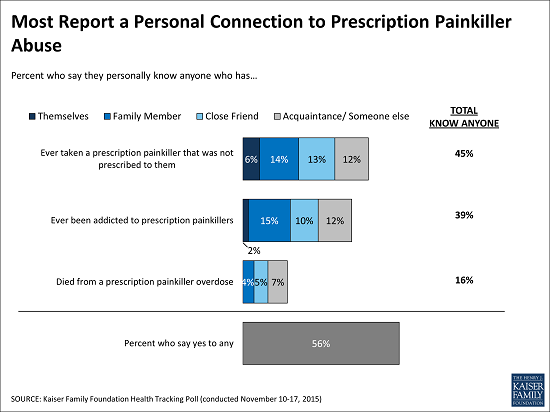
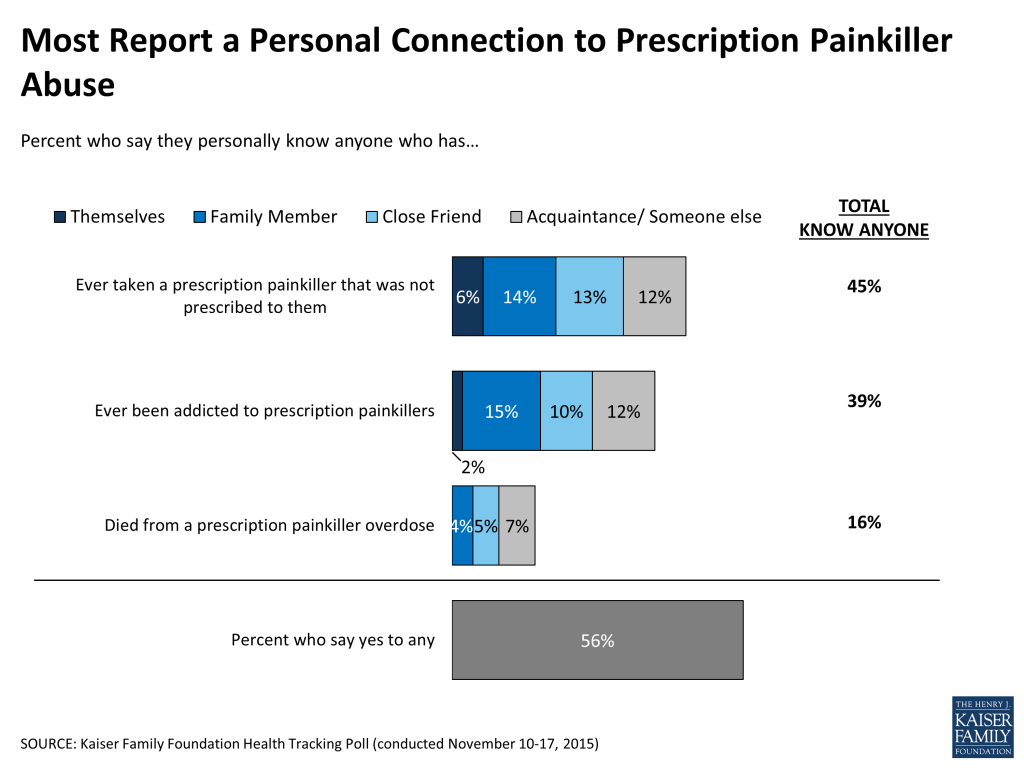
In total, 56 percent report a personal connection to painkiller abuse, because they either know someone who has taken a painkiller that wasn’t prescribed to them; have been addicted to painkillers themselves or know someone who has; or know someone who died from an overdose. Whites are more likely than Blacks and Hispanics to say to have a personal connection to prescription painkiller abuse (63% vs. 44% and 37%, respectively).

The total includes a surprising 16 percent who say they know someone who died, including 9 percent who describe that person as a close friend or family member. In addition, 27 percent say either they themselves have been, or a family member or close friend, has been addicted to painkillers.

Nov_2015_Tracking_Email_Alert_Chart_v3.png

The poll provides a detailed look at the public’s views, experiences and knowledge about prescription painkiller abuse, including a look at the importance they place on the issue.

Half (50%) say reducing prescription painkiller and heroin abuse should be a top priority for their governor and legislature, ranking the issue below improving public education (76%), making health care more accessible and affordable (68%), attracting and retaining businesses and jobs (64%), and reducing crime (64%), but similar to protecting the environment (54%), reforming the criminal justice system (50%), and improving infrastructure (46%).

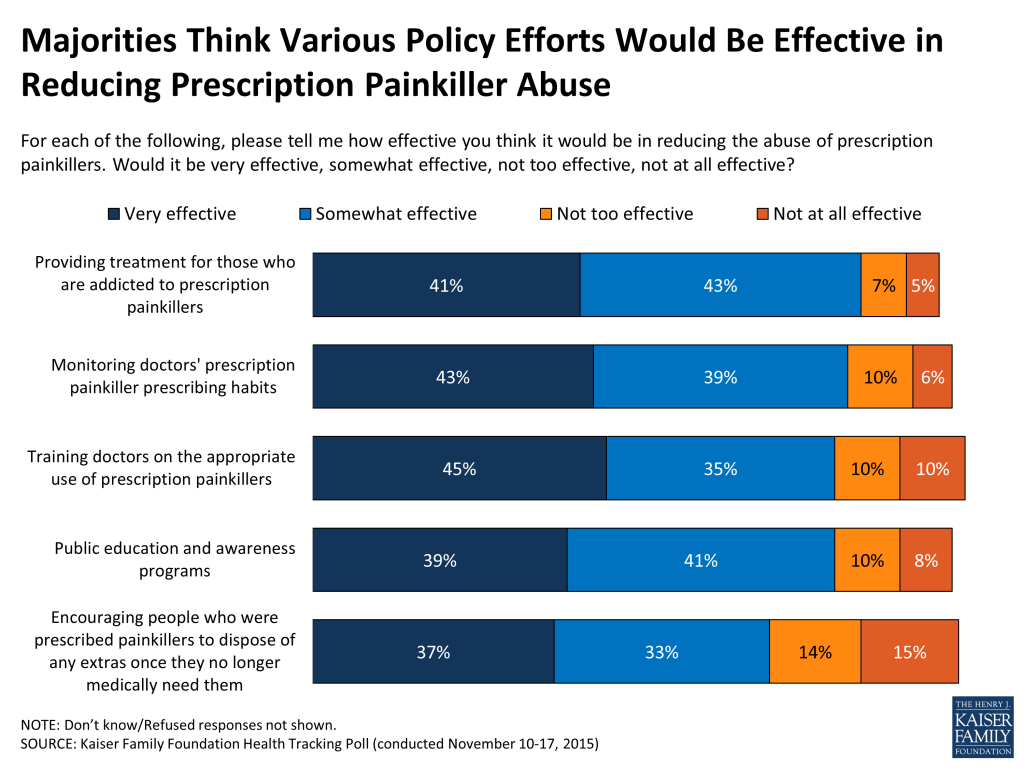
Large majorities also say a number of strategies to reduce prescription painkiller abuse would be at least somewhat effective, such as providing treatment for those who are addicted (85%), monitoring doctors’ prescribing habits (82%), public education and awareness programs (80%), training doctors on the appropriate use of painkillers (79%), and encouraging people who were prescribed painkillers to dispose of any extras once they no longer medically need them (69%).

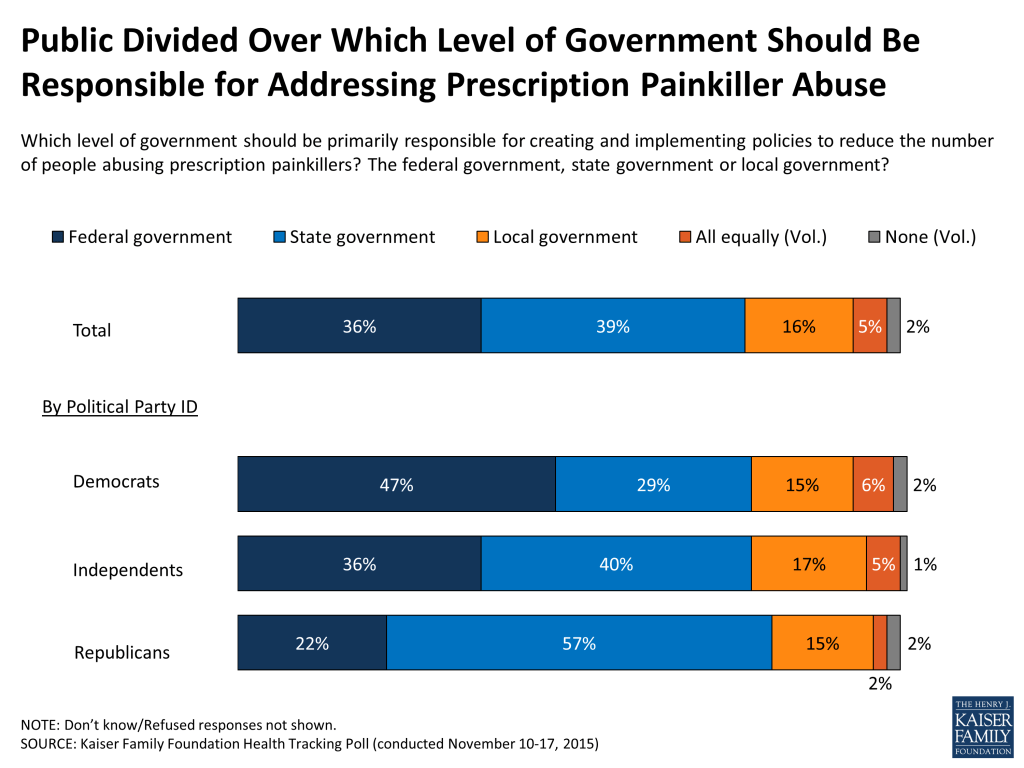
About equal shares say addressing the issue should primarily be the responsibility of the federal (36%) or state government (39%), while fewer (16%) say it should fall to local governments. Republicans are more likely to say the responsibility primarily falls to state governments, while Democrats are more apt to say it falls to the federal government.

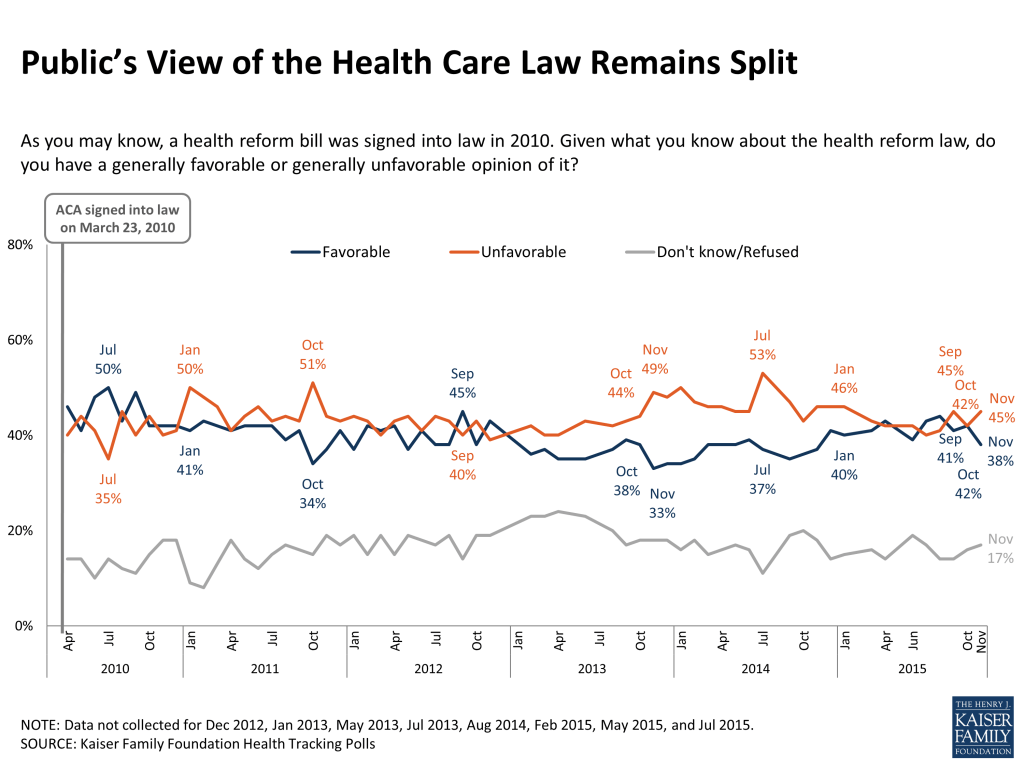
The tracking poll this month also finds more people with an unfavorable view of the Affordable Care Act than a favorable view (45% vs. 38%).  Views of the health care law had been narrowly divided for much of the year.  As in the past, there is a stark partisan divide, with most Democrats (63%) having a favorable opinion, most Republicans (75%) having an unfavorable one, and independents in the middle (36% favorable, 44% unfavorable).

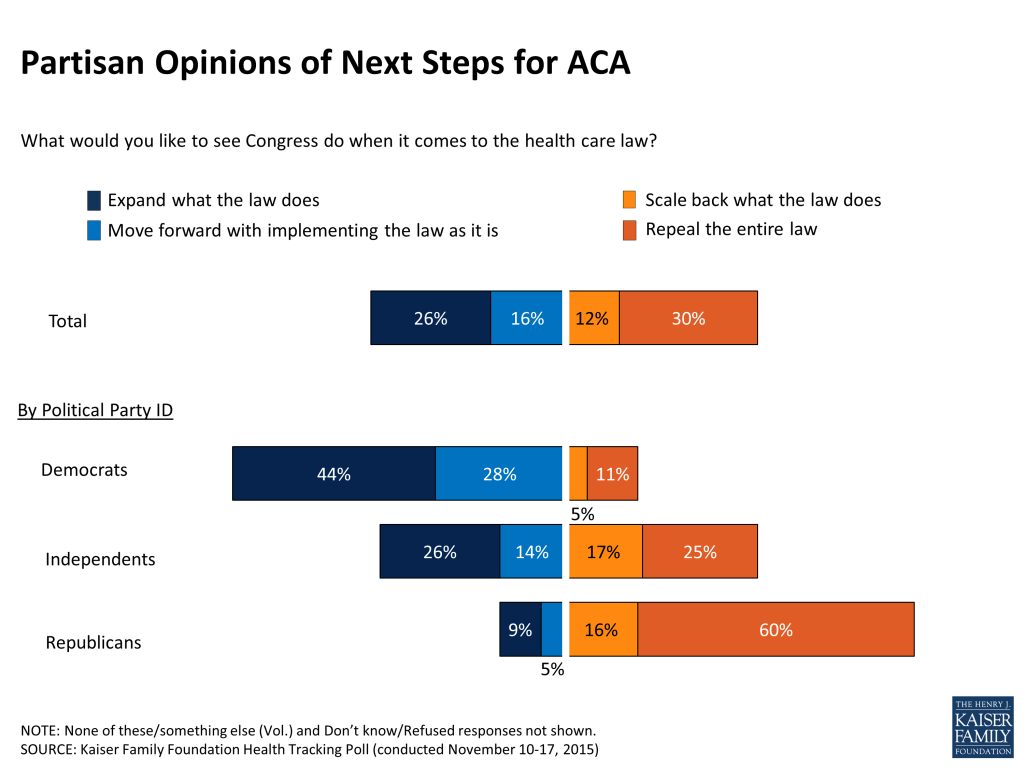
The public also remains split on what Congress should do next: 30 percent say they would like Congress repeal the entire law, 12 percent want Congress to scale it back, 16 percent want to move forward with implementing the law as is, and 26 percent want Congress to expand what the law does.

The survey finds that about a third of the public (35%, including 40% of the uninsured) say they are closely following news coverage of the ACA’s third open enrollment period. Seven in 10 (69 percent) of the uninsured say health insurance is something they need, though most have not tried to get health insurance recently.  Among those without health insurance, the largest share (33%) cites affordability of insurance as the reason they remain uninsured.

The poll was designed and analyzed by public opinion researchers at the Kaiser Family Foundation and was conducted from Nov. 10 to 17, 2015 among a nationally representative random digit dial telephone sample of 1,352. Interviews were conducted in English and Spanish by landline (540) and cell phone (812). The margin of sampling error is plus or minus 3 percentage points for the full sample. For results based on subgroups, the margin of sampling error may be higher.

Poll Finding

Kaiser Health Tracking Poll: November 2015

Authors: Bianca DiJulio, Jamie Firth, Liz Hamel, and Mollyann Brodie
Published: Nov 24, 2015

Kaiser Health Tracking Poll: November 2015 Findings

As the problem of prescription painkiller abuse has captured greater attention from policymakers and the media, the November Kaiser Health Tracking Poll explores the public’s connection to and knowledge of the issue, as well as their views of how to address it. A surprising 56 percent of the public say they have some personal connection to the issue – either because they say they know someone who has taken a prescription painkiller that wasn’t prescribed to them, know someone who has been addicted, or know someone who has died from a prescription painkiller overdose. More of the public says it’s easy for people to get access to painkillers not prescribed to them than say it is easy for people who medically need them to access them (77 percent vs.58 percent). Combatting the problem of opioid abuse ranks among several other priorities the public has for their state officials, with 50 percent saying it should be a top priority, lower than the shares who say other issues such as improving public education (76 percent) or attracting and retaining business and jobs (64 percent) are top priorities, but similar to the shares who place a top priority on reforming the criminal justice system (50 percent) and improving infrastructure (46 percent). The public is largely supportive  of ‘Good Samaritan’ laws that some states have adopted that allow people to call for emergency medical help for a drug overdose for themselves or others without fear of being prosecuted (63 percent). However, when it comes to views on access to Naloxone, a medication that can reverse the effects of a drug overdose, most of the public believes that access should be restricted to those with a prescription (62 percent). Large majorities say a number of efforts would be effective in reducing painkiller abuse, including treatment programs (85 percent), monitoring doctors’ prescribing habits (82 percent), public education programs (80 percent), training doctors (79 percent), and encouraging people to appropriately dispose of leftover medication (69 percent).

While views of the health care law have been narrowly divided for much of the year, this month more say they have an unfavorable view of the law than a favorable one (45 percent versus 38 percent, a statistically significant difference). About a third of the public (35 percent), including 40 percent of the uninsured, says they are closely following news coverage of the ACA’s third open enrollment period. The uninsured report valuing insurance, with large majorities saying it is personally important to have (86 percent) and that it is something they need (69 percent), and just over half (55 percent) intend on getting coverage in the next few months. When asked to say in their own words why they are uninsured, the most common response is that insurance is too expensive and they can’t afford it (33 percent).

Prescription Painkiller Abuse

The abuse of prescription painkillers is receiving more attention and President Obama recently addressed the issue, calling for more federal action to prevent and treat addiction. This month’s Kaiser Health Tracking Poll takes a look at the issue, examining the public’s personal connection to and knowledge of the issue as well as their views of what approaches may be effective in reducing the abuse of prescription painkillers.

Widespread Personal Connections to the Issue

More than half (56 percent) of the public report that they have some personal connection to the issue, saying that they or someone they know has abused, been addicted to, or died from prescription painkillers. More specifically, nearly half (45 percent) say they personally know someone who has taken a prescription painkiller that was not prescribed to them, including 6 percent who say they personally have done this and an additional 27 percent who say that a close friend or family member has. About four in 10 (39 percent) say they know someone who has been addicted to prescription painkillers, including 2 percent who say they personally have been and an additional 25 percent who say a close friend or family member has been addicted. About 1 in 6 (16 percent) say they know someone who has died from a prescription painkiller overdose, including 9 percent who say that person was a family member or close friend.

Figure 1

Exposure to prescription painkiller abuse, addiction and overdose impacts some subsets of the U.S. population more than others. For instance, whites are more likely than Blacks and Hispanics to say to have a personal connection to prescription painkillers (63 percent vs. 44 percent and 37 percent, respectively). Additionally, young and middle-aged Americans are more likely than adults ages 65 and older to report a personal connection to prescription painkillers. Otherwise, across most demographic groups, majorities report having a personal connection to the issue.

Figure 2 

Knowledge of Epidemic

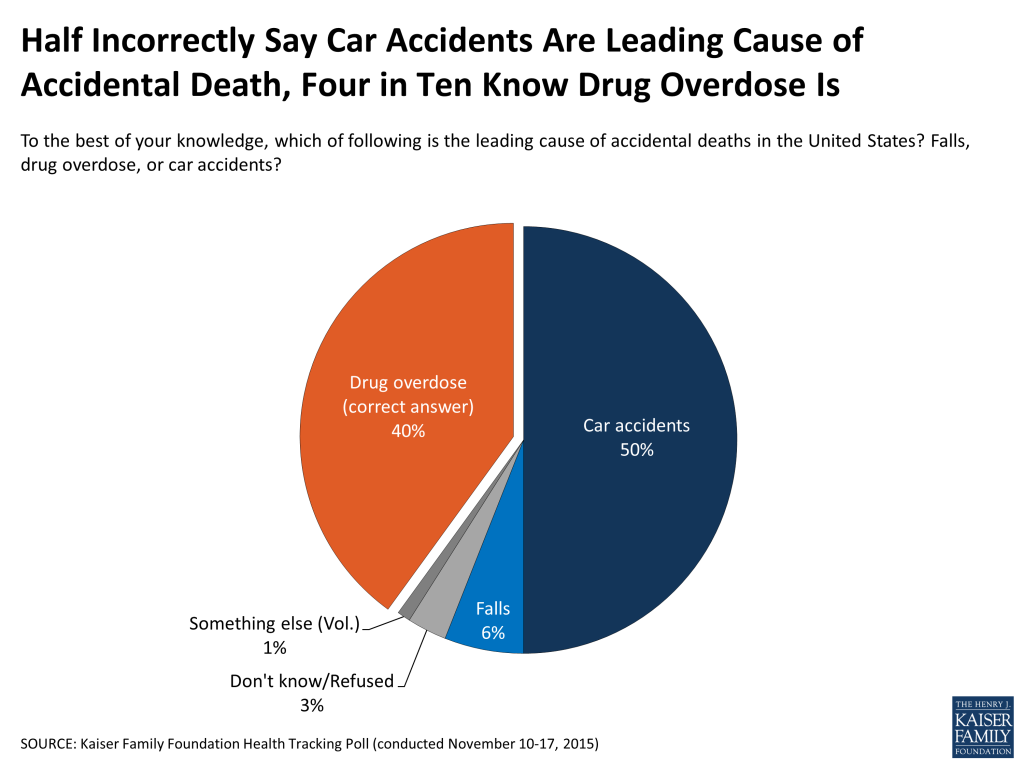
Drug overdose ranks as the leading cause of accidental deaths in the U.S. according to the Centers for Disease Control and Prevention,1  yet 4 in 10 (40 percent) Americans are aware of this fact. A larger share instead names car accidents as the main culprit (50 percent), 6 percent say falls, and the rest are unsure or volunteer another cause. Those who say they know someone who has died of a prescription painkiller overdose are more likely than those who say they don’t to correctly respond that the leading cause of accidental deaths in the U.S. is drug overdose (50 percent vs. 38 percent).

Figure 3

Access to Prescription Pain Medicines

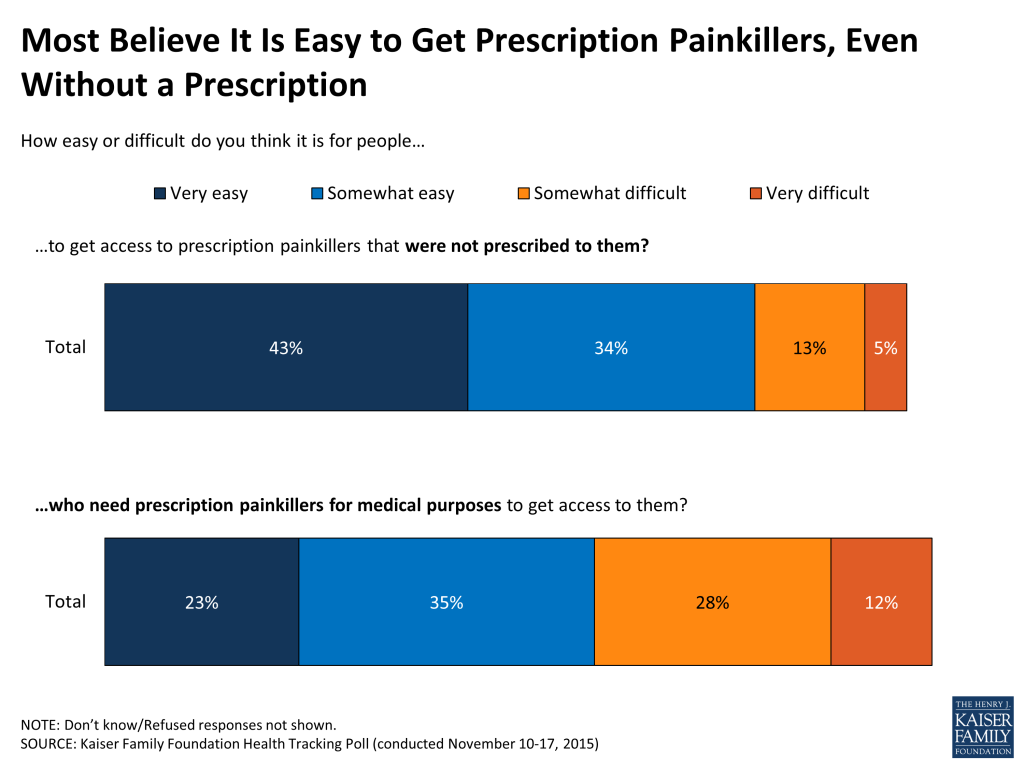
In the debate about how to rein in the abuse of prescription drugs, policymakers and medical professionals are faced with finding an appropriate balance so that access to these drugs is restricted for those who are abusing them, while at the same time, maintaining access for those who medically need them. The perception among the public is that the balance is currently in the abuser’s favor. More of the public says it’s easy for people to get access to painkillers not prescribed to them than say it is easy for people who medically need them to access them (77 percent vs.58 percent). In fact, about 4 in 10 (39 percent) say they think it is difficult for those who medically need prescription painkillers to access them.

Figure 4

Views and Knowledge of Prescription Painkillers Compared to Heroin

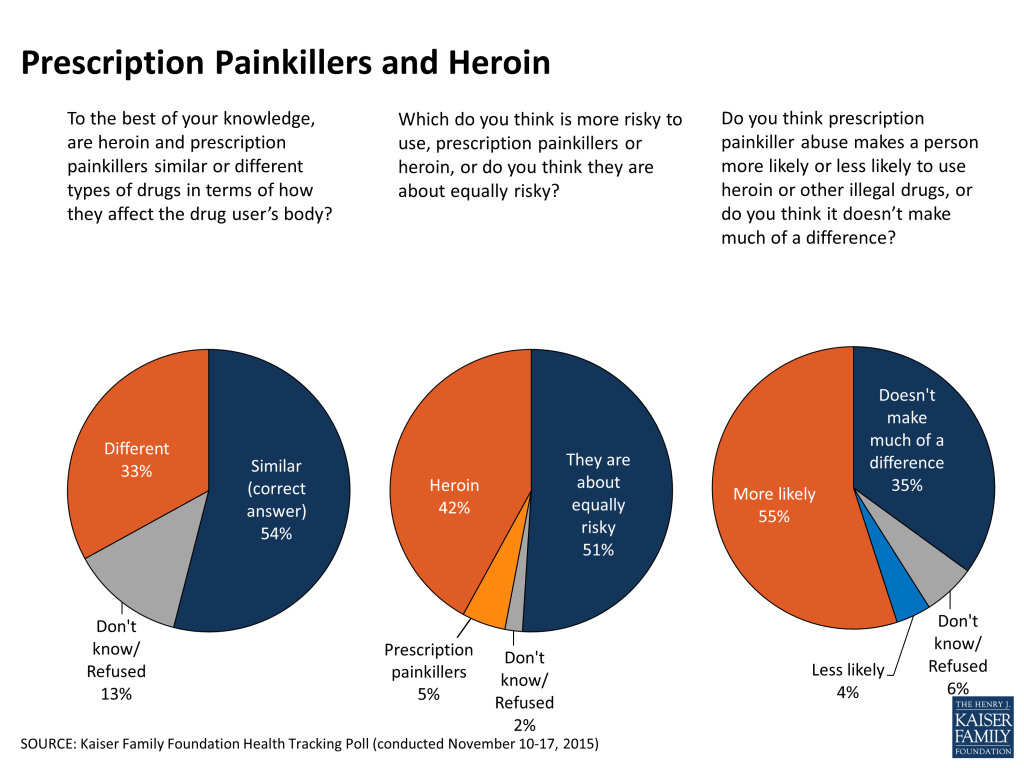
There are some misconceptions about how similar or different prescription painkillers are from heroin. In terms of how they affect the user’s body, just over half (54 percent) of the public correctly say heroin and prescription painkillers are similar, but a third (33 percent) say they affect the body differently, and 13 percent say they don’t know. When asked which is more risky to use, about half (51 percent) of the public says they are about equally risky, while about four in ten (42 percent) hold the view that heroin is more risky. Few (5 percent) say that it’s more risky to use prescription painkillers than heroin. In addition, most of the public (55 percent) acknowledges that abusing prescription painkillers makes a person more likely to use heroin or other illegal drugs,2  while about a third (35 percent) say it doesn’t make much of a difference and few (4 percent) believe prescription drug abuse makes someone less likely to use other illegal drugs.

Figure 5

Combatting the Problem

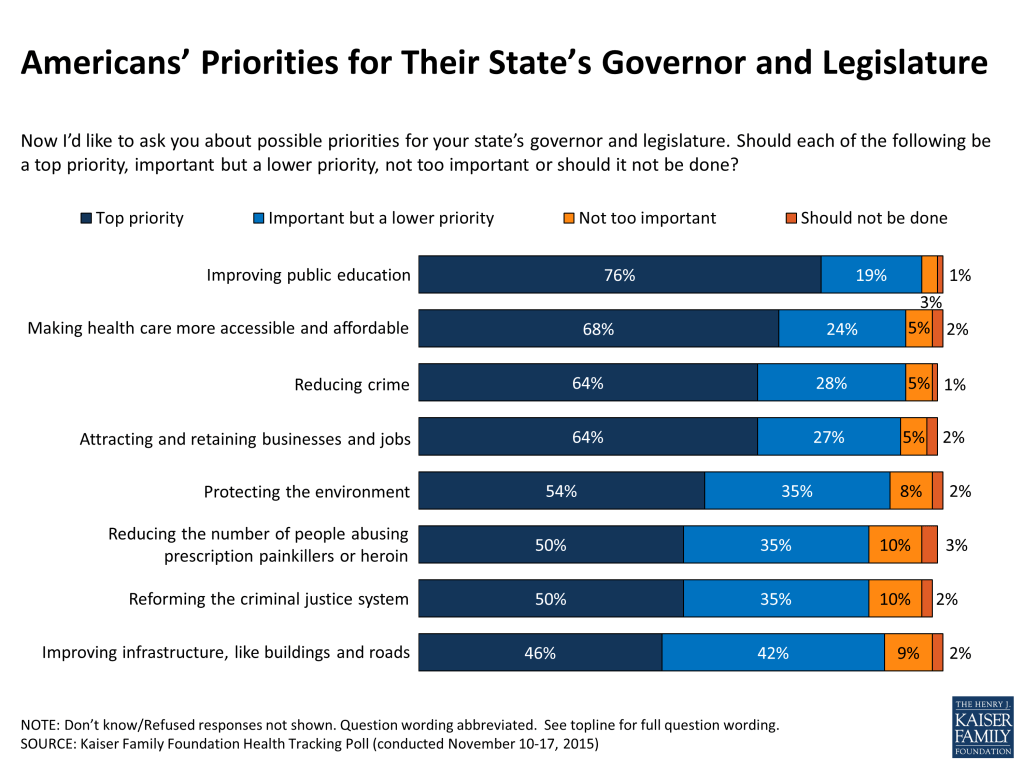
Combatting the abuse of prescription painkillers and heroin is one of many priorities the public would like their state governor and legislature to address. Half (50 percent) say reducing the number of people abusing prescription painkillers or heroin should be a top priority for their state lawmakers. This ranks below a number of other issues the public sees as top priorities for their state such as improving public education (76 percent), making health care more accessible and affordable (68 percent), attracting and retaining businesses and jobs (64 percent), and reducing crime (64 percent). Reducing opioid abuse ranks among other issues such as protecting the environment (54 percent), reforming the criminal justice system (50 percent) and improving infrastructure, like buildings and roads (46 percent). Among those who say they know someone who has died of a drug overdose, 65 percent say reducing the number of people abusing prescription painkillers or heroin should be a top priority.

Figure 6

The public is divided about which level of government should be primarily responsible for combatting prescription painkiller abuse, with about equal shares saying it is the responsibility of the federal government (36 percent) or the state government (39 percent). An additional 16 percent say the responsibility should fall to local governments. Republicans are more likely to say the responsibility primarily falls to state governments rather than the federal government (57  percent vs. 22 percent), while Democrats are more apt to say it falls to the federal government rather than state governments (47  percent vs. 29 percent).

Figure 7

Some states have passed laws specifically aimed at lowering the number of deaths from opioid overdoses.3  One such law is related to a drug called Narcan or Naloxone that can prevent people from dying if they are experiencing an overdose of a prescription painkiller or heroin. Some states have passed laws to make this drug available to adults without a prescription while other states restrict the sale of the drug due to concerns it might encourage the use of illegal drugs. When asked their views on these laws, most of the public (62 percent) say access to the drug should only be allowed with a prescription, nearly twice the share who say it should be available without a prescription (33 percent). Republicans (74 percent) are more likely than Democrats and independents to say access to the drug should be restricted, but still majorities of Democrats (54 percent) and independents (61 percent) agree. Those who know someone who has abused prescription painkillers or died from an overdose are more likely than those who don’t to say people should be able to get the drug without a prescription (41 percent vs. 23 percent).

Figure 8

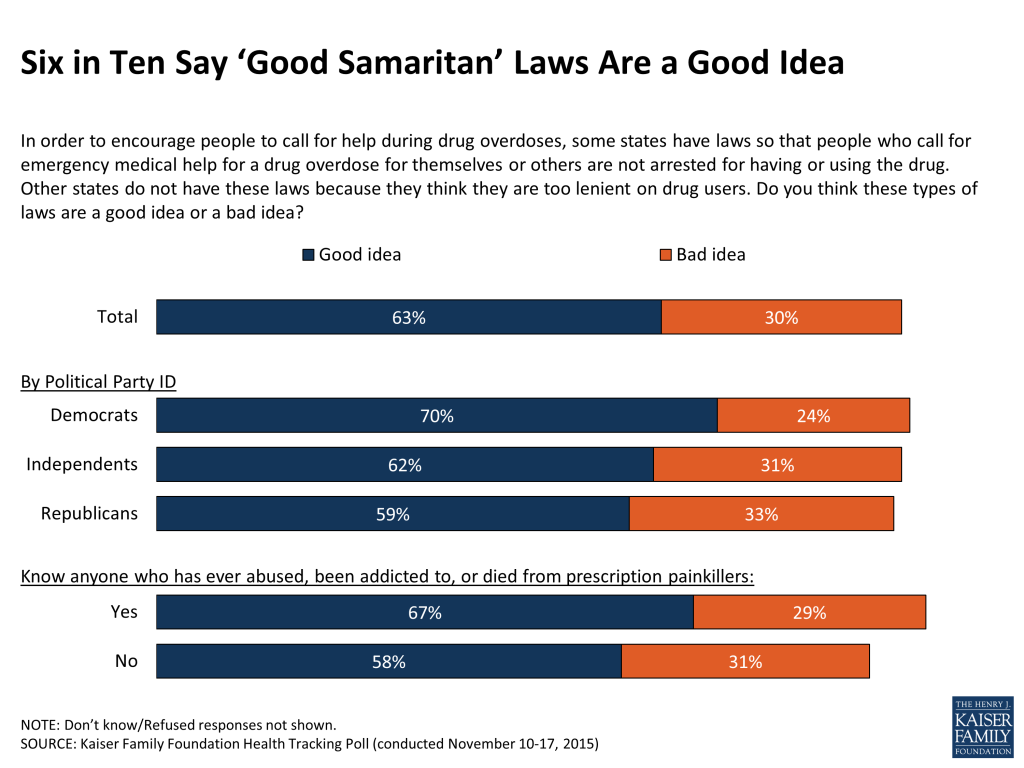
Another approach some states have taken to reduce opioid deaths is enacting ‘Good Samaritan’ laws, whereby people who call for emergency medical help for a drug overdose for themselves or others are not arrested for having or using the illicit drug. However, some criticize this approach saying it is too lenient on drug users. Most of the public (63 percent), including majorities across party lines, say these types of laws are a good idea, while 3 in 10 (30 percent) say they are a bad idea. Those who say they have a personal connection to the issue are more likely than others to say ‘Good Samaritan’ laws are a good idea (67 percent vs. 58 percent).

Figure 9

Large majorities of the public say a number of other efforts to reduce prescription painkiller abuse would be at least somewhat effective, such as providing treatment for those who are addicted to prescription painkillers (85 percent), monitoring doctors’ prescription painkiller prescribing habits (82 percent), public education and awareness programs (80 percent), training doctors on the appropriate use of prescription painkillers (79 percent), and encouraging people who were prescribed painkillers to dispose of any extras once they no longer medically need them (69 percent).

Figure 10

Views of the ACA

While views of the health care law have been narrowly divided for much of the year, this month, more say they have an unfavorable view of the law than a favorable one (45 percent versus 38 percent, a statistically significant difference). As has been true since the law passed, there is a stark partisan divide on views of the law. A majority of Democrats (63 percent) report a favorable opinion and a majority of Republicans (75 percent) report an unfavorable one. Independents fall in the middle with 36 percent feeling favorable and 44 percent feeling unfavorable.

Figure 11

In line with findings from previous Kaiser Health Tracking Polls, the public doesn’t agree on what Congress should do when it comes to the health care law. Three in 10 (30 percent) say they would like Congress to repeal the entire law and 12 percent want Congress to scale back what the law does, while 16 percent think it is best to move forward with implementing the law as is and 26 percent say they would like to see Congress expand what the law does. Similar to overall opinion of the law, opinions about the future of the law vary starkly by political party identification.

Figure 12

Kaiser Health Policy News Index: November 2015

The Kaiser Health Policy News Index is designed to help journalists and policymakers understand which health policy-related news stories Americans are paying attention to, and what the public understands about health policy issues covered in the news.

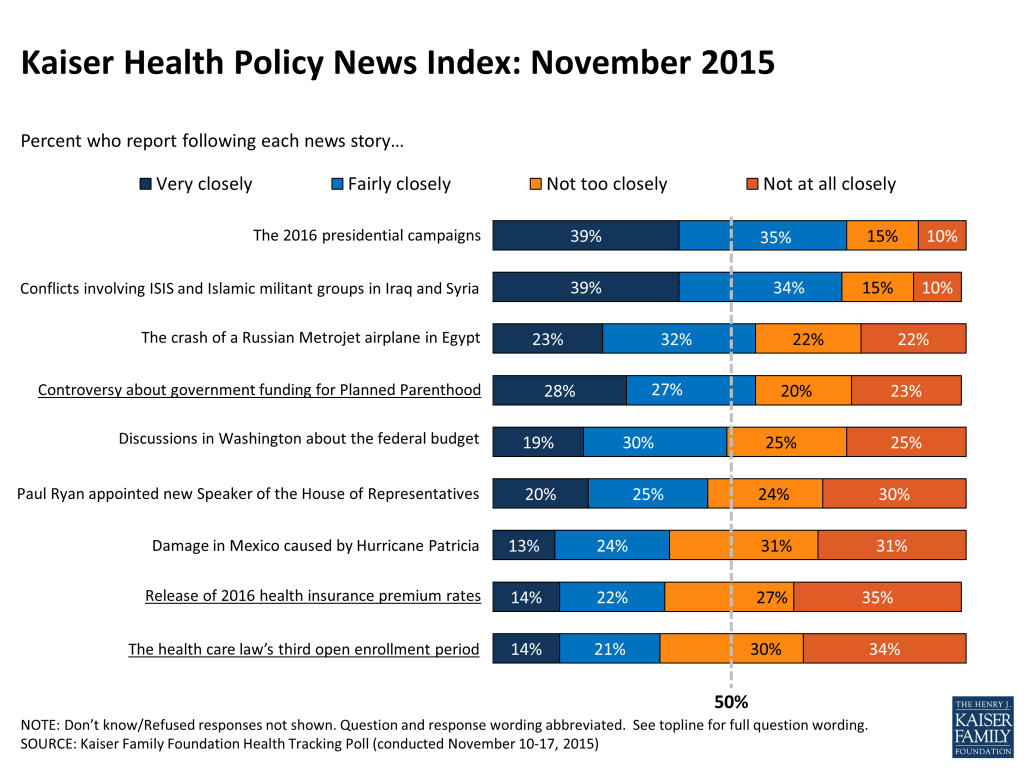
Health policy news took a back seat to other national and international news stories this month, as the public’s attention was focused on news coverage of the 2016 presidential campaigns and international conflicts involving ISIS and other Islamic militant groups in Iraq and Syria (about three-quarters say they followed each story ‘very’ or ‘fairly’ closely). This survey was in the field during the attacks on Paris, and those who took the survey on or after the day of the attacks are slightly more likely to say they followed news about ISIS (77 percent), but still 69 percent of those who took the survey before the attacks say they followed this news. Roughly half of the public reports closely following the crash of a Russian Metrojet airplane in Egypt (55 percent) and the controversy about government funding for Planned Parenthood (56 percent), along with other national stories such as discussions in Washington about the federal budget (50 percent) and news that Paul Ryan was appointed as the new Speaker of the House of Representatives (45 percent). Fewer than 4 in 10 say they closely followed damage in Mexico caused by Hurricane Patricia (37 percent) and the health policy stories about the release of 2016 health insurance premium rates (36 percent) and the health care law’s third open enrollment period (35 percent).

Figure 13

The ACA’s Third Open Enrollment Period and the Uninsured

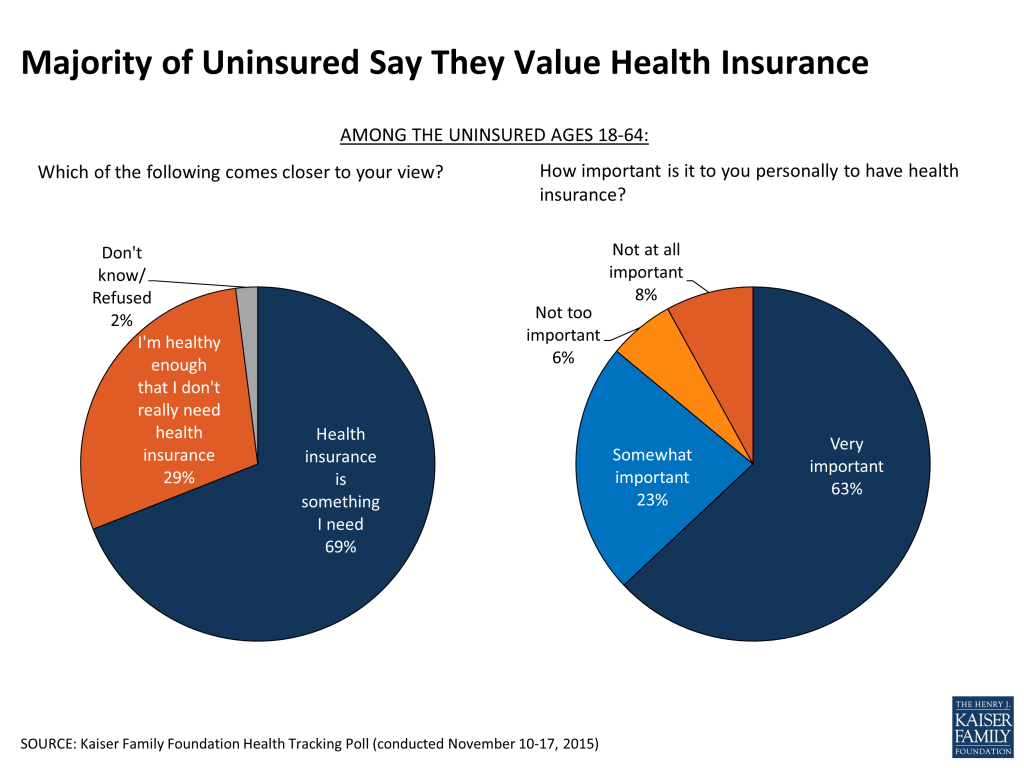
This month marks the start of the third open enrollment period under the health care law, which provides the opportunity to purchase health insurance on the exchanges and access to financial assistance, and the uninsured remain a key target for enrollment efforts. While 4 in 10 uninsured Americans (40 percent) report closely following news coverage of the health care law’s third open enrollment period, most say they value health insurance. Seven in 10 (69 percent) of the uninsured say health insurance is something they need, while 3 in 10 (29 percent) say they are healthy enough to go without. Additionally, the vast majority of the uninsured (86 percent) say it is at least somewhat important to them personally to have health insurance, including about 6 in 10 (63 percent) who say it is very important.

Figure 14

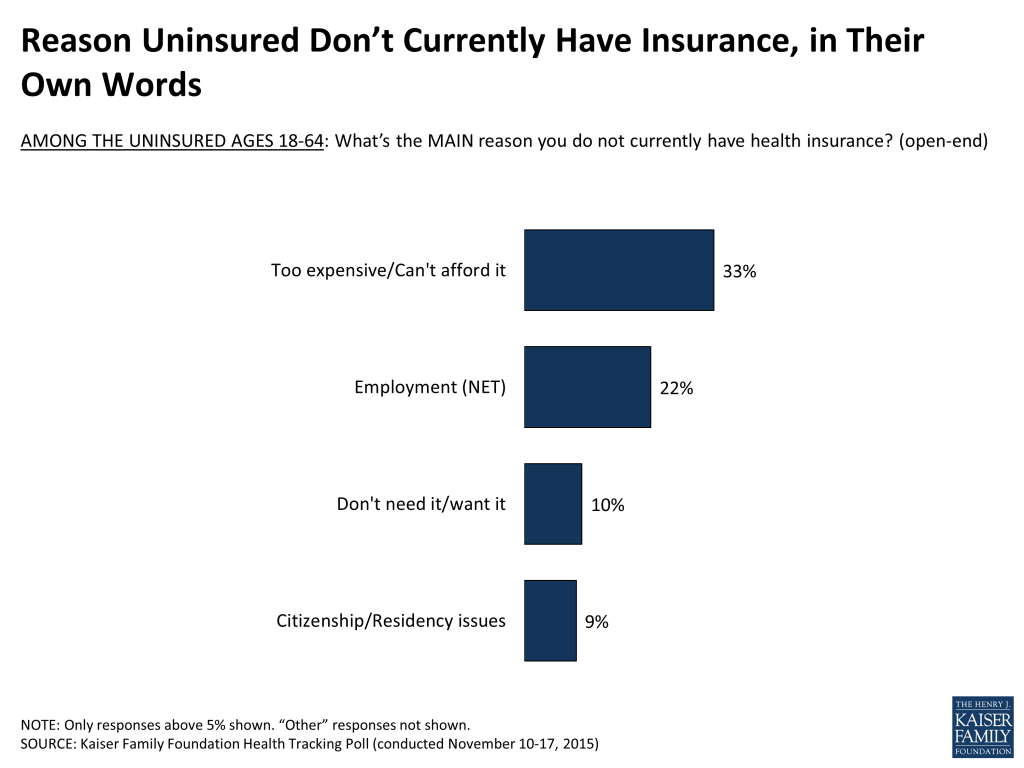
While a majority of the uninsured (68 percent) say they have not tried to get insurance in the past 6 months, about a third (32 percent) say they have tried but remain uninsured. When the uninsured are asked about the main reason they don’t have coverage, the most common response is that insurance is too expensive and they can’t afford it (33 percent), followed by job-related issues such as unemployment or their employer doesn’t offer health insurance (22 percent). About one in ten each say they don’t need or want health insurance (10 percent), or that citizenship or residency issues have prevented them from getting it (9 percent). Just over half (55 percent) say they plan to get health insurance in the next few months, while four in ten (40 percent) expect to remain uninsured.

Figure 15

Kaiser Health Tracking Poll: November 2015 Methodology

This Kaiser Health Tracking Poll was designed and analyzed by public opinion researchers at the Kaiser Family Foundation (KFF). The survey was conducted November 10-17, 2015, among a nationally representative random digit dial telephone sample of 1,352 adults ages 18 and older, living in the United States, including Alaska and Hawaii (note: persons without a telephone could not be included in the random selection process). Computer-assisted telephone interviews conducted by landline (540) and cell phone (812, including 476 who had no landline telephone) were carried out in English and Spanish by Princeton Data Source under the direction of Princeton Survey Research Associates International (PSRAI). Both the random digit dial landline and cell phone samples were provided by Survey Sampling International, LLC. For the landline sample, respondents were selected by asking for the youngest adult male or female currently at home based on a random rotation. If no one of that gender was available, interviewers asked to speak with the youngest adult of the opposite gender. For the cell phone sample, interviews were conducted with the adult who answered the phone. KFF paid for all costs associated with the survey.

The combined landline and cell phone sample was weighted to balance the sample demographics to match estimates for the national population using data from the Census Bureau’s 2013 American Community Survey (ACS) on sex, age, education, race, Hispanic origin, nativity (for Hispanics only), and region along with data from the 2010 Census on population density. The sample was also weighted to match current patterns of telephone use using data from the July-December 2014 National Health Interview Survey. The weight takes into account the fact that respondents with both a landline and cell phone have a higher probability of selection in the combined sample and also adjusts for the household size for the landline sample. All statistical tests of significance account for the effect of weighting.

The margin of sampling error including the design effect for the full sample is plus or minus 3 percentage points. Numbers of respondents and margins of sampling error for key subgroups are shown in the table below. For results based on other subgroups, the margin of sampling error may be higher. Sample sizes and margins of sampling error for other subgroups are available by request. Note that sampling error is only one of many potential sources of error in this or any other public opinion poll. Kaiser Family Foundation public opinion and survey research is a charter member of the Transparency Initiative of the American Association for Public Opinion Research.

GroupN (unweighted)M.O.S.E.
Total1,352±3 percentage points
Party Identification
   Democrats425±6 percentage points
   Republicans372±6 percentage points
   Independents390±6 percentage points
Insurance Status
  Insured, ages 18-64838±4 percentage points
  Uninsured, ages 18-64112±10 percentage points
Know anyone who has abused, been addicted to, or died from prescription painkillers
  Yes760±4 percentage points
  No577±5 percentage points

Endnotes

  1. The Centers for Disease Control and Prevention, Accidents or Unintentional Injuries, http://www.cdc.gov/nchs/fastats/accidental-injury.htm ↩︎
  2. The Centers for Disease Control and Prevention, New research reveals the trends and risk factors behind America’s growing heroin epidemic, http://www.cdc.gov/media/releases/2015/p0707-heroin-epidemic.html ↩︎
  3. National Conference of State Legislatures, http://www.ncsl.org/research/civil-and-criminal-justice/drug-overdose-immunity-good-samaritan-laws.aspx ↩︎
News Release

New Analysis Examines the $1.9 Billion Committed By the U.S. Government for the International Ebola Response To Date

Published: Nov 23, 2015

A new Kaiser Family Foundation analysis finds government agencies so far report spending approximately $1.9 billion in funding to respond to the Ebola outbreak internationally. The majority of this spending was by USAID (49%), followed by the Department of Defense (33%), and the Centers for Disease Control and Prevention (18%).

The U.S. government enacted $5.4 billion in emergency Ebola funding in December 2014, representing the largest effort by a single donor government to respond to the outbreak. More than two-thirds of the emergency funding ($3.7 billion) was specified for international response efforts, while 21 percent ($1.1 billion) was for domestic purposes, and 10 percent ($515 million) was for research and development.

Congress made most of the emergency funding package available for at least a five year period or until it is spent. Spending reports to date indicate a significant amount remains for ongoing and future activities. Currently, only limited information is publicly available as to the specific activities funded through the spending package, and status of funding from departments and agencies working on domestic and research and development activities is limited.

The goals for the emergency Ebola funding were to fortify domestic public health systems, contain the epidemic in West Africa, speed the development of vaccines, and improve countries’ ability to detect, prevent, and respond to future disease outbreaks.

These findings will be discussed today at a public briefing held by the Kaiser Family Foundation in Washington, D.C. The event will be recorded and made available on Kaiser’s website.

Proposed Changes to Medicaid Expansion in Arizona

Published: Nov 20, 2015

On September 30, 2015, Arizona submitted an application to the Centers for Medicare and Medicaid Services (CMS) for a new Section 1115 demonstration waiver that proposes changes for adults eligible through the Affordable Care Act’s (ACA) Medicaid expansion.1  Prior to the ACA, Arizona had expanded coverage through a Section 1115 waiver to include working parents up to 106% FPL and non-working parents and childless adults up to 100% FPL. Coverage for childless adults was implemented in 2000 as a result of Voter Proposition 204. Beginning in July 2011, enrollment for childless adults was capped.2  Arizona implemented the ACA’s Medicaid expansion as of January 2014 to cover most adults up to 138% of the federal poverty level (FPL, $16,242 per year for an individual in 2015). Arizona’s Medicaid expansion population includes approximately 315,000 beneficiaries, of which 63,000 were newly eligible adults (working parents from 106-138% FPL and non-working parents and childless adults from 100-138% FPL) and nearly 252,000 were previously eligible childless adults from 0 to 100% FPL who had been subject to an enrollment cap since 2011. Arizona administers its entire Medicaid program through a long-standing Section 1115 demonstration waiver, dating back to 1989, which enables Arizona to deliver Medicaid through capitated managed care. Arizona’s present waiver incorporates the ACA’s Medicaid expansion population but does not include any waiver authorities related to the ACA expansion specifically.

Arizona’s new waiver application seeks several changes as part of the proposed Choice, Accountability, Responsibility, Engagement (CARE) program that would affect the expansion population.3  If approved by CMS, Arizona’s new waiver would change coverage for the Medicaid expansion population through the CARE program as of October, 2016 in the following ways:

  • Impose monthly premiums4  of 2% of income or $25, whichever is less, on all Medicaid expansion adults from 0-138% FPL, paid into health savings accounts;
  • Require that co-payments, up to 3% of income, would be paid monthly into health savings accounts based on services already used (state legislation requires Arizona to pursue cost-sharing to the maximum allowed under federal law);
  • Establish co-payments for missed appointments and co-payments above maximum federal limits for non-emergency use of the emergency room5  pursuant to Section 1916(f) waiver authority;
  • Disenroll and lock out of coverage for six months beneficiaries from 100-138% FPL for nonpayment of premiums and co-payments; failure to make payments for beneficiaries below poverty would not result in a lock out but would be counted as a debt to the State;
  • Create a healthy behavior incentive program that would allow beneficiaries to use health savings account funds for non-covered services or reduce future account contributions if they make timely account payments and comply with one target healthy behavior and work incentives (see below);
  • Create a work incentive program, which would not be a condition of eligibility, for beneficiaries to engage in activities such as connecting to a state employment supports program, attending a job fair, enrolling in job seekers’ assistance, taking a class, or other similar goals; and
  • Waive non-emergency medical transportation services for beneficiaries from 100-138% FPL for one year from October 2015 to September 2016.

In addition, state law requires Arizona to seek waiver authority for two new provisions that would affect the Medicaid expansion population as well as all other “able-bodied” adult Medicaid beneficiaries (with certain populations exempted).6  These provisions would:

  • Require able-bodied adults receiving Medicaid to work, actively seek work, or attend school or a job training program for 20 hours per week and to verify compliance and any family income changes monthly;
  • Impose a 1-year ban on Medicaid enrollment for knowingly failing to report a change in family income or making a false statement about compliance with work requirements; and
  • Impose a 5-year lifetime limit on Medicaid benefits for able-bodied adults.

If not granted by CMS, state law requires Arizona to re-apply each year for waiver authority for the following provisions: to require work for able-bodied adults, to impose a 5 year lifetime limit on able-bodied adults, and to impose “meaningful” cost-sharing requirements for non-emergency use of the emergency room and use of ambulance services for non-emergency use or when not medically necessary.7 

Arizona’s new waiver application also proposes changes in other aspects of its Medicaid program, including a delivery system reform incentive payment program, medical homes for American Indians, payment reforms to transition from the safety net care pool, and the continuation of Arizona’s current demonstration authorities.8  Arizona’s proposal is subject to approval by CMS after a federal public comment period that ends on November 16, 2015.

To date, CMS has approved Medicaid expansion waivers in six states (Arkansas, Iowa, Indiana, Michigan, New Hampshire,9  and Montana). A seventh state, Pennsylvania, initially had implemented the Medicaid expansion using a Section 1115 demonstration, but later changed to a traditional Medicaid expansion.

Table 1 describes the major elements that would apply to newly eligible adults in Arizona’s proposed Section 1115 demonstration.

Table 1: Provisions Affecting Medicaid Expansion Adults inArizona’s Proposed Section 1115 Medicaid Expansion Demonstration Waiver
ElementArizona Waiver Proposal
Overview:Seeks to change Medicaid coverage for the ACA expansion population by imposing premiums of 2% of income; disenrolling beneficiaries from 100-138% FPL for six months for nonpayment of premiums; imposing copays up to 3% of income paid monthly into health savings accounts; imposing copayments above state plan amounts for non-emergency use of the emergency room and missed appointments; creating a healthy behavior incentive program; implementing a work incentive program; and waiving non-emergency medical transportation for one year for beneficiaries from 100-138% FPL.

Also seeks a work requirement and a 5-year lifetime limit on benefits for all “able-bodied” adult Medicaid beneficiaries.

Duration:10/1/16 through 9/30/21
Proposed Waiver Provisions That Would Apply to ACA Medicaid Expansion Adults (CARE Program):
Coverage Groups:Newly eligible working parents from 106-138% FPL and non-working parents and childless adults from 100-138% FPL.

Previously eligible childless adults from 0-100% FPL.10 

Exempt Populations:American Indian/Alaska Natives, people with serious mental illness, people who are medially frail (to be defined by state in consultation with CMS), and people who serve as caregivers to a senior or person with a disability are exempt from the CARE program.

Working parents from 0-106% FPL and non-working parents from 0-100% FPL may choose to participate in the CARE program.

Premiums:Would require premiums of 2% of income or $25/month, whichever is less, paid into health savings account (described below).
Co-Payments:Would require co-payments up to 3% of annual household income. Co-payments would be paid into health savings account (described below) monthly for services already used instead of at point of service.

No co-payments for preventive or wellness services, services to manage chronic illness, any services (well or sick visit) at PCP or OB/GYN office, specialist services with PCP referral, behavioral health services/people with serious mental illness, or prescription drugs (except for opioids other than for people with cancer or who are terminally ill and brand name drugs unless doctor has determined that generic is ineffective).

Co-payments would be at state plan amounts, except that state seeks waiver authority to impose co-payments in excess of federal law as follows:

Non-emergency use of the emergency room:

New adults 0-100% FPL: $25 if within 20 miles of community health center, rural health center or urgent care center; otherwise $8 for first use if not admitted and $25 for subsequent use if not admitted

New adults 100-138% FPL: $25 for each non-emergency use of ER if not admitted

Missed appointments:

All new adults 0-138% FPL: copay that would otherwise have been due for the service

Premiums and copays would be limited to 5% of annual household income.

Disenrollment and Lock-Out for Non-Payment:Beneficiaries from 100-138% FPL would be disenrolled and locked out of Medicaid eligibility for 6 months for nonpayment of monthly premiums and co-payments.

Beneficiaries from 0-100% FPL would not lose Medicaid eligibility for nonpayment of premiums and co-payments but would have any unpaid amounts counted as a debt to the state.

Health Savings Accounts:Health savings account funds could be used for non-covered dental, vision or chiropractic services, nutritional counseling, recognized weight loss programs, gym membership, and sunscreen if beneficiary makes timely payments, complies with work incentive program, and meets one healthy behavior target (described below).

Employers could make voluntary tax-deductible health savings account contributions for their employees that could be used to reduce the beneficiary’s account contributions or to access non-covered services. Philanthropic organizations could make health savings account contributions for targeted purposes, such as smoking cession or managing chronic disease, or to support an identified population.

Once a beneficiary’s income exceeds Medicaid eligibility levels, the account balance would transfer to a private health savings account or the beneficiary could continue to use the health savings account through the state’s Medicaid third party administrator.

Healthy Behavior Incentives: If beneficiaries meet one healthy behavior target, they could use their health savings account funds to pay for non-covered services as described above. They also would have the option to reduce their health savings account payments or to roll unused health savings account funds over into the next year. If beneficiaries meet more than one healthy behavior target, they may qualify for incentives that the state is exploring through corporate and philanthropic partnerships.

Healthy behavior targets would include activities such as wellness exams, flu shots, glucose screening, mammogram, tobacco cession, and managing chronic diseases such as diabetes, substance use disorder, and asthma.

State will provide education about healthy behavior program to beneficiaries.

Medically frail beneficiaries unable to meet a healthy behavior target are exempt, and meeting healthy behavior targets is not a condition of Medicaid eligibility.

Delivery System and Benefits: Mandatory Medicaid MCO enrollment (no changes from AZ’s existing Section 1115 waiver).

Seeks waiver of non-emergency medical transportation services for new adults from 100-138% FPL from Oct. 1, 2015 through Sept. 30, 2016. State will explore opportunities to exempt medically frail beneficiaries from the non-emergency medical transportation waiver.

Work Incentive Program: Beneficiaries in the expansion population would comply with the work incentive program by connecting to a state employment supports program, attending a job fair, enrolling in job seeker’s assistance, taking a class, or other similar goals.

State will provide beneficiary education about work incentive program.

Medicaid eligibility is not conditioned on participation in work incentive program, and medically frail beneficiaries are exempt from work incentive program.

Proposed Waiver Provisions That Would Apply to All Able-Bodied Adult Medicaid Beneficiaries:
Work Requirement:State legislation requires that all able-bodied adults must work, actively seek work as verified by the state, or attend school or a job training program at least 20 hours/week. Exemptions for full-time high school students age 19 and older, sole caregivers of children under age 6, people receiving temporary or permanent long-term private or government disability benefits, and people determined physically or mentally unfit for work by health care professional according to state rules.

Beneficiaries must verify compliance and any change in family income monthly. State must verify changes in income and redetermine eligibility. State may ban beneficiary from enrollment for one year due to knowingly failing to report change in family income or making false statement about work program compliance.

Lifetime Limit on Benefits: State legislation requires state to seek waiver authority to impose a lifetime limit of 5 years of benefits on all able-bodied adults, to begin when waiver is approved. Exemptions for children, pregnant women, those who are working full-time, full-time high school students age 19 and older, sole caregiver of family member under age 6, and those receiving temporary or permanent long-term private or government disability benefits.
Financing:State anticipates that expenditures for newly eligible adults will be the same with and without the waiver.
Next Steps:Waiver application is subject to approval by CMS after a  federal public comment period that ends on Dec. 6, 2015.
  1. Arizona Health Care Cost Containment System, Application for a New Section 1115 Demonstration (Arizona Health Care Cost Containment System, Sept. 30, 2015), http://www.medicaid.gov/Medicaid-CHIP-Program-Information/By-Topics/Waivers/1115/downloads/az/az-hccc-pa2.pdf. ↩︎
  2. Kaiser Commission on Medicaid and the Uninsured, Medicaid Eligibility for Adults as of January 1, 2014 at Table 1 (Washington, DC: Kaiser Commission on Medicaid and the Uninsured, Oct. 2013), https://modern.kff.org/medicaid/fact-sheet/medicaid-eligibility-for-adults-as-of-january-1-2014/. ↩︎
  3. In addition, Arizona’s current waiver proposal would be voluntary for an additional over 256,000 previously eligible parents from 0-106% FPL (although in some places, the waiver narrative still indicates that participation for this group would instead be required). Arizona Health Care Cost Containment System, Application for a New Section 1115 Demonstration, Section 3 – Narrative at 2 (Arizona Health Care Cost Containment System, Sept. 30, 2015), http://www.medicaid.gov/Medicaid-CHIP-Program-Information/By-Topics/Waivers/1115/downloads/az/az-hccc-pa2.pdf. ↩︎
  4. In February, 2014, Arizona sought waiver authority from CMS to impose premiums up to 2% of income for newly eligible adults from 100-138% FPL; the state later withdrew this request. Letter from Cindy Mann, Director, CMS Center for Medicaid and CHIP Services to Thomas Betlach, Director, Arizona Health Care Cost Containment System at 2 (Dec. 15, 2014), http://www.medicaid.gov/Medicaid-CHIP-Program-Information/By-Topics/Waivers/1115/downloads/az/az-hccc-ca.pdf. ↩︎
  5. In February, 2014, Arizona sought waiver authority from CMS to impose a $200 copay for non-emergency use of the emergency room for newly eligible adults from 100-138% FPL. CMS denied this request because it “far exceeds the nominal $8 co-pay for such services established under Medicaid regulations and would be subject to the provisions under 1916(f) of the Social Security Act, which circumscribes [CMS’s] legal authority in waiving cost-sharing under Medicaid.” Letter from Cindy Mann, Director, CMS Center for Medicaid and CHIP Services to Thomas Betlach, Director, Arizona Health Care Cost Containment System at 2 (Dec. 15, 2014), http://www.medicaid.gov/Medicaid-CHIP-Program-Information/By-Topics/Waivers/1115/downloads/az/az-hccc-ca.pdf; see also Letter from Andrew M. Slavitt, Acting Administrator, CMS to Thomas Betlach, Director, Arizona Health Care Cost Containment System (June 22, 2015), http://www.medicaid.gov/Medicaid-CHIP-Program-Information/By-Topics/Waivers/1115/downloads/az/Health-Care-Cost-Containment-System/az-hccc-disappvl-ltr-06222015.pdf. ↩︎
  6. Arizona Health Care Cost Containment System, Application for a New Section 1115 Demonstration at 6-8 (reproducing Senate Bills 1475 and 1092) (Arizona Health Care Cost Containment System, Sept. 30, 2015), http://www.medicaid.gov/Medicaid-CHIP-Program-Information/By-Topics/Waivers/1115/downloads/az/az-hccc-pa2.pdf. ↩︎
  7. Arizona Health Care Cost Containment System, Application for a New Section 1115 Demonstration at 7-8 (reproducing Senate Bill 1092) (Arizona Health Care Cost Containment System, Sept. 30, 2015), http://www.medicaid.gov/Medicaid-CHIP-Program-Information/By-Topics/Waivers/1115/downloads/az/az-hccc-pa2.pdf. ↩︎
  8. Arizona Health Care Cost Containment System, Application for a New Section 1115 Demonstration (Arizona Health Care Cost Containment System, Sept. 30, 2015), http://www.medicaid.gov/Medicaid-CHIP-Program-Information/By-Topics/Waivers/1115/downloads/az/az-hccc-pa2.pdf. ↩︎
  9. NH is currently implementing a traditional expansion under state plan authority and will transition to demonstration authority as of 2016. ↩︎
  10. Prior to the ACA, Arizona covered childless adults from 0-100% FPL but enrollment was capped. Kaiser Commission on Medicaid and the Uninsured, Medicaid Eligibility for Adults as of January 1, 2014 at Table 1 (Washington, DC: Kaiser Commission on Medicaid and the Uninsured, Oct. 2013), https://modern.kff.org/medicaid/fact-sheet/medicaid-eligibility-for-adults-as-of-january-1-2014/. ↩︎

Medicaid Expansion in Iowa

Published: Nov 20, 2015

In December 2013, the Centers for Medicare and Medicaid Services (CMS) approved two Section 11115 waivers for Iowa to implement the Affordable Care Act’s (ACA’s) Medicaid expansion. Originally, one of Iowa’s waivers required newly eligible adults with income from 101-138% of the federal poverty level (FPL, up to $16,242 per year for an individual in 2015) to enroll in a Marketplace Qualified Health Plan (QHP) with Medicaid funds as premium assistance. The other waiver required newly eligible beneficiaries at or below 100% FPL to enroll in Medicaid managed care.1  Medicaid managed care options in Iowa presently range from managed fee-for-service models to capitated managed care organizations (MCOs), depending upon where beneficiaries live.  Together, both waivers cover all newly eligible adults statewide.

As of October, 2014, CMS approved Iowa’s request to make Marketplace QHP enrollment voluntary for beneficiaries from 101-138% FPL, after one of the two QHPs withdrew from the Marketplace; if beneficiaries do not choose to enroll in the remaining QHP, they are enrolled in Medicaid managed care.2  Subsequently, the remaining QHP informed Iowa that it will no longer accept new Medicaid members.  As a result, in September 2015, Iowa submitted a waiver amendment request to CMS seeking to require all newly eligible adults to enroll in capitated Medicaid MCOs as of January, 2016.3  Iowa also submitted a Section 1915(b) waiver request to expand its capitated Medicaid managed care delivery system statewide for nearly all beneficiaries, including newly eligible adults.4 ,5  If CMS approves these waivers, newly eligible adults who are enrolled in the remaining QHP will transition to Medicaid MCOs. The state will maintain its demonstration authority to enroll Medicaid beneficiaries from 101-138% FPL in Marketplace coverage using Medicaid as premium assistance should another QHP offer coverage in the future.

Iowa’s demonstration also:

  • Includes premiums of $10 per month for beneficiaries from 101-138% FPL and $5 per month for beneficiaries from 50-100% FPL, beginning in the second year of enrollment. Medically frail beneficiaries are exempt from premiums. Premiums are waived for the first year of enrollment and can be waived in subsequent years by completing specified healthy behavior activities; however, Iowa has determined that it will need additional time during calendar year 2015 to research and develop the healthy behavior incentive program for year two.6  Medicaid eligibility cannot be terminated for non-payment of premiums for beneficiaries at or below 100% FPL. Those from 101-138% FPL can be disenrolled for non-payment of premiums but may re-enroll at any time;
  • Includes co-payments only for non-emergency use of the emergency room, at state plan amounts;
  • Offers additional dental benefits to those who complete periodic dental exams; and
  • Waives non-emergency medical transportation (NEMT) services. The original NEMT waiver applied through December 31, 2014, and extension was conditioned on an evaluation of the waiver’s impact on beneficiary access to care. In December 2014, CMS approved a waiver amendment extending the NEMT waiver through July 1, 2015, while noting that Iowa had submitted preliminary data that “raised concerns about beneficiary access[,] particularly for those with incomes below 100 percent of the FPL.”7  A fall 2014 beneficiary survey found that beneficiaries not receiving NEMT services were more likely than beneficiaries with access to NEMT services to have an unmet need for transportation to or from a health care visit, although the difference was not statistically significant. The fall 2014 beneficiary survey also found that beneficiaries not receiving NEMT are more likely than beneficiaries with access to NEMT to need assistance with travel to a health care visit because of their need to rely on others for transportation; this finding was statistically significant. After review, CMS extended the NEMT waiver through March 31, 2016, and instructed the state to conduct another survey for CMS to compare with the Fall 2014 survey results if the state seeks a further extension of the NEMT waiver. Iowa provides NEMT to beneficiaries who are medically frail and those under age 21.8 

As of November 2015, 31 states (including DC) have adopted the Affordable Care Act’s (ACA) Medicaid expansion to low-income adults, creating a new coverage option for adults who were previously excluded from the program. Iowa is one of four states (along with ArkansasIndiana, and Michigan) currently implementing the Medicaid expansion using a Section 1115 demonstration waiver. New Hampshire will transition to demonstration authority as of 2016, and coverage under Montana’s recently approved demonstration will begin in January 2016. Pennsylvania had implemented the Medicaid expansion using a Section 1115 demonstration, but later transitioned to a traditional Medicaid expansion.

Other states expanding or seeking to expand Medicaid through Marketplace premium assistance include Arkansas (required for all newly eligible adults) and New Hampshire (will move expansion from direct coverage in the state’s Medicaid program to Marketplace premium assistance beginning January 2016).  Additional details about Iowa’s demonstration are included in Table 1.

Table 1: Iowa’s Section 1115 Medicaid Expansion Demonstration Waivers
ElementIowa (approved, as amended, and with Sept. 2015 waiver amendment pending)
Overview:Covers newly eligible adults with incomes up to 138% FPL through Medicaid managed care.

Previously used Medicaid funds to pay Marketplace QHP premiums for newly eligible adults from 101-138% FPL statewide under the ACA’s Medicaid expansion.

While Iowa is transitioning newly eligible adults from 101-138% FPL to Medicaid managed care, due to the loss of both Marketplace QHPs, the state maintains its waiver authority to enroll this population in Marketplace coverage should another QHP provide coverage in the future.

Duration:12/10/13 to 12/31/16

Eligibility effective 1/1/14

Coverage Groups:Adults ages 19-64 up to 138% FPL.

People who have access to cost-effective ESI are required to receive premium assistance for ESI.

Enrollment:As of January 1, 2016, all Medicaid beneficiaries through 138% FPL would be enrolled in Medicaid managed care organizations, pending approval of Iowa’s § 1115 waiver amendment and § 1915(b) managed care waiver that seeks to expand Medicaid MCOs statewide. Presently, most newly eligible adults in Iowa are enrolled in Medicaid managed care (either capitated MCOs or managed fee-for-service).  Beneficiaries from 101-138% FPL who already were enrolled in the one remaining Marketplace QHP will transition to Medicaid MCOs after waiver approval. Beneficiaries have 90 days after enrollment to change plans.
Exempt Populations:American Indian/Alaska Natives can voluntarily opt into demonstration.
Premiums and Healthy Behavior Incentive Program:After the first year of enrollment, beneficiaries from 50-100% FPL pay premiums of $5/month. Non-payment of premiums for this group cannot result in disenrollment.

Also after the first year of enrollment, beneficiaries from 101-138% FPL pay premiums of $10/month.

Beneficiaries have a 90-day grace period to pay past-due premiums in full, after which beneficiaries from 101-138% FPL will be disenrolled and unpaid premiums will be considered a collectable debt owed to the state. These individuals can re-apply for coverage at any time.

State must waive premiums for beneficiaries who self-attest to financial hardship. Opportunity to self-attest shall be on each premium invoice.

All unpaid premiums will be considered a debt to the state, which will be forgiven if the beneficiary does not re-apply or is no longer Medicaid-eligible at renewal.

Beneficiary premiums waived for the first year of enrollment. In subsequent years, premiums are waived if beneficiaries complete specified healthy behavior activities. In year 1, these include completing an online health risk assessment and obtaining a wellness examination. Iowa has retroactively broadened the definition of a qualifying wellness exam to allow providers to choose a routine medical exam in lieu of a more comprehensive annual physical, depending on the beneficiary’s individual needs.

Beneficiaries have a 30 day grace period in the year in which premiums are due to complete the prior year’s healthy behaviors and have premiums waived for the remainder of the year.

Beneficiaries who have completed the health risk assessment and wellness exam can then complete specified preventive health-related activities to earn financial rewards. Iowa will conduct additional research during 2015 and submit a protocol to CMS with the financial incentive program design for year 2.9 

Those with income below 50% FPL, those who are medically frail, and American Indians/Alaska Natives are exempt from premiums but still may participate in the healthy behaviors program to earn financial incentives.

State submitted for CMS approval a protocol and must document through data and on-going monitoring that enrollees have access to providers in order to apply healthy behavior provisions. Any changes to the healthy behaviors protocol must be approved by CMS.

Co-payments:Cost-sharing limited to 5% of quarterly income, including premiums.

Beneficiaries must pay copay for non-emergency use of the emergency room (amount per state plan) beginning in the second year of enrollment.

Benefits:MCOs provide services in the state’s Medicaid Alternative Benefits Package (ABP) for newly eligible adults, based on the state employee plan benefits package. Because the new adult ABP is not aligned with the state plan benefit package, medically frail adults must have access to an ABP that includes the full Medicaid state plan benefit package.

Dental:  state provides dental benefits through a capitated commercial dental plan carve-out.  Core dental benefits provided through ABP SPA. Demonstration provides enhanced dental benefits if beneficiaries complete periodic exam within 6-12 months of first visit and enhanced plus dental benefits if beneficiaries continue periodic exams every 6-12 months. State must assist beneficiaries who timely report that they were unable to obtain a dental appointment and provide access to enhanced benefits for those with a demonstrable need who were unable to access periodic exams.

Non-emergency medical transportation:  state initially was granted one year waiver of obligation to provide non-emergency medical transportation for newly eligible beneficiaries (unless medically frail), after which impact on access to care was be evaluated. In December 2014, CMS approved waiver amendment extending NEMT waiver through July 31, 2015. After reviewing the results of a beneficiary survey conducted in Fall 2014, CMS extended the NEMT waiver through March 31, 201610  and has instructed the state to conduct another survey for CMS to compare with the Fall 2014 survey results if state seeks a further extension of the waiver.

Iowa provides NEMT to beneficiaries who are medically frail and those under age 21.

Appeals:All demonstration enrollees use the state fair hearing process for all appeals. State may submit SPA delegating hearing responsibility to another state agency.
Financing:Does not specify cost without the waiver. Estimates that the waiver will cost $137 million in CY 2014, $205 million in 2015, $213 million in 2016, $221 million in 2017, and $230 million in 2018.
Oversight:State Medicaid agency and state insurance departments will enter into MOU or agreement with QHPs regarding enrollment, payment of premiums and cost-sharing reductions, reporting and data requirements, notices, and audits.
Status:Demonstration approved 12/10/13 and amended 12/30/13, 5/1/14, 12/30/14, and 7/31/15. Pending amendment to require all Medicaid beneficiaries to be enrolled in Medicaid MCOs as of Jan. 2016.

Within 6 months of implementation and annually thereafter, state must hold forum for public comment.

Evaluation:State submitted draft evaluation design approved by CMS.11   Evaluation shall be conducted by an independent entity.
Reporting:State must submit quarterly and annual reports to CMS.
  1. Iowa Marketplace Choice Plan, CMS Special Terms and Conditions (Jan. 1, 2014-Dec. 31, 2016, amended July 31, 2015), http://medicaid.gov/Medicaid-CHIP-Program-Information/By-Topics/Waivers/1115/downloads/ia/ia-marketplace-choice-plan-ca.pdf; Iowa Wellness Plan, CMS Special Terms and Conditions (Jan. 1, 2014-Dec. 31, 2016, amended July 31, 2015), http://www.medicaid.gov/Medicaid-CHIP-Program-Information/By-Topics/Waivers/1115/downloads/ia/ia-wellness-plan-ca.pdf. ↩︎
  2. Iowa State Plan Amendment # 14-0024 at 1 (approved March 24, 2015, effective Oct. 1, 2014), http://www.medicaid.gov/State-resource-center/Medicaid-State-Plan-Amendments/Downloads/IA/IA-14-024.pdf; see also Iowa State Plan Amendment # 14-0023 (approved March 23, 2015, effective Oct. 1, 2014), http://www.medicaid.gov/State-resource-center/Medicaid-State-Plan-Amendments/Downloads/IA/IA-14-023.pdf; Letter from Cindy Mann, Director, CMS, Center for Medicaid and CHIP Services to Julie Lovelady, Interim Medicaid Director, State of Iowa at p.2 (Dec. 30, 2014), http://www.medicaid.gov/Medicaid-CHIP-Program-Information/By-Topics/Waivers/1115/downloads/ia/Market-Place-Choice-Plan/ia-marketplace-choice-plan-current-appvl-02022015.pdf. ↩︎
  3. Iowa Dep’t of Human Services, Section 1115 Demonstration Amendment: Iowa Wellness Plan (Iowa Dep’t of Human Services, Sept. 3, 2015), https://dhs.iowa.gov/sites/default/files/1115WellnessPlan_Waiver_Amendment.pdf. ↩︎
  4. Iowa Dep’t of Human Services, Section 1915(b) Waiver Proposal for MCO, PIHP, PAHP, PCCM Programs and FFS Selective Contracting Programs: The Iowa High Quality Healthcare Initiative (Sept. 3, 2015), https://dhs.iowa.gov/sites/default/files/1915bHQHI_Waiver_Narrative.pdf. ↩︎
  5. Beneficiaries will have the choice of enrolling in plans offered by Amerigroup Iowa, AmeriHealth Caritas Iowa, UnitedHealthcare Plan of the River Valley, or WellCare of Iowa. ↩︎
  6. Iowa received only one response to its RFP and determined that it was not sufficient to meet program needs.  CMS Special Terms and Conditions, Iowa Wellness Plan (#11-W-00289/5), Attachment A, Iowa Medicaid Healthy Behaviors Program and Premium Monitoring Protocols, at 45 (amended July 31, 2015), http://www.medicaid.gov/Medicaid-CHIP-Program-Information/By-Topics/Waivers/1115/downloads/ia/ia-wellness-plan-ca.pdf. ↩︎
  7. Letter from Cindy Mann, Director, CMCS, CMS to Julie Lovelady, Interim Medicaid Director, State of Iowa (Dec. 30, 2014), http://medicaid.gov/Medicaid-CHIP-Program-Information/By-Topics/Waivers/1115/downloads/ia/ia-marketplace-choice-plan-ca.pdf. ↩︎
  8. Letter from Vikki Wachino, Director, CMCS, CMS to Mikki Stier, Medicaid Director, State of Iowa (July 31, 2015), http://medicaid.gov/Medicaid-CHIP-Program-Information/By-Topics/Waivers/1115/downloads/ia/ia-marketplace-choice-plan-ca.pdf ↩︎
  9. Examples of activities include smoking cessation program, an annual dental exam, or chronic disease management education and examples of financial rewards include over-the-counter pharmacy products, tobacco cessation supplies, dental supplies, gym memberships, and weight loss programs. The rewards will equal at least the annual premium amounts ($60 for those from 50-100% FPL and $120 for those from 101-138% FPL). Iowa released an RFP for a vendor to manage the healthy behaviors reward program but received only one response, which the state determined was insufficient to meet the program’s needs. CMS Special Terms and Conditions, Iowa Wellness Plan (#11-W-00289/5), Attachment A, Iowa Medicaid Healthy Behaviors Program and Premium Monitoring Protocols, at 45 (amended July 31, 2015), http://www.medicaid.gov/Medicaid-CHIP-Program-Information/By-Topics/Waivers/1115/downloads/ia/ia-wellness-plan-ca.pdf. ↩︎
  10. Letter from Vikki Wachino, Director, CMCS, CMS to Mikki Stier, Medicaid Director, State of Iowa (July 31, 2015), http://medicaid.gov/Medicaid-CHIP-Program-Information/By-Topics/Waivers/1115/downloads/ia/ia-marketplace-choice-plan-ca.pdf ↩︎
  11. Iowa Wellness Plan Evaluation Design Approval, (June 4, 2014),  http://dhs.iowa.gov/sites/default/files/WellnessPlanEvaluationDesignApproval.pdf; Iowa Marketplace Choice Plan Evaluation Design (June 4, 2014), http://dhs.iowa.gov/sites/default/files/MarketplaceChoicePlanEvaluationDesignApproval.pdf. ↩︎

The ACA and Medicaid Expansion Waivers

Authors: Robin Rudowitz and MaryBeth Musumeci
Published: Nov 20, 2015


Executive Summary

Under the Affordable Care Act (ACA), Medicaid plays a key role in efforts to reduce the number of uninsured by expanding eligibility to nearly all low income adults with incomes at or below 138% of the federal poverty level (FPL, $16,242 per year for an individual in 2015) with full federal financing for the first three years, gradually decreasing to 90% federal funding; however, the Supreme Court ruling on the ACA’s constitutionality effectively made the expansion a state option. According to CMS guidance, states cannot receive the enhanced federal funding for the ACA expansion unless they cover all newly eligible adults through 138% FPL; enrollment caps also are not permitted. As of November 2015, 31 states including DC have adopted the expansion, and nearly all are implementing the expansion as set forth by the law. A limited number of states have obtained or are seeking approval through Section 1115 waivers to implement the expansion in ways that extend beyond the flexibility provided by the law.  In some cases, alternative models to implement expansion through waivers are seen  as a politically viable way to extend coverage and capture enhanced federal matching funds for newly eligible adults. This brief provides an overview of the role of Section 1115 waivers in expanding coverage since the enactment of the ACA and highlights key themes in these waivers as well as highlights provisions that CMS has turned down.

To date, six states are currently implementing or planning to implement the Medicaid expansion through an approved Section 1115 Waiver (Arkansas, Iowa, Michigan, Indiana, New Hampshire, and Montana). New Hampshire will transition from a state plan amendment to a waiver in January, 2016, and expansion coverage in Montana will be effective in January, 2016. Pennsylvania had received waiver approval to implement the Medicaid expansion, but transitioned from a waiver to a state plan amendment in mid-2015, so Pennsylvania is not included in the discussion of current and pending waivers.

Two states currently have waiver proposals pending with CMS. Arizona implemented the expansion, but now has a waiver application pending with CMS seeking changes based on state law. Michigan has a pending waiver amendment seeking changes required by state law to continue its expansion after April 2016 (Table 1).

While the waivers are each unique, they include some common provisions. Common provisions approved to date include implementing the Medicaid expansion through a premium assistance model; charging premiums; eliminating non-emergency medical transportation, an otherwise required benefit; and using healthy behavior incentives to reduce premiums and/or co-payments. Indiana’s waiver approval included provisions that had not been approved in other states. These include allowing the state to waive retroactive eligibility (which was also later approved in New Hampshire); to make coverage effective beginning on the date of the first premium payment, rather than on the date of application; and to bar certain expansion adults from re-enrolling in coverage for six months if they are dis-enrolled for unpaid premiums (a lock-out of up to three months for certain expansion adults was later approved in Montana). In addition, under separate waiver authority (§1916(f)), Indiana received approval to charge higher cost-sharing than otherwise allowed under federal rules for non-emergency use of the emergency room. Also unique among the expansion waivers to date, Montana received approval to implement 12-month continuous eligibility for new adults to reduce the effects of churning between Medicaid and Marketplace coverage due to small changes in income (Table 1).

Table 1: Key Themes in Approved and Pending ACA Expansion Waivers
 Approved WaiversPending Waivers
Waiver ProvisionARIA*MIIN*NH*MTMI*AZ
Premium AssistanceQHPESIESIQHPQHP
Premiums / Monthly ContributionsXXXXXXX
Healthy Behavior IncentivesXXXXX
Waive Required Benefits (NEMT)XXX
Reasonable PromptnessX
Waive Retroactive EligibilityXX
Co-payments Above Statutory LimitsXXX
12-Month Continuous EligibilityX
Time limit on CoverageXX
Work RequirementX
NOTES: * New Hampshire will transition from a SPA to a waiver in 2016. Cost-sharing waiver approved in IN under Section 1916(f), not Section 1115. IA has approval for mandatory QHP enrollment with premium assistance for new adults from 101-138% FPL but has a waiver amendment pending to instead require mandatory Medicaid managed care due to the loss of both QHPs. MI’s pending amendment would apply to beneficiaries from 101-138% FPL after 48 months of coverage; MI’s state legislation requires the Medicaid expansion to end on 4/30/16 if the new provisions are not approved by 12/31/15. PA transitioned from a waiver to a SPA in 2015 (so it is not included in the table).

SOURCE: KCMU analysis of waiver proposals.

CMS has denied a number of provisions included in Section 1115 Waiver proposals. CMS has denied waiver authority to include premiums for individuals with incomes under 100% FPL as a condition of eligibility; requirements to omit wrap-around benefits for Early and Periodic Screening, Diagnostic, and Treatment (EPSDT) and free choice of family planning provider; and work requirements or incentives as a condition of Medicaid eligibility.

Looking ahead, additional states may consider waivers to implement or modify the expansion. There is no deadline for states to participate in the Medicaid expansion and moving into the legislative sessions for state fiscal year 2017, other states continue to explore opportunities to implement the Medicaid expansion. In addition, states may also consider using the new state innovation waiver authority (Section 1332) available in 2017, which will allow states to waive Marketplace coverage provisions and combine those waivers with Medicaid and CHIP waivers, although no state has yet released such a proposal.

Particularly as waiver designs become increasingly more complex, studying and assessing the effects of key waiver provisions will help inform policymakers about whether such policies can be effectively administered and whether beneficiaries understand the policies. Among the issues and waiver provisions to be studied are using Medicaid as premium assistance to purchase Marketplace coverage; imposing premiums and cost-sharing above federal limits; offering healthy behavior incentives; limiting non-emergency medical transportation; and adopting a mix of provisions in different waivers that interrupt, delay or extend effective coverage dates.  It will be important to study these provisions for their impact on beneficiary access to care and in comparison to the Marketplace experience that people above poverty would fact if their state did not expand Medicaid. The ACA’s waiver transparency regulations require states to have a publicly available, approved evaluation strategy, and a federal contract has been awarded to evaluate a number of Section 1115 waivers.

Ensuring that evaluations are timely and that findings are publicly available will be important for enabling researchers, policymakers, and other stakeholders to identify and examine lessons learned from these waiver experiences. As more states seek waivers to implement the expansion, what we learn from their experiences will help inform the future direction of coverage for low-income adults and families. CMS, states, and other stakeholders will continue to navigate the balance between state waiver requests in an effort to reduce the number of uninsured adults while preserving key beneficiary protections and requirements in the Medicaid program.
Issue Brief

Introduction

To date, the majority of the 31 states (including DC) that have adopted the ACA’s Medicaid expansion1  have done so under the existing rules and options provided by the Medicaid program. However, a small number of states have obtained Section 1115 waiver approvals to implement the expansion in ways that extend beyond the flexibility already provided by federal law,2  and additional states are considering waiver approaches to adopt the expansion. This brief provides an overview of the role of Section 1115 waivers in expanding coverage since the enactment of the ACA and key themes in recently approved and proposed coverage expansion waivers. Detailed summaries of approved and proposed waivers are available at www.kff.org.

Context for Understanding Expansion Waivers

Prior to the enactment of the ACA, a number of states used Section 1115 waivers to expand coverage to childless adults, who could not otherwise be covered under federal rules. Because Section 1115 waivers must be budget neutral for federal spending, according to long-standing federal policy,3  states could not receive additional federal funds to expand coverage to these adults and, as such, needed to redirect existing federal funds or find offsetting program savings to finance such coverage.

The ACA eliminates the historic exclusion of adults without dependent children from Medicaid and provides significant federal funding for states to expand coverage. The federal government is funding 100% of the cost of covering newly eligible adults for the first three years of the expansion, gradually phasing down to 90% by 2020 and beyond. The 90% match is significantly higher than the traditional Medicaid matching rate that ranges from a floor of 50% to a high of 73% based on a state’s relative per capita income.

In states that do not expand Medicaid, many adults will fall into a “coverage gap” because they have incomes above Medicaid eligibility limits but below the lower limit for Marketplace premium tax credits. Because the ACA envisioned low-income people receiving coverage through Medicaid nationwide, it does not provide financial assistance to people below poverty for other coverage options. However, the Supreme Court’s ruling on the ACA’s constitutionality effectively made the expansion a state option. In states that do not implement the Medicaid expansion, Medicaid eligibility for adults remains quite limited.

The ACA’s Medicaid expansion eliminates the need for a state to obtain a Section 1115 waiver to cover childless adults, but a small number of states have still used Section 1115 waivers to implement the Medicaid expansion in ways that differ from options provided to states under federal law. CMS has issued guidance that establishes some parameters for such waivers. Through this guidance, CMS has indicated that states cannot receive the enhanced federal funding available for newly eligible adults unless they implement the full expansion to cover all newly eligible adults through 138% FPL; it also will not approve enrollment caps for the adult expansion group. CMS indicated it will approve a limited number of premium assistance waivers to test the use of Medicaid funds to purchase Marketplace coverage for the Medicaid expansion population, subject to certain requirements.

The ACA makes Medicaid expansion waivers subject to new rules about transparency, public input and evaluation. In February, 2012, the Department of Health and Human Services (HHS) issued new regulations that require public notice and comment periods at the state and federal levels before new Section 1115 waivers and extensions of existing waivers are approved by CMS.4  The terms and conditions of Michigan and Montana’s expansion waivers also require public notice and comment for waiver amendments;5  this process has been followed for Michigan’s pending amendment request, which seeks significant changes to its demonstration pursuant to state law.

The waiver transparency regulations also require states to have a publicly available, approved evaluation strategy and to submit an annual report to HHS that includes, among other things, a description of the changes occurring and their impact on outcomes, quality, and access; beneficiary satisfaction surveys; grievance and appeals data; financial data; and audits. A federal contract has been awarded to evaluate a number of Section 1115 waivers (related to the ACA Medicaid expansion as well as other demonstration waivers). CMS released its first report to Congress as required under the ACA outlining how it has complied with the transparency rules in its review and approval of Section 1115 waivers.6 

A Look at Medicaid Expansion Waivers Post 2014

A few states have sought Section 1115 waivers to implement the Medicaid expansion, in part because they could not otherwise secure political support to expand coverage. To date, CMS has approved waivers to implement the Medicaid expansion in seven states (Arkansas, Iowa, Michigan, Pennsylvania, Indiana, New Hampshire, and Montana). Arkansas, Iowa, Michigan, and Indiana are currently operating their expansions through a Section 1115 waiver. New Hampshire will transition from state plan authority to a waiver as of January, 2016. Montana’s expansion coverage will take effect in January, 2016. Pennsylvania had a waiver approved but transitioned to state plan authority in mid-2015, and is not included in the discussion of current and pending waivers.

Two states have waivers pending with CMS (Arizona and Michigan). Arizona implemented the expansion in 2014, but now has a waiver application seeking changes to its expansion required by state law.7  Michigan has a waiver amendment pending with CMS seeking changes for new adults from 101-138% FPL after 48 months of coverage, and state law requires approval to continue the expansion beyond April 2016. Governors in Utah and Tennessee negotiated expansion waiver proposals with CMS, but waiver applications have not yet been submitted and plans were not approved by state legislatures.  In a special session in early February, 2015, the legislature in Tennessee rejected the Governor’s expansion plan. In Utah, the UtahAccess+ plan only was able to garner seven of 63 House Republicans’ votes to support the plan in mid-October, 2015. However, a legislative committee continues to debate expansion.

Each of the approved and pending expansion waivers is unique, but there are some common themes across the waivers. The following sections examine waiver provisions that have been approved and denied by CMS to date. Table 1 summarizes the key provisions in the approved and pending waivers.

Table 1: Key Themes in Approved and Pending ACA Expansion Waivers
 Approved WaiversPending Waivers
Waiver ProvisionARIA*MIIN*NH*MTMI*AZ
Premium AssistanceQHPESIESIQHPQHP
Premiums / Monthly ContributionsXXXXXXX
Healthy Behavior IncentivesXXXXX
Waive Required Benefits (NEMT)XXX
Reasonable PromptnessX
Waive Retroactive EligibilityXX
Co-payments Above Statutory LimitsXXX
12-Month Continuous EligibilityX
Time Limit on CoverageXX
Work RequirementX
NOTES: * New Hampshire will transition from a SPA to a waiver in 2016. Cost-sharing waiver approved in IN under Section 1916(f), not Section 1115. IA has approval for mandatory QHP enrollment with premium assistance for new adults from 101-138% FPL but has a waiver amendment pending to instead require mandatory Medicaid managed care due to the loss of both QHPs. MI’s pending amendment would apply to beneficiaries from 101-138% FPL after 48 months of coverage; MI’s state legislation requires the Medicaid expansion to end on 4/30/16 if the new provisions are not approved by 12/31/15. PA transitioned from a waiver to a SPA in 2015 (so is not included in the table).

SOURCE: KCMU analysis of waiver proposals.

Waiver Provisions Approved by CMS

Premium Assistance

Three states have received approval to implement the Medicaid expansion through a premium assistance model using mandatory enrollment in private coverage through Marketplace plans (Arkansas, Iowa, and New Hampshire). According to guidance released by CMS, it will approve a limited number of waivers to allow states to use Medicaid funds to purchase coverage for some or all newly eligible beneficiaries in Marketplace Qualified Health Plans (QHPs) as a “private approach” to expansion. States can implement premium assistance programs without a waiver, subject to certain rules. Arkansas, Iowa, and New Hampshire received waivers to allow them to mandatorily enroll beneficiaries in premium assistance. In Arkansas, all newly eligible adults are enrolled in premium assistance,8  and as of January, 2016, all newly eligible adults in New Hampshire will be enrolled in Marketplace premium assistance.9  In Iowa, only newly eligible adults with incomes from 101 to 138% FPL were enrolled in premium assistance; however, due to the loss of both Marketplace QHPs, Iowa is transitioning these beneficiaries from Marketplace premium assistance to mandatory capitated Medicaid managed care organizations.10  These states indicate that they are using premium assistance to test how private coverage works for Medicaid beneficiaries and whether enrolling beneficiaries in Marketplace coverage will increase provider access and reduce churn between Medicaid and Marketplace coverage due to income fluctuations.

Some states also have included premium assistance for beneficiaries with access to employer-sponsored insurance (ESI). ESI premium assistance is required in Iowa and optional in Indiana.

Premiums and/or Monthly Contributions

CMS has approved waivers that allow states to charge premiums or require monthly contributions primarily for expansion adults with incomes from 101-138% FPL. Under federal law, Medicaid beneficiaries with incomes below 150% FPL ($17,655 per year for an individual in 2015) cannot be charged premiums. Premiums in the Medicaid program are limited because a large body of research shows that premiums and enrollment fees act as barriers to obtaining and maintaining coverage for people with low incomes.11  Five of the approved expansion waivers (Arkansas, Iowa, Michigan, Indiana, and Montana) allow the states to impose premiums and/or monthly contributions for newly eligible beneficiaries with incomes between 101-138% FPL. These premiums (equal to about 2% of income) are about the same level as those allowed for individuals at these incomes who are eligible for tax credits to purchase coverage through the Marketplace in states not expanding Medicaid.

Arkansas received waiver approval to require certain non-medically frail beneficiaries to make monthly income-based contributions to health savings accounts (HSAs) to be used for co-payments and co-insurance in lieu of paying at the point of service and is currently implementing this provision for those from 101-138% FPL. Co-payment rates are at state plan amounts.

Michigan’s waiver provides for monthly premiums of 2% of income for beneficiaries from 101-138% FPL as well as monthly payments into HSAs based on their prior six months of co-payments for services used. The co-payments are based on state plan amounts and not changed from what would have been collected without the waiver.

Iowa has waiver authority to impose premiums of $10 per month for non-medically frail beneficiaries from 101-138% FPL beginning in the second year of enrollment. Iowa beneficiaries only incur co-payments for non-emergency use of the emergency room (at state plan amounts). In Indiana, monthly premiums of 2% of income are paid into HSAs, and individuals who make these payments do not face point of service co-payments (other than for non-emergency use of the ER, discussed below).

In Montana, beneficiaries are subject to monthly premiums of 2% of income. Beneficiaries receive a credit in the amount of their premiums toward co-payments incurred so that they effectively only have to pay co-payments that exceed 2% of income.

Among states with waiver applications pending with CMS, Arizona proposes monthly premiums of 2% of income or $25, whichever is less, for all new adults. In addition, Arizona proposes co-payments at state plan amounts up to 3% of income, which would be paid monthly into HSAs for services already used instead of at point of service.12  Arizona also seeks waiver authority to impose co-payments in excess of federal limits for non-emergency use of the emergency room and missed appointments, discussed below.

Michigan’s pending waiver amendment creates two options for beneficiaries from 101-138% FPL who have been enrolled in waiver coverage for 48 cumulative months: transfer to Marketplace QHP coverage with Medicaid premium assistance and cost-sharing subsidies, or continue to receive coverage through Medicaid managed care but with premiums increased to 3.5% of income, which exceeds the 2% Marketplace premiums for people at that income level, and total cost-sharing (including premiums and co-payments) increased to 7% of income, which exceeds the federal Medicaid limit of 5% of income.

The consequences of non-payment of premiums for adults with incomes above poverty vary across states, but two states (Indiana and Montana) have approval to impose a lock-out for beneficiaries dis-enrolled due to unpaid premiums. Indiana’s waiver allows the state to impose a six month lock-out period for non-medically frail individuals above poverty who are dis-enrolled due to unpaid premiums after a 60-day grace period. Individuals who never make their initial premium payment are not subject to the 6-month lock-out. In Montana, beneficiaries above poverty can be dis-enrolled for non-payment of premiums after notice and a 90-day grace period and can re-enroll upon payment of arrears or after the debt is assessed against their state income taxes, no later than the end of the calendar quarter. Re-enrollment in Montana does not require a new application, and the state must establish a process to exempt beneficiaries from dis-enrollment for good cause.

In Arkansas and Michigan, payment of premiums or monthly contributions is not a condition of eligibility. In Arkansas, beneficiaries from 101-138% FPL who fail to make monthly HSA contributions are responsible for Medicaid state plan level co-payments and co-insurance at the point of service, and providers can deny services for failure to pay cost-sharing. Arkansas beneficiaries will incur a debt to the state but can self-attest to financial hardship if their accounts have insufficient funds to cover co-payments for services used. Michigan beneficiaries cannot lose or be denied Medicaid eligibility, be denied health plan enrollment, or be denied access to services, and providers may not deny services for failure to pay co-payments or premiums.  In Iowa, beneficiaries have a 90-day grace period to pay past-due premiums in full before they are dis-enrolled from Medicaid, and the state must waive premiums for beneficiaries who self-attest to financial hardship; in addition, individuals in Iowa can re-enroll at any time.

Among states with pending waivers, Arizona has proposed a provision similar to Indiana’s, where beneficiaries from 101-138% FPL would be dis-enrolled and locked out of Medicaid eligibility for 6 months for non-payment of monthly premiums and co-payments.

In Arkansas, Iowa, Indiana, and Montana, the waivers allow the states to collect monthly contributions from individuals below poverty; however, failure to pay these amounts cannot result in the termination of Medicaid coverage. Arkansas’s waiver authority for monthly HSA contributions in lieu of co-payments at the point of service extends down to 50% FPL, but Arkansas currently is not implementing this provision for those with incomes below poverty. In Iowa, the waiver allows the state to impose monthly contributions of $5 per month for non-medically frail beneficiaries with incomes between 50-100% FPL beginning in year two; however, Medicaid eligibility cannot be terminated for non-payment of premiums for beneficiaries at or below 100% FPL.

The waiver in Indiana imposes monthly contributions at 2% of income to a HSA for most eligible (new eligible as well as parents who were eligible before the ACA with an exception for the medically frail) with incomes between 0-138% FPL. Those with incomes between 0-5% FPL (up to $589 per year for an individual in 2015) must pay $1.00 per month. If individuals with incomes at or below poverty do not pay the monthly HSA contributions, they receive a less generous benefit package and must pay co-payments at point of service. Montana has waiver authority to charge premiums at 2% of income down to 50% FPL. These beneficiaries cannot be dis-enrolled for non-payment of premiums and receive a credit toward incurred co-payments so that they effectively only pay out-of-pocket for co-payments that exceed 2% of income.

In Arizona’s pending waiver, beneficiaries from 0-100% FPL would not lose Medicaid eligibility for non-payment of premiums and co-payments but would have any unpaid amounts counted as a debt to the state.

In Indiana, the waiver allows the state not to begin coverage until the first premium is paid. Coverage in Indiana begins the first day of the month in which a beneficiary pays a premium, instead of the date of Medicaid application, which required a waiver of the state’s obligation to provide Medicaid benefits with “reasonable promptness.”13  Individuals from 101-138% FPL who do not make a premium payment are not enrolled in coverage. Those from 0-100% FPL who do not make a premium payment within 60 days are enrolled in a more limited benefit package and subject to co-payments at the point of service (the medically frail below poverty would not move to a more limited benefit package but would be subject to co-payments at point of service). Indiana’s waiver also includes Federally Qualified Health Centers (FQHCs), Rural Health Clinics (RHCs), Community Mental Health Centers (CMHCs), and health department sites in an expanded presumptive eligibility program. Presumptive eligibility enables applicants to receive Medicaid-covered services as of the date that a qualified provider entity preliminarily determines that the applicant is eligible for Medicaid, while the final determination is pending. To maintain the reasonable promptness waiver, the state must make final eligibility determinations for a certain percentage of presumptively eligible applicants (out of eligibility determinations made on all types of applications).

Healthy Behavior Incentives

CMS has approved the use of healthy behavior incentives to reduce or eliminate beneficiaries’ out-of-pocket expenses. The waivers in Iowa, Michigan, and Indiana all include healthy behavior programs. Under these waivers, individuals who complete specified healthy behaviors will have their premiums and cost sharing waived or reduced. Separate protocols must be approved by CMS to implement these healthy behavior programs. The protocols are required to: (1) specify the types of healthy behaviors (such as health risk assessments); (2) include a diverse set of behaviors as well as a strategy to measure access to providers to ensure that all beneficiaries have an opportunity to receive healthy behavior incentives; (3) engage stakeholders and the public in developing the healthy behavior standards; (4) show how healthy behaviors will be tracked and monitored at the enrollee and provider level; (5) include a beneficiary and provider education strategy; and (6) include the methodology describing how healthy behavior incentives will be applied to reduce premiums or copayments.

In Iowa, beneficiary premiums are not charged for the first year of enrollment. In subsequent years, premiums are not charged if beneficiaries complete specified healthy behavior activities. In the first year of Iowa’s healthy behavior program, these include completing an online health risk assessment and obtaining a wellness examination. Iowa has retroactively broadened the definition of a qualifying wellness exam to allow providers to choose a routine medical exam in lieu of a more comprehensive annual physical, depending on the beneficiary’s individual needs. Iowa also offers enhanced dental benefits if beneficiaries have periodic dental exams.  In 2015, Iowa determined that it needed to conduct additional research before submitting a protocol to CMS to implement its year two healthy behavior program.

In Michigan, demonstration beneficiaries can have monthly cost-sharing payments that exceed 2% of income reduced through compliance with healthy behaviors. Michigan’s waiver amendment proposes increasing this threshold to 3% of income. Indiana beneficiaries can reduce their premiums to 1% of income if they make timely payments and comply with healthy behaviors.

Arkansas does not have a healthy behavior program but if six HSA payments are made in a year, beneficiaries will be awarded account credits for future QHP, ESI, or Medicare premiums after they are no longer eligible for Medicaid.

Arizona proposes that beneficiaries from 101-138% FPL could reduce monthly payments if they comply with healthy behaviors and work incentives and make timely payments; Arizona beneficiaries also could use their HSA payments to fund specific non-covered services.

Waivers of Benefits

CMS has approved limited waivers of non-emergency medical transportation (NEMT), an otherwise required Medicaid benefit. In implementing the ACA, states have considerable flexibility in determining benefits packages for those newly eligible for coverage by the ACA’s Medicaid expansion. States must cover the ten ACA-required Essential Health Benefits (EHBs) along with certain other mandatory Medicaid services. States also must meet mental health parity requirements. Beyond these requirements, states have flexibility to choose a benchmark plan for coverage that may include one of several specified private insurance options or “Secretary-approved coverage,” which can include a state’s current Medicaid benefit package for adults. However, some states have sought waiver approval for greater flexibility in the provision of benefits.

Iowa was the first state to receive approval to waive NEMT for newly eligible adults. The original NEMT waiver applied through December 31, 2014, and extension is conditioned on an evaluation of the waiver’s impact on beneficiary access to care. In December 2014, CMS approved a waiver amendment extending the NEMT waiver through July 1, 2015, while noting that Iowa had submitted preliminary data that “raised concerns about beneficiary access[,] particularly for those with incomes below 100 percent of the FPL.”14  In July, 2015, CMS extended the NEMT waiver through March, 2016, although data from a fall 2014 beneficiary survey show that beneficiaries without NEMT are more likely than those with NEMT to need assistance to travel to a health care visit. CMS has directed Iowa to collect additional data if it seeks a further extension of this waiver. Iowa provides NEMT to beneficiaries who are medically frail and those under age 21.

Indiana was also allowed to waive NEMT for most newly eligible adults for one year, to be extended based on the results of an evaluation assessing the impact on access to care. Arkansas had sought waiver authority to limit NEMT to 8 trip legs per year for non-medically frail beneficiaries, but instead, the state established a prior authorization process for NEMT for newly eligible adults (a change that does not require waiver authority). Arizona’s pending application seeks a one year waiver of NEMT for those from 101-138% FPL.

The Indiana waiver allows for different benefit packages for individuals below poverty who do not pay premiums. Under the Indiana waiver, newly eligible adults from 0-138% FPL who pay monthly premiums receive an expanded benefit package, which includes the ACA’s essential health benefits and adult dental and vision benefits. Newly eligible adults at or below 100% FPL who do not pay premiums receive a more limited benefit package, which includes the ACA’s essential health benefits but no vision or dental coverage. The more limited benefit package includes all EPSDT services for 19- and 20-year-olds, consistent with federal law.

Waivers of Coverage Periods

Two states have been granted time-limited waivers of retroactive eligibility, which limit the period during which beneficiaries otherwise would be eligible for Medicaid under federal law. Federal law extends coverage to medical bills incurred for three months prior to the month of application, if the individual would have been eligible during the retroactive period.15  Indiana was granted a one-year waiver of retroactive eligibility, and New Hampshire has a conditional one-year waiver of retroactive eligibility after CMS reviews state data to determine that there are no gaps in coverage.

In a different vein, Montana has waiver authority to provide 12-month continuous eligibility for all newly eligible adults, which seeks to stabilize coverage over time.16  Under the ACA, all states must conduct Medicaid eligibility renewals once every 12 months. States can further support stable coverage and reduce churn resulting from small fluctuations in income by opting to provide 12-month continuous eligibility, which allows beneficiaries to remain enrolled for a full year regardless of changes in circumstances. This policy is available as a state plan option for children, and as of January, 2015, 23 states have implemented this option in their Medicaid programs.17  Waiver authority is required to adopt 12-month continuous eligibility for adults. New York has an approved Section 1115 waiver to test the effects of 12-month continuous eligibility for adults on stability and continuity of coverage and care.18 

Cost-Sharing Waivers

Indiana has received approval to impose cost-sharing in amounts greater than those allowed under federal law under separate Section 1916(f) authority. Section 1115 waiver authority does not extend to Medicaid cost-sharing requirements. In order to impose higher cost-sharing than otherwise allowed under federal law, a state needs to meet separate cost-sharing waiver requirements under Section 1916(f). Section 1916(f) permits a state to seek a demonstration waiver to charge cost-sharing above otherwise allowable amounts if the state meets specific requirements and criteria, including testing a unique and previously untested use of co-payments and limiting the demonstration to no longer than two years.

In July 2013, final regulations were released that streamlined and simplified existing rules around premiums and cost-sharing in Medicaid, increased the nominal rate for cost-sharing, and increased allowable cost-sharing amounts for non-preferred drugs and non-emergency use of the emergency room. Indiana received Section 1916(f) waiver authority to charge cost-sharing that exceeds the $8 maximum allowed for non-emergency use of the emergency room under these federal rules. This waiver allows the state to implement a two-year demonstration (until Jan. 31, 2017) to test whether graduated co-payments ($8 for first visit and $25 for subsequent visits in the same year) discourage non-emergency use of the emergency room. This authority applies to both newly eligible adults and previously eligible parents. On May 1, 2015, the state submitted a protocol to CMS that includes the methodology for establishing a control group with a minimum of 5,000 beneficiaries who will not be subject to the increased co-payments.

Two states have pending waiver proposals involving cost-sharing above federal limits. Arizona seeks Section 1916(f) waiver authority to impose a $25 co-payment for non-emergency use of the ER if beneficiaries live within 20 miles of a community health center, rural health center, or urgent care center; otherwise, Arizona proposes $8 and then $25 for those under 100% FPL and $25 for all visits for those over 100% FPL. Arizona also seeks to require co-payments for missed appointments. Michigan’s pending waiver amendment would require cost-sharing up to 7% of income, above the Medicaid limit of 5%, for those from 101-138% FPL after 48 months of coverage if these beneficiaries did not move to Marketplace premium assistance (discussed above).

Waiver Provisions Denied by CMS

CMS has not approved waiver requests proposing premiums for individuals with incomes below 100% FPL where payment is a condition of eligibility. As noted above, Arkansas, Iowa, Indiana, and Montana do have authority to impose monthly contributions for individuals with incomes below poverty; however, Medicaid eligibility cannot be terminated for non-payment.

CMS has denied requests to waive certain Medicaid benefits. In their waiver proposals, some states requested additional changes in benefits that were not approved. Specifically, CMS denied Iowa and Indiana’s requests to waive the provision of EPSDT services for newly eligible 19- and 20-year-olds and requests from Iowa and Pennsylvania to waive the provision of free choice of family planning providers for newly eligible adults.

CMS has denied most waivers for states seeking to impose cost-sharing in amounts greater than those allowed under federal law. While Indiana recently received waiver authority to impose higher than statutory cost-sharing under Section 1916(f), CMS did not approve an earlier waiver request to allow Arizona to impose a $200 co-pay for non-emergency use of the emergency room.19 

CMS has not approved a waiver to include a work requirement or referral as a condition of Medicaid eligibility. Pennsylvania initially sought a work requirement as a condition of Medicaid eligibility (later amended to a voluntary work search program) for current and newly eligible beneficiaries as part of its waiver application, but none of these elements were included as part of the demonstration approved by CMS.20  Indiana sought waiver authority to require a work referral as a condition of eligibility, which was not approved by CMS. Instead, Indiana may administer a voluntary state-run work search and job training program, which is separate from the Medicaid expansion demonstration.21  New Hampshire’s waiver proposal included a referral to state job counseling services for unemployed applicants but such a program was not included as part of CMS’s waiver approval.

In Arizona’s pending waiver application, the state seeks to include a voluntary work incentive program for newly eligible adults. The state would provide beneficiary education about the program, and beneficiaries in the expansion population would comply with the work incentive program by connecting to a state employment supports program, attending a job fair, enrolling in job seekers’ assistance, taking a class, or other similar goals. Medicaid eligibility is not conditioned on participation in the work incentive program, and medically frail beneficiaries are exempt. However, in compliance with state legislative requirements, the Arizona waiver also would require that all able-bodied adult Medicaid beneficiaries must work, actively seek work as verified by the state, or attend school or a job training program at least 20 hours/week to be eligible for coverage.  Beneficiaries must verify compliance and any change in family income monthly, and the state must verify changes in income and re-determine eligibility. In addition, the state may ban beneficiaries from enrollment for one year due to knowingly failing to report a change in family income or making a false statement about work program compliance.

Other Waiver Provisions Pending with CMS

Two states have pending waiver proposals involving time limits, neither of which has been previously approved by CMS. As noted earlier, Michigan’s state legislation requires certain changes in the delivery system (option for Marketplace premium assistance) and/or cost-sharing (above federal limits if remain in Medicaid managed care) for beneficiaries from 101-138% FPL after 48 months of coverage in order for Michigan’s expansion to continue beyond April 2016. Arizona’s state legislation requires it to seek waiver approval for a five year lifetime limit on Medicaid coverage for all able-bodied adults.

Key Issues Looking Forward

To date, 31 states (including DC) have adopted the ACA’s Medicaid expansion including a small number of states that are implementing the expansion under waiver authority. Examining what provisions CMS has approved and denied in recent waiver approvals can help inform states considering waivers moving forward. Other states debating moving forward with the expansion are considering implementing the expansion through a waiver, including Tennessee and Utah.

Particularly as waiver designs become increasingly more complex, studying and assessing the effects of key waiver provisions will help inform policymakers about whether such policies can be effectively administered and whether beneficiaries understand the policies. Among the issues and waiver provisions to be studied are using Medicaid as premium assistance to purchase Marketplace coverage;22  imposing premiums and cost-sharing above federal limits; offering healthy behavior incentives; limiting non-emergency medical transportation; and adopting a mix of provisions in different waivers that interrupt, delay or extend effective coverage dates.  It will be important to study these provisions for their impact on beneficiary access to care and in comparison to the Marketplace experience that people above poverty would fact if their state did not expand Medicaid. The ACA’s waiver transparency regulations require states to have a publicly available, approved evaluation strategy, and a federal contract has been awarded to evaluate a number of Section 1115 waivers.

Ensuring that evaluations are timely and that findings are publicly available will be important for enabling researchers, policymakers, and other stakeholders to identify and examine lessons learned from these waiver experiences. As more states seek waivers to implement the expansion, what we learn from their experiences will help inform the future direction of coverage for low-income adults and families. CMS, states, and other stakeholders will continue to navigate the balance between state waiver requests in an effort to reduce the number of uninsured adults while preserving key beneficiary protections and requirements in the Medicaid program.
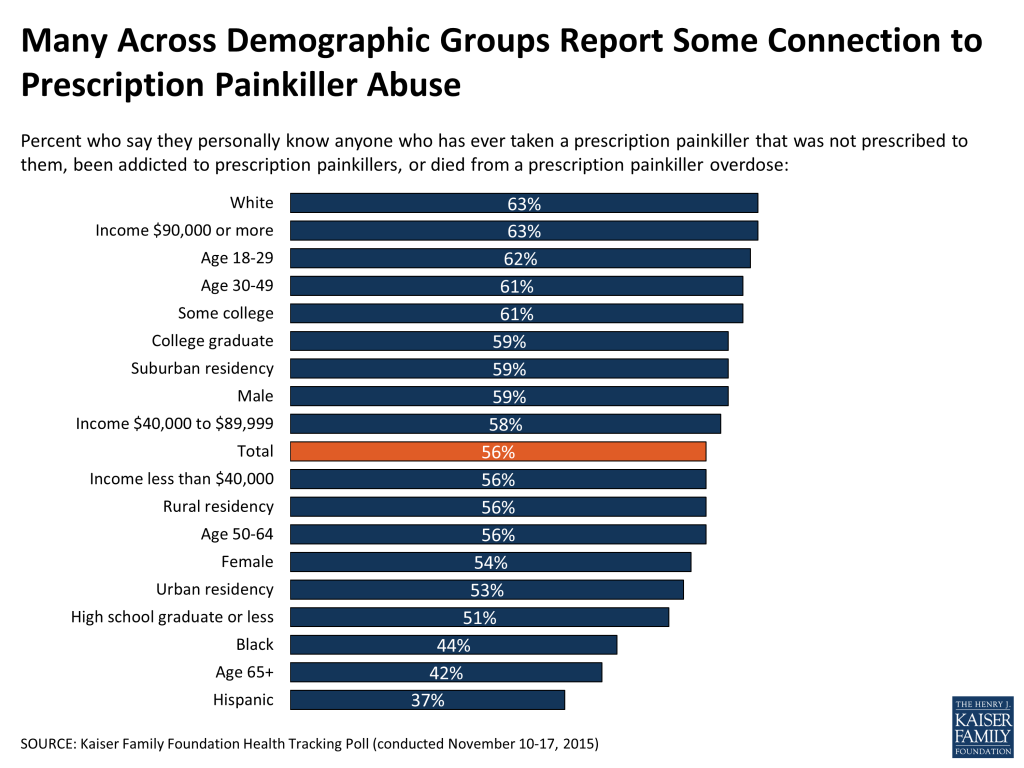
Endnotes

  1. Kaiser Family Foundation State Health Facts, Status of State Action on the Medicaid Expansion Decision. Data Source: KCMU tracking and analysis of state executive activity (Nov. 2, 2015), https://modern.kff.org/health-reform/state-indicator/state-activity-around-expanding-medicaid-under-the-affordable-care-act/. ↩︎
  2. Section 1115 waivers are intended to allow for “experimental, pilot, or demonstration projects” that, in the view of the HHS Secretary, “promote the objectives” of the Medicaid program. 42 U.S.C. § 1315(a). ↩︎
  3. Budget neutrality is established using a cap on federal matching funds over the life of the waiver. ↩︎
  4. The New Review and Approval Process Rule for Section 1115 Medicaid and CHIP Demonstration Waivers. (Washington, DC: Kaiser Commission on Medicaid and the Uninsured, March 2012) https://modern.kff.org/health-reform/fact-sheet/the-new-review-and-approval-process-rule/. ↩︎
  5. Centers for Medicare and Medicaid Services, Healthy Michigan Section 1115 Demonstration, Special Terms and Conditions at p. 5, section III.7.a (Dec. 30, 2013), http://www.michigan.gov/documents/snyder/Healthy_Michigan_1115_Demonstration_Approval_12302013_443466_7.pdf; Centers for Medicare and Medicaid Services, Montana Health and Economic Livelihood Partnership Program Demonstration, Special Terms and Conditions at p. 7-8, section III.14 (Nov. 2, 2015), available at http://www.medicaid.gov/Medicaid-CHIP-Program-Information/By-Topics/Waivers/1115/downloads/mt/mt-HELP-program-ca.pdf. ↩︎
  6. Report to Congress. The US Department of Health and Human Services’ First Report on Section 1115(a) Demonstrations: Transparency in the Review and Approval of Medicaid and Children’s Health Insurance Program (CHIP) Section 1115 Demonstrations, http://www.medicaid.gov/medicaid-chip-program-information/by-topics/waivers/1115/downloads/1115-transparency-rtc.pdf. ↩︎
  7. Arizona administers its entire Medicaid program through a long-standing Section 1115 demonstration waiver, dating back to 1989, that enables Arizona to deliver Medicaid through capitated managed care. Arizona’s present waiver incorporates the ACA’s Medicaid expansion population but does not include any waiver authorities related to the ACA expansion specifically. ↩︎
  8. Newly eligible adults in Arkansas include childless adults between 0-138% FPL and parents between 17-138% FPL. ↩︎
  9. Newly eligible adults in New Hampshire include non-working parents from 38-138% FPL, working parents from 47-138% FPL, and childless adults from 0-138% FPL. ↩︎
  10. As of October, 2014, Iowa beneficiaries from 101-138% FPL were no longer required to enroll in Marketplace premium assistance as a condition of eligibility because one of the two QHPs covering Medicaid beneficiaries was no longer participating. Instead, these beneficiaries could choose to receive coverage through the state’s Medicaid managed care delivery system or enroll in the remaining QHP with premium assistance. Subsequently, the other QHP informed Iowa that it would no longer accept new members. In September, 2015, Iowa submitted a waiver amendment request seeking to require all beneficiaries from 101-138% FPL to enroll in capitated Medicaid managed care as of January, 2016. Iowa also submitted a Section 1915(b) waiver request to expand its capitated managed care system statewide. ↩︎
  11. Laura Snyder and Robin Rudowitz, Premiums and Cost-Sharing in Medicaid: A Review of Research Findings (Washington, DC: Kaiser Commission on Medicaid and the Uninsured, February 2013), https://modern.kff.org/medicaid/issue-brief/premiums-and-cost-sharing-in-medicaid-a-review-of-research-findings/. ↩︎
  12. Arizona proposes not charging co-payments for preventive or wellness services, services to manage chronic illness, any services (well or sick visit) at PCP or OB/GYN office, specialist services with PCP referral, behavioral health services/people with serious mental illness, or prescription drugs (except for opioids other than for people with cancer or who are terminally ill and brand name drugs unless doctor has determined that generic is ineffective). ↩︎
  13. 42 U.S.C. § § 1396a(a)(8). ↩︎
  14. Letter from Cindy Mann, Director, CMCS, CMS to Julie Lovelady, Interim Medicaid Director, State of Iowa (Dec. 30, 2014), http://medicaid.gov/Medicaid-CHIP-Program-Information/By-Topics/Waivers/1115/downloads/ia/ia-marketplace-choice-plan-ca.pdf. ↩︎
  15. 42 U.S.C. § 1396a(a)(34); 42 C.F.R. § 435.914. ↩︎
  16. Montana also is expected to amend its other Section 1115 demonstration waiver to implement 12-month continuous eligibility for other populations. ↩︎
  17. Kaiser Commission on Medicaid and the Uninsured, Modern Era Medicaid: Findings from a 50-State Survey of Eligibility, Enrollment, Renewal, and Cost-Sharing Policies in Medicaid and CHIP as of January 2015 (Washington, DC: Kaiser Commission on Medicaid and the Uninsured, Jan. 2015), available at https://modern.kff.org/report-section/modern-era-medicaid-enrollment-and-renewal-processes/. ↩︎
  18. CMS Special Terms and Conditions, New York Partnership Plan Medicaid Section 1115 Demonstration, No. 11-W-00114/2, at 10 (§ IV. 4) (Sept. 30, 2015), http://www.medicaid.gov/Medicaid-CHIP-Program-Information/By-Topics/Waivers/1115/downloads/ny/ny-partnership-plan-ca.pdf. ↩︎
  19. Letter from Cindy Mann to Thomas Betlach, December 15, 2014. http://www.medicaid.gov/Medicaid-CHIP-Program-Information/By-Topics/Waivers/1115/downloads/az/az-hccc-ca.pdf ↩︎
  20. Letter from Marilyn Tavenner, CMS Administrator, to Secretary Beverly Mackereth (Aug. 28, 2014), available at http://www.medicaid.gov/Medicaid-CHIP-Program-Information/By-Topics/Waivers/1115/downloads/pa/pa-healthy-ca.pdf. ↩︎
  21. Press release: CMS and Indiana Agree on Medicaid Expansion (Jan. 27, 2015), http://www.cms.gov/Newsroom/MediaReleaseDatabase/Press-releases/2015-Press-releases-items/2015-01-27.html; see also Letter from CMS Administrator Marilyn Tavenner to Medicaid Director Joseph Moser (Jan. 27, 2015), http://www.in.gov/fssa/hip/files/IN_HIP_2.0_CMS_Approval_Ltr_1_27_15.pdf. ↩︎
  22. Kaiser Commission on Medicaid and the Uninsured, A Look at the Private Option in Arkansas (Washington, DC: Kaiser Commission on Medicaid and the Uninsured, Aug. 2015), https://modern.kff.org/medicaid/issue-brief/a-look-at-the-private-option-in-arkansas/; MaryBeth Musumeci. Medicaid Expansion Through Marketplace Premium Assistance (Washington, DC: Kaiser Commission on Medicaid and the Uninsured, Sept. 2013), http://modern.kff.org/medicaid/fact-sheet/medicaid-expansion-through-marketplace-premium-assistance/. ↩︎

Medicaid Expansion in Montana

Published: Nov 20, 2015

On November 2, 2015, the Centers for Medicare and Medicaid Services (CMS) approved Montana’s Section 1115 demonstration waiver to expand Medicaid under the Affordable Care Act (ACA) as of January 1, 2016.1  The waiver implements the Montana Health and Economic Livelihood Partnership (HELP) program, which was adopted by the state legislature in April 2015. CMS also approved Montana’s § 1915(b) selective contracting waiver to use a managed fee-for-service (FFS) Third Party Administrator (TPA) to deliver services to the newly eligible adults.2  Adults who are newly eligible for Medicaid under Montana’s expansion are parents from 50-138% of the federal poverty level (FPL) and childless adults from 0-138% FPL (up to $16,242 per year for an individual in 2015) – an estimated 70,000 beneficiaries.3 

Under the waiver, enrollment began on November 1, 2015, with Medicaid expansion coverage effective on January 1, 2016. The waiver does the following:4 

  • Expands Medicaid coverage to newly eligible adults ages 19-64 through a managed FFS TPA (described below). In order to implement the TPA, the state has approval to waive freedom of choice requirements (except for family planning providers) so that newly eligible adults will receive services from the TPA’s provider network.
  • Exempts certain groups of people from enrolling in the TPA and all of the Section 1115 waiver provisions except 12-month continuous eligibility including those with incomes at or below 50% FPL, American Indian/Alaskan Natives, individuals who are medially frail, those with exceptional health care needs as determined by the state, people who live in regions where there are an insufficient number of providers contracted with the TPA, and people who require continuity of coverage not available or effectively delivered through the TPA.
  • Requires monthly premiums up to 2% of household income for newly eligible adults from 51-138% FPL receiving services through the TPA. Beneficiaries from 101-138% FPL may be dis-enrolled for failing to pay premiums after notice and a 90 day grace period. These beneficiaries may re-enroll upon payment of arrears or when the state Department of Revenue assesses the debt against income taxes, no later than the end of the quarter; re-enrollment shall not require a new application. The state shall establish a process to exempt beneficiaries from dis-enrollment for good cause.
  • Subjects enrollees to premiums and copayments up to 5% of income, consistent with federal limits. Beneficiaries subject to premiums will receive a credit toward co-payments accrued up to 2% of income. Certain service categories are exempt from co-payments (including preventive health care, immunizations and medically necessary health screenings), and providers may not deny services for failure to pay copayments for individuals with incomes below poverty.
  • Implements twelve month continuous eligibility for all newly eligible adults to reduce the effects of churning between Medicaid and Marketplace coverage as income fluctuates.5 

As mentioned above, the state also was granted § 1915(b) selective contracting waiver authority to use a managed FFS TPA to deliver services to the newly eligible adults. According to the Section 1915(b) waiver application, the TPA must establish a provider network,6  reimburse providers on a fee-for-service basis on behalf of the state, collect beneficiary premiums, and assume other administrative functions for most newly eligible adults. The Section 1915(b) waiver application also provides that the TPA would also ensure that services provided are medically necessary,7  oversee case management and care coordination, and ensure continuity of care.

Given the low population density of the state, Montana will contract with a TPA to deliver services to the newly eligible population to use the provider network and administrative infrastructure of an insurer already providing services to individuals in the state. The state chose a company offering a qualified health plan on the Marketplace with the goal of decreasing churn and increasing continuity of care between Medicaid and the Marketplace. The Section 1915(b) waiver application defines network adequacy standards for the TPA. Currently, the state uses the TPA model to administer and deliver care for the state’s Children’s Health Insurance Program, Healthy Montana Kids.

To date, CMS has approved Medicaid expansion waivers in five other states (Arkansas, Iowa, Indiana, Michigan, New Hampshire8 ). A sixth state, Pennsylvania, initially had implemented the Medicaid expansion using a Section 1115 demonstration, but later changed to a traditional Medicaid expansion. Some provisions in Montana’s proposal are similar to provisions approved in other waivers,9  such as imposing premiums of 2% of income for beneficiaries between 51-138% FPL with the ability to dis-enroll those from 101-138% FPL for non-payment for up to 3 months. Montana’s waiver authority to implement 12-month continuous eligibility for the newly eligible population is unique among states seeking Medicaid expansion waivers. Table 1 describes the major elements of Montana’s proposed Section 1115 demonstration.

Table 1: Montana’s Approved Section 1115 Medicaid Expansion Demonstration Waiver
ElementMontana Waiver Provision
Overview:Covers approximately 70,000 newly eligible adults through a managed fee-for-service (FFS) Third Party Administrator (TPA).

Requires premiums up to 2% of income for newly eligible beneficiaries from 51-138% FPL receiving services through the TPA. Individuals between 101-138% FPL who do not pay their premiums will be dis-enrolled from Medicaid after notice and a 90 day grace period and not allowed to re-enroll until past due premiums are paid or assessed against state income tax refunds by the end of the calendar quarter. Beneficiaries subject to premiums will receive a credit toward accrued co-payments up to 2% of income.

The state will implement twelve month continuous eligibility for all newly eligible adults.

Duration:1/1/16 to 12/31/20, pending state legislative reauthorization of the HELP Program beyond June 30, 2019. If HELP Program is not reauthorized, the state will terminate the waiver.
Coverage Groups:Covers newly eligible adults ages 19-64 (parents with incomes 50-138% FPL and childless adults with incomes 0-138% FPL).
Exempt Populations:People with incomes at or below 50% FPL; American Indians/Alaskan Natives; people who have exceptional health needs including but not limited to medical, mental health or developmental conditions (including people who are medically frail); people who live in regions where there are an insufficient number of providers contracted with the TPA; people who require continuity of coverage not available or effectively delivered through the TPA.

Individuals exempt from the TPA are also exempt from all demonstration provisions (including premiums) except 12-month continuous eligibility.

The waiver application indicated that medically frail beneficiaries will be identified through questions on the Medicaid application and can request an exemption from TPA enrollment at any point thereafter. The 1915(b) selective contracting waiver application also provided that the TPA will refer medically frail individuals that it identifies to the state.

Renewal Simplification:Twelve month continuous eligibility established for newly eligible adults10  regardless of the delivery system through which they receive benefits (i.e. even if they are exempt from the TPA).11 
Premiums:Newly eligible adults from 51-138% FPL receiving services through the TPA will pay premiums equal to 2% of household income. Beneficiaries may report changes in income to have premiums re-calculated for the following quarter.

Beneficiaries from 101-138% FPL can be dis-enrolled for failure to pay premiums after notice and a 90 day grace period. Re-enrollment when overdue premiums are paid or the state Department of Revenue assesses the premium debt against income tax refunds, no later than the end of the calendar quarter. Re-enrollment shall not require a new application. The state shall establish a process to exempt beneficiaries from dis-enrollment for good cause.

Authority to charge premiums is contingent upon the state demonstrating the ability to electronically track out-of-pocket costs quarterly and CMS’s approval of the state’s preventive services protocol (describing services exempt from co-payments).

Third parties are permitted to contribute toward beneficiaries’ premium and co-payment obligations.

Co-Payments:Beneficiaries subject to premiums will receive a credit toward accrued co-payments up to 2% of income. ,

Co-payments will be at state plan amounts with certain services exempt including preventive health care services, immunizations and medically necessary health screenings.12 

Providers may not deny services for failure to pay copayments for individuals below poverty.

All cost-sharing (including premiums and co-payments) is limited to 5% of quarterly household income.

Delivery System and Benefits: Most newly eligible Medicaid beneficiaries will be enrolled in the TPA. The TPA will be a commercial insurer that already has an established provider network in the state. The state will contract with the TPA to administer the delivery of and payment for services, establish a provider network, reimburse providers on behalf of the state, collect beneficiary premiums, and assume other administrative functions. The TPA is part of the § 1915(b) selective contracting waiver, not the § 1115 waiver.

Beneficiaries will receive an ABP benefit package according to a SPA. The ABP for newly eligible individuals enrolled in the TPA will include all services in the Medicaid state plan benefit package except long term care services. Newly eligible adults who are exempt from TPA enrollment will receive an ABP that includes long-term care services through the state’s existing fee-for-service system.

The Section 1915(b) waiver application provides that certain benefits, such as non-emergency medical transportation and dental services, will be provided outside TPA.

Next Steps:State to submit for CMS approval a preventive services protocol for services exempt from cost-sharing by December 11, 2015, and a premium and cost-sharing operations protocol and draft evaluation design by March 1, 2016. State must hold public forum about the demonstration’s progress within 6 months of implementation and annually thereafter.
  1. CMS, Special Terms and Conditions, Montana Health and Economic Livelihood Partnership Program Demonstration (approved Nov. 2, 2015), http://www.medicaid.gov/Medicaid-CHIP-Program-Information/By-Topics/Waivers/1115/downloads/mt/mt-HELP-program-ca.pdf. ↩︎
  2. Provider reimbursement will be FFS and the TPA will receive an administrative fee. Montana Dep’t of Health & Human Servs., Montana Health and Economic Livelihood Partnership Program, Section 1915(b)(4) Waiver Fee-for-Service Selective Contracting Program Application (Montana Dep’t of Health & Human Servs., Sept. 15, 2015), http://dphhs.mt.gov/medicaidexpansion/waiversubmission. ↩︎
  3.  Montana Dep’t of Public Health & Human Servs., Montana Health and Economic Livelihood Partnership Program Section 1115 Research and Demonstration Waiver Application (Montana Dep’t of Health & Human Servs., Sept. 15, 2015), http://www.medicaid.gov/Medicaid-CHIP-Program-Information/By-Topics/Waivers/1115/downloads/mt/mt-HELP-program-pa.pdf. ↩︎
  4. Montana’s waiver application also indicated that it would assess a $100 per month fee on demonstration beneficiaries with assets beyond limits in the state statute, but no waiver authority to do so was requested or granted.  These limits include a primary residence and attached property above $250,000, one light vehicle, and more than $50,000 cash/cash equivalent. The fee is $100 per month with an additional $4 per month for each $1000 in excess of the limit. Mont. Health and Economic Livelihood Partnership Act, § 18, http://leg.mt.gov/bills/2015/sb0499/SB0405_x.pdf. ↩︎
  5. The waiver application submitted for state level public comment also proposed seeking separate authority to use Fast Track Express Lane Eligibility, which allows states to use data and eligibility findings from other public benefit programs to determine eligibility for Medicaid at application or renewal for these same beneficiaries. ↩︎
  6. The Section 1915(b) selective contracting waiver application provides that the TPA’s provider network would be comparable to or broader than the state’s current Medicaid FFS provider network. ↩︎
  7. The Section 1915(b) waiver application indicates that state believes that the TPA arrangement is structured to avoid the incentive to limit services because the TPA assumes no insurance risk, and administrative fees are not based on performance related to total medical expenses for new adults. ↩︎
  8. NH is currently implementing a traditional expansion under state plan authority and will transition to demonstration authority as of 2016. ↩︎
  9. Robin Rudowitz, MaryBeth Musumeci. The ACA and Medicaid Expansion Waivers (Washington, DC: Kaiser Commission on Medicaid and the Uninsured, November 2015), https://modern.kff.org/medicaid/issue-brief/the-aca-and-medicaid-expansion-waivers/. ↩︎
  10. Montana is expected to amend its other Section 1115 demonstration waiver to also implement 12-month continuous eligibility for other coverage groups. ↩︎
  11. Claimed expenditures at the enhanced matching rate will be adjusted downward by 2.6% to account for the fact that the regular matching rate applies to a proportion of expenditures for 12-month continuous eligibility consistent with CMS guidance. ↩︎
  12. CMS, Special Terms and Conditions, Montana Health and Economic Livelihood Partnership Program Demonstration, Attachment A, Copayment Schedule and Exempt Services (approved Nov. 2, 2015), http://www.medicaid.gov/Medicaid-CHIP-Program-Information/By-Topics/Waivers/1115/downloads/mt/mt-HELP-program-ca.pdf. ↩︎

Uninsured Quiz

Published: Nov 19, 2015

The large number of uninsured people in the United States has been at the forefront of health policy discussions for decades and has received increased attention with the passage of the Affordable Care Act in 2010 and the implementation of its major coverage expansions in 2014.

How much do you know about the uninsured population and the consequences of not having coverage?

Step 1 of 10

How many people under 65 in the United States were without coverage in 2014?(Required)

News Release

New Animated Video Provides an Engaging Look at the Cost and Quality of the Nation’s Health System

Published: Nov 19, 2015

A new animated video on the Peterson-Kaiser Health System Tracker provides an engaging “check-up” of the nation’s health system, addressing questions of whether it’s getting better or worse and how it compares to other countries.

Health of the Healthcare System, produced by the Kaiser Family Foundation, draws on the most up-to-date, reliable data to offer an easy-to-understand portrait of cost, quality and access to health care in the United States. Julie Rovner, a veteran health reporter formerly of NPR now working for Kaiser Health News, narrates the four-minute video.

11.19.15-Peterson-FOR-EMAIL-HealthoftheHealthCareSystem.png

Health of the Healthcare System can be linked from numerous social media networks and can be embedded on other web sites using YouTube’s share button. For those who wish to explore the topic further, supporting data and research are available as a collection of charts.

For more information on health costs, visit the Peterson-Kaiser Health System Tracker and follow @cynthiaccox on Twitter.