News Release

Donor Government Support for Family Planning Rose 6% in 2017, but Remains below 2014 Peak

Published: Nov 12, 2018

A new KFF (Kaiser Family Foundation) analysis finds that donor government support for global family planning efforts totaled US$1.27 billion in 2017, up 6 percent from 2016 but still below its 2014 peak.

Funding from the United States, the world’s largest donor, declined from US$532.7 in 2016 to US$488.7 million in 2017, largely due to a delay in the disbursement of funds. U.S. appropriations have been holding steady in recent years.

Increases in other countries offset the U.S. lag. Among the 10 largest donor governments, Canada, Denmark, the Netherlands, Sweden, and the United Kingdom increased their contributions between 2016 and 2017.  Australia and Germany reported flat funding, while France and Norway, along with the U.S., reported declines.

Collectively, these 10 governments account for 98 percent of the total international assistance for family planning services in low- to middle-income countries. These services includes counselling; information, education and communication activities; delivery of contraceptives; capacity building; and training.

The analysis is being released in conjunction with the annual report from Family Planning 2020, a global partnership to monitor progress toward the 2012 London Summit on Family Planning goals to expand services to an additional 120 million women and girls in developing countries by 2020.

Why Do Short-Term Health Insurance Plans Have Lower Premiums Than Plans That Comply with the ACA?

Authors: Larry Levitt, Rachel Fehr, Gary Claxton, Cynthia Cox, and Karen Pollitz
Published: Oct 31, 2018

The Trump administration earlier this year issued a regulation that expands the availability of “short-term” health insurance plans that do not have to comply with any of the rules in the Affordable Care Act (ACA) for plans sold in the individual market. Specifically, the regulation allows short-term plans to be offered for up to 364 days and renewed at the discretion of the insurer for up to three years. Short-term plans are also expected to be more attractive now that ACA’s individual mandate penalty has been repealed, since people previously enrolling in these plans were liable for the penalty.

Short-term plans pose tradeoffs for consumers. On the one hand, they typically have substantially lower premiums than ACA plans. On the other hand, they exclude people with pre-existing conditions — an estimated 27% of all non-elderly adults — and offer more limited benefits than ACA plans.

In this analysis, we quantify the effects of the eligibility rules and more limited benefits generally found in short-term plans on the premiums in those plans. We estimate that by screening out people with pre-existing conditions and providing less comprehensive benefits, insurers may be able to offer short-term plans at premiums 54% lower than ACA-compliant plans.

Denial of Coverage to People with Pre-Existing Conditions

Short-term plans generally limit coverage of pre-existing conditions in two ways: by denying insurance altogether to people with pre-existing conditions, and by excluding coverage of pre-existing conditions for people who are offered a policy. By covering primarily people who are healthy at the time they apply, short-term plans have much lower claims costs than ACA-compliant plans and can charge substantially lower premiums.

We estimate conservatively that excluding coverage of pre-existing conditions results in 38% lower premiums relative to ACA-compliant plans.

Our estimate is derived by comparing average health care expenses paid by insurance for people with private health insurance overall – which includes a mix of both healthy and sick people in individual and employer-based plans – to average expenses for people who do not have a pre-existing condition that would have led to a denial of insurance before the ACA. The estimate is conservative because it assumes that the ACA’s risk pool includes a proportionate mix of healthy and sick enrollees, while it is likely that actual enrollment in ACA individual market plans are disproportionately sick. To the extent the current ACA risk pool is sicker than average, the potential reduction in premiums in short-term plans that exclude people with pre-existing conditions could be greater. If insurers start to offer guaranteed renewable short-term policies, the premium advantage would moderate as some enrollees develop health conditions over time. However, our review of products now on the market suggests that insurers are generally not yet offering a renewal option.

Limited Benefits

Short-term plans often exclude or severely limit benefits that ACA-compliant plans are required to cover, including prescription drugs, maternity care, mental health, and substance use treatment. Excluding people with pre-existing conditions eliminates a substantial amount of expenses in each of these benefit categories, but excluding the categories altogether further reduces spending and premiums.

Eliminating prescription drug coverage reduces premiums by an estimated 13%, after accounting for the reduction from excluding people with pre-existing conditions. This estimate is based on analysis of prescription drug expenses paid by private insurance for people without pre-existing conditions. Since the survey data on which this estimate is based do not account for rebates provided by drug manufacturers to insurance companies, it is likely slightly overstated.

Maternity expenses account for an estimated 3.4% of claims expenses in private insurance plans. However, because women who are pregnant at the time they apply for coverage would be excluded, the effect on premiums would be approximately one-quarter of that amount, or about 0.85%.

Mental health and substance abuse treatment account for 4.2% of claims expenses. It is difficult to estimate how much an insurance plan would pay for mental health and substance abuse, once people with pre-existing conditions (e.g., severe mental illness or a history of alcohol or substance abuse with recent treatment) are excluded. We assume half of the claims expenses for these services, or 2.1% total expenses, would be eliminated if plans did not cover mental health and substance abuse treatment.

In total, we estimate that the benefits often excluded or limited in short-term plans could reduce premiums by about 16%.

Other Factors Affecting Premiums

Short-term plans can be purchased with a variety of features, which will also affect the premiums they charge, including:

  • Deductibles, coinsurance, and copays. Higher or lower levels of patient cost-sharing than in standard ACA-compliant plans (i.e., bronze, silver, and gold) will result in different premiums. Since short-term plans do not have to cap patient out-of-pocket costs like ACA-compliant plans, they can be purchased with very high deductibles and lower premiums.
  • Dollar limits on coverage. Short-term plans can and generally do impose annual limits on benefits, which results in lower premiums. In some cases, an enrollee can choose the level of the limit. Short-term plans also in some cases cap what they will pay for a day in the hospital or a physician visit, which lowers premiums but could result in balance billing for patients.
  • Age and gender rating. The ACA prohibits premiums from varying by gender and limits the variation in premiums due to age to a ratio of three to one. Short-term plans are not subject to those restrictions.
  • Medical loss ratio. Individual market insurers must have a medical loss ratio of at least 80% — meaning 80% of premiums are spent on health care expenses – or pay rebates to consumers. Short-term plans can devote a larger share of premiums to overhead and profit, which may push premiums up.

Conclusion

Short-term health insurance plans present a tradeoff to consumers – lower premiums in exchange for more limited coverage and less protection than ACA-compliant plans. Overall, we estimate that short-term plans could provide coverage with fewer benefits at premiums 54% lower than ACA-compliant plans. However, the bulk of these premium savings result from exclusion of people with pre-existing conditions, for whom short-term plans are not an option.

The lower premiums will likely prove attractive to people who are healthy, especially those buying their own coverage now who have incomes too high to qualify for ACA premium subsidies. If such individuals opt for short-term plans and then become seriously ill or injured, however, they could face higher out-of-pocket costs.

To the extent short-term plans siphon off healthy enrollees attracted by lower premiums, ACA-compliant plans will be left with a sicker pool of enrollees, and individuals with pre-existing conditions not eligible for subsidies will face higher premiums.

Methods

Average total spending and prescription drug spending by private insurance come from the 2015 Medical Expenditure Panel Survey (MEPS). These spending averages are for people ages 18 to 64, with nine or more months of private insurance and zero months of Medicaid in 2015. For the purposes of this analysis, people with pre-existing conditions are those who have at least one declinable health condition, based on ICD9 codes, condition classification codes, and BMI data from MEPS.

Medicare’s Income-Related Premiums Under Current Law and Changes for 2019

Published: Oct 31, 2018

For several years, Medicare beneficiaries with relatively high incomes have been required to pay income-related monthly premiums for Part B, which covers physician and other outpatient services, and for Part D, which covers outpatient prescription drugs. Most Medicare beneficiaries pay the standard monthly premium, which is set to cover 25 percent of Part B and Part D program costs, but higher-income beneficiaries are required to pay a larger share of program costs. According to the Medicare trustees, in 2017, 3.5 million Medicare beneficiaries paid Part B income-related premiums (6.6 percent of beneficiaries in Part B) and 2.5 million beneficiaries paid Part D income-related premiums (5.6 percent of Part D enrollees). This issue brief describes current requirements with respect to Medicare’s Part B and Part D income-related premiums and changes to these premiums that will take effect in 2019, based on a provision in the Bipartisan Budget Act of 2018.

How much are Medicare’s income-related premiums in 2019? Part B premiums for higher-income beneficiaries will range from $189.60/mo for individuals with incomes of $85,001 to $107,000, to $460.50/mo for those individuals with incomes above $500,000

Part B and Part D Standard Premiums

Monthly premiums for most people on Medicare equal 25 percent of average per capita Part B expenditures for Part B enrollees and 25.5 percent of average per capita Part D expenditures for drug plan enrollees. In 2019, the Part B standard monthly premium is $135.50, up from $134 in 2018; for Part D, the national average monthly premium for 2019 is $33.19, but actual monthly premiums for stand-alone Part D drug plans vary across plans and regions from a low of $10.40 to a high of $156.

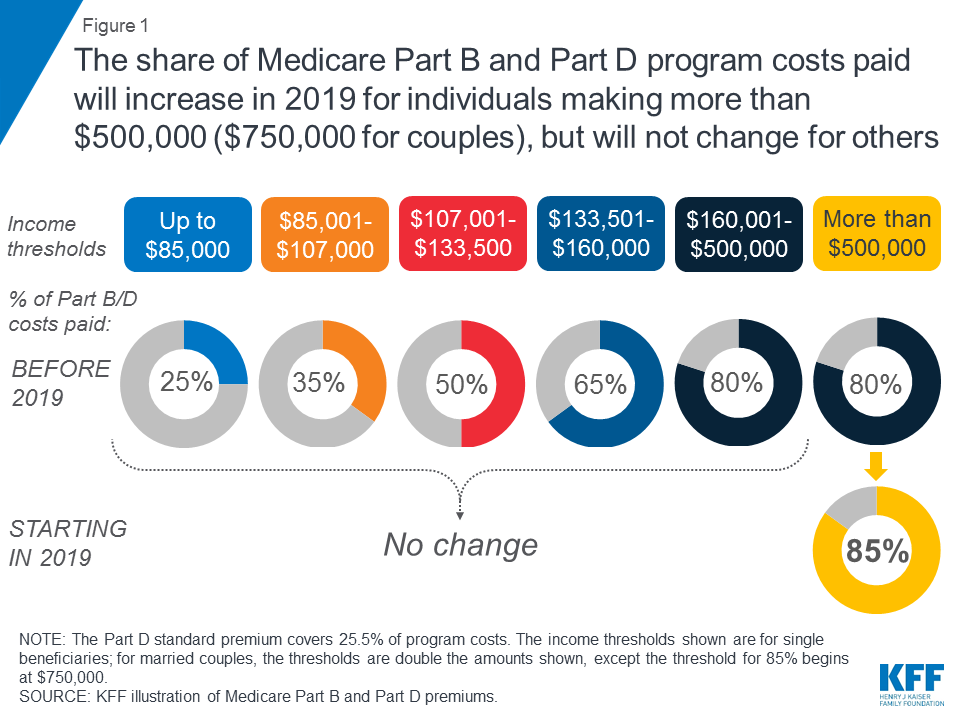
People on Medicare with incomes above $85,000 for individuals and $170,000 for couples are currently required to pay higher premiums for Medicare Part B and Part D. These premiums were first required for Part B in 2007 and for Part D in 2011, and have been modified over time, with the latest change taking effect in 2019 (Figure 1).

Figure 1: The share of Medicare Part B and Part D program costs paid will increase in 2019 for individuals making more than $500,000 ($750,000 for couples), but will not change for others
  • The Part B income-related premium was established by the Medicare Modernization Act of 2003 (MMA) and took effect in 2007. For the first time in the program’s history, the MMA required beneficiaries with higher incomes (defined in the MMA as single beneficiaries with incomes above $80,000 and married couples with incomes above $160,000) to pay a larger share of Part B per capita costs than the standard 25 percent, ranging from 35 percent to 80 percent, depending on their income.
  • The Part D income-related premium was established by the Affordable Care Act (ACA) in 2010 and took effect in 2011. Under this provision, Part D enrollees with higher incomes were required to pay an income-related premium surcharge in addition to the monthly premium for their chosen Part D plan. The Part D income-related surcharge is calculated as a percent of the national average cost of the standard drug benefit, using the same percentages (35 percent to 80 percent) and income thresholds as for Part B.
  • The Medicare Access and CHIP Reauthorization Act of 2015 (MACRA) made changes to Medicare’s income-related premiums by requiring beneficiaries with incomes above $133,500 ($267,000 for married couples) to pay a larger share of Part B and Part D program costs than under the original MMA and ACA provisions. Under MACRA, beginning in 2018, beneficiaries with incomes above $133,500 and up to $160,000 ($267,000-$320,000 for married couples) were required to pay 65 percent of Part B and Part D program costs, up from 50 percent prior to 2018, while beneficiaries with incomes above $160,000 and up to $214,000 ($320,000-$428,000 for married couples) were required to pay 80 percent of Part B and Part D program costs, up from 65 percent.
  • The most recent change to Medicare’s income-related premiums was incorporated in the Bipartisan Budget Act of 2018 (BBA). This change will affect beneficiaries with incomes above $500,000 ($750,000 for married couples) by requiring them to pay 85 percent of program costs beginning in 2019, up from 80 percent prior to 2019.

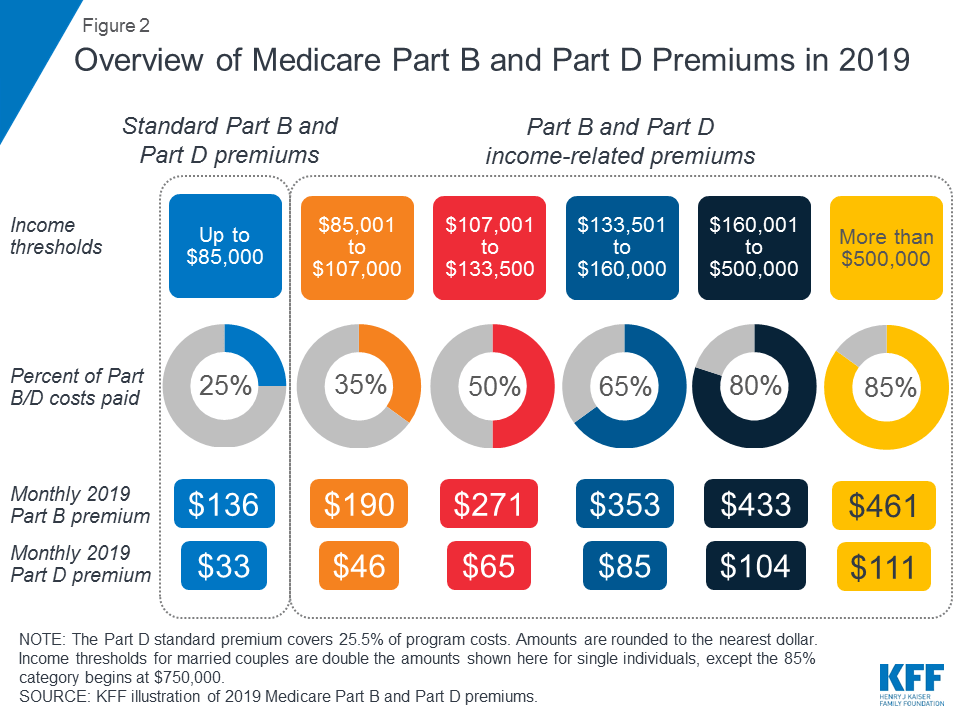
In 2019, Part B premiums for higher-income beneficiaries range from $189.60 per month for individuals with annual incomes above $85,000 up to $107,000 who are required to pay 35 percent of program costs, to $460.50 per month for individuals with incomes above $500,000 who are required to pay 85 percent of program costs (Figure 2). For Part D, the 2019 monthly premium surcharge ranges from $12.40 for individuals with annual income above $85,000 up to $107,000, to an additional $77.40 for individuals with incomes above $500,000. When combined with the national average premium amount, higher-income Part D enrollees will pay between $46 and $111 per month in 2019.

Figure 2: Overview of Medicare Part B and Part D Premiums in 2019

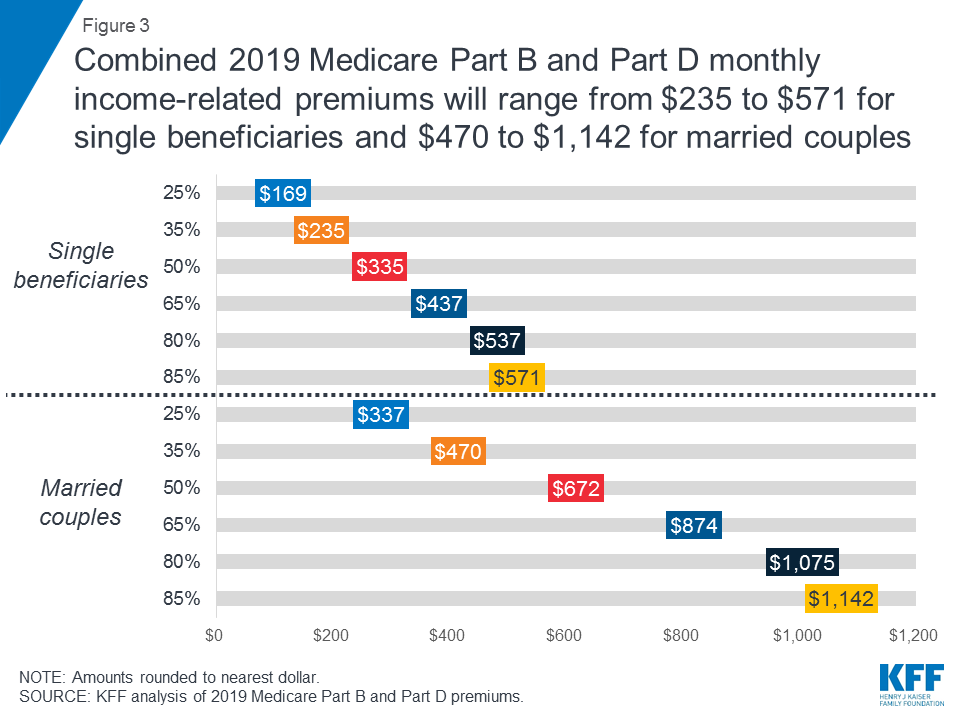
For beneficiaries enrolled in both Part B and Part D, the combined income-related monthly premiums for 2019 range from around $235 for single beneficiaries with incomes above $85,000 up to $107,000, to $571 for beneficiaries with incomes above $500,000 (Figure 3). Monthly income-related premiums for married couples who are both enrolled in Part B and Part D are twice these amounts, ranging from $470 to $1,142.

Figure 3: Combined 2019 Medicare Part B and Part D monthly income-related premiums will range from $235 to $571 for single beneficiaries and $470 to $1,142 for married couples

How Do the Income Thresholds Change Over Time?

For the first few years that the Medicare Part B income-related premium was in effect (between 2007 and 2010), the income thresholds that determined who paid the higher amounts were set to increase annually with the rate of price inflation so that about 5 percent of Part B enrollees would pay the income-related premium each year. In 2007, the initial threshold was set at $80,000 for single beneficiaries and $160,000 for married beneficiaries, increasing to $82,000/$164,000 for 2008 and $85,000/$170,000 for both 2009 and 2010; there was no increase for 2010 because there was no price inflation.

Since 2011, the income thresholds that determine who pays the higher Part B premiums have been fixed at their current levels through 2019 (a provision of the ACA); this provision also applies to Part D. As a result, a growing share of beneficiaries have been subject to the income-related premiums over this time period.

In 2020 and subsequent years, the income thresholds will once again be indexed to general price inflation, based on their levels in 2019 (a provision in MACRA), except that the top-level income thresholds of $500,000/$750,000 that determine who pays 85 percent of Part B and Part D costs will be frozen through 2027 and adjusted annually for inflation starting in 2028 (a provision of the BBA of 2018). As a result, the number and share of beneficiaries paying the top 85 percent level of income-related premiums will increase as the number of people on Medicare continues to grow in future years and as their incomes rise.

News Release

Short-Term Health Insurance Plans Charge Less than Half as Much in Premiums as ACA Plans By Excluding Pre-Existing Conditions and Severely Limiting Benefits

Published: Oct 31, 2018

Short-term health insurance plans offer a trade-off for consumers: substantially lower premiums than plans that comply with the Affordable Care Act, but much less protection if they get sick and need care.

Just how much cheaper are the premiums and what are consumers giving up to get them? A new KFF (Kaiser Family Foundation) analysis finds short-term plans are able to charge premiums 54 percent lower than ACA-compliant plans, by excluding pre-existing conditions and severely limiting benefits. Specifically, it finds:

  • Plans achieve 38 percent lower premiums by simply denying insurance altogether to people with pre-existing conditions, or refusing to cover such conditions for those offered a policy.
  • A further 16 percent reduction relative to ACA-compliant plans arises from short-term plans’ exclusion of, or severe restrictions on, potentially costly benefits such as coverage for prescription drugs, maternity care and mental health and substance abuse treatment.

The Trump administration has expanded the availability of such plans, which can offer coverage for up to 364 days and do not have to comply with the ACA’s rules. The lower premiums will likely lure healthy people away from ACA-compliant plans, especially consumers with incomes too high to qualify for ACA premium subsidies.  As a result, ACA-compliant plans will be left with a sicker pool of enrollees and higher premiums.

Para consumidores que estén considerando planes de salud de corto plazo…

Published: Oct 30, 2018

Nuevas reglas publicadas por la administración Trump este año pueden ayudar a promover la venta de planes de salud de corto plazo, que generalmente tienen primas más bajas comparado con los planes que cumplen con la Ley de Cuidado de Salud Asequible (ACA).

Todos los planes de salud de corto plazo deben incluir un aviso prominente a los consumidores para que “verifiquen su póliza cuidadosamente, para asegurarse de estar al tanto de cualquier exclusión o limitación con respecto a la cobertura de condiciones preexistentes o beneficios de salud…” Los planes de corto plazo son diferentes a los que cumplen con ACA en varios aspectos importantes. Esta hoja informativa identifica las características de los planes de salud de corto plazo que los consumidores pueden querer revisar cuidadosamente.

Elegibilidad en base al estado de salud

Excepto en estados que prohíben su venta1 , los planes de seguros de salud de corto plazo tienen un proceso para conocer su estado de salud (el término en inglés es “medical underwritten”). Eso significa que los consumidores pueden, y probablemente sean, rechazados si tienen condiciones de salud preexistentes. En las solicitudes de planes de corto plazo habrá preguntas sobre la salud, por ejemplo, si la solicitante está embarazada o planea quedar embarazada, o si la persona ha sido diagnosticada o tratada por cáncer, hepatitis, trastornos de salud mental o abuso de sustancias, VIH/SIDA u otras condiciones. Es muy probable que las aseguradoras se nieguen a vender planes de corto plazo a las personas que respondan “sí” a cualquiera de esas preguntas.

Duración de la cobertura y “renovabilidad”

Bajo las nuevas reglas, los planes de corto plazo pueden brindar cobertura hasta 364 días. También se están vendiendo planes que duran 3 o 6 meses. Al final del período de la póliza, la cobertura termina. Pero ahora, algunos planes pueden incluir una opción para extender o renovar la cobertura cuando el plan termine. Sin embargo, le corresponde a la aseguradora decidir. Las personas que compran un plan de corto plazo y luego se enferman probablemente no podrán extender o renovar su cobertura.

Es importante destacar que la pérdida de cobertura bajo un plan de corto plazo durante el año no vuelve a las personas elegibles para un período de inscripción especial (SEP) para cambiar a un plan del mercado que cumpla con ACA. Tendrán que esperar hasta el próximo Período de Inscripción Abierta para comprar un plan que no pueda rechazarlos.

Límites en los beneficios cubiertos

Los planes de corto plazo generalmente cubren beneficios médicos importantes, aunque a menudo se aplican límites. Por ejemplo:

  • Límites en las visitas médicas cubiertas. Revise el plan de corto plazo para ver si limita el número de visitas cubiertas al doctor, por ejemplo, a no más de 3.
  • Límites de dólares en beneficios cubiertos. Verifique si se aplican límites en dólares para beneficios cubiertos específicos, como por ejemplo $1,000 por día en el hospital. Si un plan aplica límites de dólares, los cargos reales por encima del límite no se cubrirán. (Por ejemplo, según gov, el costo promedio de una estadía en el hospital de 3 días es de alrededor de $30,000). Prácticamente todos los planes de corto plazo aplican un tope general en dólares a todos los beneficios cubiertos que van, por ejemplo, desde $100,000 a $2 millones.
  • Límites en la cobertura de medicamentos recetados. Si los medicamentos recetados están cubiertos, verifique si se aplican otros límites, por ejemplo, si están cubiertos solo durante una internación hospitalaria. Es posible que algunos planes de corto plazo no cubran los medicamentos, pero en su lugar ofrezcan una tarjeta de descuento para medicamentos. Una tarjeta de descuento no es lo mismo que la cobertura del seguro: el paciente tendrá que pagar el precio completo después del descuento, sin ningún reembolso por parte de la aseguradora.
  • Beneficios excluidos. Lea cuidadosamente la información sobre lo que la póliza excluye. Los planes de corto plazo no cubren cuidado de maternidad, y muchos no cubren el tratamiento de las adicciones y servicios de salud mental.

Los planes de corto plazo excluyen a las condiciones preexistentes. Si realiza un reclamo bajo un plan de corto plazo, la aseguradora puede investigar si su condición existía antes de comprar la póliza. Las condiciones se considerarán preexistentes si recibió tratamiento antes de inscribirse en el plan. Según el plan y las leyes del estado en el que vive, la aseguradora también puede negarse a cubrir una condición que existía, incluso si no había sido diagnosticada, antes de que comprara la póliza (por ejemplo un cáncer que estaba desarrollándose). Algunos planes de corto plazo ofrecen una cobertura limitada para ciertas afecciones preexistentes, como alergias, si usted es lo suficientemente saludable como para comprar el plan.

Costos compartidos para beneficios cubiertos

La mayoría de los planes de corto plazo tienen un límite de gastos de bolsillo para los costos compartidos. En los planes que cumplen con ACA, éste cubre lo que los consumidores pagan en un año para todos los tipos de costos compartidos: deducibles, copagos y coseguros. Para 2019, ese límite es de $7,900 anuales para una sola persona. Sin embargo, en un plan de corto plazo, el límite podría no incluir el deducible y los copagos. Además, los límites de costos compartidos se restablecen al final del plazo de la póliza si se renueva la cobertura o si se compra un nuevo plan de corto plazo.

Redes de proveedores

Asegúrese de verificar si el plan de corto plazo ofrece una red de proveedores. Si es así, tendrá que buscar atención dentro de la red para estar cubierto (o, en el caso de los planes “PPO”, para obtener el nivel más alto de cobertura). Algunos planes de corto plazo se describen como pólizas de “indemnización”. Eso significa que la aseguradora no limita la cobertura a una red de médicos y hospitales. También significa que la aseguradora no ha negociado ningún límite sobre lo que los médicos y hospitales pueden cobrarle. Un plan de indemnización le reembolsará hasta un monto que la aseguradora permita, y usted será responsable de la diferencia entre ese monto y el monto real facturado. Esta diferencia se llama “facturación de saldo” y puede ser muy costosa.

Otras diferencias con los planes que cumplen con ACA

Los planes de corto plazo no pueden venderse en cuidadodesalud.gov ni en los sitios de internet de los mercados de seguros de salud estatales. Los consumidores elegibles para subsidios en el mercado de seguros no pueden usarlos para comprar planes de corto plazo.

  1. Hasta ahora, California, Hawaii, Massachusetts, New Jersey, New York, y Oregon prohíben la venta de planes de salud de corto plazo, que carecen de protecciones para las personas con condiciones preexistentes.   ↩︎
News Release

Analysis: Workers Increasingly Have Access to Same-Sex Spousal Benefits 

Published: Oct 30, 2018

While workplace health benefits for married same-sex spouses are becoming more common, new data from KFF’s 2018 Employer Health Benefits Survey shows they still lag behind benefits available to opposite sex-spouses.

In 2018, nearly two-thirds (63%) of employers offering health insurance coverage to opposite-sex spouses also provided coverage to same-sex spouses – up significantly from 2016, when fewer than half (43%) did. Few (6%) say they do not offer same-sex spousal benefits, while others, mostly small employers, say they have not encountered such a situation.

Larger employers are more likely than smaller ones to offer same-sex spousal benefits. As a result, a large majority (88%) of covered workers are at firms that provide such benefits. Relatively few (6%) are at firms that do not offer same-sex spousal benefits.

The analysis examines trends in same-sex spousal benefits following the 2015 Supreme Court decision legalizing same-sex marriage nationwide.

News Release

2019 Premiums for ACA Silver Plans Will Be 16 Percent Higher Than They Would Have Been Absent the Repeal of the Individual Mandate, Expansion of Short-Term Plans and Loss of Federal Cost-Sharing Payments, Analysis Finds

Published: Oct 26, 2018

Although 2019 premiums for plans in the Affordable Care Act marketplaces are flat or falling in many parts of the country, they would be substantially lower still if not for several Trump administration-backed changes to private insurance markets, finds a new KFF analysis.

ACA silver-level plans sold in the marketplaces will cost an average of 16 percent more than they otherwise would have, thanks to the combined effects of the loss of ACA cost-sharing reduction payments, the repeal of the ACA’s individual mandate penalty, and the expansion in the availability of more loosely-regulated plans, the analysis of insurer filings finds. In dollar terms, that means that 2019 benchmark silver plan premiums for a 40-year-old on healthcare.gov would have averaged $427 per month in 2019, instead of the $495 per month recently reported by the Department of Health and Human Services.

More broadly, the analysis finds that premiums for all ACA-compliant plans — including those sold both on- and off-exchange — will on average be 6 percent higher than they otherwise would have been based on what insurers explicitly reported in their 2019 rate filings were the effects of the repeal of the individual mandate penalty and the expansion in the availability of short-term and association health plans. This is likely a conservative estimate, since some insurers also increased premiums in 2018 based on an expectation that the individual mandate might be repealed or weakly enforced.

Repealing the mandate penalty and expanding the availability of short-term plans and association health plans effectively siphons healthy people from the ACA marketplaces, driving up premiums as insurers’ risk pools include a larger share of sick people relative to healthier ones. The stripping of federal payments that insurers used under the ACA to lower the cost-sharing burden of some customers caused insurers to raise premiums to recover costs that they subsequently had to bear themselves, in many cases increasing premiums only for silver plans.

Consumers eligible for federal premium tax credits in the ACA marketplaces are shielded from the effect of higher premiums. But for unsubsidized consumers and those who buy ACA-compliant policies off-exchange, recent premium hikes have made health insurance increasingly less affordable in recent years, effectively pricing some of them out of the market.

How Repeal of the Individual Mandate and Expansion of Loosely Regulated Plans are Affecting 2019 Premiums

Authors: Rabah Kamal, Cynthia Cox, Rachel Fehr, Marco Ramirez, Katherine Horstman, and Larry Levitt
Published: Oct 26, 2018

Issue Brief

In health insurance systems designed to protect people with pre-existing conditions and guarantee availability of coverage regardless of health status, countervailing measures are also needed to ensure people do not wait until they are sick to sign up for coverage (as doing so would drive up average costs for other enrollees). The Affordable Care Act (ACA) included a variety of “carrots” (e.g., premium tax credits and cost-sharing reductions) and “sticks” (e.g., the individual mandate penalty and limited enrollment opportunities) to encourage healthy as well as sick people to enroll in health insurance coverage.

Although 2019 premiums for plans in the ACA marketplaces are flat or falling in many places, they would be substantially lower still if not for several key policy and legislative changes.

Despite the enduring popularity of the ACA’s protections for people with pre-existing conditions, the individual mandate – which requires most people to maintain health insurance coverage or else pay a penalty – has consistently been viewed negatively by a substantial share of the public. After broader attempts to repeal and replace the ACA stalled out in the summer of 2017, Congress reduced the individual mandate penalty to $0 effective in 2019 as part of tax reform legislation passed last December.

Soon thereafter, the Trump administration also announced new rules that will allow more loosely regulated plans – short-term limited duration (STLD) plans and association health plans (AHPs) – to proliferate on the individual market in competition with ACA-compliant coverage. These more loosely regulated plans will serve as a more affordable option for some people who are not eligible for the ACA’s premium tax credits. However, particularly in the case of short-term plans, this lower-cost coverage is generally unavailable to people with pre-existing conditions and the plans often exclude coverage for certain services. STLD plans do not meet the ACA’s requirement to maintain coverage, but, because the penalty for going without coverage will soon be $0, the attractiveness of STLD coverage will grow for healthy people. These plans will attract disproportionately healthy individuals away from ACA-compliant coverage, thus having an upward effect on premiums in the ACA-compliant individual market.

With the effective repeal of the individual mandate penalty and the expansion of short term and association health plans, we set out to quantify how much of an upward effect these policy and legislative changes are having on 2019 premiums. Among insurers that publicly specify the effect of these legislative and policy changes in their filings to state insurance commissioners, we found that 2019 premiums will be an average of 6% higher, as a direct result of individual mandate repeal and expansion of more loosely regulated plans, than would otherwise be the case.

Adding the impact from the loss of cost-sharing reduction payments – which drove up silver premiums by an average of 10% according to the Congressional Budget Office – to the impact from individual mandate penalty repeal and expansion of more loosely regulated plans, this analysis suggests on-exchange benchmark silver premiums will be about 16% higher in 2019 than would otherwise be the case.

A separate analysis finds that 2019 premiums on the whole are staying relatively flat or dropping in many parts of the country, in large part because insurers are currently overpriced. Nonetheless, this analysis finds that 2019 premiums would be dropping even more if the individual mandate penalty were still in full effect.

Analyzing Insurer Rate Filings

Each year, insurers submit rate filings to state regulators justifying their premium changes for the upcoming year. These filings include varying amounts of detail, depending on the state and insurer, and sections of the publicly available filings are often redacted. Insurers sometimes do not include much detail in the public filings, and do not always explicitly mention the effect policy changes will have on rates.

We reviewed all publicly available filings insurers across the United States submitted to state regulators detailing their justifications for rate changes in the ACA-compliant individual market, both on- and off-exchange. While many insurers identify the repeal of the individual mandate penalty and/or the expansion of STLD/AHP plans as factors that will have an upward effect on 2019 premiums, not all companies quantify the amount by which rates will increase specifically due to these changes, and others redact this information from their publicly available filings. Additionally, some companies group together the upward effect of the individual mandate penalty repeal with the expansion of short-term and association plans, while other companies report these effects separately or only publicly quantify the effects of one of these changes.

We exclude from this analysis states that have implemented their own individual mandates (Massachusetts, New Jersey, and Washington, DC) or, in the case of New York, prohibited insurers from loading an individual mandate surcharge into 2019 premiums.

Among insurers that publicly quantify a rate impact from legislative and regulatory changes – effective repeal of the individual mandate penalty and/or expansion of more loosely regulated plans – the upward effect on 2019 premiums ranges from 0% to 16%. Among these insurers, the average rate increase in 2019 due to the individual mandate penalty repeal and expansion of more loosely regulated plans is 6%. Most 2019 rate impacts due to these legislative and policy changes fall between 4% and 8% (the 25th and 75th percentiles).

Table 3 in the Appendix shows rate increases by state and insurer among companies that publicly quantified the amount by which premiums will increase due to these legislative and policy changes in either 2018 or 2019.

In many cases, these rate increases come on the heels of similar assumptions made going into 2018 that the individual mandate would be repealed or weakly enforced (as insurers had to finalize 2018 rates before a decision had been made in Congress to effectively repeal the individual mandate). In setting rates for 2018, some insurers assumed either repeal, reduced enforcement, or public perception of reduced enforcement of the individual mandate would lead to a sicker risk pool in 2018 and priced accordingly. In 2018, among insurers that publicly quantified an impact of uncertainty about the individual mandate, companies incorporated a premium increase of 0% to 25%. Among these insurers, the average rate increase due to individual mandate uncertainty in 2018 was 5% and most fell between 2% and 6% (the 25th and 75th percentiles).

A number of insurers factored in rate impacts due to individual mandate uncertainty in 2018 and individual mandate penalty repeal in 2019. In many of these cases, though, the 2019 load appears to supersede the 2018 load and the two are not cumulative. There may be some cases when the 2019 individual mandate load is in addition to the 2018 load, but we assume the values in 2019 and 2018 are never cumulative, which is the more conservative approach.

Table 1: Range of Premium Impacts from Individual Mandate Uncertainty/Repeal in 2018 and 2019
Year of filingsMin25th PercentileAverage75th PercentileMax
20190%4%6%8%16%
20180%2%5%6%25%
NOTE: In some cases, the effect due to the individual mandate also includes the expansion STLD/AHPs, reduced outreach, or other legislative uncertainty.

SOURCE: Kaiser Family Foundation analysis of insurer rate filings to state regulators, state insurance regulators, and ratereview.healthcare.gov.

The upward effect on 2019 premiums due to the effective repeal of the individual mandate and expansion of more loosely regulated plans is in addition to other significant rate increases due to the Trump administration’s decision to halt cost-sharing reduction subsidy payments. This decision, the Congressional Budget Office estimates, is responsible for a 10% increase in 2018 on-exchange silver premiums.1  Altogether, on-exchange silver premiums in 2019 are therefore approximately 16% higher than would otherwise be the case if federal CSR payments had continued (the loss of which contributed approximately 10% to silver exchange premiums), the individual mandate penalty were still enforced, and more loosely-regulated plans were not expanding (the latter changes contributed an additional 6% to 2019 rates).2 

Many states allowed insurers to load the loss of CSR payments onto silver premiums and many insurers only added that cost to plans offered on the marketplace in 2018. Therefore, in most states, the effect of the loss of CSR payments was considerably smaller for bronze and gold plans offered off-exchange than for silver plans offered on-exchange. Because premium tax credits on the exchanges are tied to the cost of silver premiums, the effect of the loss of CSR payments was cushioned for many enrollees on-exchange. The impact of the individual mandate penalty repeal and expansion of more loosely regulated plans, however, is concentrated primarily off-exchange, where enrollees do not receive a subsidy to offset increases.

Table 2: Premium Impacts from Legislative and Policy Changes to the ACA
Legislative or Policy ChangeAverage percent by which 2019 unsubsidized premiums are higher than would be the case without change
  • Individual mandate penalty repeal
  • Expansion of AHP / STLD plans
6% (all premiums on/off exchange)
  • Loss of CSR payments
10% (silver exchange premiums)*
Combined Impact:
  • Individual mandate penalty repeal
  • Loss of CSR payments
  • Expansion of AHP / STLD plans
16% (silver exchange premiums)*
SOURCE: Kaiser Family Foundation analysis of insurer rate filings to state regulators, state insurance regulators, and ratereview.healthcare.gov. Premium impact due to CSR loss is from Congressional Budget Office (CBO) estimate.

NOTES: Premium changes represent the change in premiums before accounting for the premium tax credit. How each premium impact relates to other impacts depends on how each insurer calculates rate impacts. We conservatively assume the rates are additive (6% + 10% = 16%), as opposed to multiplicative (1.06 x 1.1 = 1.166, or 16.6%). *The CBO estimate of the loss of CSR payments’ effect was specifically for silver exchange premiums. However, some insurers also applied a CSR load onto other metal levels and/or off-exchange premiums.

Going into 2018, insurers on average likely increased rates more than was necessary. As of mid-2018, insurers in the individual market are doing quite well financially on average, so many are unable to justify another year of premium increases going into 2019. Therefore, despite repeal of the individual mandate penalty and expansion of more loosely regulated plans in 2019, premiums in much of the country are holding flat or decreasing relative to 2018. In states that use healthcare.gov, unsubsidized benchmark premiums are dropping an average of 1.5% next year, from $502 per month for a 40-year-old in 2018, to $495 in 2019.

Our analysis therefore suggests the average healthcare.gov benchmark silver premium for a 40-year-old would be approximately $427 per month (instead of $495) in 2019, if it were not for the repeal of the individual mandate penalty, expansion of short-term plans, and loss of cost-sharing subsidy payments.3 

Discussion

Exchange premiums will be moderating in 2019, as many insurers are currently profitable after overshooting with 2018 rates. Benchmark silver premiums in states that use Healthcare.gov will be an average of 1.5% lower in 2019 than they were in 2018, which will likely come as welcomed news to people who are ineligible for subsidies and paying full-price for coverage in the individual market in states where there is a decrease. However, a number of middle and upper-middle income individuals and families have already been priced out of the market and a small decrease in premiums may not be enough to bring them back.

Among insurers that publicly specify the effect of these legislative and policy changes, we found that 2019 premiums will be an average of 6% higher, as a direct result of individual mandate penalty repeal and expansion of more loosely regulated plans, than would otherwise be the case. Combined with estimates from the Congressional Budget Office, our analysis suggests the elimination of the cost-sharing subsidy and individual mandate penalty, as well as expansion of more loosely regulated plans, has caused on-exchange silver premiums to be 16% higher than would otherwise be the case. Instead of 2019 benchmark silver premiums on healthcare.gov averaging $495 per month for a 40-year-old, as was recently reported by HHS, we estimate the premium would be approximately $427 in the absence of individual mandate penalty repeal, expansion of more loosely regulated plans, and the loss of cost-sharing subsidy payments.

From a consumer perspective, the rate impact from these policy and legislative changes has played out differently for subsidized on-exchange consumers than for unsubsidized off-exchange consumers. Heading into 2018, off-exchange consumers generally experienced the 5% rate impact from uncertainty around the individual mandate enforcement, but many were able to avoid the steeper premium increases due to the loss of cost-sharing subsidy payments as insurers in many states were able to load this cost onto only silver plans, and/or only exchange plans. In some cases, on-exchange consumers in 2018 may have ended up paying less because of the loss of CSR payments, because of larger subsidies due to silver loading.

Looking ahead to 2019, premiums in much of the country are holding flat or decreasing a bit, but unsubsidized off-exchange consumers on average will nonetheless pay an average of 6% more than they otherwise would have, if it were not for repeal of the individual mandate and expansion of more loosely regulated plans. On the exchange, meanwhile, subsidized customers will continue to pay sliding-scale premiums based largely on their incomes, and so the amount of premium they pay is mostly unaffected by the repeal of the individual mandate and expansion of short-term plans.

Methods

Data were collected from publicly available health insurer rate filing submitted to state regulators for ACA-compliant coverage offered on- and off-exchange. Most rate information is available in the form of a SERFF filing (System for Electronic Rate and Form Filing) that includes a base rate and other factors that build up to an individual rate. For some states where approved filings were unavailable, we gathered data from preliminary information released by state insurance departments and healthcare.gov. We did not group subsidiaries by parent company as some subsidiaries within a given state made differing assumptions.

We exclude insurers where the individual mandate penalty was not specified in the public rate filings. We assigned these insurers a value of “NA,” meaning the company (1) did not mention the individual mandate, STLD, or AHPs at all; (2) mentioned an impact but did not quantify the amount; or (3) quantified the rate impact but redacted the amount from public filings. In some cases, we assigned a value of “NA” when it was clear the insurer requested a rate impact but it was unclear whether the state allowed that load, or if the insurer built in the load elsewhere in their rate calculations. A value of “0%” means the insurer did publicly quantify the impact and specified that it was 0%.

We exclude from this analysis states that have implemented their own individual mandates (Massachusetts, New Jersey, and Washington, DC) or, in the case of New York, prohibited insurers from loading an individual mandate surcharge into 2019 premiums.

Appendix

Table 3: Impact of Individual Mandate Penalty Repeal and Other Legislative and Regulatory Changes on Premiums, by State and Insurer, 2018 and 2019
StateInsurerOverall2018-2019Rate Change2018 Rate Impact of Individual Mandate(IM) Uncertainty2019 Rate Impact of IM Penalty Repeal (Impact of other legislative and regulatory changes, if noted)
AZBCBS0%4%10% (IM; STLD)
AZBright HealthNA – 2019 entrantNA – 2019 entrant4% (IM; STLD/AHPs;”other legislative uncertainty”)
AZHealth Net-6%NA2%
AZOscarNA – 2019 entrantNA – 2019 entrant5-10% (IM; “other potential reforms”)
CAAnthem BC4%0%3% (Primarily IM)
CABlue Shield CA10%3%5%
CAChinese Community7%NA2%
CAHealth Net8%0%2%
CAKaiser9%0%5%
CAL.A. Care7%NA5%
CAMolina2%0%6%
CAOscar7%0%5%
CASharp10%NA5%
CASutter15%0%10%
CAValley-1%0%5%
CAWestern Hlth Advntg7%0%5%
COBright Health7%0%~6% (5% IM; <1% STLD)
COCigna8%NA12% (IM; STLD/AHPs)
CODenver Health22%NA5%
COFriday Health Plans7%10%4%
COKaiser7%NA~7% (6% IM; 1.3% STLD)
CORocky Mountain HMO6%5%10%
CTAnthem Blue Cross-3%NA5% (IM; STLD/AHPs)
CTConnectiCare6%2%~1% (0.5% IM; 0.5% STLD)
CTConnectiCare Ben.4%2%~1% (0.5% IM; 0.5% STLD)
CTConnectiCare Ins.9%2%~1% (0.5% IM; 0.5% STLD)
FLMolina-2%6%8%
ILHealth Alliance7%3%~8% (2.5% IM; 5% STLD)
INCareSource Indiana5%NA5%
MDCareFirst Blue Choice-17%0%5%
MDCareFirst CFMI-11%NA0%
MDCareFirst GHMSI-11%NA0%
MDKaiser-7%NA9% (Primarily IM)
MEAnthem-4%0%5% (IM; “sustainability of the ACA marketplace”)
MECommunity Hlth Opt.1%13%~10% (5% IM; 5% STLD)
MEHarvard Pilgrim2%14%14%
MIAlliance0%NA5% (IM; STLD)
MIBlue Care Network1%5%5%
MIBCBS4%5%5%
MIMeridian1%NA2%
MIMolina2%10%7%
MITotal Health Care8%NA5% (IM; “other market-wide changes”)
MNGroup Health-7%NA~9% (5-8% IM; 1.5-4% STLD/AHPs)
MNMedica-12%NA3%
MNPreferredOne-11%NA0%
MNUCare-10%NA5%
MOMedicaNA – 2019 entrantNA – 2019 entrant3%
MTMontana Health Coop.10%5%16%
MTPacificSource6%NA7%
NCBCBS-4%NA4%
NEMedica2%0%7% (IM; STLD/AHPs)
NMChristus4%0%6% (IM; reduced outreach)
NMHCSC0%NA6%
NMMolina-6%0%6%
NVHealth Plan of Nevada0%NA10%
NVSierra-2%NA10%
OHAultCare9%NA~16% (13% IM; 2% STLD; 0.9% AHPs)
OHCareSource17%NA5%
OHMedical Health Ins. Co9%NA4% (IM; STLD)
OHMolina6%6%9%
OHParamount2%NA7% (IM; STLD/AHPs)
ORBridgeSpan5%5%8% (IM; STLD/AHPs)
ORHealth Net10%2%4% (IM; STLD/AHPs)
ORKaiser9%2%8% (IM; STLD/AHPs)
ORModa6%2%4% (IM; STLD/AHPs)
ORPacificSource-10%2%5% (IM; STLD/AHPs)
ORProvidence10%5%8% (IM; STLD/AHPs)
ORRegence BCBS0%5%8% (IM; STLD/AHPs)
PACap. Adv. Assurance-21%6%6%
PACap. Adv. Insurance-43%6%6%
PAFirst Priority Health1%6%6%
PAFirst Priority Life7%6%6%
PAGeisinger Health Plan0%6%6%
PAGeisinger Quality Opt.8%6%6%
PAHighmark6%6%6%
PAHighmark Choice4%6%6%
PAHighmark Select Res.0%6%6%
PAHighmark Health Ins-7%6%6%
PAKeystone, Central-7%6%6%
PAKeystone, East-2%6%6%
PAPA Health & WellnessNA – 2019 entrantNA – 2019 entrant6%
PAQCC-6%NA6%
PAUPMC Health Cov.12%6%6%
PAUPMC Health Opt.2%6%6%
RIBCBS8%NA0%
RINeighborhood9%NA2%
SCBlueChoice7%6%NA
SCBCBSUnknown6%NA
SDAvera3%5%5%
SDSanford10%NA3%
TNBCBS-15%7%1%
TNBright HealthNA – 2019 entrantNA – 2019 entrant4% (IM; STLD/AHPs; “other legislative uncertainty”)
TNCelticNA – 2019 entrantNA – 2019 entrant5%
TNCigna-13%14% (IM; non-compliant)NA
TNOscar Insurance7%0%5-10%
TXChristus3%15% (IM; reduced outreach)0%
TXMolina7%6%6%
TXSendero16%NA10%
TXVista360health16%NA2%
UTMolina Healthcare23%8%10%
VACareFirst BlueChoice15%3%5% (IM; STLD/AHPs)
VACigna11%NA12% (IM; STLD/AHPs)
VAGHMS45%0%5% (IM; STLD/AHPs)
VAKaiser34%NA8%
VAOptima-7%25%15% (IM; STLD/AHPs)
VAPiedmont12%0%~12% (11.4% primarily IM; 0.8% STLD/AHPs)
VTBCBS6%NA2%
VTMVP7%NA2%
WAAsuris6%5%NA
WABridgeSpan0%5%NA
WACoordinated Care14%0%5% (IM; STLD/AHPs)
WAHealth Alliance7%0%NA
WAKaiser, NW14%8%NA
WAKaiser, WA19%4%3%
WALifeWise7%6%NA
WAMolina7%5%NA
WAPremera BC2%4%NA
WARegence BCBS8%5%NA
WARegence BS3%5%NA
WIAspirus AriseUnknownNA4%
WIGroup HealthUnknown3%7% (IM; STLD/AHPs)
WIMolina-18%7%11%
WINetwork Health PlanUnknownNA10% (IM; AHPs)
WVCareSource13%NA5%
Average 5%6%
NOTES: Rate impacts are rounded to the nearest percent. “IM” refers to the uncertainty about and/or repeal of the individual mandate penalty. “STLD” refers to Short Term Limited Duration plans. “AHPs” refer to Association Health Plans. “NA” means an insurer did not publicly quantify a rate impact, including instances where insurers did not mention the individual mandate, STLD, or AHPs at all; mentioned an impact of these factors but did not explicitly quantify the rate impact; or quantified the rate impact but redacted the amount from public filings. A value of “0%” means the insurer did publicly quantify the impact and specified that it was 0%. Excludes data for DC, Massachusetts, and New Jersey, which have state-enforced individual mandates, and New York, which prohibited insurers from raising rates due to the individual mandate penalty repeal.

SOURCE:  Kaiser Family Foundation analysis of insurer rate filings to state regulators and ratereview.healthcare.gov

Endnotes

  1. The CBO expects this amount to increase to 20% by 2021. We conservatively assume the 2019 impact remains at 10%. ↩︎
  2. How these premium increases (due to CSR payments halting, individual mandate penalty dropping to zero, and short-term plans expanding) interact with each other on each insurersu2019 calculations. We conservatively assume they are additive (i.e., 6% plus 10%, resulting in 16%) rather than multiplicative (i.e., 6% increase on top of a 10% increase, which would be 16.6% overall). ↩︎
  3. Note that this dollar figure is an approximation as we are applying a simple average (16%) load to weighted average healthcare.gov premiums, and this load is based on information that is publicly available information in all states. ↩︎