
Out-of-Pocket Costs for Insulin Among People with Medicare Decreased by Half Between 2020 and 2024
Addressing the cost of insulin has been at the forefront of policy discussions around prescription drug prices for several years, amid public concern about high drug prices and challenges for Americans in affording prescription drugs. The Inflation Reduction Act (IRA) of 2022, signed by President Biden, included several provisions related to prescription drug spending in Medicare, including a provision to cap Medicare beneficiaries’ monthly out-of-pocket costs for insulin to $35 beginning in 2023, including all insulin products covered under the Part D prescription drug benefit and under Part B. A separate voluntary, time-limited model (called the Part D Senior Savings Model), initiated under the first Trump administration, was in effect for some Medicare Part D enrollees starting in 2021, with participating Part D plans agreeing to cap monthly copays for selected insulin products to $35. This model was in effect through the end of 2023. Legislation to extend the $35 insulin copay cap to people with private insurance has been introduced by policymakers at the federal level but not enacted. Similar actions at the state level are also underway.
This analysis examines out-of-pocket costs for insulin among Medicare Part D enrollees between 2020 and 2024 to assess changes over time as these voluntary and mandatory insulin copay limits took effect. The analysis is based on Medicare Part D prescription drug event data and focuses on costs among enrollees without Part D Low-Income subsidies (LIS) who used any insulin product during this period, since enrollees who receive LIS face only nominal copays for their prescriptions. The implementation of these voluntary and mandatory measures to improve the affordability of insulin for Medicare Part D enrollees resulted in a substantial reduction in out-of-pocket spending by enrollees without low-income subsidies who used insulin, with out-of-pocket spending on insulin decreasing from $971 million to $506 million in the aggregate between 2020 and 2024 and from $54 to $25 for each insulin prescription over the same period.
Among Medicare Part D Enrollees Without Low-Income Subsidies, Total Out-of-Pocket Spending on Insulin Decreased from Nearly $1 Billion in 2020 to $0.5 Billion in 2024
For Part D enrollees without LIS, aggregate out-of-pocket spending on insulin decreased by 23% between 2020 and 2021, the first year of the temporary Part D Senior Savings Model, from $971 million to $745 million, and then decreased further to $677 million in 2022, the second year of the model (Figure 1). In 2023, the first year of the IRA’s mandatory $35 insulin copay cap, out-of-pocket spending decreased by an additional 23% to $514 million, followed by a modest decrease in 2024 to $506 million. Including Part D enrollees with LIS, aggregate out-of-pocket spending on insulin decreased from slightly over $1.0 billion in 2020 to $535 million in 2024.
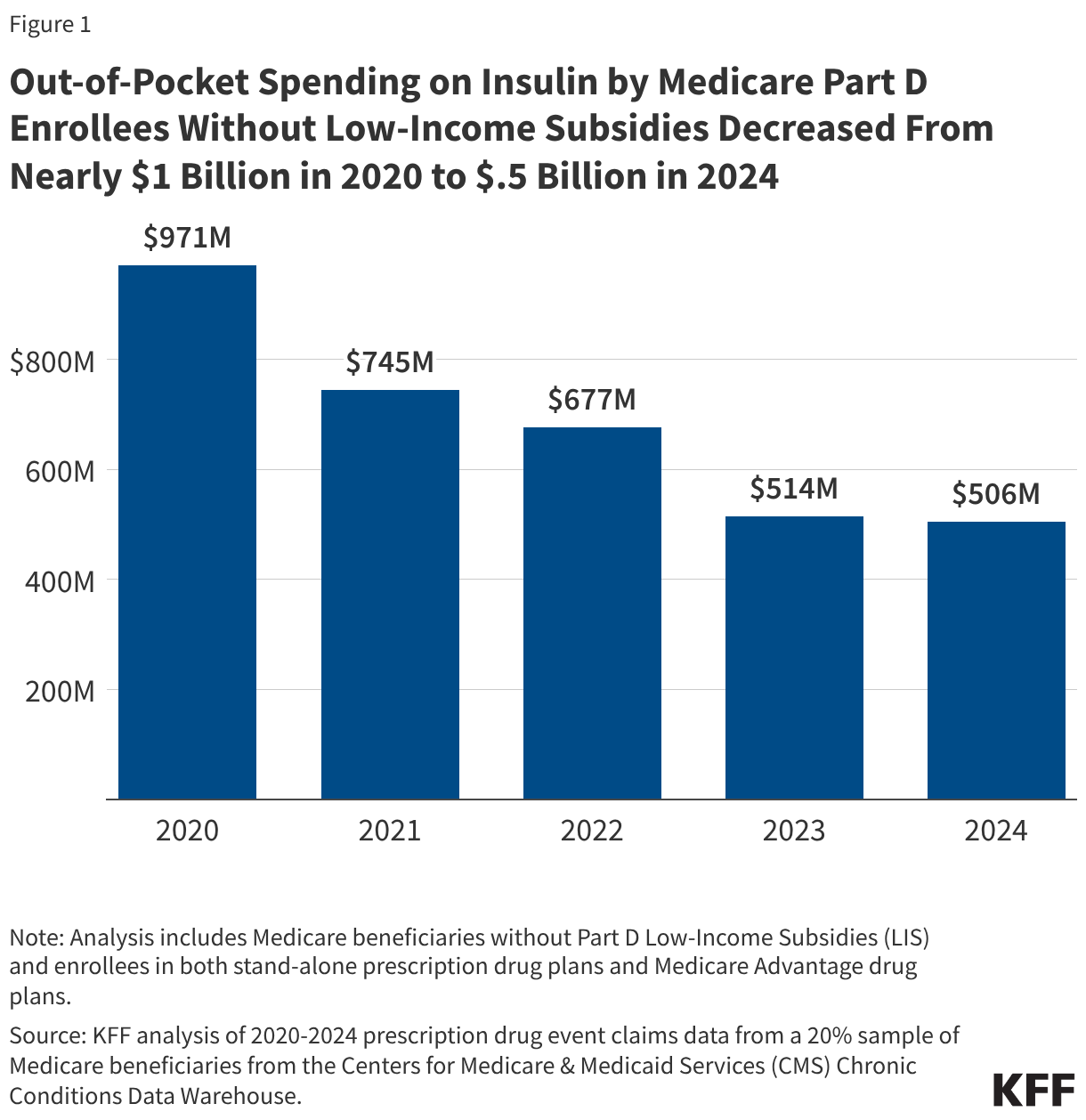
The number of Part D enrollees overall using insulin increased over these years from 3.3 million to 3.5 million, while the total number of insulin prescriptions filled (per 30-day supply) increased from 37.5 million to 38.8 million. Among Part D enrollees without LIS, the number of insulin users increased over these years from 1.7 million to 1.9 million, while the total number of insulin prescriptions filled (per 30-day supply) increased from 18.1 million to 20.4 million. While the number of insulin users and insulin prescriptions increased in the aggregate over this period, insulin use on a per capita basis was flat over these years (11 fills per user), suggesting that the aggregate increase is likely related to increased enrollment in Part D overall.
Out-of-Pocket Costs per Insulin Prescription Among Enrollees Without Low-Income Subsidies Decreased by Half (54%) Between 2020 and 2024, from $54 to $25
For Part D enrollees without LIS, out-of-pocket spending per insulin prescription decreased from $54 in 2020 to $40 in 2021, the first year of the temporary Part D Senior Savings Model, a 26% reduction (Figure 2). Out-of-pocket spending per insulin prescription decreased an additional 28%, from $36 in 2022 to $26 in 2023, the first year of the IRA’s mandatory $35 insulin copay cap, followed by a modest reduction to $25 in 2024.
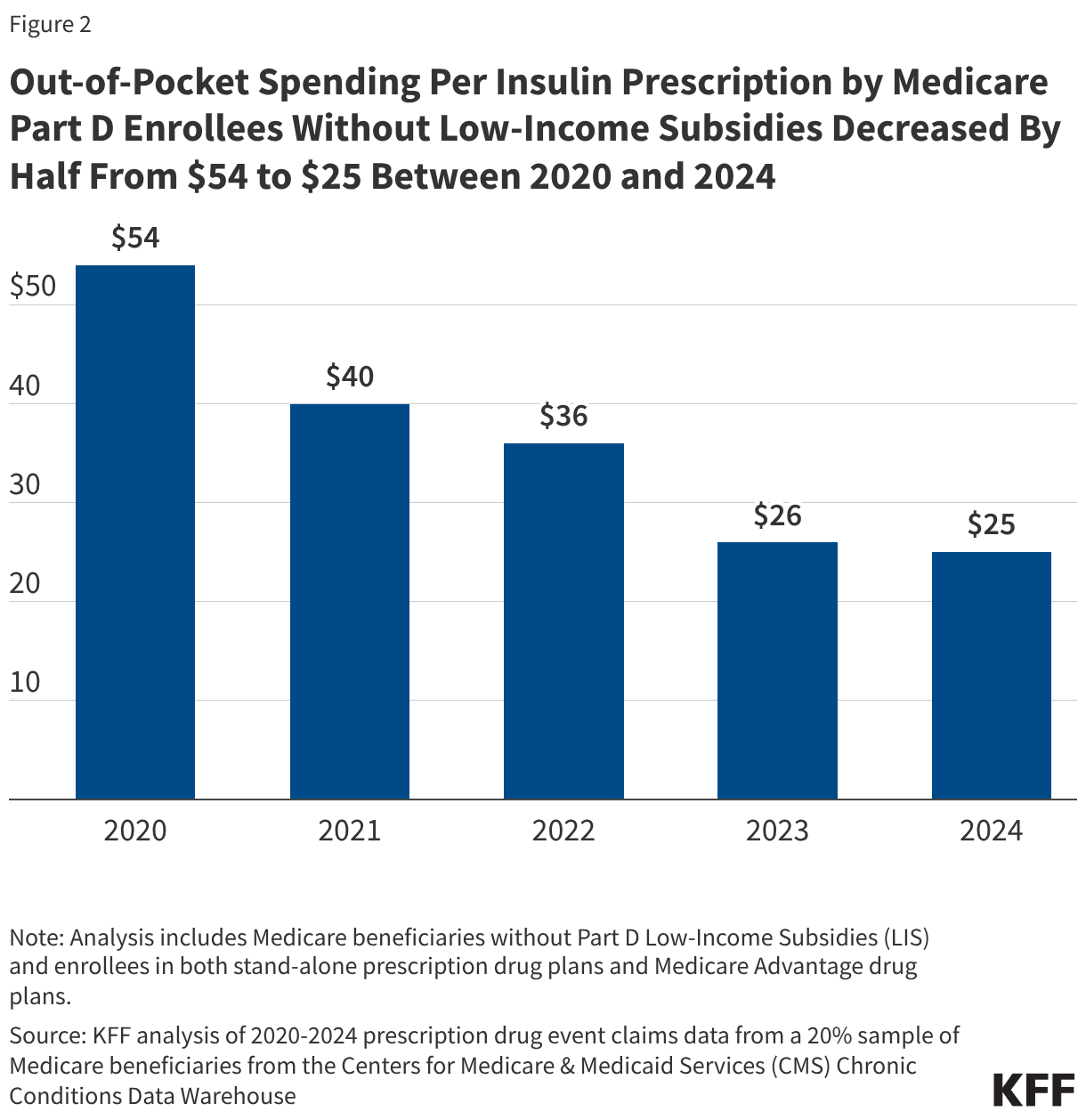
With enrollees filling 11 insulin prescriptions each year over this period, annual out-of-pocket spending on insulin among these same enrollees decreased at the same rate, a 54% reduction, from $572 to $265 between 2020 and 2024 (Figure 2).
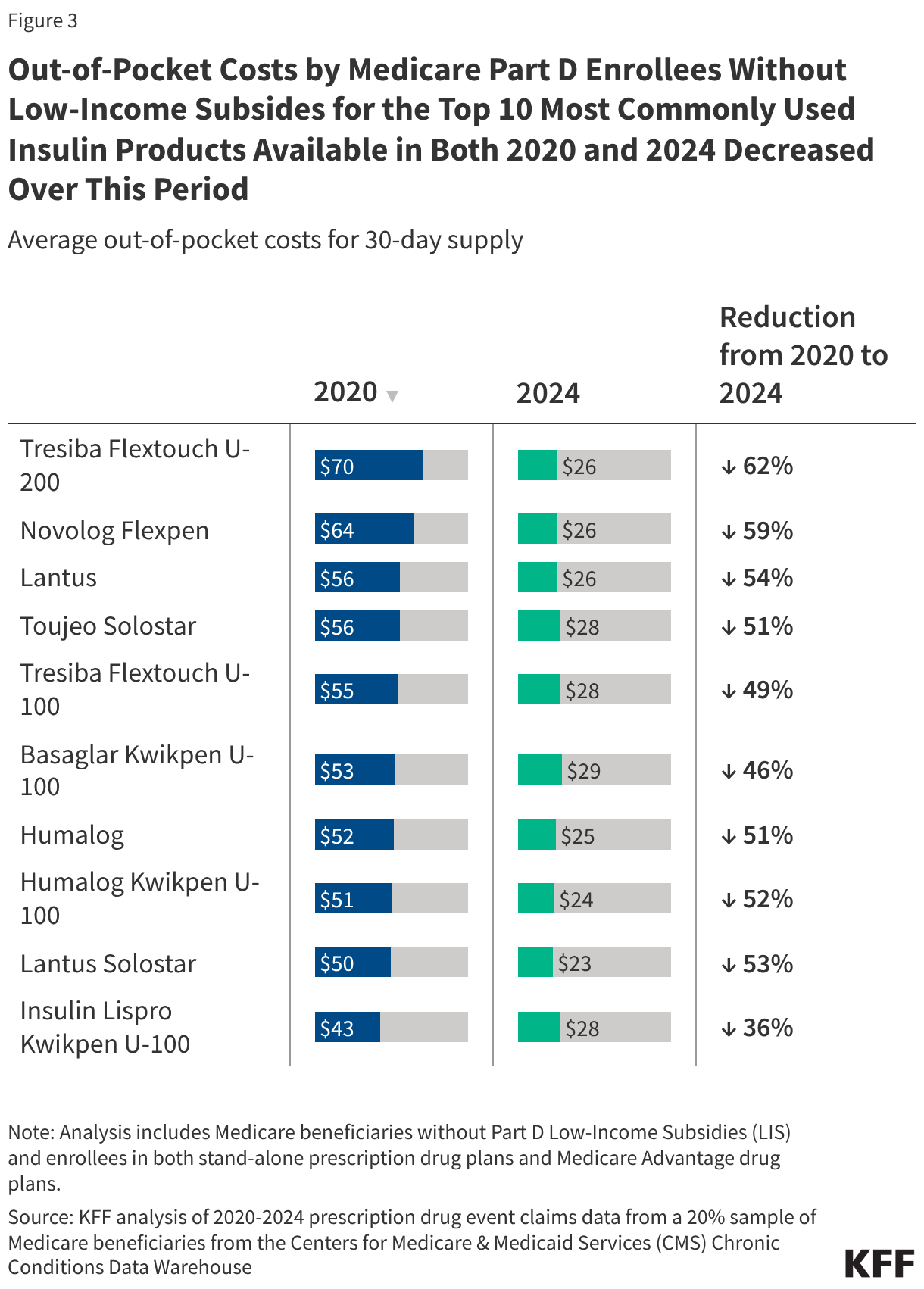
Average Out-of-Pocket Costs for a 30-Day Supply of the Top 10 Most Commonly Used Insulin Products Available in Both 2020 and 2024 Decreased Over This Period
In 2020, Part D enrollees without LIS paid more than $35 for a 30-day supply of each of the 10 most commonly used insulin products, ranging from a high of $70 for Tresiba Flextouch U-200 down to $43 for Insulin Lispro Kwikpen U-100. By 2024, out-of-pocket costs for each product had fallen below $35 and ranged from a high of $29 for Basaglar Kwikpen U-100 down to $23 for Lantus Solostar (Figure 3).
This work was supported in part by Arnold Ventures. KFF maintains full editorial control over all of its policy analysis, polling, and journalism activities.
Juliette Cubanski and Meredith Freed are with KFF. Anthony Damico is an independent consultant.