Medicaid’s Transportation Benefit and the People Who Use It
Medicaid’s non-emergency medical transportation (NEMT) benefit provides transportation to care for low-income enrollees who otherwise may not have a reliable, affordable means of getting to health care appointments. NEMT also assists people with disabilities who have frequent appointments and people with limited public transit options or long travel times to health care providers, such as those in rural areas. Medicaid covers a range of transportation services under the NEMT benefit, including van rides, public transportation, buses, taxis, and ride shares. In some cases, NEMT may subsidize the costs of travel in personal vehicles by reimbursing enrollees for gas and mileage. Despite representing less than 1% of Medicaid spending, NEMT facilitates access to Medicaid services. Recent policy discussions focus on potential overuse or fraud in NEMT services, but there may also be people who need and are eligible for NEMT but are unaware of the benefit. KFF’s analysis of the 2024 National Health Interview Survey (NHIS) finds that more than 3.8 million adult Medicaid enrollees under age 65 have missed medical appointments, meetings, work, or other things needed for daily living due to lack of reliable transportation (data not shown).
Potential fraud in state Medicaid programs is garnering more attention and creating additional administrative tasks for states and providers of services deemed “high risk.” The Centers for Medicare & Medicaid Services (CMS) has classified NEMT as a high-risk service, flagging NEMT in letters to California, New York, and Minnesota, thus increasing attention on Medicaid’s NEMT benefit. In September 2026, a House Energy and Commerce Committee majority staff report identified NEMT as one of several Medicaid services with “high rates of fraud,” and noted that Colorado, Minnesota, and New York deemed providers of NEMT as “high risk” concerning program integrity. The same month, Committee Republicans introduced a package of Medicaid program integrity bills. One of those bills, the Strengthening Tools for Oversight to Prevent (STOP) Medicaid Fraud Act, would extend electronic visit verification (EVV) requirements to NEMT trips. Current EVV requirements apply to Medicaid personal care and home health, using computer/mobile systems to track and record details about services provided under Medicaid.
While additional scrutiny and oversight could limit fraudulent or inappropriate Medicaid spending, these efforts and new administrative burdens for providers could also result in fewer providers and more limited access for Medicaid enrollees who rely on the benefit. This issue brief describes the NEMT benefit structure and administration, Medicaid spending on NEMT, and the demographic and health characteristics of Medicaid enrollees who use NEMT compared with all Medicaid enrollees. Key takeaways include:
- States are required to provide NEMT but have flexibility in how they deliver and pay for it.
- Medicaid spending and utilization of NEMT have increased nearly every year since 2020, yet NEMT still accounts for less than 1% of total Medicaid spending.
- Medicaid enrollees who use NEMT are more likely to qualify for Medicaid through aged or disabled pathways, to be dually-eligible for Medicare and Medicaid, and to have chronic conditions when compared with all Medicaid enrollees.
What is NEMT and how is it administered?
People who are low income or have significant disabilities may have difficulty with transportation to medical care. As a result, states are required to provide NEMT, but they have choices regarding which services to offer, the way to administer the program, and how to claim reimbursement for the federal share of costs. This section describes federal requirements governing NEMT and the flexibility available to states.
State Medicaid programs are required to provide NEMT for enrollees who otherwise may not be able to access care. Medicaid covers a range of transportation services under the NEMT benefit. The method of transportation covered by Medicaid varies depending on the enrollee’s geographic location, individual needs, and states’ policy choices. For example, enrollees in urban areas are more likely to use public transit, while those in rural areas more often rely on taxis or mileage reimbursement for personal vehicles, and enrollees with mobility limitations may need wheelchair-accessible or stretcher vans. Enrollees can use NEMT to get to any Medicaid-covered medical appointment or service, including transportation to and from pharmacies.
State Medicaid agencies have the flexibility to administer NEMT using one or a combination of three delivery methods. Federal regulations require state Medicaid programs to specify which methods they use to administer NEMT: fee-for-service (FFS), where the state pays providers directly, managed care, where the state pays a managed care organization to provide benefits, or a brokerage model, where the state pays a third party to administer the benefit. Paying providers directly allows the state the most control and may facilitate coordination with non-Medicaid state transportation services, but brokerage models may allow states to benefit from specialized expertise from brokers, and managed care models may allow states to have more predictable spending and coordinate NEMT with health care services for people enrolled in comprehensive managed care organizations (MCOs) (see Appendix). As of 2024, 19 states used the FFS delivery model, 12 states used the managed care delivery model, and 30 states used the brokerage model in some capacity.
States can choose whether to claim NEMT reimbursement as administrative expenses or as medical service expenses. Claiming NEMT as an administrative expense offers states greater flexibility in system design but, in most cases, a lower matching rate from the federal government (see Appendix). States must specify their choice in the Medicaid state plan. In 2024, the year of the most recent available Medicaid expenditure reports (known as the CMS-64), 32 states claimed NEMT as medical expenses, 3 states claimed NEMT as administrative expenses, and 16 states claimed NEMT under both categories.
How much does Medicaid spend on NEMT?
In February 2026, the Department of Health and Human Services (HHS) released a publicly available dataset with provider-level spending data. The data include the national provider identifier (NPI) for the billing and servicing providers, the Healthcare Common Procedure Coding System (HCPCS) code, the month and year, the number of enrollees seen, the count of claims, and the total amount paid for the services (FFS and MCO). An advantage of the HHS data relative to other Medicaid claims is that they include payments from MCOs to health care providers. (Other claims data have more detailed information and can be linked to specific enrollees, but do not include payments from MCOs, which cover most Medicaid enrollees.) The public data include claims and encounter records for noninstitutional services used by Medicaid enrollees. Noninstitutional services include a wide range of services such as professional and clinical services, labs and radiology, outpatient hospital services and home care. They also include professional services billed separately during inpatient stays. NEMT claims and spending were identified using HCPCS codes, which also identified the type of transportation:
- Individual (transportation provided in a personal vehicle),
- Taxi,
- Public transportation,
- Van (transportation in a shared or specialized van),
- Airplane,
- Non-transport ancillary services (costs associated with transportation—parking, tolls, etc.), and
- NEMT other (trips that do not specify vehicle type or other costs—per diem billing, driver wait time, etc.).
Medicaid spending and utilization of NEMT have increased nearly every year since 2020 (Figure 1). In 2020, the COVID-19 pandemic led to major declines in the use of all health care. At the end of 2020, health services spending was down almost 3% and remained suppressed at the beginning of 2021. The pandemic, and subsequently the decrease in overall health care use, likely explains the sharp decrease in Medicaid spending and utilization of NEMT services in 2020. In nearly every year after 2020, Medicaid spending and utilization of NEMT have grown. In 2024, Medicaid spent $4.65 billion on NEMT services. While spending on NEMT has grown, NEMT is still a small share of overall Medicaid spending, accounting for less than 1% of all Medicaid spending.
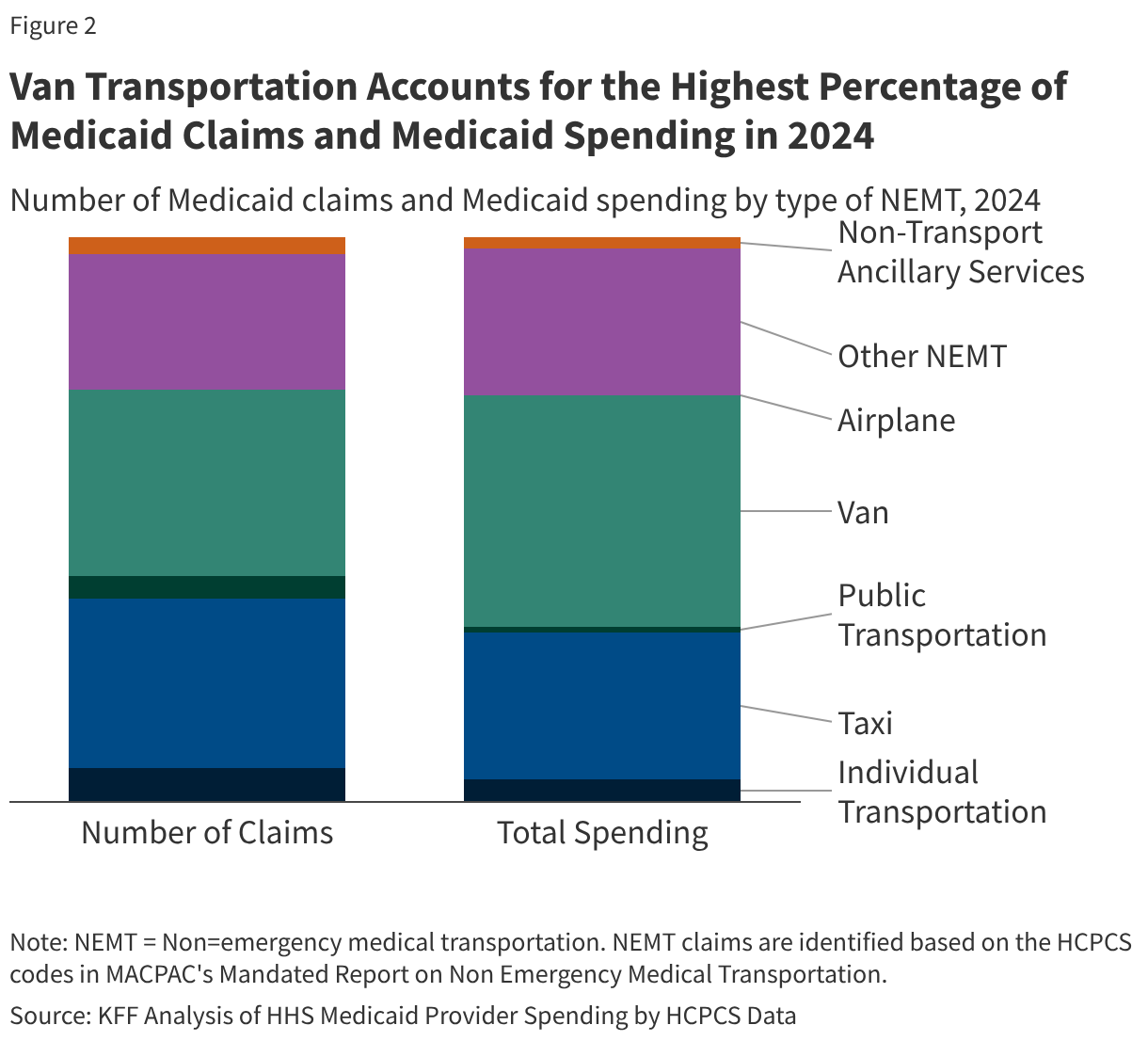
Two-thirds of Medicaid NEMT spending in the public data pays for van and taxi services (Figure 2). Van and taxi transportation account for about two-thirds of Medicaid NEMT spending (67%) and utilization (63%) in 2024. The “other” NEMT services category makes up the next largest share of Medicaid spending (26%) and utilization (24%). Services in this category include claims for NEMT case workers, patient attendants, escorts, and per diems. Combined, the remaining categories (individual transportation, public transportation, airplane, and non-transport ancillary services) account for less than 10% of Medicaid spending on NEMT and 13% of Medicaid NEMT utilization.
Who uses NEMT?
This analysis uses 2024 Medicaid claims data (the Transformed Medicaid Statistical Information System [T-MSIS] Analytic Files) to understand the characteristics of people who use Medicaid NEMT. People were identified as using NEMT if they had at least one claim with an NEMT-identified HCPCS code in the 2024 Other Services (OT) T-MSIS Research Identifiable File. The OT file captures claims for all noninstitutional services, which includes a wide range of services such as professional services (regardless of where they were provided), labs and radiology, clinical services, outpatient hospital services, and home care. People’s chronic conditions were identified as described in KFF’s earlier work on chronic conditions among adult Medicaid enrollees. The research identifiable file does not include spending from MCO encounter records, so the analysis only includes measures of utilization and omits spending estimates. Data about dual eligibility and chronic conditions exclude Oregon due to data quality issues.
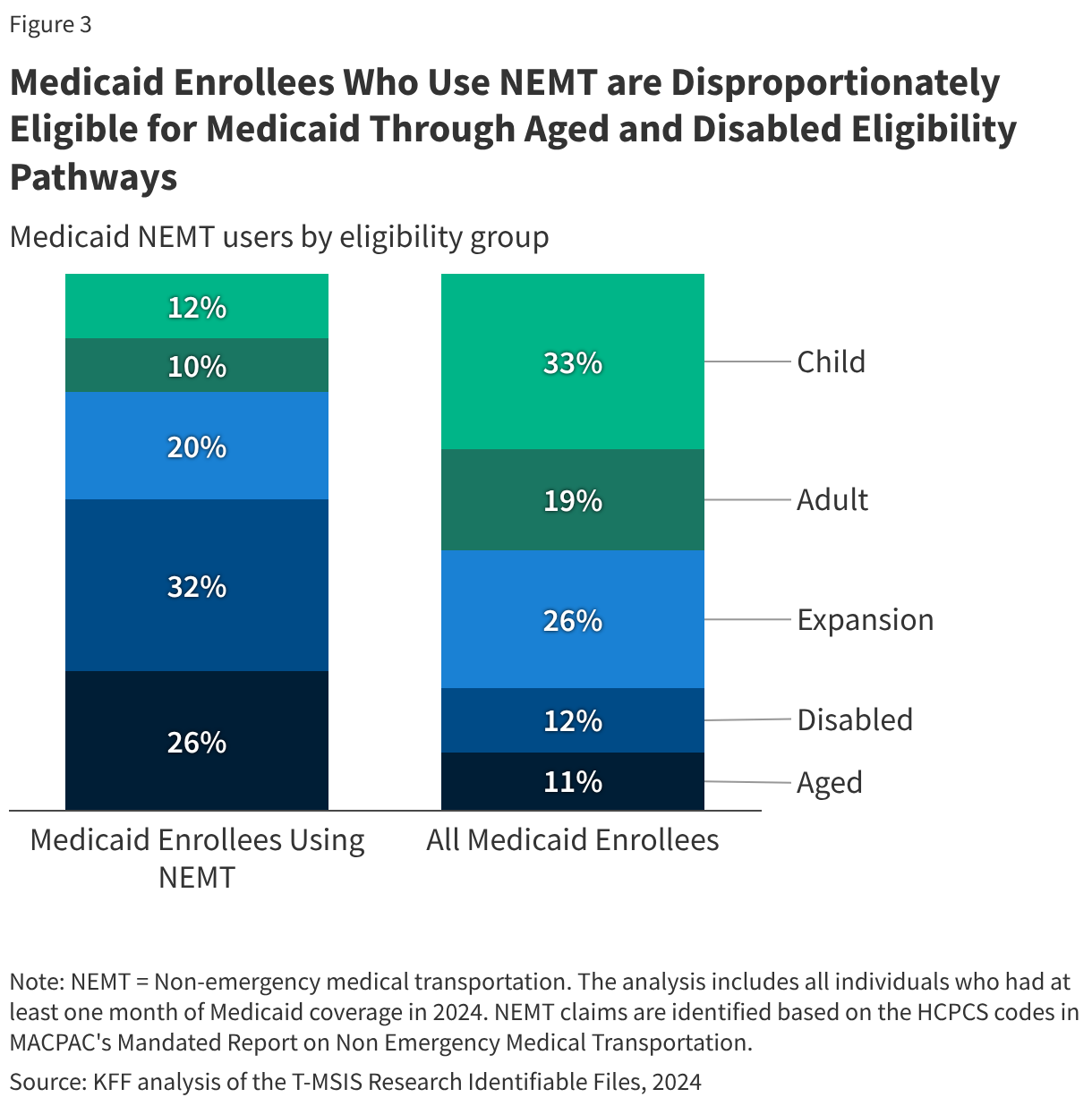
A disproportionate share of Medicaid enrollees who use NEMT qualify for Medicaid because of a disability or because they are age 65 or older compared with all Medicaid enrollees (Figure 3). More than half (58%) of the Medicaid enrollees who use NEMT are eligible for Medicaid because they are age 65 or older or have a long-term disability, compared with about one in five (23%) of all Medicaid enrollees. Conversely, children make up 33% of all Medicaid enrollees, but only 12% of Medicaid enrollees who use NEMT. Medicaid enrollees who are older or qualify for a disability use more health care than other enrollees and also may have greater need for assistance with transportation.
More than one in three (39%) NEMT users are dually eligible for Medicare and Medicaid, compared with 14% of overall Medicaid enrollees. Traditional Medicare does not typically cover NEMT benefits. Some Medicare Advantage (MA) plans offer supplemental NEMT benefits, but coverage varies by plan. For dual-eligible individuals, Medicare is the primary payer and covers medical and post-acute care, while Medicaid wraps around Medicare coverage by paying Medicare premiums and, in most cases, cost sharing. For medical appointments where Medicare is the primary payer, Medicaid can still pay for transportation to get to the appointment.
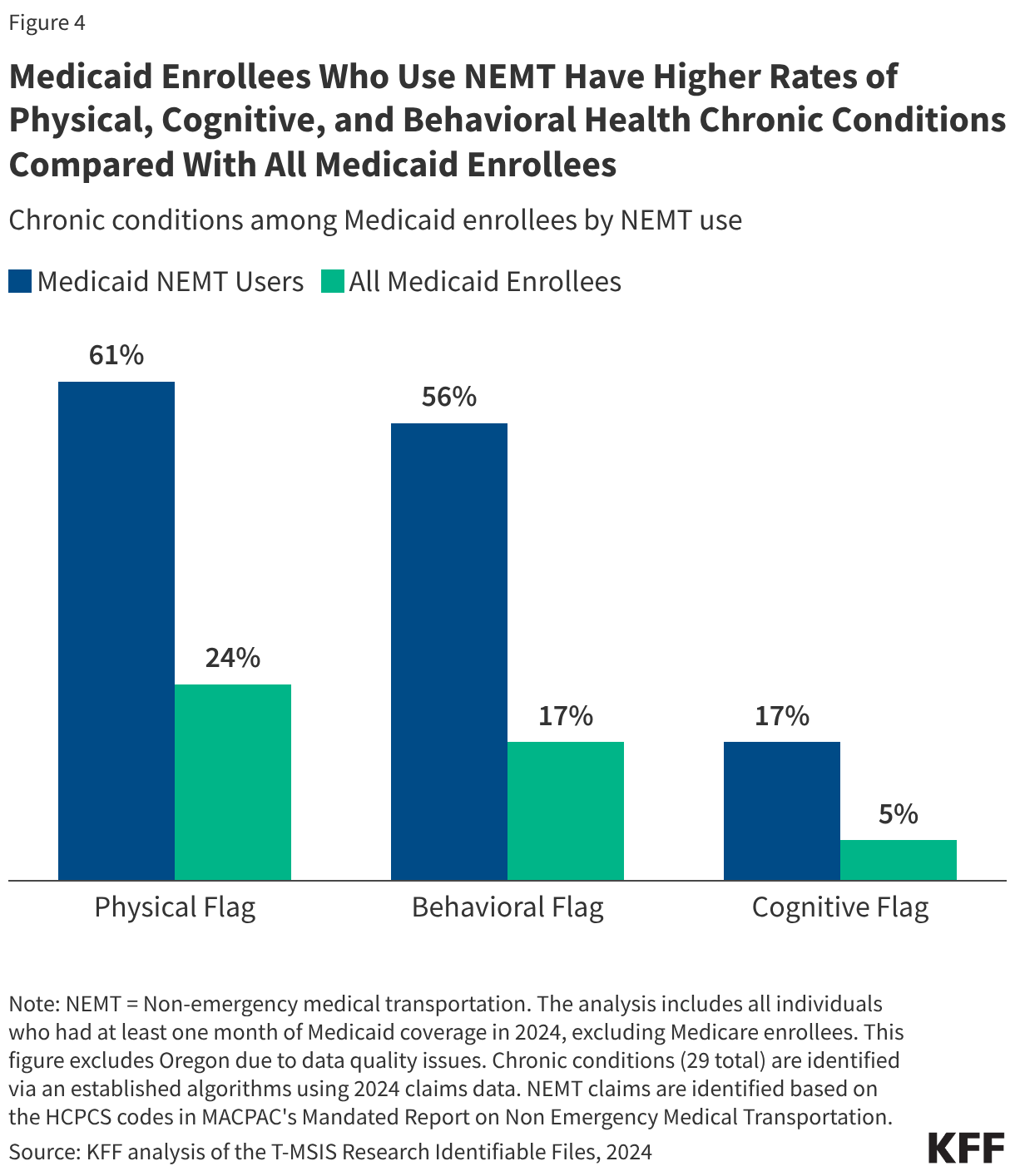
Nearly nine in ten (85%) Medicaid enrollees using NEMT have at least one chronic condition, compared with fewer than four in ten Medicaid enrollees overall (36%, Figure 4). Medicaid enrollees who use NEMT are most likely to have a physical health condition (61%), compared with 24% of all Medicaid enrollees. Rates of behavioral health conditions (56% vs. 17%) and cognitive health conditions (17% vs. 5%) are also higher among individuals using NEMT compared with all Medicaid enrollees. NEMT may provide disproportionate benefits for enrollees with certain conditions, like chronic kidney disease or intellectual and developmental disabilities. Such enrollees need regular access to care but may face additional transportation-related obstacles to accessing their ongoing services (Box 1).
Box 1: NEMT for Individuals with Certain Conditions
- Chronic Kidney Disease: Seven percent of Medicaid enrollees without Medicare coverage using NEMT have chronic kidney disease compared with 1% of all Medicaid enrollees. There is currently no cure for chronic kidney disease, and as chronic kidney disease progresses, it can advance to end-stage renal disease (ESRD). ESRD may be treated through weekly dialysis appointments, often requiring regular transportation to and from dialysis centers. Individuals with ESRD who are enrolled in Medicaid may not be able to afford a car or other forms of transportation. They may also have other chronic conditions that limit their ability to drive or navigate transportation independently. In 2021, dialysis facilities were among the top four destinations for NEMT trips.
- Intellectual and Developmental Disabilities (I/DD): Sixteen percent of Medicaid enrollees using NEMT have I/DD, compared with just 5% of all Medicaid enrollees. I/DD include various disabilities such as intellectual disabilities, autism, developmental delays, and learning disabilities. These disabilities are usually present at birth or manifest during childhood and affect the trajectory of the individual’s physical, intellectual, and/or emotional development. Individuals with I/DD may not have the ability to drive or use public transportation independently. Individuals with I/DD may also require frequent medical appointments, such as occupational therapy, behavioral therapy, and physical therapy, along with typical preventive care medical appointments. NEMT services allow individuals who are unable to drive, lack access to a car, or need specialized vehicles, such as wheelchair-accessible vans, to access necessary medical care.
This work was supported in part by Arnold Ventures. KFF maintains full editorial control over all of its policy analysis, polling, and journalism activities.
Appendix: States’ Options for Providing NEMT and Claiming Federal Reimbursement
A 2021 report to Congress by the Medicaid and CHIP Payment and Access Commission (MACPAC) summarizes each delivery model and its benefits and drawbacks:
- Fee-for-service (FFS): Under an FFS (or in-house) model, states contract with independent transportation providers and reimburse providers for services based on payment rates set by the state. This model provides states with more control over NEMT policies and operations and can facilitate coordination with other state programs that subsidize transportation costs for low-income people (such as those offered through state departments of transportation). However, FFS NEMT delivery also carries a large administrative burden for states, including the burden of ensuring program integrity and identifying fraud and abuse.
- Managed care: Some MCOs “carve in” NEMT as part of their coverage, alongside other Medicaid benefits. The individual managed care plans that include NEMT coverage can choose to directly manage NEMT themselves or contract with a broker. Using managed care to administer NEMT removes some administrative burden from states, provides greater predictability in spending, and can allow for better coordination with other benefits also provided under the managed care plan. However, this delivery model can increase the administrative burden for NEMT providers who must contract with multiple managed care plans rather than only with the state.
- Brokerage: Under a brokerage model, states contract with a third party that manages their NEMT benefit. States can pay the broker on an FFS basis or using another approach such as paying a flat amount for each enrollee each month (i.e., a capitated approach). Brokerage models allow states to leverage brokers’ expertise in transportation administration and their capacity to administer the benefit. One risk of using capitated payments with brokers is that it creates an incentive for the brokers to decline trips, potentially making it harder for enrollees to access NEMT.
A Medicaid Transportation Coverage Guide from the Centers for Medicare and Medicaid Services (CMS) describes the two reimbursement methods as well as their benefits and drawbacks.
- Administrative expenses: When states claim spending as an administrative expense, the federal government pays 50% of the total cost, which is the administrative expense federal matching rate. When states claim NEMT as an administrative expense, they are exempt from Medicaid’s requirement to provide enrollees with free choice of providers, allowing for contracts with a single provider and alternative payment models, like vouchers. Additionally, electing to claim NEMT as an administrative expense allows states to limit the amount, duration, and scope of NEMT benefits.
- Medical service expenses: When states claim spending as a medical expense, the federal government pays the state’s regular federal matching rate (ranging from 50% to 77.32% in fiscal year 2027). Claiming NEMT as a medical service expense generally makes NEMT services subject to additional guidelines, including the free choice of provider, comparability, and statewideness requirements. The Deficit Reduction Act (DRA) of 2005 added an option for states to include NEMT brokerage programs in their Medicaid state plans where cost-effective, and to waive some of the additional guidelines, such as limiting enrollees’ free choice of provider. However, states must provide NEMT using a brokerage if they want additional flexibility, so some states may prefer to continue claiming NEMT as administrative expenses.