The Trump Administration’s Latest Expansion of the Mexico City Policy: A Funding Analysis
Issue Brief
On January 27, 2026, the Trump administration released details of the latest expansion of the Mexico City Policy, a policy he reinstated in January of last year. The policy, which has been in effect, depending on the party of the President, since 1984, has required foreign non-governmental organizations (NGOs) to certify that they would not “perform or actively promote abortion as a method of family planning” using funds from any source (including non-U.S. funds) as a condition of receiving U.S. government global family planning funding. In 2017, President Trump reinstated the policy but also significantly expanded it to encompass the vast majority of U.S. bilateral global health assistance. The latest expansion, now part of a broader set of restrictions known as the “Promoting Human Flourishing in Foreign Assistance (PHFFA)” Policy, applies to significantly more funding, many more organizations, and new services and activities. Specifically, it now applies to most non-military foreign assistance and most recipients of foreign aid (not just foreign NGOs). And, in addition to abortion, it prohibits activities related to diversity, equity, and inclusion (DEI) and promoting or providing gender affirming care, legal protections based on gender identity, and other related services and activities. This analysis assesses the potential reach of the latest expansion of the policy by examining foreign assistance funding provided in FY 2024, the most recent year with complete information, to identify the amount of funding, number of organizations, and range of foreign assistance sectors that stand to be affected. The analysis looks at total funding that would be subject to restrictions, and although not all recipients are necessarily currently engaging in activities subject to the restrictions, all would have to decide whether they accept the policies’ terms. Among the key findings:
- In FY 2024, $39.8 billion in U.S. foreign aid, spanning 160 countries, was obligated to prime recipients, funding that would be subject to the latest expansion (additional funding could be subject to the policy if it was ultimately provided, directly or indirectly, to recipients or sub-recipients).
- Notably, this is tens of billions more than the amount of global health assistance subject to the policy under the Trump administration’s previously expanded policy ($7.3 billion in FY 2020), and significantly more than the amount of family planning assistance subject to the policy during earlier administrations (between $300-$600 million).
- By recipient type, the largest share (41%) of the $39.8 billion was provided to multilateral organizations, recipients that are newly subject to the policy under the latest expansion. The second largest (29%) was provided to private sector organizations, including the newly-subject U.S. private sector.
- By sector, humanitarian assistance accounted for the largest share of funding (29%), followed by health (26%) and economic development (22%); two of these sectors (humanitarian assistance and economic development) are among the several sectors newly subject to the policy under the latest expansion.
- There were almost 2,600 prime recipients of U.S. foreign aid in FY 2024, a significantly higher number than for health alone (756 prime recipients). This number should be considered a floor, since prime recipients must “flow-down” the policy to any sub-recipients. The majority of prime recipients were foreign entities (62%); U.S.-based entities accounted for 34%, with multilateral recipients accounting for 4%.
- Whether or not the full extent of the expansion will be instituted (there are likely to be legal challenges to some aspects of the policy, which could limit its reach, and some additional rule-making has yet to occur), it represents a significant expansion in terms of funding, number of organizations, and content and services restricted, well beyond the reach of what was in place during the first Trump administration.
Background
The Mexico City Policy (MCP) is a U.S. government (USG) policy that – when in effect – has required foreign NGOs1 to certify that they will not “perform or actively promote abortion as a method of family planning” using funds from any source (including non-U.S. funds) as a condition of receiving U.S. global family planning assistance and, in 2017 under the first Trump administration, most other U.S. global health assistance. First announced in 1984 by the Reagan administration, the policy has been rescinded and reinstated by subsequent administrations along party lines since and has been in effect for 23 of the past 42 years. It has also been steadily expanded over time (see Table 1). Under the first Trump administration, the policy was renamed “Protecting Life in Global Health Assistance” (PLGHA). Among opponents, it has also been known as the “Global Gag Rule,” because among other activities, it prohibited foreign NGOs from using any funds (including non-U.S. funds) to provide information about abortion as a method of family planning and to lobby a foreign government to legalize abortion.
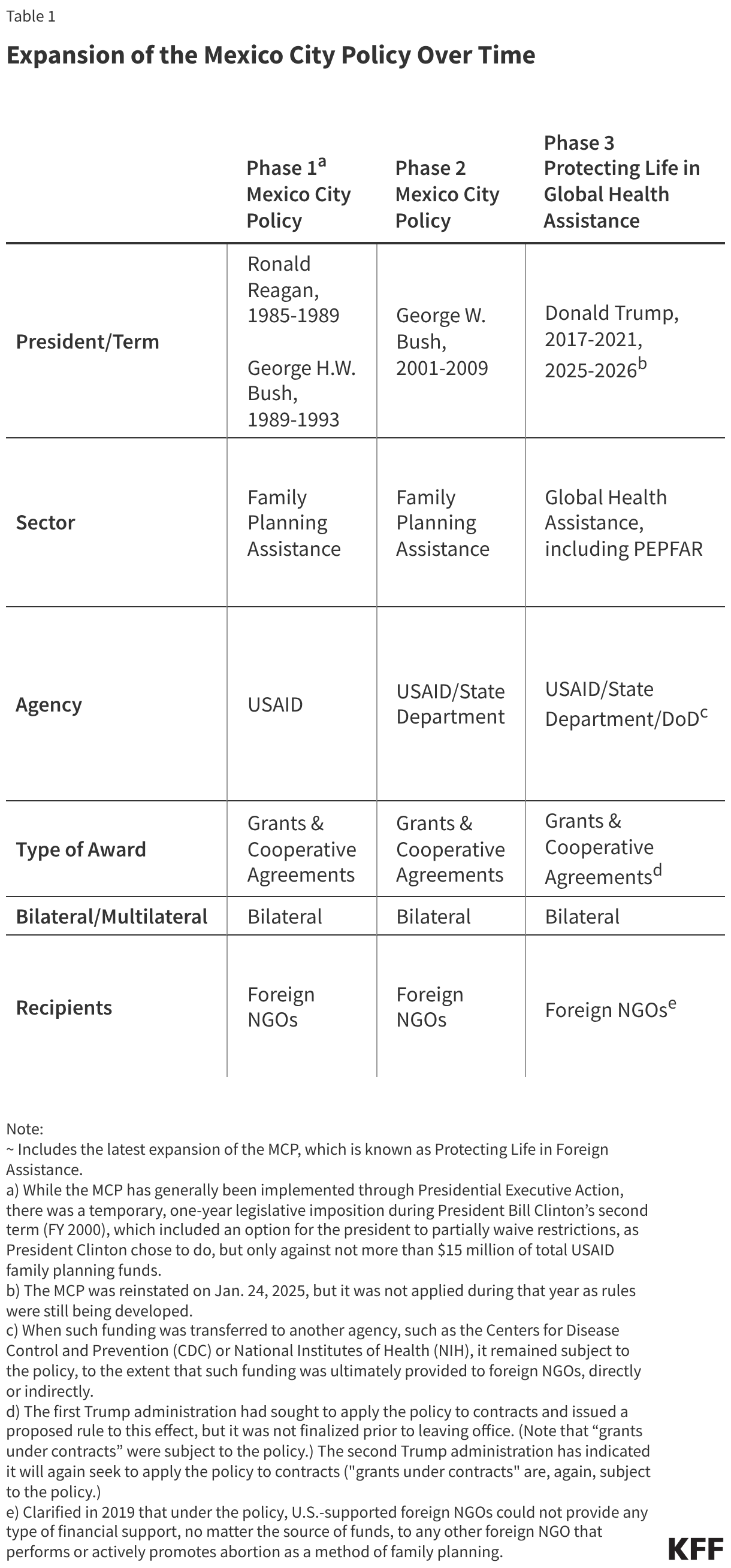
The second Trump administration reinstated the MCP through a Presidential Memorandum on January 24, 2025, noting that the policy would be expanded even further. On January 27, 2026, the policy details were released under three separate, but inter-related final rules (interim final rules were first posted on January 23), now called the “Promoting Human Flourishing in Foreign Assistance (PHFFA) Policy” (see Box 1).
Box 1: Promoting Human Flourishing in Foreign Assistance (PHFFA) Policy
The Trump administration released details of its new Promoting Human Flourishing in Foreign Assistance (PHFFA) Policy, which includes the latest expansion of the Mexico City Policy, via three separate, but related, final rules on January 27, 2026. Each rule applies to the same funding streams, types of organizations, and award mechanisms but restricts different activities and services:
- Protecting Life in Foreign Assistance (PLFA): prohibits recipients from performing or actively promoting abortion as a method of family planning; the latest expansion of the Mexico City Policy.
- Combating Discriminatory Equity Ideology in Foreign Assistance Rules: prohibits recipients from promoting DEI-related policies and activities.
- Combating Gender Ideology in Foreign Assistance: prohibits recipients from providing or promoting gender affirming care, legal protections based on gender identity, and other related activities; defines sex as “person’s immutable biological classification as either male or female.”
This marks the most significant expansion of the policy to date. Specifically, it:
- expands to all non-military U.S. foreign assistance (not just global health) administered by the State Department2 (with an intention for the State Department to work with other agencies that administer foreign assistance to also incorporate these provisions);
- expands the types of recipients, and consequently the number of organizations, subject to the policy to also include multilateral organizations, foreign governments, and U.S.-based NGOs (not just foreign NGOs);3
- expands to prohibit additional content areas and services newly subject to the policy: DEI-related activities as well as support for gender affirming care and services, information, and legal protections based on gender identity, among other related activities (referred to as promoting “gender ideology”); and
- expresses an intent to expand to include funding provided through contracts (not just grants and cooperative agreements), although this will be the subject of future rule-making.
Findings
To assess the potential reach of the latest expansion, this analysis looks at U.S. government foreign assistance obligation data for FY 2024 (the most recent year for which complete obligation data by sector are available) to quantify the amount of funding and number and type of prime recipients that could be affected. While not all recipients are necessarily currently engaging in activities subject to the restrictions, all would have to decide whether they accept the policies’ terms. Obligations were analyzed because the policy applies to funding once newly obligated to a recipient (either through an existing or a new award). Data were obtained from ForeignAssistance.gov, the U.S. government’s centralized data portal for budgetary and financial data provided by more than 20 federal agencies that manage foreign assistance programs. The analysis is based on the funding identified in the PHFAA rules, which includes all non-military foreign assistance4 appropriated to the State Department or U.S. Agency for International Development (USAID) under Title III and four other accounts under Department of State, Foreign Operations, and Related Programs (SFOPs)/National Security, State Department, and Related Programs (NSRP) appropriations acts (specifically, “International Narcotics Control and Law Enforcement,” “Nonproliferation, Anti-Terrorism, Demining and Related Programs,” “Peacekeeping Operations,” and “International Organizations and Programs”). The analysis also includes funding provided through contracts (not just grants and cooperative agreements) for two reasons: first, the rules indicate that further rule-making will be undertaken to add these policy restrictions to contracts; and second, it is not possible to disaggregate obligations by funding instrument in ForeignAssistance.gov (see Box 2 for key terms, Methodology for more detail, and Appendix for detailed data).
Box 2: Key Terms
- Obligation: A binding agreement that will result in outlays of funds immediately or at a later date.
- Prime Recipient: The main recipient, or those that receive funding directly from the U.S. government to carry out foreign assistance work.
- Sub-Recipient: Those that receive funding indirectly from the U.S. government through an agreement with the prime recipient.
- Non-Governmental Organization (NGO): a for-profit or not-for-profit organization that is not part of the U.S. government, a foreign government, or a multilateral organization; includes private sector organizations, non-profit organizations, and educational institutions.5
- Multilateral Organization: an organization that is jointly supported by multiple governments and, often, other partners (versus bilateral efforts, which are carried out on a country-to-country basis); includes specialty agencies of the United Nations (U.N.) and international financing mechanisms that pool and direct resources from multiple public and private donors for specific causes.6
- Foreign Government: any department, agency, independent establishment, or other entity of the government of a foreign country.
- Parastatal: foreign-government-owned organization operated as a commercial company or other organization, including non-profits, or enterprises in which foreign governments or foreign government agencies have a controlling interest.
- In FY 2024, $39.8 billion in U.S. foreign aid was obligated to prime recipients, funding that would be subject to the latest expansion. This includes funding provided to U.S. and foreign NGOs, international organizations, foreign governments, and parastatals (additional funding could be affected if it was ultimately provided, directly or indirectly, to recipients or sub-recipients subject to the policy).
- Notably, this is tens of billions more than the amount of global health assistance subject to the policy under the first Trump administration’s previously expanded policy ($7.3 billion in FY 2020), and significantly more than the amount of family planning assistance subject to the policy during earlier administrations (between $300-$600 million). See Box 3.
Box 3: Funding Newly Subject under the Latest Expansion of the MCP
By Recipient Type:
- Multilateral organizations: $16.3 billion
- Foreign governments: $1.3 billion
- U.S. NGOs: $16.5 billion^
- Foreign NGOs: $3.5 billion in non-health sectors
By Sector:
- Non-health sectors: $29.2 billion, including (for example):
- Humanitarian assistance: $11.5 billion
- Economic development: $8.7 billion
- Democracy, human rights, and governance: $2.6 billion
- Peace and security: $2.2 billion
- Education and social services: $1.2 billion
- Health sector: $8.3 billion in U.S. NGO,^ multilateral, and foreign government funding
Note: Amounts by recipient type and sector are not mutually exclusive categories. ^ Any foreign NGO that was a sub-recipient of U.S. global health assistance from a U.S. NGO would have been subject to the previously expanded MCP, PLGHA, when in place.
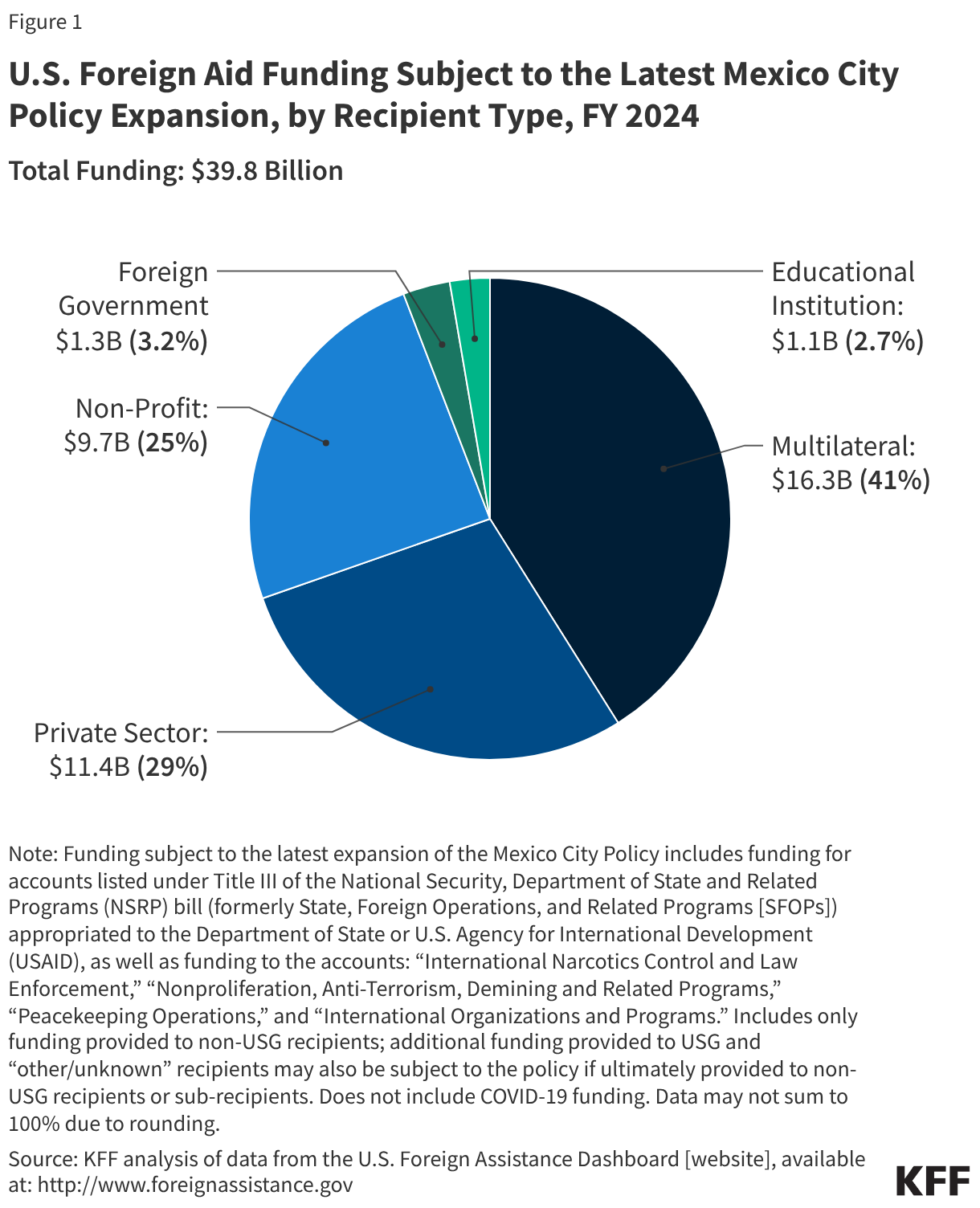
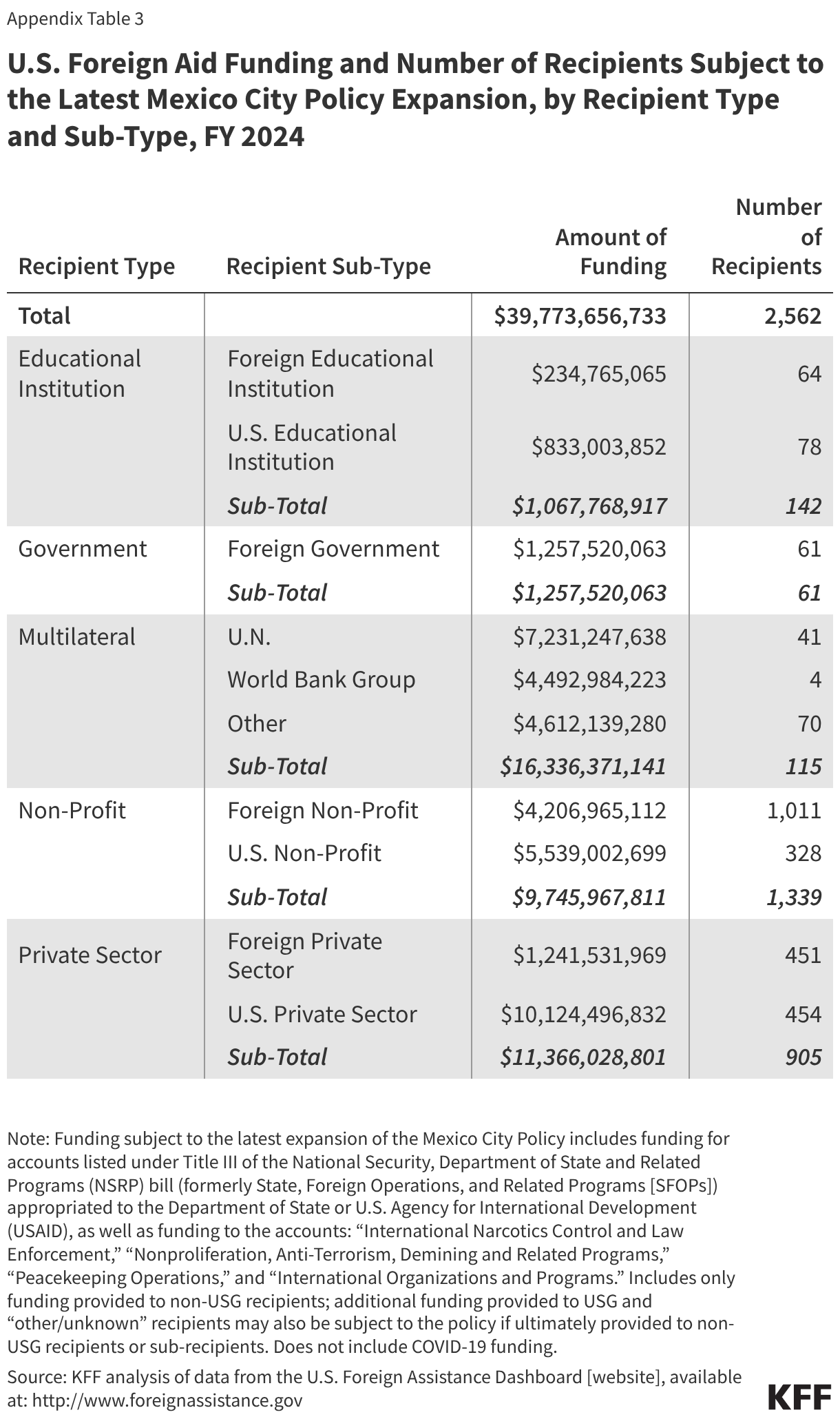
- By recipient type, the largest share of funding was provided to multilateral organizations ($16.3 billion, or 41%), entities that are newly subject to the policy. The private sector received the next largest amount of funding ($11.4 billion, or 29%), followed by the non-profit sector ($9.7 billion, or 25%). Smaller amounts were provided to foreign governments ($1.3 billion, or 3.2%) and educational institutions ($1.1 billion, or 2.7%) (see Figure 1).
- U.S.-based recipients received $16.5 billion (41%). These included U.S. NGOs, specifically U.S. non-profits, private sector organizations, and educational institutions (all newly subject to the policy). Foreign recipients, both governments and NGOs, received $6.9 billion (17%); foreign governments are also newly subject to the policy.
- Collectively, the $39.8 billion in foreign assistance was provided to 160 countries, with more countries likely reached through “regional” and “worldwide” activities.7 This is significantly more countries than would be reached with global health assistance alone (87 countries).
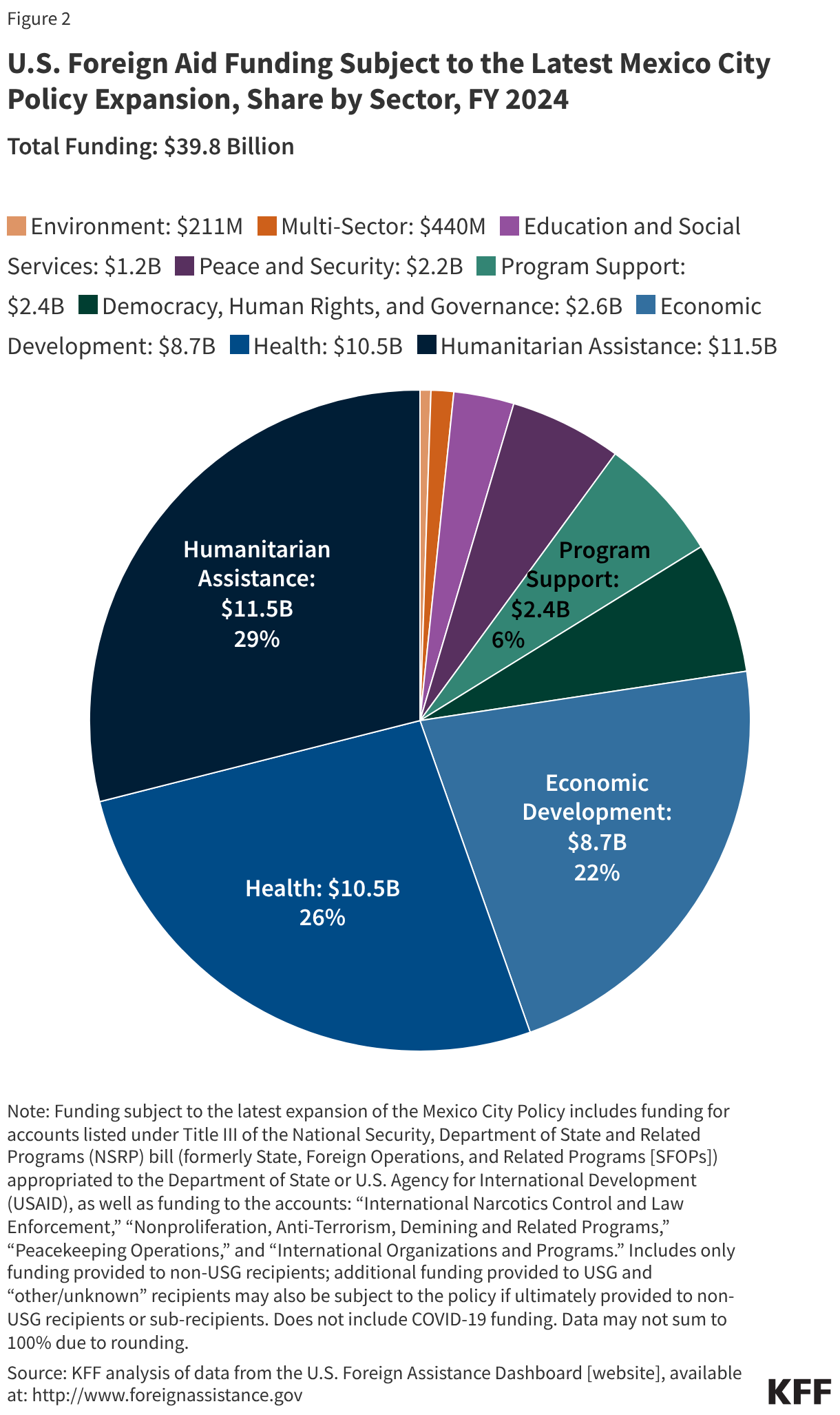
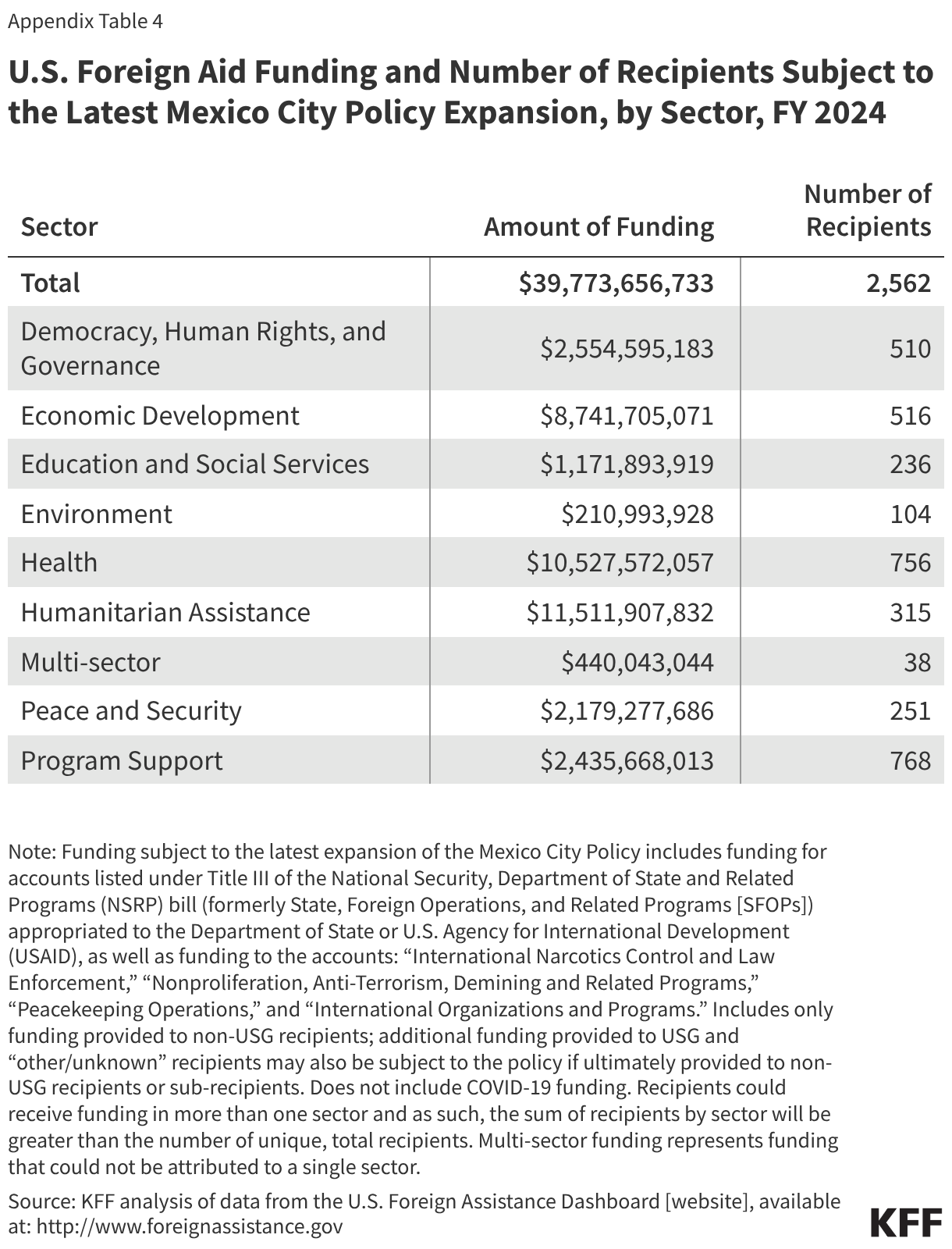
- By sector, humanitarian assistance accounted for the largest share of funding ($11.5 billion, or 29%) in FY 2024, followed by health ($10.5 billion, or 26%) and economic development ($8.7 billion, or 22%). Two of these sectors (humanitarian assistance and economic development) are newly subject to the policy (see Figure 2). The remaining sectors each accounted for approximately $3 billion (6%) or less.
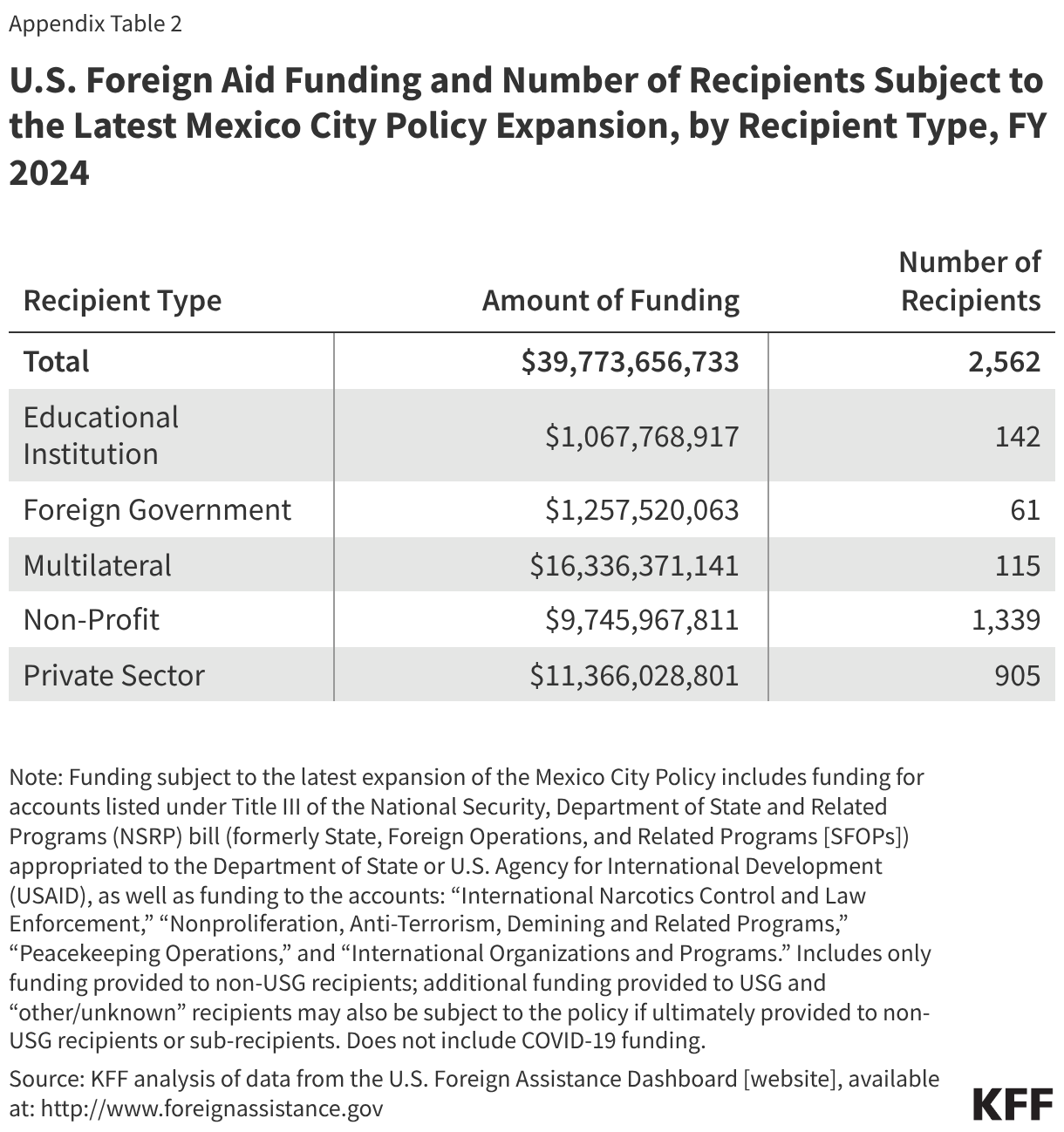
- There were 2,562 non-USG prime recipients of U.S. foreign assistance in FY 2024, most8 of which (2,111 or 82%) would be subject to the policy for the first time. This number should be considered a floor, since any sub-recipients of U.S. foreign aid would also be subject to the policy.
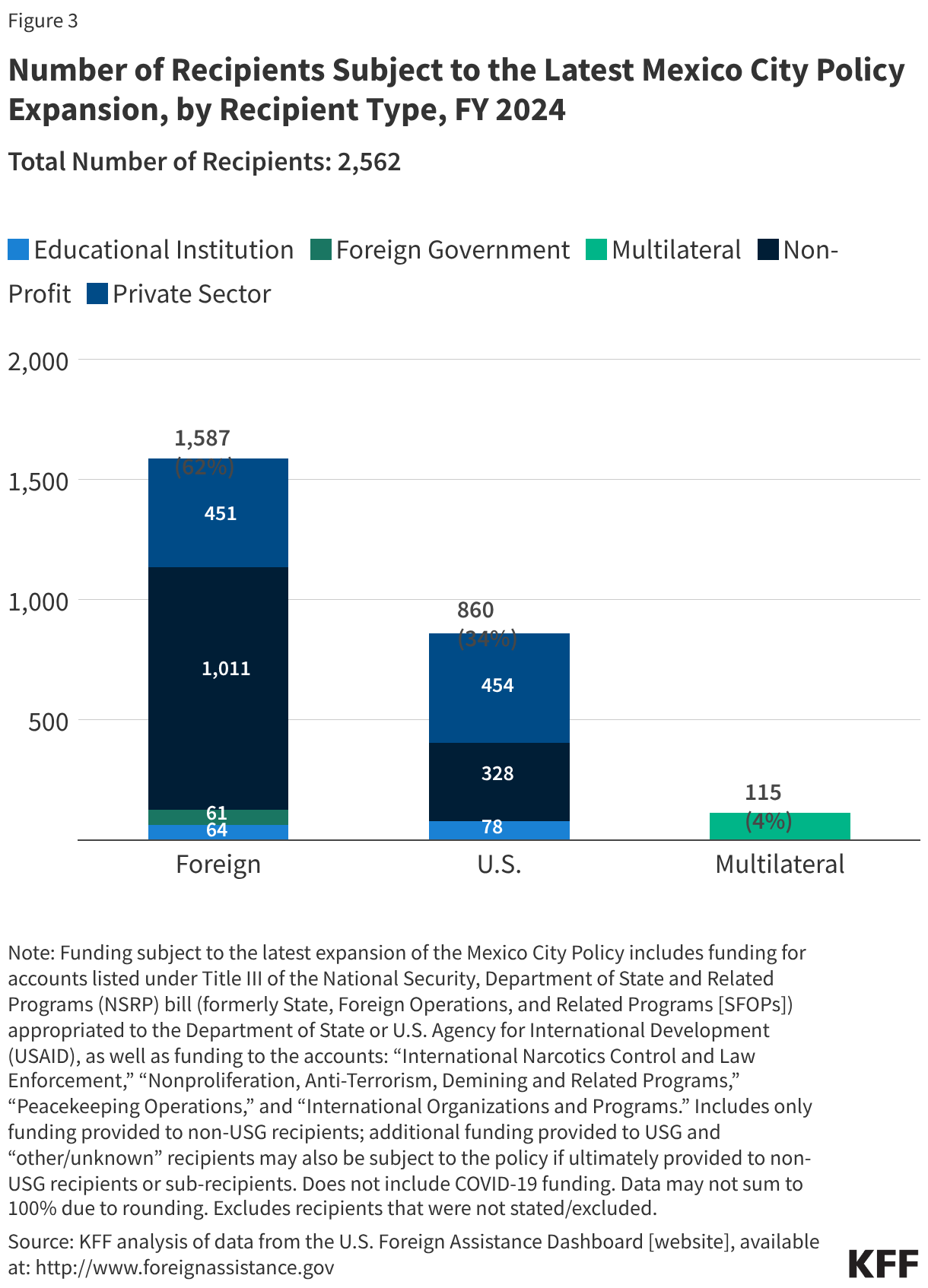
- Whereas most funding was provided to multilateral organizations, most recipients (62%, or 1,587) were foreign-based organizations. About a third (34%, or 860) were U.S.-based organizations. Multilateral organizations accounted for the remaining 4% (115) (see Figure 3).
- NGOs (foreign- and U.S.-based) accounted for the vast majority (93%, or 2,386) of recipients. NGOs include:
- non-profits (more than half – 52% – of all 2,562 recipients, or 1,339),
- private sector organizations (more than a third – 35% – of all recipients, or 905), and
- educational institutions (6% of all recipients, or 142).
- Among the 2,386 NGO recipients, almost two-thirds (64%, or 1,526) were foreign NGOs, and the other third (36%, or 860) were U.S.-based NGOs.
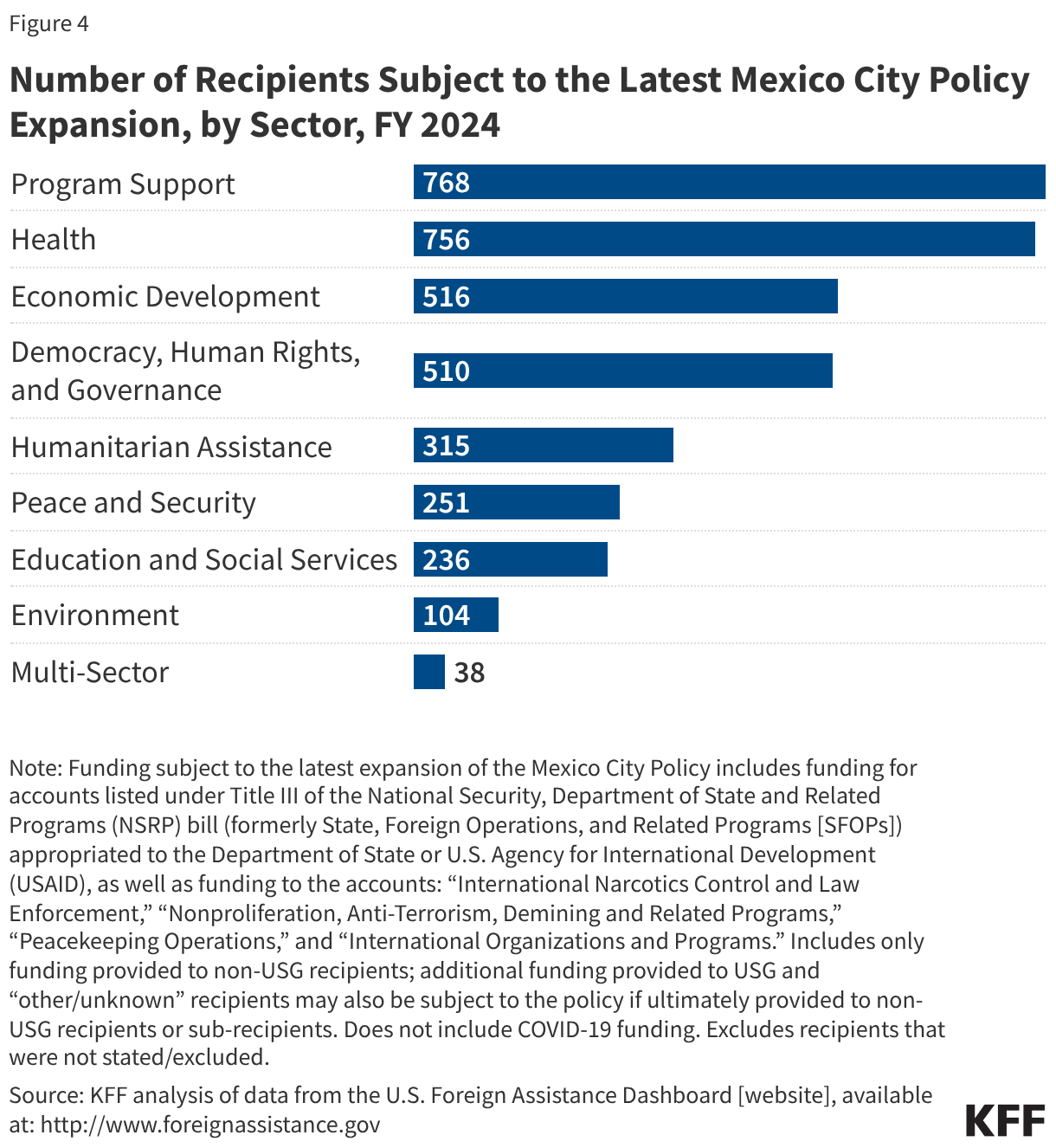
- The sectors with the largest numbers of recipients in FY 2024 were program support9 (768), health (756), and economic development (516). The next largest sector was democracy, human rights, and governance (510), followed by humanitarian assistance (315) (see Figure 4).
Methodology
This analysis uses FY 2024 foreign assistance obligation data, downloaded from ForeignAssistance.gov on November 20, 2025. ForeignAssistance.gov is the U.S. government’s centralized data portal for budgetary and financial data provided by more than 20 federal agencies that manage foreign assistance programs. Obligations are binding agreements that will result in outlays of funding, immediately or sometime in the future. The policy, when in place, is applied to funding that is obligated to recipients either as part of an existing award or as part of a new award. Data on funding amounts and recipients were analyzed by agency, sector, location, and type of entity. To the extent possible, COVID-19 emergency funding was excluded from this analysis, as it represented one-time funding for a particular event.
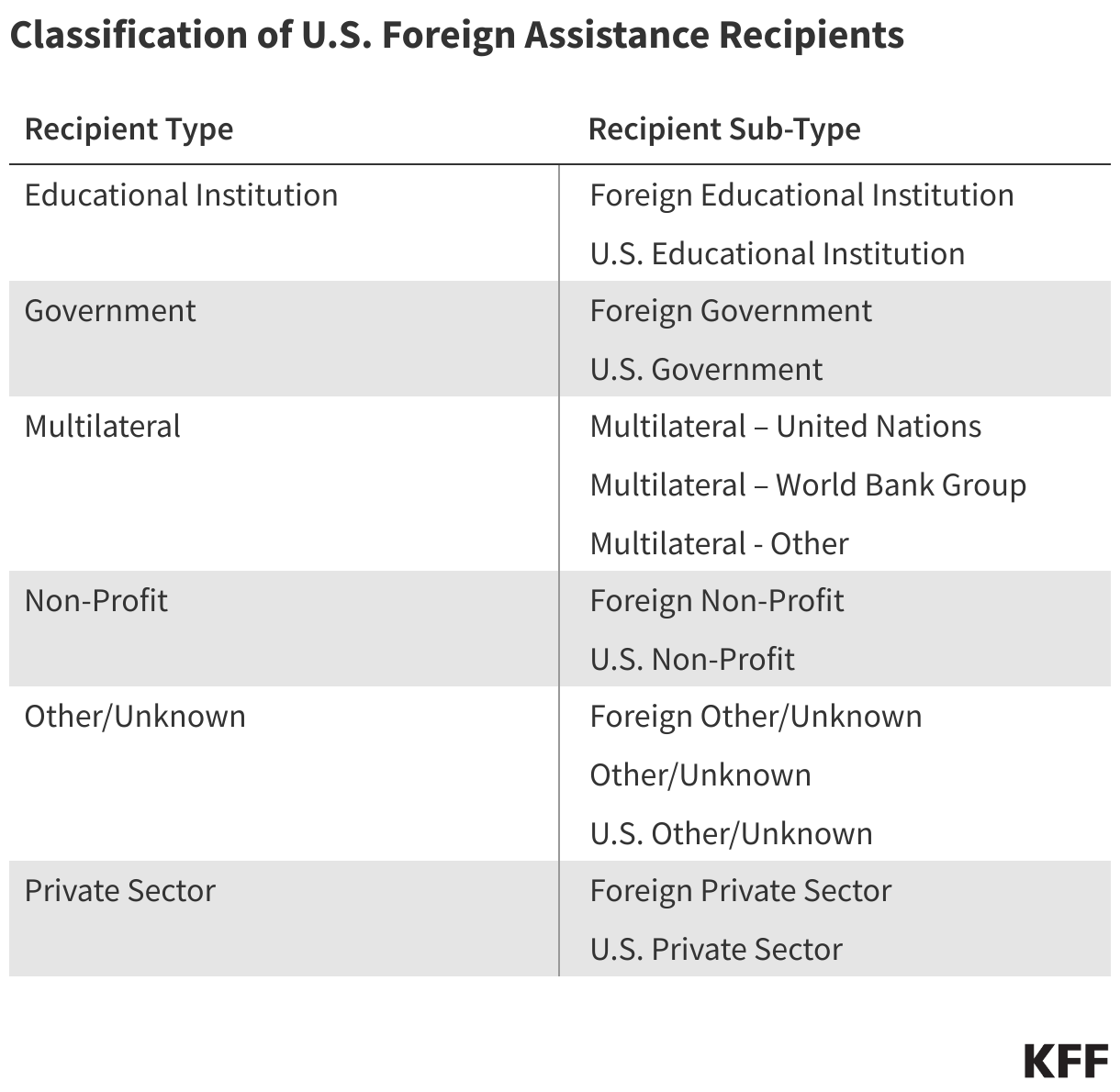
Recipients were categorized into the following groups (see table below) based on classifications already present in the ForeignAssistance.gov data as well as background research, where such classifications were not provided. Each recipient was reviewed, and the review sought to correct any mis-categorization in the original data and remove duplicates. “Other/Unknown” recipients were those that could not be easily identified as belonging to a particular recipient type/sub-type. Where it was not possible to identify a recipient as a single, implementing entity, they were excluded from analysis looking at the number of unique recipients.
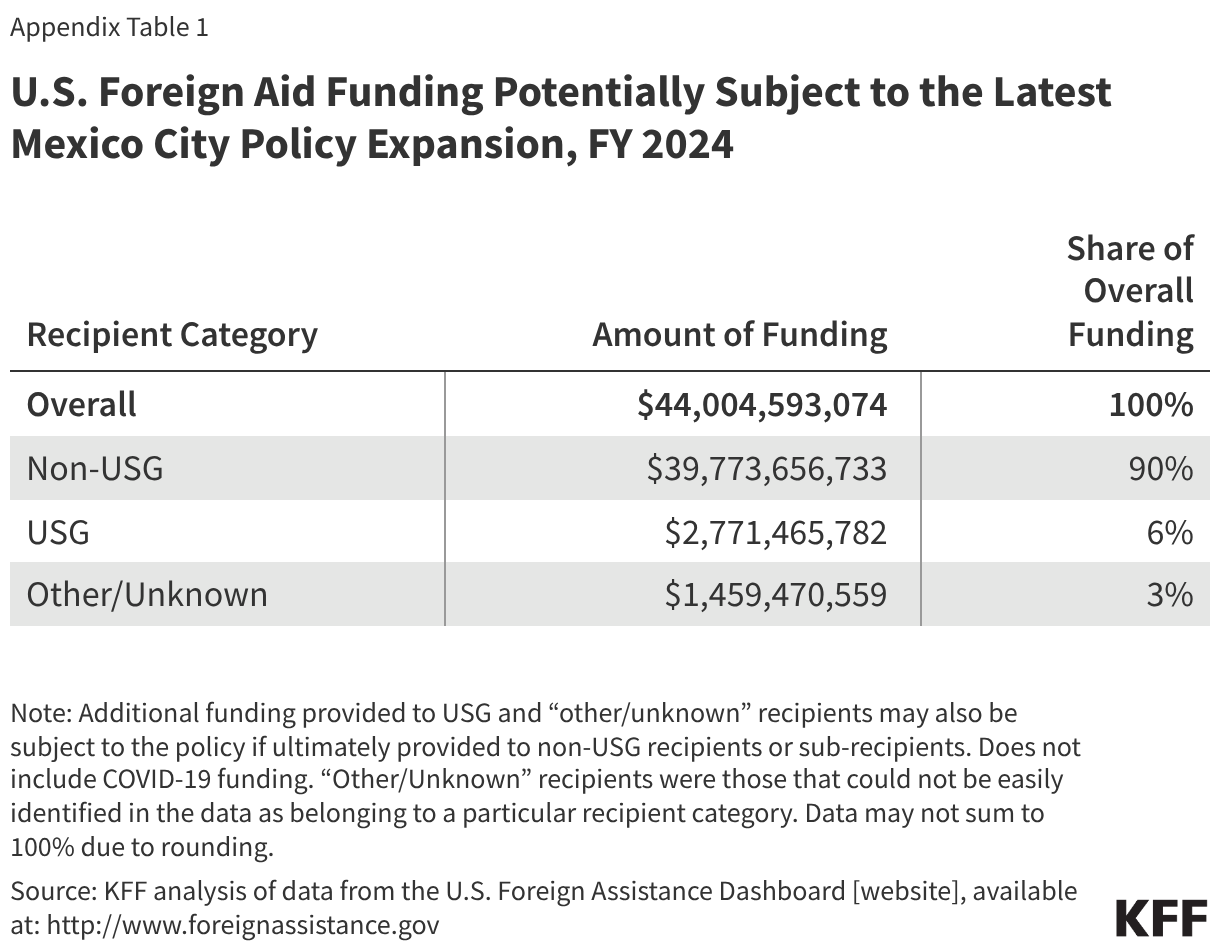
Funding included in the analysis was based on the specifications in the final rules and includes Title III funding appropriated to the State Department and USAID (now administered by the State Department) as well as funding appropriated to four other accounts under Department of State, Foreign Operations, and Related Programs (SFOPs)/National Security, State Department, and Related Programs (NSRP) appropriations acts (specifically, “International Narcotics Control and Law Enforcement,” “Nonproliferation, Anti-Terrorism, Demining and Related Programs,” “Peacekeeping Operations,” and “International Organizations and Programs”), whether or not these data were listed as “Economic” or “Military” funding. The analysis excluded the funding in these accounts that was directed to U.S. departments or agencies as prime recipients, which totaled $2.8 billion in FY 2024, as well as funding directed to “Other/Unknown” recipients, which totaled $1.5 billion in FY 2024 (although to the extent that this funding is ultimately provided to a non-USG sub-recipient, it too would be subject to the policy). The U.S. government has also indicated that its intention is to apply the latest MCP expansion to additional non-military foreign assistance at other U.S. agencies and departments, which would also increase the amount of funding and number of organizations subject to the latest expansion.
The analysis also includes funding provided through contracts (not just grants and cooperative agreements) for two reasons: first, the rules indicate that further rule-making will be undertaken to add these policy restrictions to contracts; and second, it is not possible to disaggregate obligations by funding instrument in ForeignAssistance.gov data.
Appendix Tables
- Per the interim rules, a foreign non-governmental organization is defined as “any non-governmental organization or entity, whether non-profit or profit-making (including any commercial firm and educational institution), not organized or existing under the laws of the United States, any State of the United States, the District of Columbia, the Commonwealth of Puerto Rico, or any other territory or possession of the United States.” ↩︎
- Specifically, funding appropriated to the U.S. Agency for International Development (USAID) and the State Department; this funding is “administered” by the State Department. USAID was dissolved by the Trump administration in 2025, with its remaining programs transferred to other agencies, including mainly but not solely the State Department. ↩︎
- The policies apply differently to U.S. NGOs and foreign governments/parastatals than to foreign NGOs and multilateral organizations. ↩︎
- The analysis excluded approximately $82 million in FY 2024 foreign aid funding that was identifiable as emergency COVID-19 assistance since it was one-time emergency funding. ↩︎
- Each rule of PHFFA defines a foreign NGO as “any non-governmental organization or entity, whether non-profit or profit-making (including any commercial firm and educational institution), not organized or existing under the laws of the United States, any State of the United States, the District of Columbia, the Commonwealth of Puerto Rico, or any other territory or possession of the United States,” and it defines a U.S. NGO as “any non-governmental organization or entity, whether non-profit or profit-making (including any commercial firm and educational institution), organized or existing under the laws of the United States, any State of the United States, the District of Columbia, the Commonwealth of Puerto Rico, or any other territory or possession of the United States.” ↩︎
- Each rule of PHFFA defines an international organization as “(A) Any organization designated as being entitled to enjoy the privileges, exemptions, and immunities under the International Organizations Immunities Act; (B) Any organization treated as a public international organization pursuant to the regulations or policies of the Department of State; (C) Any organization established by international agreement and whose governing body is composed principally of representatives of national governments; or (D) Any other multilateral entity in which sovereign nations participate.” ↩︎
- Number of countries represents countries that received funding directly from the U.S. government; additional countries may be reached through regional and worldwide programming. ↩︎
- Includes number of foreign governments, multilaterals, and U.S. NGOs that received foreign assistance as well as the number of foreign NGOs that received non-health assistance only. ↩︎
- Program support is “general management support required to ensure completion of U.S. foreign assistance objectives by facilitating program management, accounting and tracking for costs” according to the State Department, Standardized Program Structure and Definitions (SPSD) [Updated Foreign Assistance Standardized Program Structure and Definitions], June 2017, uploaded Feb. 2023, available at: https://www.state.gov/wp-content/uploads/2023/02/The-New-SPSD-June-2017-Accessible-2.16.2023.pdf. ↩︎