Racial Equity and Health Policy

Survey of Immigrants

KFF-New York Times Survey: Immigrants Report Rising Fear, Negative Economic and Health Impacts, and Changing Political Views During the First Year of President Trump’s Second Term

The 2025 Survey of Immigrants, a partnership between KFF and The New York Times, takes an in-depth look at the experiences of immigrants during the first year of President Trump’s second term, including their worries related to increased immigration enforcement, their health and economic wellbeing, and the political views and preferences of immigrant voters. The survey paints a portrait of families under strain — where fear of detention and economic instability are negatively impacting immigrants’ health and reshaping immigrant families’ daily lives and views of U.S. political parties.

Read the News Release | Explore The New York Times’ Reporting
the Essentials
  • Disparities in Health and Health Care: 5 Key Questions and Answers

    This brief provides an introduction to what health and health care disparities are, why it is important to address them, what the status of disparities is today, recent federal actions to address disparities, and key issues related to addressing disparities in the future.
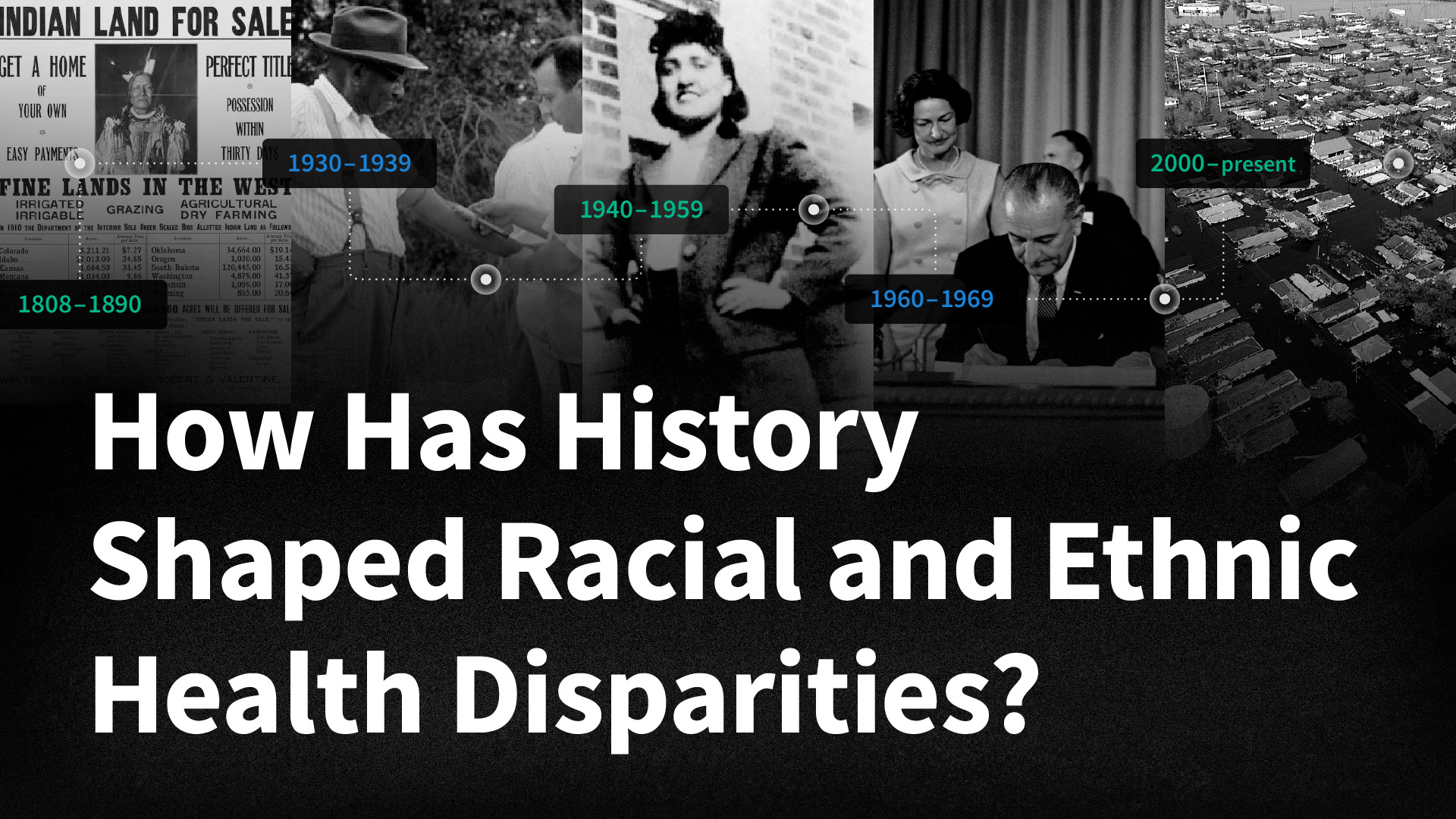
  • Timeline: How History Has Shaped Racial and Ethnic Health Disparities

    This timeline offers a historical view of significant U.S. federal policies and events spanning the early 1800s to today that have influenced present-day health disparities.
  • Health Policy 101: Chapter on Race, Inequality and Health

    Addressing persistent racial and ethnic disparities in health and health care is important for improving the nation’s health and economic prosperity. KFF explains such disparities and the factors that drive them, examines the actions to address them, and outlines future considerations.
  • Key Data on Health and Health Care by Race and Ethnicity

    Racial and ethnic disparities in health and health care remain a persistent challenge in the United States. An updated KFF resource examines how people of color fare compared to White people across 64 measures of health, health care, and social determinants of health.

Subscribe to KFF Emails

Choose which emails are best for you.
Sign up here

Filter

591 - 600 of 601 Results

  • Encuesta Nacional de Kaiser Family Foundation sobre los Latinos y el VIH/SIDA

    Report

    En encuestas anteriores, la atencion se ha concentrando en captar las impresiones de la poblacion general, incluyendo sus opiniones sobre la epidemia; su preocupacion personal en cuanto a infectarse con el VIH; sus conocimientos sobre la transmision, curso y tratamiento del VIH y el SIDA; sus experiencias con la prueba de anticuerpos; su punto de vista sobre los esfuerzos nacionales y locales para detener la epidemia; y sus fuentes de informacion sobre el VIH/SIDA. En…

  • Native Americans and Medicaid: Coverage and Financing Issues

    Report

    Medicaid plays several different roles of significance to Native Americans. Through its purchase of managed care products, Medicaid is reshaping the health care delivery system for many Native Americans and other underserved low-income populations. Medicaid also assists low-income elderly and disabled Indians who are eligible for Medicare in meeting their premium and cost-sharing obligations. Finally, Medicaid offers coverage for nursing home care and other long-term care services needed by frail elderly and disabled Native Americans.…

  • Native Americans and Medicaid: Coverage and Financing Issues

    Other Post

    Native Americans and Medicaid:Coverage and Financing Issues Prepared by Andy Schneider and JoAnn Martinez, The Center on Budget and Policy Priorities for The Kaiser Commission on the Future of Medicaid December 1997 Table 1: Medicaid Eligibility Thresholds Pregnant Women, Infants and Children (Effective October 1997) Other Eligibility Categories State Pregnant Women and Infants Children Under Age Six Children Ages Six and Older Upper Age Limit Asset Test Required Supplemental Security Income, 1996 Max. AFDC Payments…

  • Native Americans and Medicaid: Coverage and Financing Issues

    Other Post

    Native Americans and Medicaid:Coverage and Financing Issues Medicaid and Welfare Until 1996, families with children who received cash assistance under the Aid to Families with Dependent Children (AFDC) program were automatically entitled to Medicaid coverage. The welfare law enacted that year, Public Law 104-193, repealed the AFDC program and created a Temporary Assistance for Needy Families (TANF) block grant to the states. The 1996 welfare law also severed the automatic eligibility linkage between welfare and…

  • Native Americans and Medicaid: Coverage and Financing Issues – Report

    Report

    Native Americans and Medicaid:Coverage and Financing Issues Prepared by Andy Schneider and JoAnn Martinez, The Center on Budget and Policy Priorities for The Kaiser Commission on the Future of Medicaid December 1997 Table Of ContentsHighlights ii I: Background On Native American Health Care 1 II: Medicaid's Role For Native Americans 4 1. Medicaid as a Source of Health Coverage 4 2. Medicaid as a Source of Revenue for Hospitals and Clinics 6 3. Medicaid and…

  • Native Americans and Medicaid: Coverage and Financing Issues

    Other Post

    Native Americans and Medicaid:Coverage and Financing Issues Medicaid as Medicare Premium Assistance The Medicare program provides health insurance coverage for the nation's elderly and disabled.16 To enroll in Medicare Part B, which offers coverage for physician and other outpatient care, individuals must be 65 or older or must be disabled, and must pay a monthly premium. This monthly premium, which is generally deducted from an individual's Social Security check, is $43.80 per month in 1997.…

  • A Forum on the Implications of Changes in the Health Care Environment for Native American Health Care

    Report

    With the assistance of the First Nations Development Institute, the Henry J. Kaiser Family Foundation commissioned several studies of critical issues in Native-American health care. These studies examined the trends shaping the future of Native-American health care; the existing health systems and planning capacity in the Native-American health care system; the changes occurring in the IHS; the role of Medicaid in Native-American health care; the attitudes and preferences of Native American health care consumers; and…

  • The Four Americas:  Government and Social Policy Through the Eyes of America’s Multi-racial and Multi-ethnic Society

    Poll Finding

    The Four Americas: Government and Social Policy Through the Eyes of America's Multi-racial and Multi-ethnic Society This report is the first of a series of surveys conducted jointly by The Washington Post/Kaiser Family Foundation/Harvard University examining public knowledge, values and beliefs on major issues and challenges facing our nation, such as race, poverty, reducing the deficit, the role of government in our society, and our nation's obligations in the world. The hope is that this…