Racial Equity and Health Policy

Survey of Immigrants

KFF-New York Times Survey: Immigrants Report Rising Fear, Negative Economic and Health Impacts, and Changing Political Views During the First Year of President Trump’s Second Term

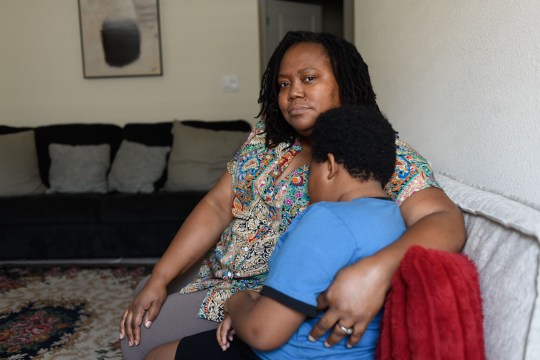
The 2025 Survey of Immigrants, a partnership between KFF and The New York Times, takes an in-depth look at the experiences of immigrants during the first year of President Trump’s second term, including their worries related to increased immigration enforcement, their health and economic wellbeing, and the political views and preferences of immigrant voters. The survey paints a portrait of families under strain — where fear of detention and economic instability are negatively impacting immigrants’ health and reshaping immigrant families’ daily lives and views of U.S. political parties.

Read the News Release | Explore The New York Times’ Reporting
the Essentials
  • Disparities in Health and Health Care: 5 Key Questions and Answers

    This brief provides an introduction to what health and health care disparities are, why it is important to address them, what the status of disparities is today, recent federal actions to address disparities, and key issues related to addressing disparities in the future.
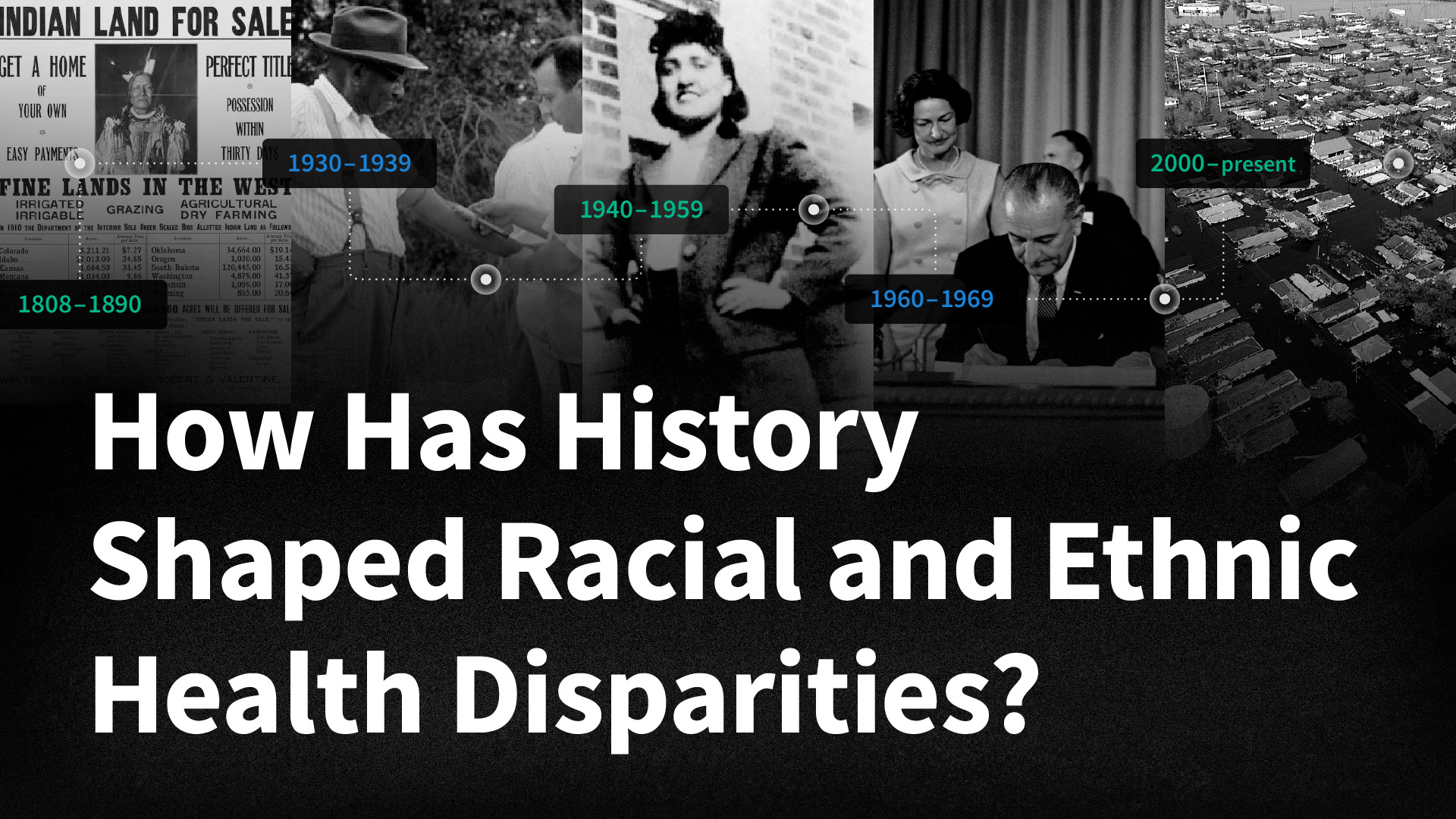
  • Timeline: How History Has Shaped Racial and Ethnic Health Disparities

    This timeline offers a historical view of significant U.S. federal policies and events spanning the early 1800s to today that have influenced present-day health disparities.
  • Health Policy 101: Chapter on Race, Inequality and Health

    Addressing persistent racial and ethnic disparities in health and health care is important for improving the nation’s health and economic prosperity. KFF explains such disparities and the factors that drive them, examines the actions to address them, and outlines future considerations.
  • Key Data on Health and Health Care by Race and Ethnicity

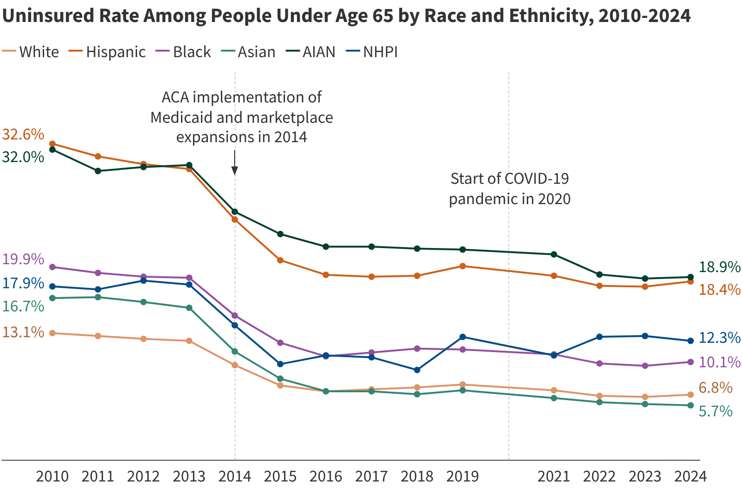
    Racial and ethnic disparities in health and health care remain a persistent challenge in the United States. An updated KFF resource examines how people of color fare compared to White people across 64 measures of health, health care, and social determinants of health.

Subscribe to KFF Emails

Choose which emails are best for you.
Sign up here

Filter

581 - 590 of 601 Results

  • Welfare Reform and Elderly Legal Immigrants – Report

    Report

    Welfare Reform and Elderly Legal Immigrants Prepared by: Robert B. Friedland and Veena Pankaj National Academy on Aging, Washington DC July 1997 Prepared for: The Henry J. Kaiser Family Foundation The Henry J. Kaiser Family Foundation, based in Menlo Park, California, is an independentnational health philanthropy and is not associated with Kaiser Permanente or Kaiser Industries. Established in 1948 by industrialist Henry J. Kaiser and his wife Bess, the Foundation focusesits work on four main…

  • Welfare Reform and Elderly Legal Immigrants

    Other Post

    Economic Status of the Elderly Legal Immigrant conomic status, especially in old age, is often dependent on a lifetime of choices and opportunities. Retirement income is directly dependent on previous labor force experiences, savings, and thehealth and insurance coverage of family members. Good health and high educational attainment tend toresult in better employment opportunities, a greater likelihood of a pension, and increased prospects forsaving. Poor health, the death of a spouse, lack of education, or…

  • What’s the Diagnosis? Latinos, Media & Health

    Report

    Three reports examining how health issues are handled by the Latino-oriented media today and how Latinos use the media as an information source on health issues. The three new studies were released at the National Association of Hispanic Journalists (NAHJ) conference. The studies are also available separately: A National and Three Region Survey of Latinos on the Media and Health, conducted by Princeton Survey Research Associates (#1410), A Study of Health Coverage in Latino Newspapers,…

  • 1998 National Survey of Latinos on HIV/AIDS – Report (HTML version)

    Report

    1998 National Survey of Latinos on HIV/AIDSThis Report is also available in PDF in English (.pdf) en Espanol (.pdf) CONTENTS Introduction The Latino Population in the United States Epidemiology and Transmission of HIV/AIDS The Health Gap and Access to Care Latino's Perceptions of the HIV/AIDS Epidemic Methodology Findings Language and Perceptions of HIV/AIDS Regional Location and Perceptions of HIV/AIDS among Latinos Income, Education and Attitudes Towards/Knowledge of HIV/AIDS Among Latinos Religion and Perceptions of HIV/AIDS among Latinos…

  • Kaiser Family Foundation National Survey of Latinos on HIV/AIDS

    Poll Finding

    A random-sample national survey of 802 Latino adults, 18 years and older. The survey, designed by staff at the Foundation and conducted by telephone in both English and Spanish by Princeton Survey Research Associates (PSRA), examines Latino's knowledge, values and beliefs with respect to HIV and AIDS. The survey data is also broken down into subgroups within the Latino community including women, young adults, parents, opinion leaders, and those with less education and lower incomes.…

  • Kaiser Family Foundation National Survey of Latinos on HIV/AIDS – News Release

    Other Post

    Two New Studies On Latinos And AIDS In America: Survey Of Latinos Finds Widespread Concern About HIV/AIDS; Impact Of Disease Felt "Close To Home" Report Documents Impact Of AIDS/HIV On Hispanics And Offers Guidance For Community Health Providers Embargoed For Release Until:9:30 am, ET, Friday, May 1, 1998 For Further Information Contact: Tina Hoff or Matt James/KFF(650) 854-9400 Xiomara Sosa/COSSMHO(202) 797-4335 Washington, DC -- Next week Latino leaders will gather at Harvard University for the…

  • African American and HIV/AIDS Survey

    Report

    A national random-sample survey of 811 African American adults, 18 years and older, on their knowledge, values and beliefs with respect to HIV and AIDS. It describes the perceptions and attitudes of African Americans, as well as subgroups within the African American community including women, young adults, parents, opinion leaders, and those with less education and lower incomes. News Release Report Download Topline Download Chartpack Download

  • African American and HIV/AIDS Survey – News Release

    Other Post

    Despite Widespread Concern About AIDS, Few African Americans See 'A Lot' of Action From Community Groups and Government in Fight Against Disease African Americans Want Practical Help on HIV/AIDS:How to Talk with Children and Partners, More Information About Testing and Treatment Media Named As Most Important Resource on HIV/AIDS Embargoed for release until: 9:00 am, ET, Tuesday, March 17, 1998 Boston, MA -- As African Americans make up a growing percent of new AIDS cases…