Racial Equity and Health Policy

the Essentials
  • How Experiencing Racial Discrimination Impacts Health

    This brief highlights research examining mechanisms underlying health outcomes linked to self-reported experiences of racial discrimination, including biological changes, chronic stress, mental health, substance use, pregnancy-related outcomes, and sleep.
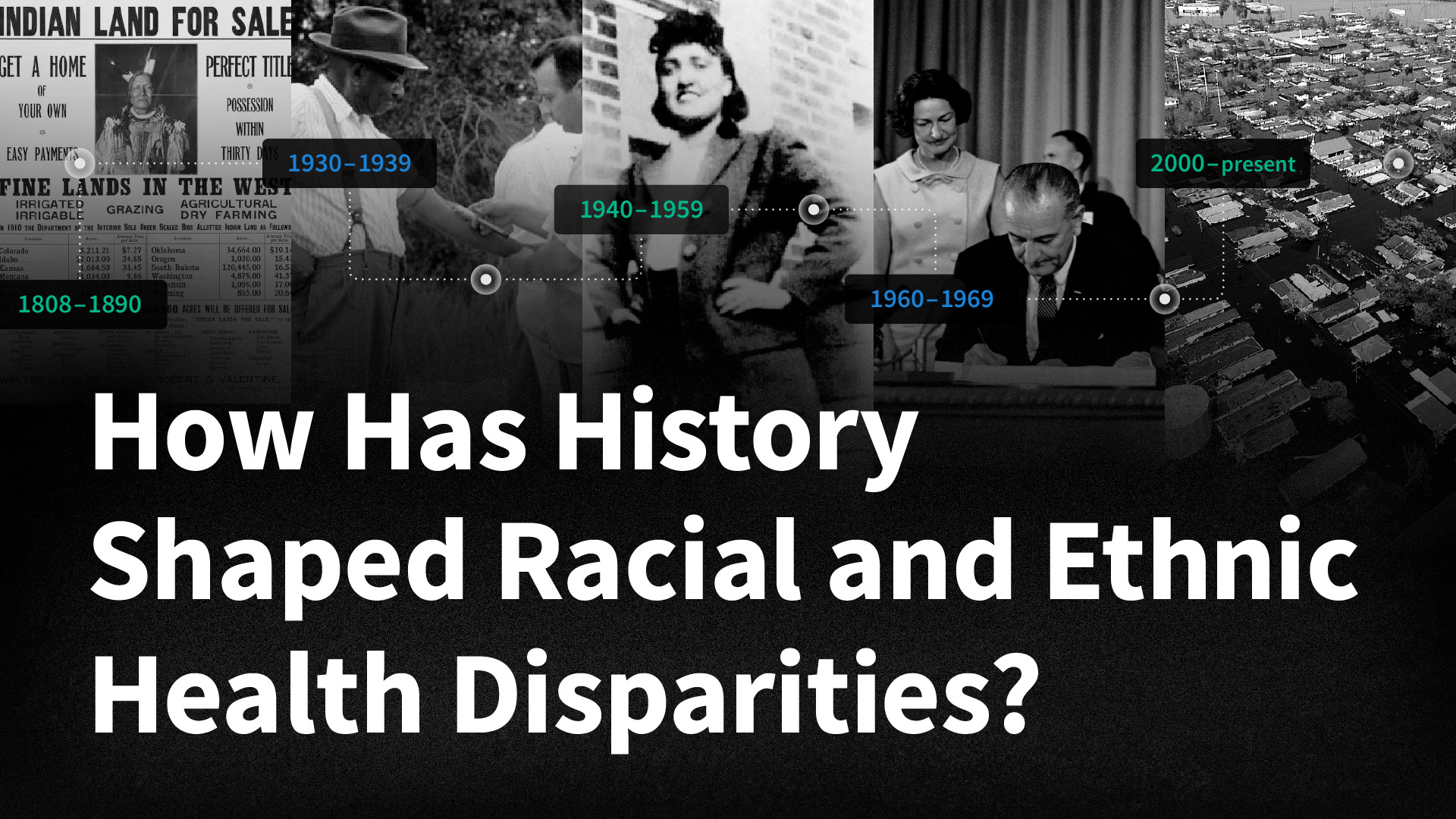
  • Timeline: How History Has Shaped Racial and Ethnic Health Disparities

    This timeline offers a historical view of significant U.S. federal policies and events spanning the early 1800s to today that have influenced present-day health disparities.
  • Health Policy 101: Chapter on Race, Inequality and Health

    Addressing persistent racial and ethnic disparities in health and health care is important for improving the nation’s health and economic prosperity. KFF explains such disparities and the factors that drive them, examines the actions to address them, and outlines future considerations.
  • Key Data on Health and Health Care by Race and Ethnicity

    Racial and ethnic disparities in health and health care remain a persistent challenge in the United States. An updated KFF resource examines how people of color fare compared to White people across 64 measures of health, health care, and social determinants of health.

Survey of Immigrants

KFF-New York Times Survey: Immigrants Report Rising Fear, Negative Economic and Health Impacts, and Changing Political Views During the First Year of President Trump’s Second Term

The 2025 Survey of Immigrants, a partnership between KFF and The New York Times, takes an in-depth look at the experiences of immigrants during the first year of President Trump’s second term, including their worries related to increased immigration enforcement, their health and economic wellbeing, and the political views and preferences of immigrant voters. The survey paints a portrait of families under strain — where fear of detention and economic instability are negatively impacting immigrants’ health and reshaping immigrant families’ daily lives and views of U.S. political parties.

Read the News Release | Explore The New York Times’ Reporting
Stay informed.

Stay informed.

Filter

561 - 570 of 602 Results

  • Racial Ethnic Difference in Cardiac Care:  The Weight of the Evidence

    Fact Sheet

    Racial Ethnic Difference in Cardiac Care: The Weight of the Evidence Numerous studies over the past two decades have documented racial and ethnic differences in care for heart conditions. To assess the quality of the evidence and to summarize the information for a physician audience, the Henry J. Kaiser Family Foundation collaborated with the American College of Cardiology Foundation to review the body of research on racial/ethnic differences in cardiac care. There is credible evidence…

  • Capitol Hill Briefing on Latinos and HIV/AIDS

    Event Date:
    Event

    As part of the Kaiser Family Foundation’s ongoing effort to raise awareness about critical issues related to HIV/AIDS, we co-hosted a Capitol Hill briefing with the National Alliance of State and Territorial AIDS Directors (NASTAD) on Latinos and HIV/AIDS. Honorary co-sponsors of the briefing included Representatives Hilda Solis (D-CA), Ciro Rodriquez (D-TX), and Ileana Ros-Lehtinen (R-FL). At the briefing, facts on the impact of the epidemic were presented that were based on a new chartbook…

  • Welfare Reform and American Indian Tribes

    Fact Sheet

    American Indian tribes have new options under the 1996 Welfare Reform legislation that created Temporary Assistance for Needy Families (TANF), a block grant enacted to replace the Aid to Families with Dependent Children (AFDC). TANF, which expires in September of this year, provides cash assistance to poor families with children, including poor American Indian Families, and gives tribes the option to design and administer their own family assistance programs following approval of the plan by…

  • 1998 National Survey of Latinos on HIV/AIDS – Report (HTML version)

    Report

    1998 National Survey of Latinos on HIV/AIDSThis Report is also available in PDF in English (.pdf) en Espanol (.pdf) CONTENTS Introduction The Latino Population in the United States Epidemiology and Transmission of HIV/AIDS The Health Gap and Access to Care Latino's Perceptions of the HIV/AIDS Epidemic Methodology Findings Language and Perceptions of HIV/AIDS Regional Location and Perceptions of HIV/AIDS among Latinos Income, Education and Attitudes Towards/Knowledge of HIV/AIDS Among Latinos Religion and Perceptions of HIV/AIDS among Latinos…

  • Native Americans and Medicaid: Coverage and Financing Issues

    Other Post

    Native Americans and Medicaid:Coverage and Financing Issues Medicaid as Medicare Premium Assistance The Medicare program provides health insurance coverage for the nation's elderly and disabled.16 To enroll in Medicare Part B, which offers coverage for physician and other outpatient care, individuals must be 65 or older or must be disabled, and must pay a monthly premium. This monthly premium, which is generally deducted from an individual's Social Security check, is $43.80 per month in 1997.…

  • Medicare and Minority Americans

    Fact Sheet

    As part of The Faces of Medicare, a collection of fact sheets profiling the characteristics and health needs of different groups of Medicare beneficiaries, provides key facts about Medicare's racial and ethnic minority population, who will account for one in three Americans 65 and older by 2025. Fact Sheet

  • Racial/Ethnic Disparities in Access to Care Among Children: How Does Medicaid do in Closing the Gaps?

    Other Post

    While Medicaid and the Children's Health Insurance Program (CHIP) have become increasingly important sources of health coverage for low-income children in all racial and ethnic groups, the program plays an especially large role for children of color, who are more likely than white children to be low-income. In 2007, Medicaid and CHIP covered nearly one in five white children, but roughly two in five African American and Hispanic children. As policymakers engaged in health reform…

  • Kaiser’s Monthly Update on Health Disparities

    Other Post

    Kaiser's Disparities Research Roundup This Kaiser Disparities Research Roundup is a regularly updated summary of new research on health care disparities. It includes selected academic research and policy papers that focus on a broad range of disparities in health care, including disparities in health insurance coverage, access to care, utilization of care, quality of care, and health status. .header {FONT-WEIGHT: bold;FONT-SIZE: 12px;COLOR: #000000;FONT-FAMILY: Verdana, Arial, Helvetica, sans-serif;text-transform: uppercase;}.text {FONT-WEIGHT: normal;FONT-SIZE: 12px;COLOR: #000000;FONT-FAMILY: Verdana, Arial, Helvetica,…

  • Connecting Eligible Immigrant Families to Health Coverage and Care: Key Lessons from Outreach and Enrollment Workers

    Issue Brief

    Beginning in 2014, health coverage options will significantly expand under health reform through an expansion in Medicaid eligibility and by making tax credits available to help individuals purchase coverage through new Health Benefit Exchanges. Given their high uninsured rate and limited access to private and public coverage, one group who could significantly benefit from this coverage expansion is lawfully residing immigrant families. However, it will be important to address barriers eligible immigrant families often face…