Racial Equity and Health Policy

Survey of Immigrants

KFF-New York Times Survey: Immigrants Report Rising Fear, Negative Economic and Health Impacts, and Changing Political Views During the First Year of President Trump’s Second Term

The 2025 Survey of Immigrants, a partnership between KFF and The New York Times, takes an in-depth look at the experiences of immigrants during the first year of President Trump’s second term, including their worries related to increased immigration enforcement, their health and economic wellbeing, and the political views and preferences of immigrant voters. The survey paints a portrait of families under strain — where fear of detention and economic instability are negatively impacting immigrants’ health and reshaping immigrant families’ daily lives and views of U.S. political parties.

Read the News Release | Explore The New York Times’ Reporting
the Essentials
  • Disparities in Health and Health Care: 5 Key Questions and Answers

    This brief provides an introduction to what health and health care disparities are, why it is important to address them, what the status of disparities is today, recent federal actions to address disparities, and key issues related to addressing disparities in the future.
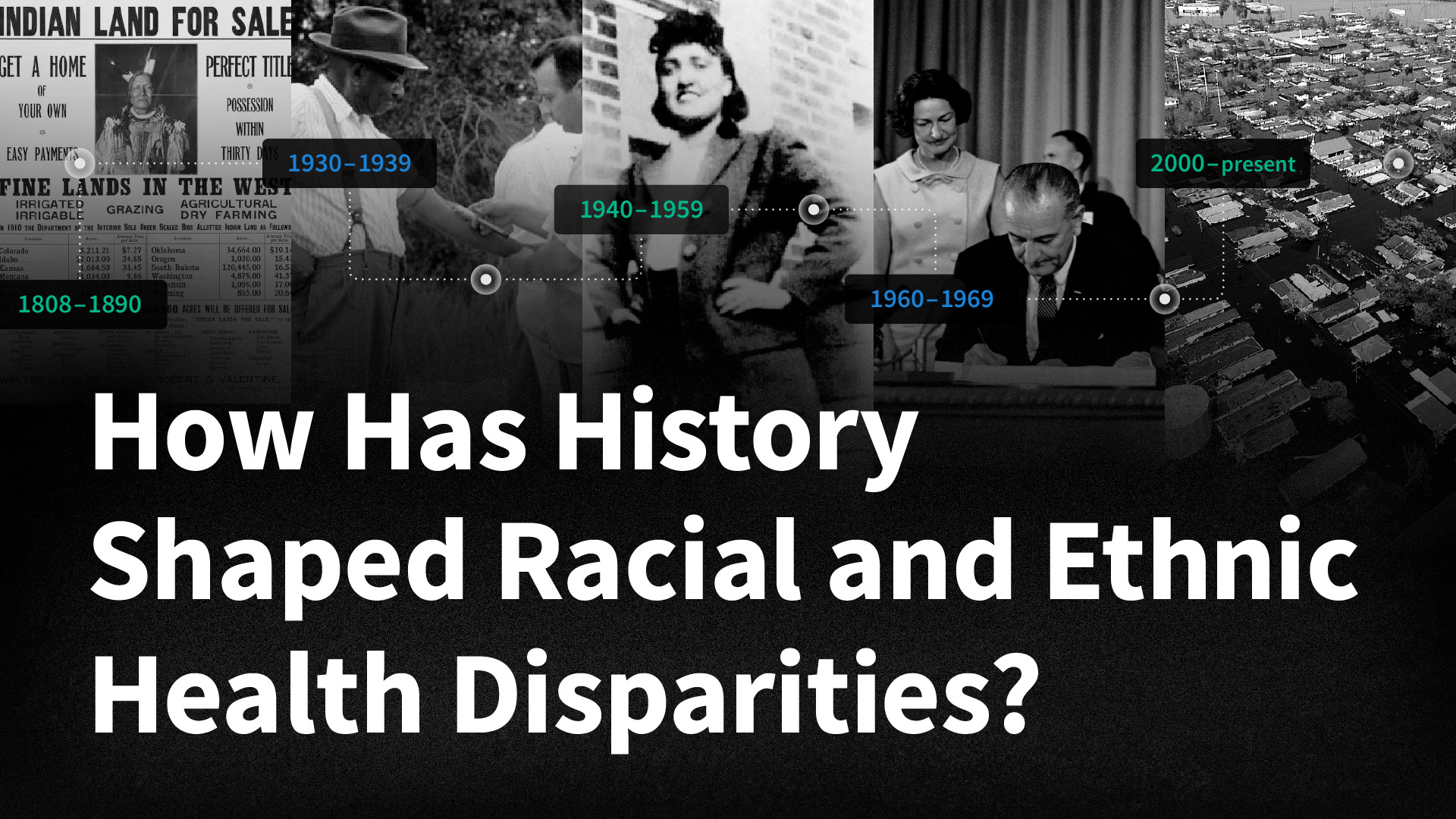
  • Timeline: How History Has Shaped Racial and Ethnic Health Disparities

    This timeline offers a historical view of significant U.S. federal policies and events spanning the early 1800s to today that have influenced present-day health disparities.
  • Health Policy 101: Chapter on Race, Inequality and Health

    Addressing persistent racial and ethnic disparities in health and health care is important for improving the nation’s health and economic prosperity. KFF explains such disparities and the factors that drive them, examines the actions to address them, and outlines future considerations.
  • Key Data on Health and Health Care by Race and Ethnicity

    Racial and ethnic disparities in health and health care remain a persistent challenge in the United States. An updated KFF resource examines how people of color fare compared to White people across 64 measures of health, health care, and social determinants of health.

Subscribe to KFF Emails

Choose which emails are best for you.
Sign up here

Filter

551 - 560 of 601 Results

  • Disparities in Women’s Health

    Other Post

    Disparities in Women's Health Disparities in health and health care continue to burden women, particularly affecting women of color or those who are poor. To shed more light on the factors contributing to inequalities in health and access to care for women, the Kaiser Family Foundation provided support for the newest issue of the Journal of the American Medical Women's Association (JAMWA) Disparities in Women's Health. This special issue features an editorial by Surgeon General…

  • Urban Indian Health

    Report

    More than half (57%) of the 2.5 million people who identify themselves solely as American Indian and Alaska Native in the 2000 Census live in metropolitan areas. This issue brief describes the large and growing urban Indian population, their health status, and the major federal health programs and federal-state programs that are available to improve Native Americans' access to needed health services. Report Introductory Letter  

  • African Americans  Views of the HIV/AIDS Epidemic at 20 Years:  Findings from a National Survey

    Poll Finding

    This report, African Americans Views of the HIV/AIDS Epidemic at 20 Years: Findings from a National Survey, examines African Americans views and knowledge of HIV/AIDS, including analysis by race/ethnicity, of trends over time, and among African American subgroups. The report is based a nationally representative survey of 2,683 adults, ages 18 and older, including 431 African Americans. This report serves as a companion document to The AIDS Epidemic at 20 Years: The View From America.…

  • Latinos  Views of the HIV/AIDS Epidemic at 20 Years:  Findings from a National Survey

    Poll Finding

    This report, Latinos Views of the HIV/AIDS Epidemic at 20 Years: Findings from a National Survey, examines Latinos views and knowledge of HIV/AIDS, including analysis by race/ethnicity, of trends over time, and among Latino subgroups. The report is based a nationally representative survey of 2,683 adults, ages 18 and older, including 549 Latinos. Interviews were completed in both English and Spanish according to respondent preference, and the report is available in both English and Spanish.…

  • Key Facts: Latinos and HIV/AIDS

    Report

    This report provides an overview of the impact of the HIV/AIDS epidemic on Latinos in the United States. It presents current snapshots and trends over time, drawing from recent data and research on the epidemiology of HIV/AIDS among Latinos, including data on AIDS cases and deaths; health services use and coverage; and attitudinal data from a recent national survey. 6008

  • The AIDS Epidemic at 20 Years: THE VIEW FROM AMERICA Survey

    Report

    Twenty years into the AIDS epidemic, the Kaiser Family Foundation conducted its most recent survey of Americans about HIV/AIDS. This report summarizes the key findings from the survey, including analysis of trends over time and across race/ethnicity, age, and gender. It describes Americans' concerns about HIV/AIDS as a personal, national, and global issue. It also assesses Americans' knowledge about HIV/AIDS, their information needs, and their perspective on important policy issues and spending priorities. Report (.pdf) Timeline (.pdf)…

  • The Joint Center for Political and Economic Studies/Kaiser Family Foundation Survey of Black Elected Officials on HIV/AIDS

    Poll Finding

    This chartpack highlights results from a survey of the perceptions and attitudes of 550 Black elected officials (BEOs) on HIV/AIDS issues. The survey, a collaborative effort of the Joint Center for Political and Economic Studies and the Kaiser Family Foundation, interviewed elected officials from 12 states and jurisdictions that have been hard hit by the HIV epidemic. The officials were selected randomly by type of office (federal, state, county, municipal, school board, judiciary). The survey…

  • Mobilizing to Fight HIV/AIDS in the African American Community

    Other Post

    This supplement to the journal Minority Health Today includes a set of papers commissioned by the Joint Center for Political and Economic Studies and the Kaiser Family Foundation for a national forum on HIV/AIDS. Included within the journal are articles on the impact of the epidemic on African American community, focusing specifically on the epidemiology of the disease, patterns of access to and utilization of HIV/AIDS treatment, and the financing of HIV/AIDS care. The journal…

  • Medical Care Research and Review

    Other Post

    Journal Supplement This special supplement of includes: original research tracking trends in disparities in health coverage and access to care over two decades; literature syntheses focused on medical treatment and the decision-making process; legal analysis of civil rights laws in the context of managed care; and findings from a national survey of public awareness of racial inequities in care. The supplement is comprised of work commissioned by the Foundation for its 1999 national policy roundtable,…

  • Minority Graduates of U.S. Medical Schools: Trends, 1950-1998

    Other Post

    While significant efforts have been made to increase minority representation in the medical profession, very little information about minority medical school graduates and minority physicians has been available to evaluate progress towards this goal. This report, prepared by the Association of American Medical Colleges, provides both trend information in minority medical graduates, as well as the current practice characteristics of minority physicians. It is the first product from a unique database developed from the archives…