Racial Equity and Health Policy

Survey of Immigrants

KFF-New York Times Survey: Immigrants Report Rising Fear, Negative Economic and Health Impacts, and Changing Political Views During the First Year of President Trump’s Second Term

The 2025 Survey of Immigrants, a partnership between KFF and The New York Times, takes an in-depth look at the experiences of immigrants during the first year of President Trump’s second term, including their worries related to increased immigration enforcement, their health and economic wellbeing, and the political views and preferences of immigrant voters. The survey paints a portrait of families under strain — where fear of detention and economic instability are negatively impacting immigrants’ health and reshaping immigrant families’ daily lives and views of U.S. political parties.

Read the News Release | Explore The New York Times’ Reporting
the Essentials
  • Disparities in Health and Health Care: 5 Key Questions and Answers

    This brief provides an introduction to what health and health care disparities are, why it is important to address them, what the status of disparities is today, recent federal actions to address disparities, and key issues related to addressing disparities in the future.
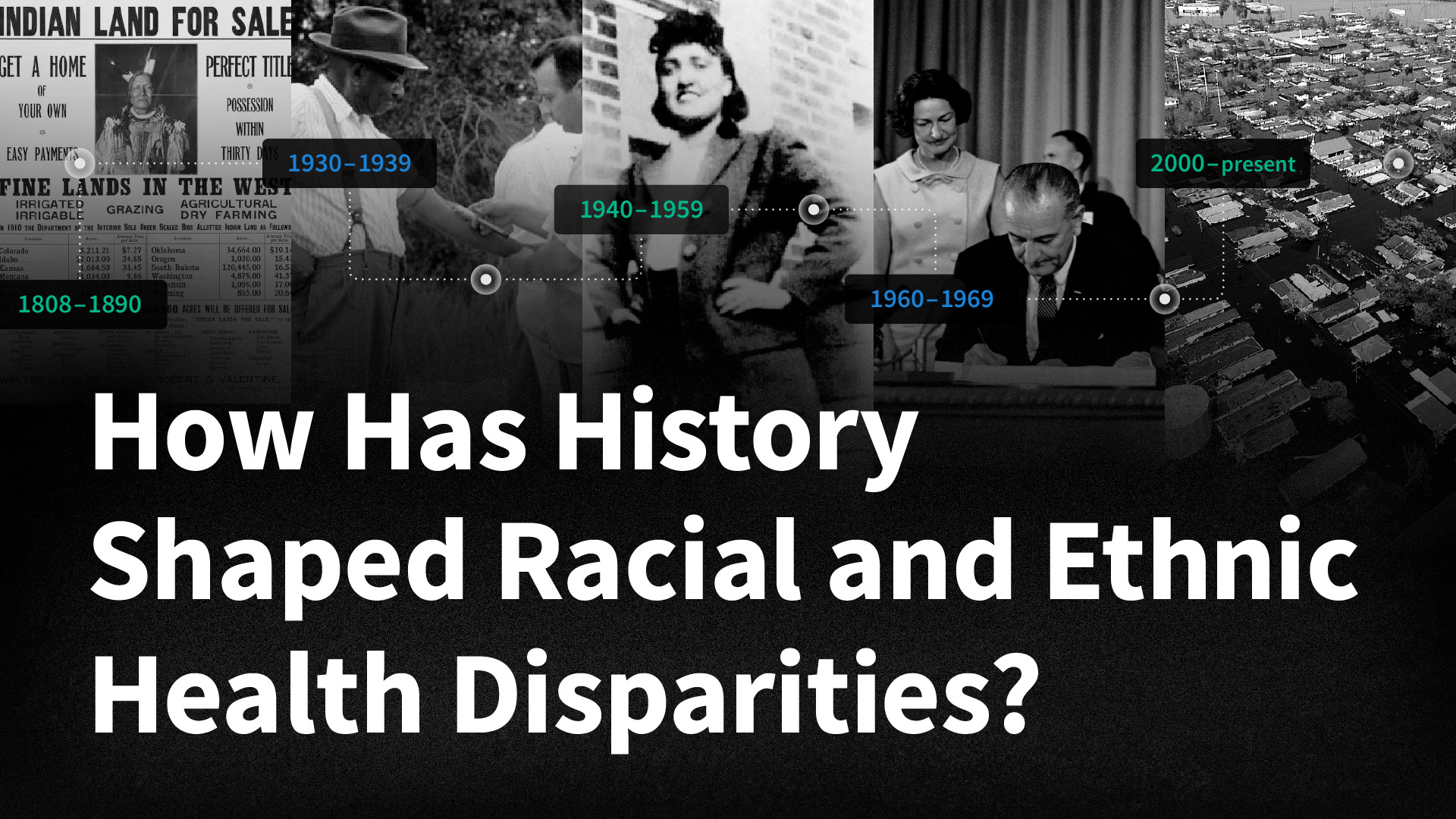
  • Timeline: How History Has Shaped Racial and Ethnic Health Disparities

    This timeline offers a historical view of significant U.S. federal policies and events spanning the early 1800s to today that have influenced present-day health disparities.
  • Health Policy 101: Chapter on Race, Inequality and Health

    Addressing persistent racial and ethnic disparities in health and health care is important for improving the nation’s health and economic prosperity. KFF explains such disparities and the factors that drive them, examines the actions to address them, and outlines future considerations.
  • Key Data on Health and Health Care by Race and Ethnicity

    Racial and ethnic disparities in health and health care remain a persistent challenge in the United States. An updated KFF resource examines how people of color fare compared to White people across 64 measures of health, health care, and social determinants of health.

Subscribe to KFF Emails

Choose which emails are best for you.
Sign up here

Filter

41 - 50 of 589 Results

  • Navigating Recovery: Health Care Financing and Delivery Systems in Puerto Rico and US Virgin Islands

    Issue Brief

    This brief identifies key issues and short and long-term options for recovery around the health care financing and delivery systems in Puerto Rico and the U.S. Virgin Islands following Hurricanes Irma and Maria, which caused significant physical damage to the territories. It draws on insights from a Nov. 30 roundtable discussion with leaders and experts representing a variety of perspectives on Medicaid policy, health insurance and care delivery systems, and disaster recovery.

  • Living in An Immigrant Family: How Fear and Toxic Stress Are Affecting Daily Life

    Living in an Immigrant Family in America: How Fear and Toxic Stress are Affecting Daily Life, Well-Being, & Health

    Issue Brief

    This brief examines the experiences of immigrant parents and children, including immigrants who are undocumented and those lawfully present, with the new restrictions on immigration and increased immigration enforcement being pursued by the Trump Administration that are reshaping U.S. immigration policy. Findings are based on focus groups in eight cities and four states with 100 parents in immigrant families from 15 countries, as well as telephone interviews with 13 pediatricians who serve immigrant communities.

  • Serious Illness in Late Life: The Public’s Views and Experiences

    Report

    In context of the rapidly growing number of older adults in the U.S. and increasing challenges that this population faces, the Kaiser Family Foundation conducted a large scale, nationally representative telephone survey to better understand people’s expectations about later life and efforts they’ve taken to plan for if they become seriously ill. To learn more about the experiences of those with serious illness specifically, this survey also included interviews with adults who are either personally age 65 or older living with a serious illness, or have an older family member who is or was before they recently died.

  • The Role of Medicaid in Rural America

    Issue Brief

    This brief describes Medicaid’s role for 52 million nonelderly children and adults living in the most rural areas in the United States and discusses how expansions or reductions in Medicaid could affect rural areas.

  • Abismo en el financiamiento de Medicaid: Implicaciones para los sistemas de atención de salud de Puerto Rico y las Islas Vírgenes de los EE.UU.

    Issue Brief

    Este resumen ofrece una descripción general del estado de los sistemas de atención médica y los programas de Medicaid en Puerto Rico y las Islas Vírgenes de los EE.UU. (USVI) aproximadamente un año y medio después que los huracanes Irma y María azotaran las islas, en septiembre de 2017. Después de las tormentas, los programas de Medicaid de los territorios han servido como recursos importantes para atender las necesidades de atención médica de los residentes, pero han operado bajo desafíos financieros de larga data. Este resumen se enfoca en esos desafíos e incluye el análisis de KFF de las consecuencias para las finanzas de los programas de Medicaid de los territorios, ya que la mayoría de los fondos federales de Medicaid provistos a través de la Ley de Cuidado de Salud a Bajo Precio (ACA), y la asistencia para desastres, expirarán a fines de septiembre de 2019. Los otros territorios de los EE.UU. (Samoa Americana, el Commonwealth de las Islas Marianas del Norte y Guam) también enfrentan retos relacionados con el vencimiento programado de los fondos de ACA. Este resumen se basa en trabajos anteriores y en informes públicos recientes, y en entrevistas con funcionarios de los territorios en los lugares afectados, con proveedores, con responsables de planes de salud de Puerto Rico y beneficiarios.

  • A First Look at North Carolina’s Section 1115 Medicaid Waiver’s Healthy Opportunities Pilots

    Issue Brief

    Medicaid funds typically cannot be used to pay for non-medical interventions that target the social determinants of health. However, in October 2018, CMS approved North Carolina’s Section 1115 waiver which provides financing for a new pilot program, called “Healthy Opportunities Pilots,” to cover evidence-based non-medical services that address specific social needs linked to health/health outcomes. The pilots will address housing instability, transportation insecurity, food insecurity, and interpersonal violence and toxic stress for a limited number of high-need Medicaid enrollees. This brief summarizes key features of the pilots.

  • Summary of HHS’s Final Rule on Nondiscrimination in Health Programs and Activities

    Issue Brief

    On May 18, 2016, the Department of Health and Human Services (HHS) published a final rule to implement Section 1557 of the Affordable Care Act (ACA), which prohibits discrimination in health coverage and care based on race, color, national origin, age or disability, and, for the first time sex. This Issue Brief provides a technical summary of Section 1557 and the final rule and highlights new protections and provisions included in the law and rule. Notably, Section 1557 is the first federal civil rights law to prohibit discrimination on the basis of sex in health care. Moreover, the proposed rule extends the definition of sex discrimination to include discrimination on the basis of gender identity. In addition, the final rule establishes regulations related to the provision of language assistance services based on long-standing HHS policy guidance.

  • 8 Questions & Answers about Puerto Rico

    Fact Sheet

    These slides provide a quick snapshot of Puerto Rico’s population, as well as current and upcoming issues that are impacting the island’s health care system.