Racial Equity and Health Policy

Survey of Immigrants

KFF-New York Times Survey: Immigrants Report Rising Fear, Negative Economic and Health Impacts, and Changing Political Views During the First Year of President Trump’s Second Term

The 2025 Survey of Immigrants, a partnership between KFF and The New York Times, takes an in-depth look at the experiences of immigrants during the first year of President Trump’s second term, including their worries related to increased immigration enforcement, their health and economic wellbeing, and the political views and preferences of immigrant voters. The survey paints a portrait of families under strain — where fear of detention and economic instability are negatively impacting immigrants’ health and reshaping immigrant families’ daily lives and views of U.S. political parties.

Read the News Release | Explore The New York Times’ Reporting
the Essentials
  • Disparities in Health and Health Care: 5 Key Questions and Answers

    This brief provides an introduction to what health and health care disparities are, why it is important to address them, what the status of disparities is today, recent federal actions to address disparities, and key issues related to addressing disparities in the future.
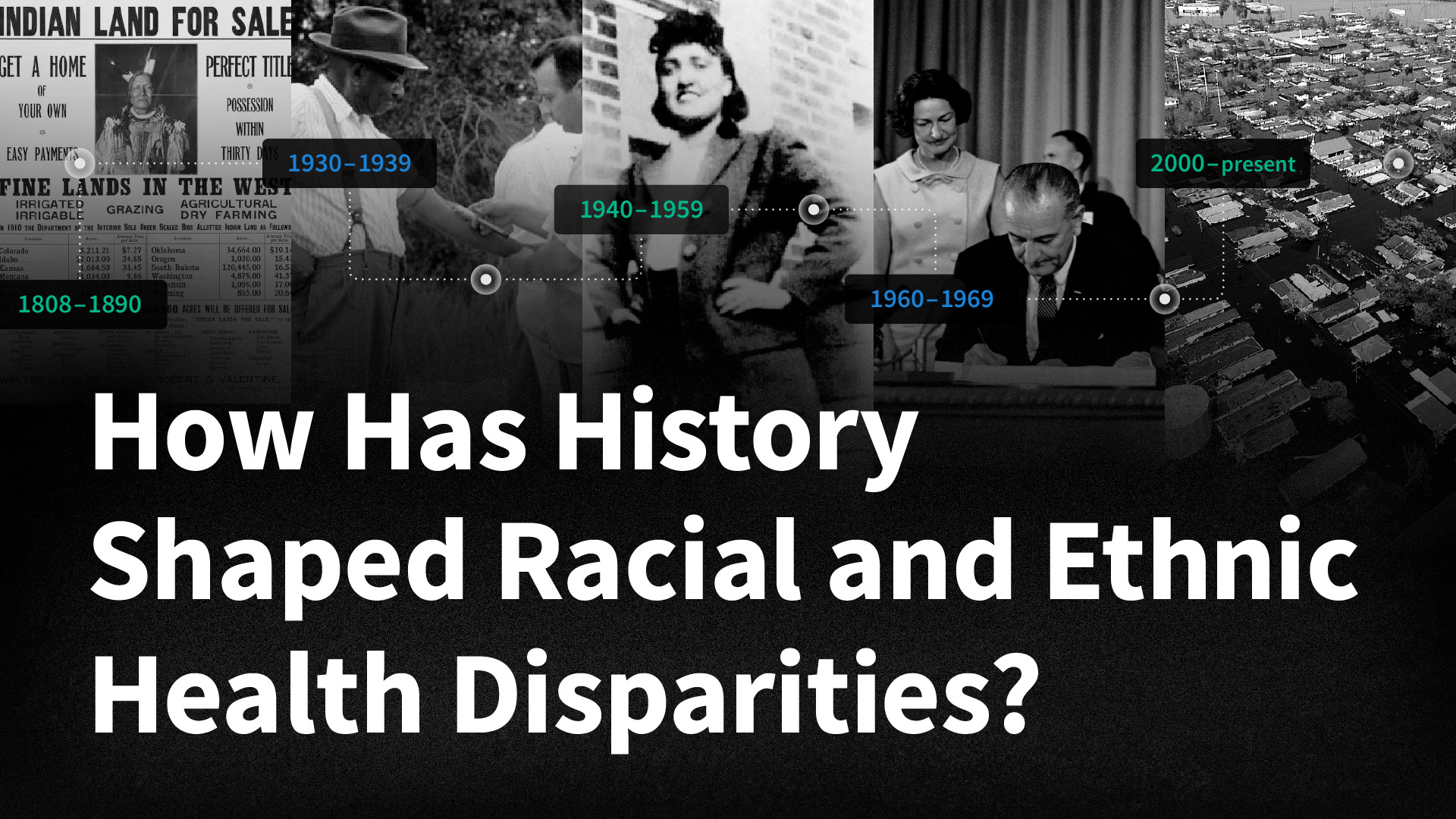
  • Timeline: How History Has Shaped Racial and Ethnic Health Disparities

    This timeline offers a historical view of significant U.S. federal policies and events spanning the early 1800s to today that have influenced present-day health disparities.
  • Health Policy 101: Chapter on Race, Inequality and Health

    Addressing persistent racial and ethnic disparities in health and health care is important for improving the nation’s health and economic prosperity. KFF explains such disparities and the factors that drive them, examines the actions to address them, and outlines future considerations.
  • Key Data on Health and Health Care by Race and Ethnicity

    Racial and ethnic disparities in health and health care remain a persistent challenge in the United States. An updated KFF resource examines how people of color fare compared to White people across 64 measures of health, health care, and social determinants of health.

Subscribe to KFF Emails

Choose which emails are best for you.
Sign up here

Filter

481 - 490 of 601 Results

  • Addressing Disparities in Health and Health Care — Issues for Reform

    Event

    Marsha Lillie-Blanton, Dr.P.H., Kaiser senior advisor on race, ethnicity and health care, testified before the House Ways and Means Health Subcommittee about the role of health insurance in reducing disparities in health care and in health status. The testimony is part of an ongoing health reform hearing series. Testimony (.pdf) Slides (.ppt)

  • Health Coverage and Access to Care Among Asian Americans, Native Hawaiians and Pacific Islanders

    Fact Sheet

    A new analysis by the Kaiser Family Foundation and the Asian & Pacific Islander American Health Forum examines the health coverage, access to health care, and health status of Asian American, Native Hawaiian and Pacific Islander ethnic groups in the United States, and finds that certain subgroups are doing much worse than others in terms of health insurance coverage and access to health care. For example, Korean Americans, Native Hawaiians and Pacific Islanders are about…

  • Five Basic Facts on Immigrants and Their Health Care

    Issue Brief

    As discussions on national health care reform move to the forefront, some have focused on the role of immigrants in the health care system, including their impact on the nation’s uninsured problem, their participation in public health coverage programs, and their use of hospital emergency rooms. To address questions about how immigrants use and affect the health care system, this brief draws on available research and data to highlight five key facts about immigrants’ health…

  • Race, Ethnicity, and Health Care Tutorial

    Interactive

    This tutorial was produced for kaiserEDU.org, a Kaiser Family Foundation website that ceased production in September 2013. The kaiserEDU.org tutorials are no longer being updated but have been made available on kff.org due to demand by professors who are using the tutorials in class assignments. You may search for other tutorials to view on kff.org. To download this or other tutorials, visit the tutorials archive page.  Slides are available for download using the “Download Slides” link within the…

  • Key Health Disparities-Focused Legislation Introduced in the 110th Congress

    Other Post

    This compendium summarizes about a dozen federal legislative initiatives introduced in the 110th Congress to address racial and ethnic disparities in health and health care. Although the 110th Congress's session is half complete, the number of bills introduced that include some attention to “health disparities” is about the same as introduced in the entire 109th Congress. While a number of bills introduced this year may have an impact on health disparities and/or affect minority health,…

  • An Overview of HIV/AIDS in Black America

    Report

    Black Americans account for more HIV and AIDS cases, people estimated to be living with AIDS, and HIV-related deaths than any other racial/ethnic group in the U.S. Today, Black Americans make up about 12 percent of the U.S. population, but account for half of all new AIDS cases. And, despite medical advances which have sharply reduced HIV-related mortality rates for all racial/ethnic groups, HIV death rates are still significantly higher for Black Americans than other…

  • The Health Status of African American Men in the United States  

    Fact Sheet

    The Health Status of African American Men in the United States This fact sheet provides an overview of the health of the nation's 17.3 million African American men, including mortality rates, health status, insurance coverage and access to care. It also looks at the population's socioeconomic factors that relate to health status. Fact Sheet (.pdf)

  • Key Facts: Race, Ethnicity and Medical Care

    Report

    The Kaiser Family Foundation's updated version of Key Facts: Race, Ethnicity and Medical Care, 2007 Update, serves as a quick reference source on health disparities, presenting the best available data and analysis. This report includes data on the uninsured and access to care by race/ethnicity as well as information about the disproportionate effect that specific conditions such as diabetes, HIV/AIDS, and asthma have on racial and ethnic minority populations in the U.S. New in the 2007…

  • Health Coverage and Access to Care for Hispanics in “New Growth Communities” and “Major Hispanic Centers”

    Report

    Health Coverage and Access to Care for Hispanics in "New Growth Communities" and "Major Hispanic Centers" A new report from the Foundation's Kaiser Commission on Medicaid and the Uninsured finds that as the Hispanic population grows and moves beyond urban centers, Hispanics in "new growth communities" face greater barriers to health care than those in cities considered "major Hispanic centers." By 2003, the uninsured rate for Hispanics in new growth communities rose to a level…

  • Health Care Coverage and Access for Hispanics: How Does It Differ Across America

    Event Date:
    Event

    A new report from the Foundation's Kaiser Commission on Medicaid and the Uninsured finds that as the Hispanic population grows and moves beyond urban centers, Hispanics in "new growth communities" face greater barriers to health care than those in cities considered "major Hispanic centers." By 2003, the uninsured rate for Hispanics in new growth communities rose to a level equal to that of Hispanics in major centers. However, less than half (43%) of the Hispanic…