Racial Equity and Health Policy

Survey of Immigrants

KFF-New York Times Survey: Immigrants Report Rising Fear, Negative Economic and Health Impacts, and Changing Political Views During the First Year of President Trump’s Second Term

The 2025 Survey of Immigrants, a partnership between KFF and The New York Times, takes an in-depth look at the experiences of immigrants during the first year of President Trump’s second term, including their worries related to increased immigration enforcement, their health and economic wellbeing, and the political views and preferences of immigrant voters. The survey paints a portrait of families under strain — where fear of detention and economic instability are negatively impacting immigrants’ health and reshaping immigrant families’ daily lives and views of U.S. political parties.

Read the News Release | Explore The New York Times’ Reporting
the Essentials
  • Disparities in Health and Health Care: 5 Key Questions and Answers

    This brief provides an introduction to what health and health care disparities are, why it is important to address them, what the status of disparities is today, recent federal actions to address disparities, and key issues related to addressing disparities in the future.
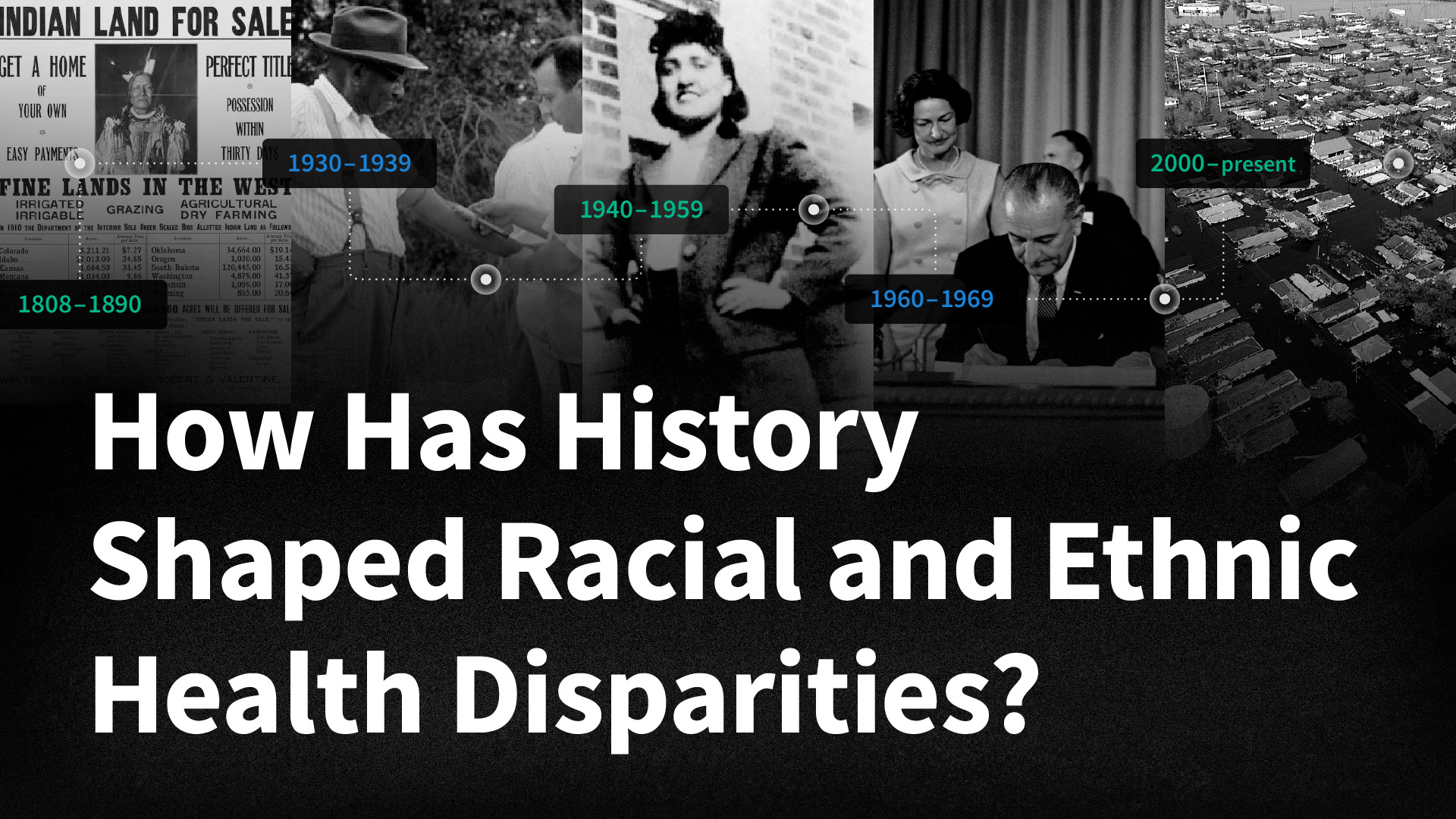
  • Timeline: How History Has Shaped Racial and Ethnic Health Disparities

    This timeline offers a historical view of significant U.S. federal policies and events spanning the early 1800s to today that have influenced present-day health disparities.
  • Health Policy 101: Chapter on Race, Inequality and Health

    Addressing persistent racial and ethnic disparities in health and health care is important for improving the nation’s health and economic prosperity. KFF explains such disparities and the factors that drive them, examines the actions to address them, and outlines future considerations.
  • Key Data on Health and Health Care by Race and Ethnicity

    Racial and ethnic disparities in health and health care remain a persistent challenge in the United States. An updated KFF resource examines how people of color fare compared to White people across 64 measures of health, health care, and social determinants of health.

Subscribe to KFF Emails

Choose which emails are best for you.
Sign up here

Filter

451 - 460 of 601 Results

  • Today’s Topics In Health Disparities: HHS’ Action Plan to Reduce Health Disparities

    Event Date:
    Event

    Today's Topics in Health Disparities webcast examined the new Department of Health and Human Services’ Action Plan to Reduce Racial and Ethnic Health Disparities. The program addressed the contents of the strategy and its timeline for implementation as well as its implications for providers. The panelists also discussed how the new strategy relates to other recently released HHS strategies including the National Strategy for Quality Improvement in Health Care, the National Prevention and Health Promotion…

  • The Digital Divide And Access To Health Information Online

    Poll Finding

    The Affordable Care Act (ACA) calls for a number of web-based initiatives, including development of the website healthcare.gov which provides a variety of health information and helps individuals find coverage options. Therefore, understanding the level and quality of Internet access among those groups most likely to benefit from reform, such as the uninsured, those with lower incomes, and members of racial and ethnic minority groups, is an important consideration as health reform is implemented. A…

  • Physician Willingness and Resources to Serve More Medicaid Patients: Perspectives from Primary Care Physicians

    Issue Brief

    This issue brief attempts to assess how primary care physicians will respond to the entry of 32 million newly insured people into the health care system under health reform. The increase in the number of people with health coverage is expected to intensify competition among patients and payers for primary care resources. The brief analyzes data from a nationally representative survey of physicians to assess which adult-care primary care physicians are most likely to respond…

  • Race and Recession Survey

    Poll Finding

    The Washington Post/Kaiser Family Foundation/Harvard University partnership conducted a survey to examine how the recession has reshaped the lives of Americans and takes a closer look at experiences by race and ethnicity. This survey is the 21st in a series of surveys dating back to 1995 that have been conducted as part of The Washington Post/Kaiser Family Foundation Survey Project. Toplines (.pdf) Read The Washington Post articles on the survey:Economy poll: African Americans, Hispanics were…

  • Health Reform and Communities of Color: Implications for Racial and Ethnic Health Disparities

    Issue Brief

    This issue brief examines the key provisions of the 2010 health reform law that will expand health coverage and are likely to improve access to care for people of color, as well as some of the other provisions that will likely have either a direct or indirect impact on health disparities. Issue Brief (.pdf)) Previous Version: November 2009 (.pdf)

  • Pulling It Together: New Orleans Five Years After the Levees Broke

    Perspective

    President Obama's visit to New Orleans on August 29, five years after Hurricane Katrina and the levee failures nearly destroyed the city, presented an opportunity for him to deliver a message on behalf of us all: The country still cares. It was a timely message. Seven-in-ten residents of New Orleans told us in our recent survey that they believe the rest of the country has forgotten them and the difficulties the city still faces in…

  • New Orleans Residents Say Recovery Is Making Progress, But Many Believe The Gulf Oil Spill Will Be More Damaging Than Katrina

    News Release

    Crime is By Far The Biggest Concern in New Orleans Seven in 10 Residents Say Americans Have Forgotten The City’s Plight African-Americans View Their Recovery Differently; It’s Much Slower MENLO PARK, Calif. -- Five years after Hurricane Katrina, an increasing majority of the city’s residents says the rebuilding process is going well, but substantial majorities still report that the city has not recovered and feel the nation has forgotten them, according to a new comprehensive…

  • Daily Media Use Among Children and Teens Up Dramatically From Five Years Ago

    News Release

    Most Youth Say They Have No Rules About How Much Time They Can Spend With TV, Video Games, or Computers WASHINGTON – With technology allowing nearly 24-hour media access as children and teens go about their daily lives, the amount of time young people spend with entertainment media has risen dramatically, especially among minority youth, according to a study released today by the Kaiser Family Foundation.  Today, 8-18 year-olds devote an average of 7 hours and 38…

  • Today’s Topics In Health Disparities: What Might Health Reform Mean for Women of Color?

    Event Date:
    Event

    This December 16, 2009, Today's Topics In Health Disparities webcast examined aspects of the current Senate and House health reform bills that particularly impact women of color. Women tend to be greater users of the health care system than men, have higher rates of some chronic illnesses, and have unique reproductive health care needs. Women also tend to take the lead when it comes to obtaining health care for their family members. Provisions such as…

  • States Sustain and Expand Coverage For Low-Income Children and Families Despite Recession, But Gains Are Threatened By Impending End of Federal Assistance

    News Release

    New 50-State Survey Illustrates Key Role of CHIP Reauthorization and the Federal Stimulus Law in Safeguarding Coverage    WASHINGTON  – Despite the deep recession, most states have managed to safeguard and, in some cases, expand health coverage for children and parents in their Medicaid and Children's Health Insurance Programs in 2009, according to a new survey from the Kaiser Family Foundation's Commission on Medicaid and the Uninsured.  But the gains, which could serve as a…