Racial Equity and Health Policy

Survey of Immigrants

KFF-New York Times Survey: Immigrants Report Rising Fear, Negative Economic and Health Impacts, and Changing Political Views During the First Year of President Trump’s Second Term

The 2025 Survey of Immigrants, a partnership between KFF and The New York Times, takes an in-depth look at the experiences of immigrants during the first year of President Trump’s second term, including their worries related to increased immigration enforcement, their health and economic wellbeing, and the political views and preferences of immigrant voters. The survey paints a portrait of families under strain — where fear of detention and economic instability are negatively impacting immigrants’ health and reshaping immigrant families’ daily lives and views of U.S. political parties.

Read the News Release | Explore The New York Times’ Reporting
the Essentials
  • Disparities in Health and Health Care: 5 Key Questions and Answers

    This brief provides an introduction to what health and health care disparities are, why it is important to address them, what the status of disparities is today, recent federal actions to address disparities, and key issues related to addressing disparities in the future.
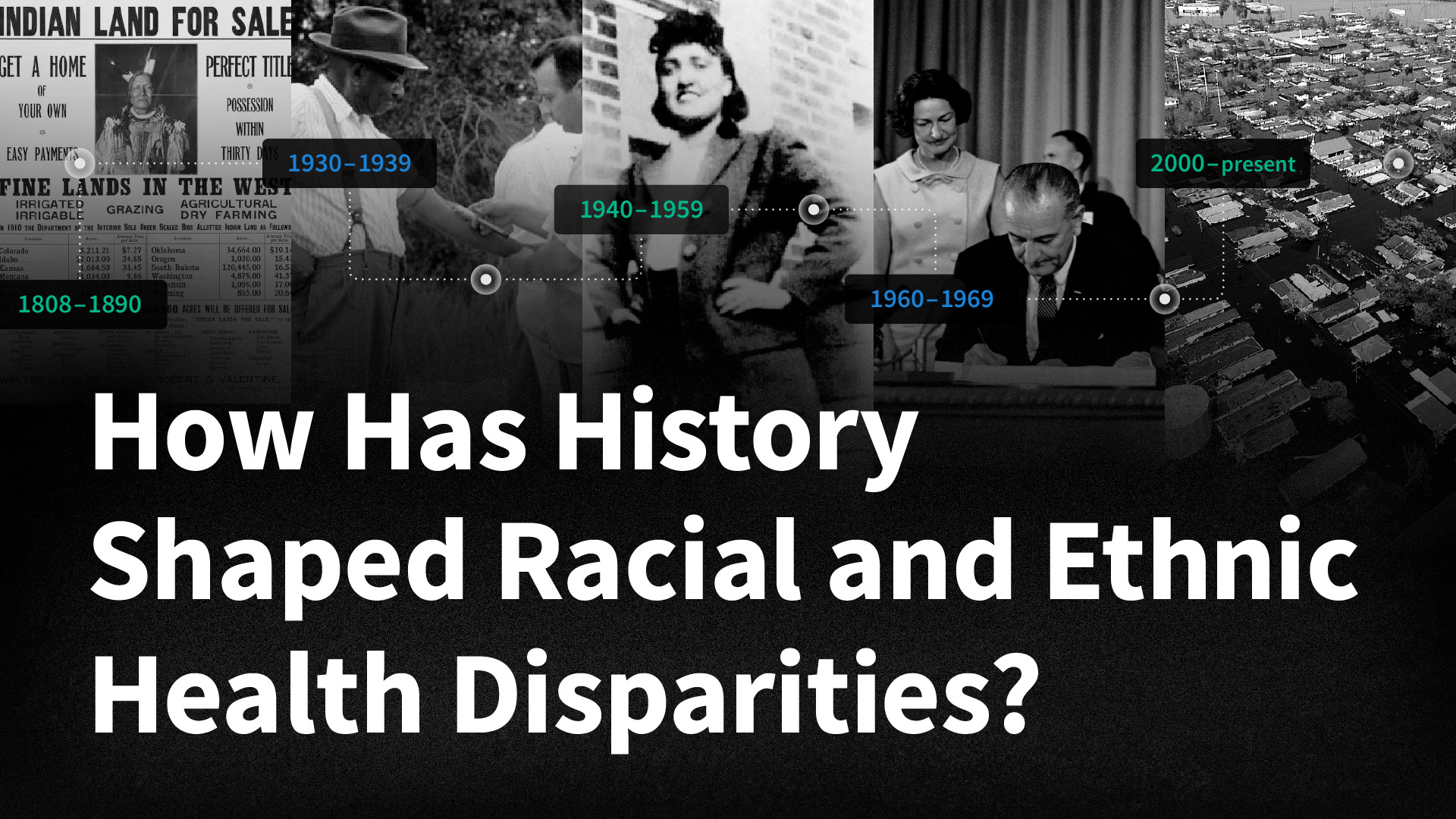
  • Timeline: How History Has Shaped Racial and Ethnic Health Disparities

    This timeline offers a historical view of significant U.S. federal policies and events spanning the early 1800s to today that have influenced present-day health disparities.
  • Health Policy 101: Chapter on Race, Inequality and Health

    Addressing persistent racial and ethnic disparities in health and health care is important for improving the nation’s health and economic prosperity. KFF explains such disparities and the factors that drive them, examines the actions to address them, and outlines future considerations.
  • Key Data on Health and Health Care by Race and Ethnicity

    Racial and ethnic disparities in health and health care remain a persistent challenge in the United States. An updated KFF resource examines how people of color fare compared to White people across 64 measures of health, health care, and social determinants of health.

Subscribe to KFF Emails

Choose which emails are best for you.
Sign up here

Filter

441 - 450 of 589 Results

  • Brief Provides Update on LGBT Coverage and Health as More States Recognize Same-Sex Marriage

    News Release

    An updated issue brief from the Kaiser Family Foundation gives a detailed profile of health concerns for lesbian, gay, bisexual and transgender individuals, offers the latest demographic data, and discusses the impact of recent changes in state and federal policies on health coverage, including the Affordable Care Act and same-sex marriage.

  • Climate Change and Health Equity: Key Questions and Answers

    Issue Brief

    While climate change poses health threats for everyone, people of color, low-income people, and other marginalized or high-need groups face disproportionate risks due to underlying inequities and structural racism and discrimination.

  • How Equitable is Access to COVID-19 Treatments?

    Issue Brief

    This issue brief assesses the availability of oral antiviral treatments by county and certain county characteristics, including metro vs. non-metro status, poverty rate, and majority Black, Hispanic, or American Indian or Alaska Native (AIAN).

  • Addressing the Justice-Involved Population in Coronavirus Response Efforts

    Issue Brief

    Addressing health care needs of people moving into and out of the criminal justice system and staff who work them is an important component of coronavirus response efforts and protecting and promoting public health within the communities in which correctional facilities are located. This brief provides data on spread of coronavirus within correctional facilities, discusses the health risks for the justice-involved population and the staff who work with them, identifies the role Medicaid can play in response efforts for justice-involved individuals, and highlights other steps correctional systems can take to mitigate risk of coronavirus for the justice-involved population and promote public health.

  • Racial and Ethnic Disparities in COVID-19 Cases and Deaths in Nursing Homes

    Issue Brief

    This data note presents national data that shows that nursing homes with a high share of Black or Hispanic residents were more likely to have at least one coronavirus case, at least one COVID-19 death, and (among facilities with cases) more severe case outbreaks than facilities with a low share of Black or Hispanic residents. This piece also includes state-level data from 21 states where a sufficient sample of facilities with a high share of Black or Hispanic residents was available.

  • Who are the 3.4 Million People Who Work in the Nation’s Food Production Industries?

    News Release

    Roughly 3.4 million individuals work in food production industries, more than a third of them in animal production and processing where there have been several COVID-19 outbreaks, a new KFF analysis shows. Workers at meat and poultry plants face a higher risk of coronavirus exposure due to the close quarters of their workplaces.

  • ‘In Focus with KFF’: Rethinking the Use of Race in Medicine

    Video

    KFF Vice President Samantha Artiga discusses how the medical system continues to use race in ways that may perpetuate disparities, including through provider and institutional bias, clinical guidelines, and medical education and training approaches.

  • Rethinking the Use of Race in Medicine

    News Release

    The COVID-19 pandemic has shined a spotlight on racial disparities in health and health care, but disparities are hardly new. They have been driven by longstanding inequities within and beyond the health care system that are rooted in racism.