Racial Equity and Health Policy

Survey of Immigrants

KFF-New York Times Survey: Immigrants Report Rising Fear, Negative Economic and Health Impacts, and Changing Political Views During the First Year of President Trump’s Second Term

The 2025 Survey of Immigrants, a partnership between KFF and The New York Times, takes an in-depth look at the experiences of immigrants during the first year of President Trump’s second term, including their worries related to increased immigration enforcement, their health and economic wellbeing, and the political views and preferences of immigrant voters. The survey paints a portrait of families under strain — where fear of detention and economic instability are negatively impacting immigrants’ health and reshaping immigrant families’ daily lives and views of U.S. political parties.

Read the News Release | Explore The New York Times’ Reporting
the Essentials
  • Disparities in Health and Health Care: 5 Key Questions and Answers

    This brief provides an introduction to what health and health care disparities are, why it is important to address them, what the status of disparities is today, recent federal actions to address disparities, and key issues related to addressing disparities in the future.
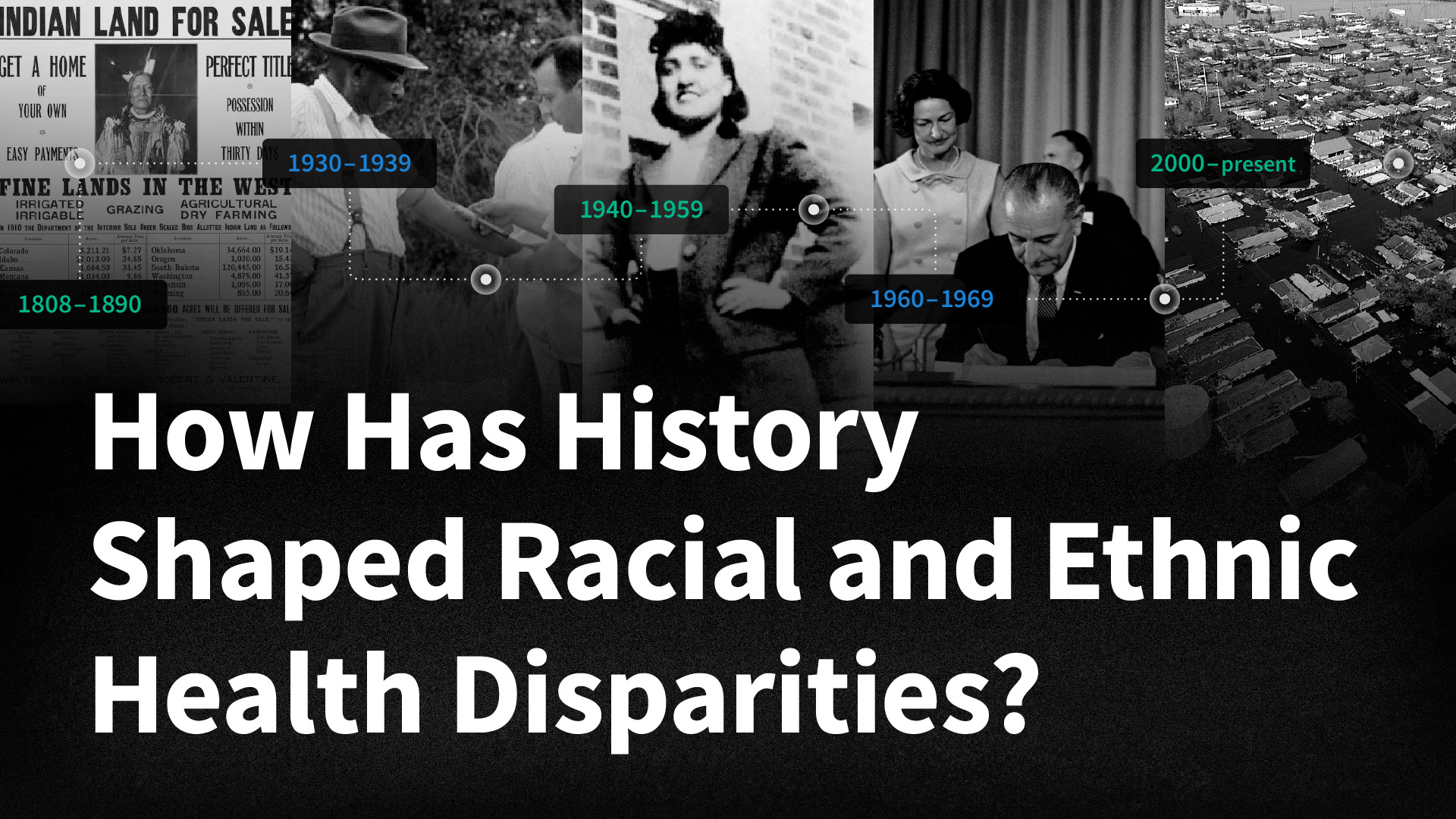
  • Timeline: How History Has Shaped Racial and Ethnic Health Disparities

    This timeline offers a historical view of significant U.S. federal policies and events spanning the early 1800s to today that have influenced present-day health disparities.
  • Health Policy 101: Chapter on Race, Inequality and Health

    Addressing persistent racial and ethnic disparities in health and health care is important for improving the nation’s health and economic prosperity. KFF explains such disparities and the factors that drive them, examines the actions to address them, and outlines future considerations.
  • Key Data on Health and Health Care by Race and Ethnicity

    Racial and ethnic disparities in health and health care remain a persistent challenge in the United States. An updated KFF resource examines how people of color fare compared to White people across 64 measures of health, health care, and social determinants of health.

Subscribe to KFF Emails

Choose which emails are best for you.
Sign up here

Filter

421 - 430 of 597 Results

  • How Do Health Expenditures Vary Across the Population?

    Issue Brief

    This analysis explores the variation in health spending across the population using 2023 Medical Expenditure Panel Survey data. Five percent of the population accounted for nearly half of all health spending in 2023.

  • Native American Health Policy Fellowship Program, 1999 – 2003

    Other Post

    Established in 1999, the Henry J. Kaiser Family Foundation Native American Health Policy Fellowships were awarded to outstanding American Indian/Alaska Natives who made their career in health-related fields and were interested in health policy.

  • Key Facts: Latinos and HIV/AIDS

    Report

    This report provides an overview of the impact of the HIV/AIDS epidemic on Latinos in the United States.

  • Sources of Financing and the Level of Health Spending for Native Americans

    Report

    This study of Native Americans health care funding and expenditures includes the following: An analysis of all sources of financing and the level of total health expenditures by and on behalf of Native Americans, a detailed analysis of the same data for each of the 12 Indian Health Service areas across the country, an estimate…

  • Perceptions of How Race & Ethnic Background Affect Medical Care

    Report

    This document is a summary of the findings from twelve separate focus groups conducted to better understand how race and ethnic background affect medical care. Seven of the focus groups were minority American health care consumers and the other five focus groups were largely white health care professionals and hospital administrators.

  • Minority Graduates of U.S. Medical Schools: Trends, 1950-1998

    Other Post

    While significant efforts have been made to increase minority representation in the medical profession, very little information about minority medical school graduates and minority physicians has been available to evaluate progress towards this goal.

  • 2002 National Survey of Latinos

    Poll Finding

    The Pew Hispanic Center/Kaiser Family Foundation examines how members of the Hispanic community identify themselves, their views of the United States, their experiences with discrimination both within the Latino community itself and from non-Latino groups, their language abilities and preferences, their economic and financial situations and their experiences within the health care system.