Racial Equity and Health Policy

Survey of Immigrants

KFF-New York Times Survey: Immigrants Report Rising Fear, Negative Economic and Health Impacts, and Changing Political Views During the First Year of President Trump’s Second Term

The 2025 Survey of Immigrants, a partnership between KFF and The New York Times, takes an in-depth look at the experiences of immigrants during the first year of President Trump’s second term, including their worries related to increased immigration enforcement, their health and economic wellbeing, and the political views and preferences of immigrant voters. The survey paints a portrait of families under strain — where fear of detention and economic instability are negatively impacting immigrants’ health and reshaping immigrant families’ daily lives and views of U.S. political parties.

Read the News Release | Explore The New York Times’ Reporting
the Essentials
  • Disparities in Health and Health Care: 5 Key Questions and Answers

    This brief provides an introduction to what health and health care disparities are, why it is important to address them, what the status of disparities is today, recent federal actions to address disparities, and key issues related to addressing disparities in the future.
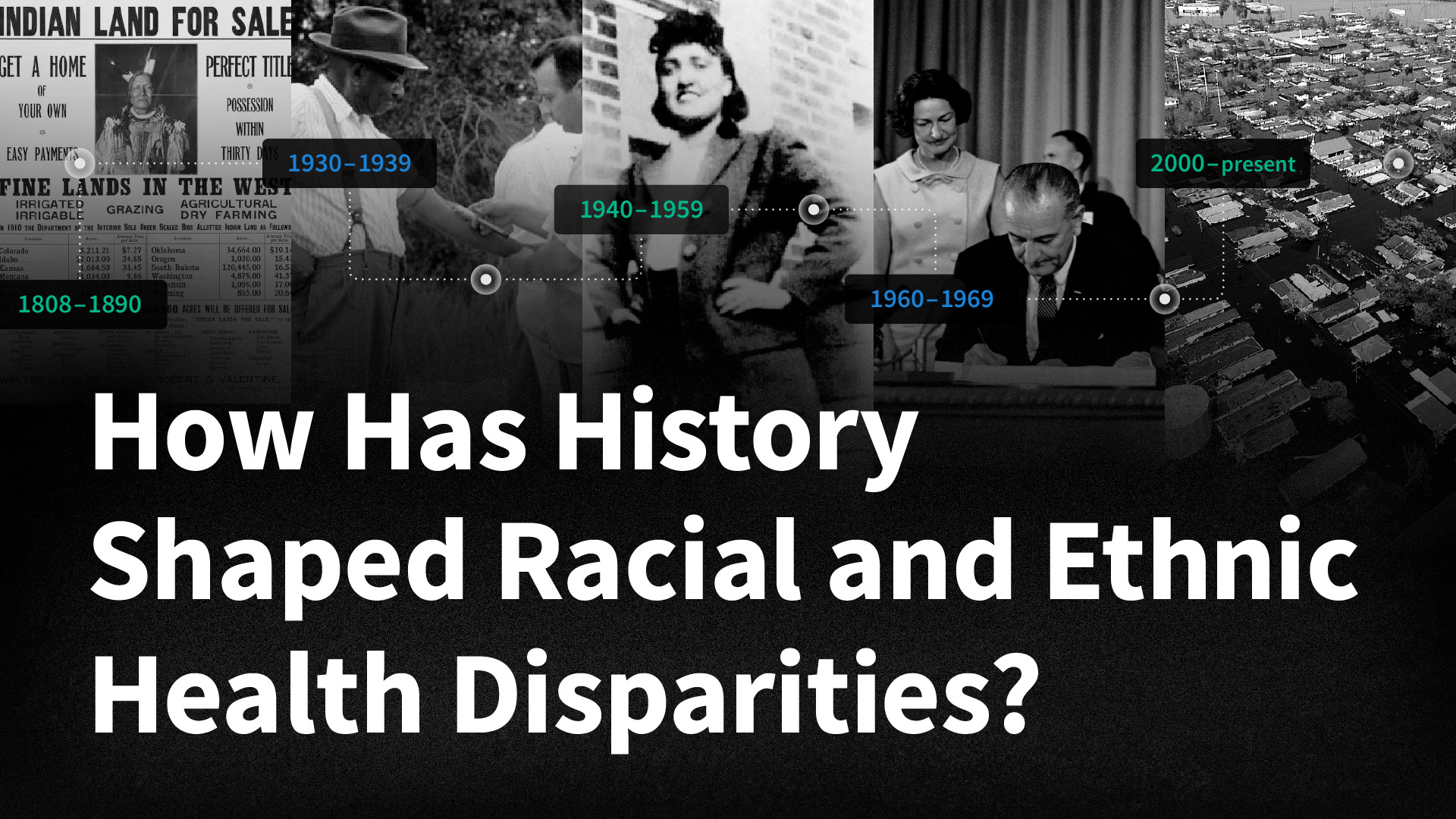
  • Timeline: How History Has Shaped Racial and Ethnic Health Disparities

    This timeline offers a historical view of significant U.S. federal policies and events spanning the early 1800s to today that have influenced present-day health disparities.
  • Health Policy 101: Chapter on Race, Inequality and Health

    Addressing persistent racial and ethnic disparities in health and health care is important for improving the nation’s health and economic prosperity. KFF explains such disparities and the factors that drive them, examines the actions to address them, and outlines future considerations.
  • Key Data on Health and Health Care by Race and Ethnicity

    Racial and ethnic disparities in health and health care remain a persistent challenge in the United States. An updated KFF resource examines how people of color fare compared to White people across 64 measures of health, health care, and social determinants of health.

Subscribe to KFF Emails

Choose which emails are best for you.
Sign up here

Filter

421 - 430 of 599 Results

  • Immigrants in the U.S. Continue to Face Health Care Challenges

    Feature

    June marks National Immigrant Heritage Month, which honors the contributions of immigrants to the U.S. As of 2020, there were close to 45 million immigrants residing in the U.S., accounting for 14% of the total U.S. population.

  • How Equitable is Access to COVID-19 Treatments?

    Issue Brief

    This issue brief assesses the availability of oral antiviral treatments by county and certain county characteristics, including metro vs. non-metro status, poverty rate, and majority Black, Hispanic, or American Indian or Alaska Native (AIAN).

  • Medicaid Authorities and Options to Address Social Determinants of Health

    Issue Brief

    Social determinants of health (SDOH) are the conditions in which people are born, grow, live, work and age. While there are limits, states can use Medicaid – which, by design, serves a primarily low-income population with greater social needs – to address social determinants of health. This brief outlines the range of Medicaid authorities and flexibilities that can be used to add benefits and design programs to address the social determinants of health.

  • Racial Disparities in COVID-19 Impacts and Vaccinations for Children

    Issue Brief

    COVID-19 has disproportionately negatively affected the physical and mental health, academic growth, and economic security of children of color. At the same time, the limited data available to date suggest some children of color may be less likely to receive a COVID-19 vaccine, leaving them at elevated risk as the virus continues to spread and as many return to in-person school.

  • Early Data Show Racial Disparities in Monkeypox Cases

    Policy Watch

    This policy watch examines early data showing that Black and Hispanic people are bearing a disproportionate burden of monkeypox cases and discusses the importance of centering equity in response efforts, including prevention, testing, and treatment.

  • Advancing Health Equity Requires More and Better Data

    Policy Watch

    Increasing availability of high-quality comprehensive data disaggregated by race/ethnicity is a prerequisite for efforts to advance health equity, not only related to COVID-19 but in health and health care more broadly.

  • Key Facts on Health and Health Care by Race and Ethnicity

    News Release

    With the COVID-19 pandemic impacting communities of color disproportionately in their health and economic well-being, long-term racial and ethnic disparities have received growing attention. But these inequities in our health system are not new and are a part of larger issues of systemic racism.