Racial Equity and Health Policy

the Essentials
  • How Experiencing Racial Discrimination Impacts Health

    This brief highlights research examining mechanisms underlying health outcomes linked to self-reported experiences of racial discrimination, including biological changes, chronic stress, mental health, substance use, pregnancy-related outcomes, and sleep.
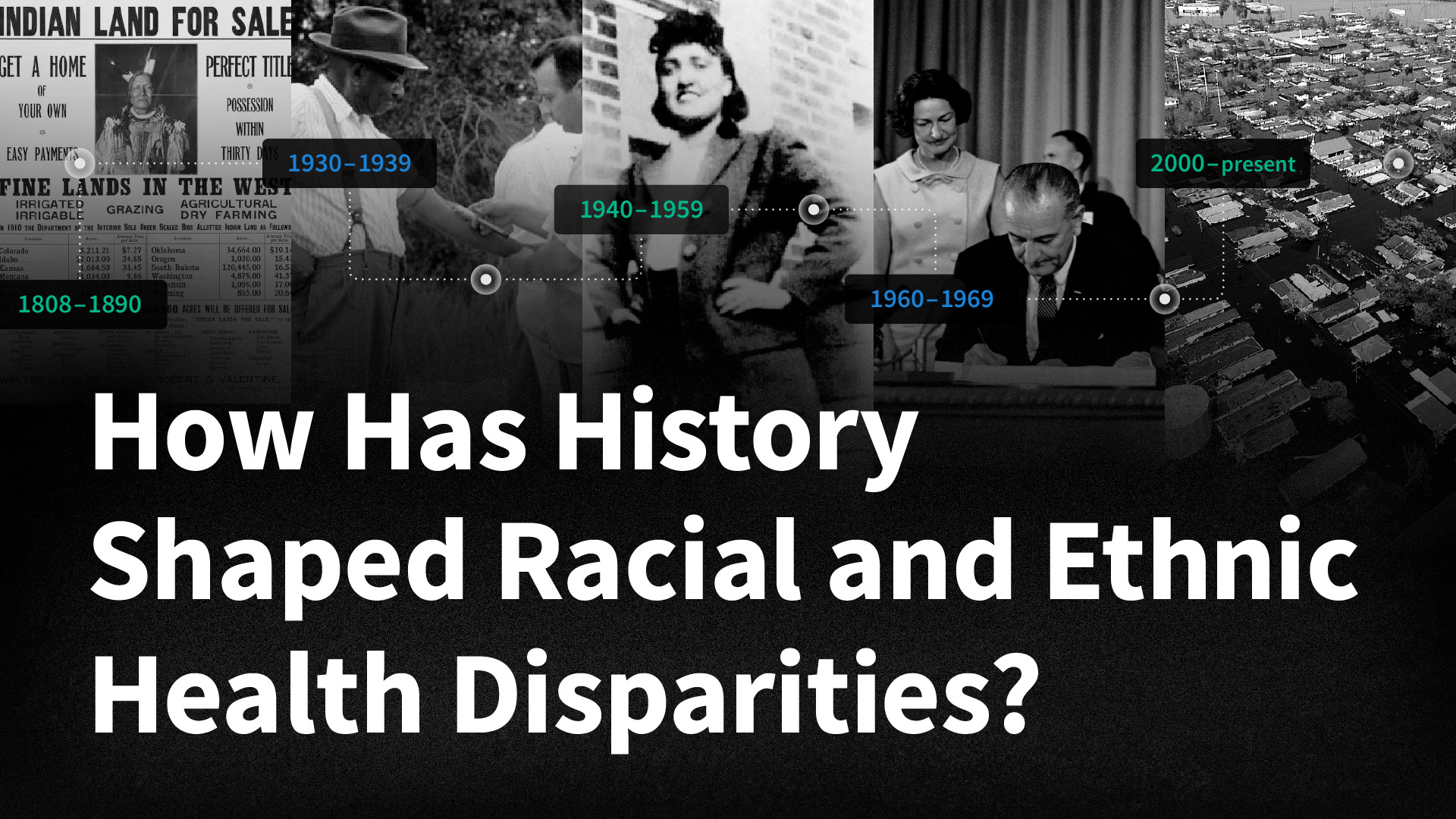
  • Timeline: How History Has Shaped Racial and Ethnic Health Disparities

    This timeline offers a historical view of significant U.S. federal policies and events spanning the early 1800s to today that have influenced present-day health disparities.
  • Health Policy 101: Chapter on Race, Inequality and Health

    Addressing persistent racial and ethnic disparities in health and health care is important for improving the nation’s health and economic prosperity. KFF explains such disparities and the factors that drive them, examines the actions to address them, and outlines future considerations.
  • Key Data on Health and Health Care by Race and Ethnicity

    Racial and ethnic disparities in health and health care remain a persistent challenge in the United States. An updated KFF resource examines how people of color fare compared to White people across 64 measures of health, health care, and social determinants of health.

Survey of Immigrants

KFF-New York Times Survey: Immigrants Report Rising Fear, Negative Economic and Health Impacts, and Changing Political Views During the First Year of President Trump’s Second Term

The 2025 Survey of Immigrants, a partnership between KFF and The New York Times, takes an in-depth look at the experiences of immigrants during the first year of President Trump’s second term, including their worries related to increased immigration enforcement, their health and economic wellbeing, and the political views and preferences of immigrant voters. The survey paints a portrait of families under strain — where fear of detention and economic instability are negatively impacting immigrants’ health and reshaping immigrant families’ daily lives and views of U.S. political parties.

Read the News Release | Explore The New York Times’ Reporting
Stay informed.

Stay informed.

Filter

391 - 400 of 602 Results

  • Analysis: Workers Increasingly Have Access to Same-Sex Spousal Benefits 

    News Release

    While workplace health benefits for married same-sex spouses are becoming more common, new data from KFF’s 2018 Employer Health Benefits Survey shows they still lag behind benefits available to opposite sex-spouses. In 2018, nearly two-thirds (63%) of employers offering health insurance coverage to opposite-sex spouses also provided coverage to same-sex spouses – up significantly from 2016, when fewer than half (43%) did. Few (6%) say they do not offer same-sex spousal benefits, while others, mostly…

  • States Sustain and Expand Coverage For Low-Income Children and Families Despite Recession, But Gains Are Threatened By Impending End of Federal Assistance

    News Release

    New 50-State Survey Illustrates Key Role of CHIP Reauthorization and the Federal Stimulus Law in Safeguarding Coverage    WASHINGTON  – Despite the deep recession, most states have managed to safeguard and, in some cases, expand health coverage for children and parents in their Medicaid and Children's Health Insurance Programs in 2009, according to a new survey from the Kaiser Family Foundation's Commission on Medicaid and the Uninsured.  But the gains, which could serve as a…

  • Age-Adjusted Death Rates, by Race/Ethnicity, 2006-2008

    Feature

    Age-Adjusted Death Rates, by Race/Ethnicity, 2006-2008 Download Source Centers for Disease Control and Prevention. National Vital Statistics Report. January 2012. http://www.cdc.gov/nchs/data/nvsr/nvsr60/nvsr60_04.pdf    

  • Excess Medical Expenditures Due to Health Inequities

    Feature

    Excess Medical Expenditures Due to Health Inequities Download Source LaVeist, T., Gaskin, D., and P. Richard, “The Economic Burden of Health Inequalities in the United States,” Joint Center for Political and Economic Studies, September 2009,   

  • Gaps Between Average Income of the Richest and Poorest Households in the United States

    Feature

    Gaps Between Average Income of the Richest and Poorest Households in the United States Download Source Economic Policy Institute/Center on Budget and Policy Priorities analysis of U.S. Census Bureau Data. Income is post-federal. tax and includes the value of the EITC, food stamps, and housing subsidies. Income is adjusted for inflation (to 2009 dollars) and for household size. Pulling Apart, A State-by-State Analysis of Income Trends, November 15, 2012, http://www.cbpp.org/cms/index.cfm?fa=view&id=3860  

  • Infant Mortality by Race/Ethnicity, 2007

    Feature

    Infant Mortality by Race/Ethnicity, 2007 Download Source Centers for Disease Control and Prevention. National Center for Health Statistics. June 2011. http://www.cdc.gov/nchs/data/nvsr/nvsr59/nvsr59_06.pdf