Racial Equity and Health Policy

Survey of Immigrants

KFF-New York Times Survey: Immigrants Report Rising Fear, Negative Economic and Health Impacts, and Changing Political Views During the First Year of President Trump’s Second Term

The 2025 Survey of Immigrants, a partnership between KFF and The New York Times, takes an in-depth look at the experiences of immigrants during the first year of President Trump’s second term, including their worries related to increased immigration enforcement, their health and economic wellbeing, and the political views and preferences of immigrant voters. The survey paints a portrait of families under strain — where fear of detention and economic instability are negatively impacting immigrants’ health and reshaping immigrant families’ daily lives and views of U.S. political parties.

Read the News Release | Explore The New York Times’ Reporting
the Essentials
  • Disparities in Health and Health Care: 5 Key Questions and Answers

    This brief provides an introduction to what health and health care disparities are, why it is important to address them, what the status of disparities is today, recent federal actions to address disparities, and key issues related to addressing disparities in the future.
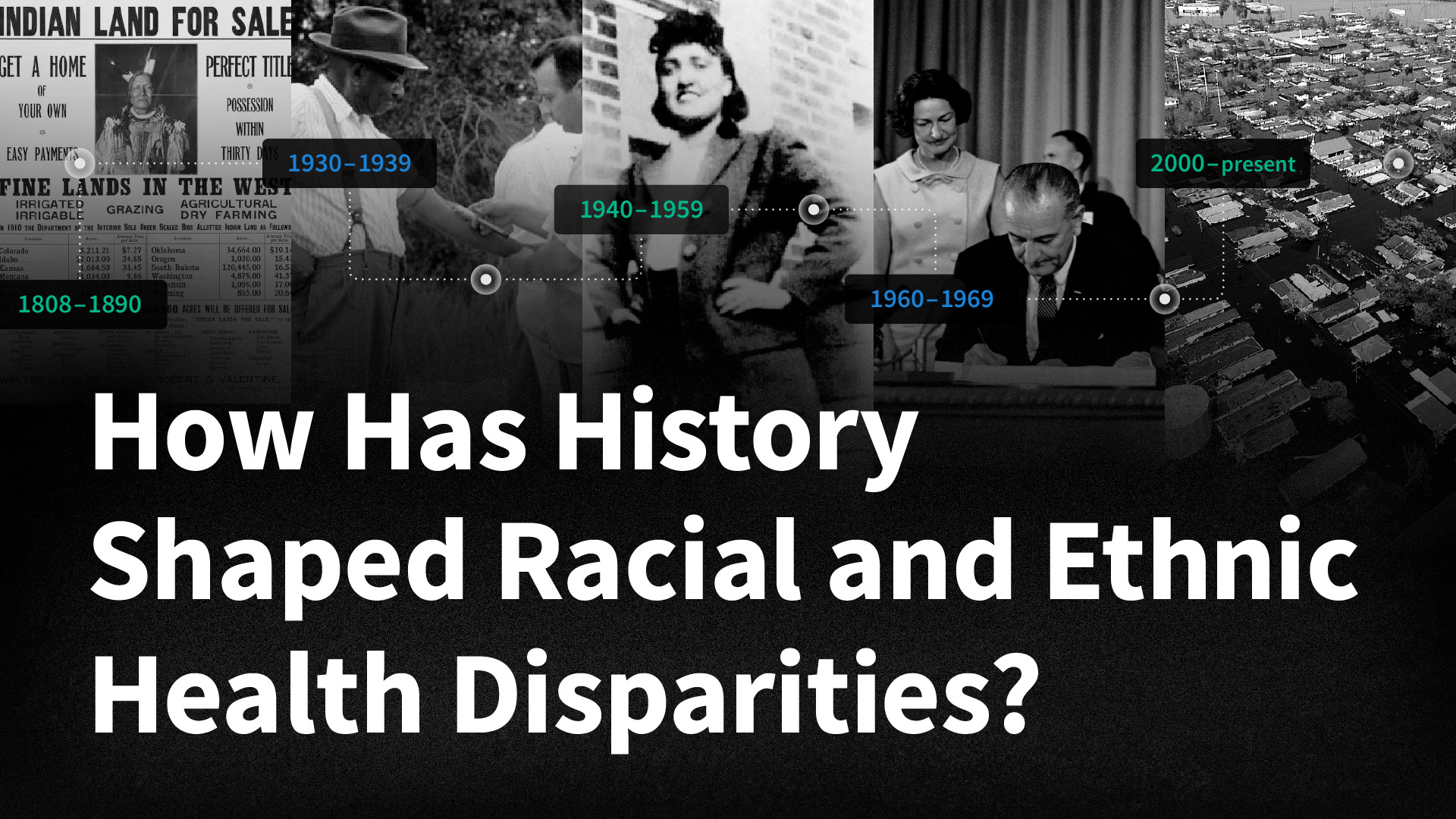
  • Timeline: How History Has Shaped Racial and Ethnic Health Disparities

    This timeline offers a historical view of significant U.S. federal policies and events spanning the early 1800s to today that have influenced present-day health disparities.
  • Health Policy 101: Chapter on Race, Inequality and Health

    Addressing persistent racial and ethnic disparities in health and health care is important for improving the nation’s health and economic prosperity. KFF explains such disparities and the factors that drive them, examines the actions to address them, and outlines future considerations.
  • Key Data on Health and Health Care by Race and Ethnicity

    Racial and ethnic disparities in health and health care remain a persistent challenge in the United States. An updated KFF resource examines how people of color fare compared to White people across 64 measures of health, health care, and social determinants of health.

Subscribe to KFF Emails

Choose which emails are best for you.
Sign up here

Filter

381 - 390 of 598 Results

  • Survey of Hurricane Katrina Evacuees

    Report

    To give voice to people whose lives have been devastated by Hurricane Katrina and the ensuing floods, The Washington Post, the Kaiser Family Foundation, and the Harvard School of Public Health conducted a unique survey of evacuees in shelters in the Houston area.

  • The Health Status of African American Men in the United States  

    Fact Sheet

    The Health Status of African American Men in the United States This fact sheet provides an overview of the health of the nation's 17.3 million African American men, including mortality rates, health status, insurance coverage and access to care. It also looks at the population's socioeconomic factors that relate to health status. Fact Sheet (.

  • What’s the Diagnosis? Latinos, Media & Health: A Series of Three Reports – Report

    Report

    What's the Diagnosis? A Series of Three Reports on Latinos, Media & Health Summary of Key Findings June 1998 Overview: A Series of 3 Reports Latinos are disproportionately affected by some of the most serious health problems facing our country. They are more likely to be uninsured and face problems getting health care when needed.

  • Medicare’s Role for Latinos

    Fact Sheet

    Medicare's Role for Latinos Fact Sheet: The Medicare Program: Medicare's Role For Latinos…

  • Survey of Asians in the Bay Area

    Report

    Survey of Asians In the Bay Area This survey explores the attitudes and experiences of the Asian community in the Bay Area, which has the largest Asian population in the country. The Kaiser Family Foundation and San Jose Mercury News collaborated on the survey.

  • Racial Ethnic Difference in Cardiac Care:  The Weight of the Evidence

    Fact Sheet

    Racial Ethnic Difference in Cardiac Care: The Weight of the Evidence Numerous studies over the past two decades have documented racial and ethnic differences in care for heart conditions. To assess the quality of the evidence and to summarize the information for a physician audience, the Henry J.