Racial Equity and Health Policy

the Essentials
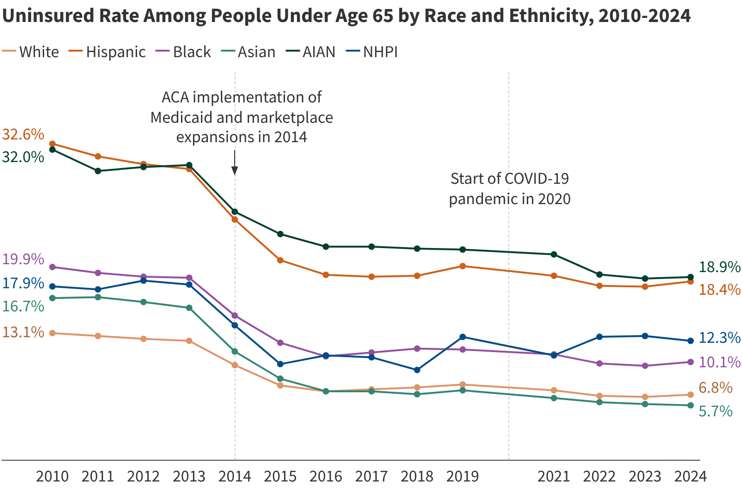
  • Health Coverage by Race and Ethnicity, 2010-2024

    There have been longstanding racial and ethnic disparities in health coverage that contribute to disparities in health. This brief examines trends in health coverage by race and ethnicity from 2010 through 2024 and discusses the implications for such disparities.
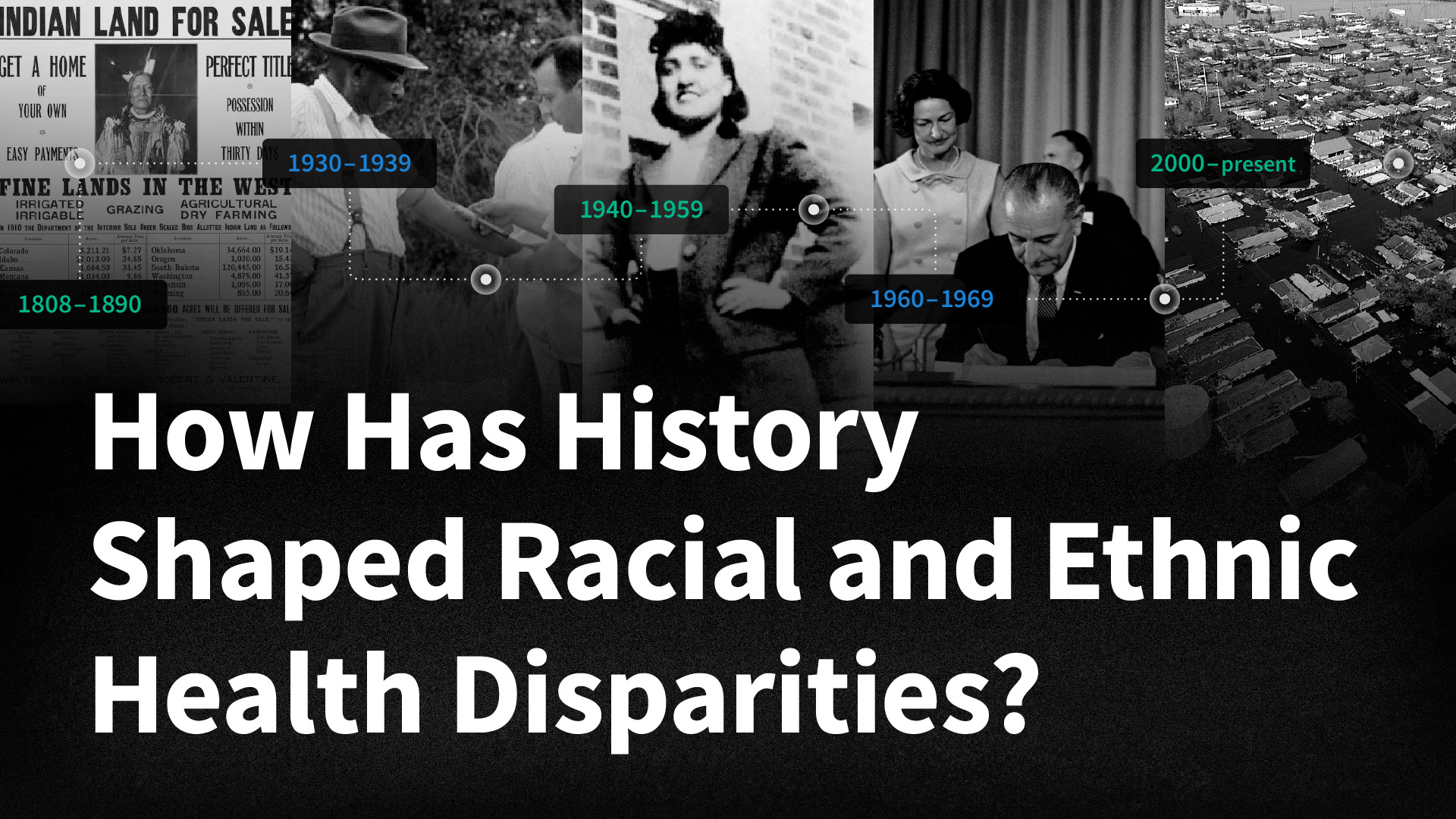
  • Timeline: How History Has Shaped Racial and Ethnic Health Disparities

    This timeline offers a historical view of significant U.S. federal policies and events spanning the early 1800s to today that have influenced present-day health disparities.
  • Health Policy 101: Chapter on Race, Inequality and Health

    Addressing persistent racial and ethnic disparities in health and health care is important for improving the nation’s health and economic prosperity. KFF explains such disparities and the factors that drive them, examines the actions to address them, and outlines future considerations.
  • Key Data on Health and Health Care by Race and Ethnicity

    Racial and ethnic disparities in health and health care remain a persistent challenge in the United States. An updated KFF resource examines how people of color fare compared to White people across 64 measures of health, health care, and social determinants of health.

Survey of Immigrants

KFF-New York Times Survey: Immigrants Report Rising Fear, Negative Economic and Health Impacts, and Changing Political Views During the First Year of President Trump’s Second Term

The 2025 Survey of Immigrants, a partnership between KFF and The New York Times, takes an in-depth look at the experiences of immigrants during the first year of President Trump’s second term, including their worries related to increased immigration enforcement, their health and economic wellbeing, and the political views and preferences of immigrant voters. The survey paints a portrait of families under strain — where fear of detention and economic instability are negatively impacting immigrants’ health and reshaping immigrant families’ daily lives and views of U.S. political parties.

Read the News Release | Explore The New York Times’ Reporting
Subscribe to KFF Emails

Choose which emails are best for you.
Sign up here

Filter

351 - 360 of 602 Results

  • Navigating Recovery: Health Care Financing and Delivery Systems in Puerto Rico and US Virgin Islands

    Issue Brief

    This brief identifies key issues and short and long-term options for recovery around the health care financing and delivery systems in Puerto Rico and the U.S. Virgin Islands following Hurricanes Irma and Maria, which caused significant physical damage to the territories. It draws on insights from a Nov. 30 roundtable discussion with leaders and experts representing a variety of perspectives on Medicaid policy, health insurance and care delivery systems, and disaster recovery.

  • Voces de Puerto Rico: Reflexiones Dos Meses Después de María (Video)

    Video

    En este video, los residentes de Puerto Rico hablan sobre su vida cotidiana y puntos de vista de los esfuerzos de recuperación dos meses después del huracán María. Describen un clima de frustración, la pérdida de empleo y problemas económicas, la falta de servicios básicos como la electricidad y el efecto en la salud mental y física de la población

  • Key Facts: Race, Ethnicity and Medical Care

    Report

    The Kaiser Family Foundation's updated version of Key Facts: Race, Ethnicity and Medical Care, 2007 Update, serves as a quick reference source on health disparities, presenting the best available data and analysis. This report includes data on the uninsured and access to care by race/ethnicity as well as information about the disproportionate effect that specific conditions such as diabetes, HIV/AIDS, and asthma have on racial and ethnic minority populations in the U.S. New in the 2007…

  • Health Care Experiences – 2002 National Survey of Latinos Survey Brief

    Poll Finding

    This survey brief of new analysis from the 2002 National Survey of Latinos examines Latinos experiences with health care in the United States. Topics discussed include coverage, accessing health care services, and communicating with health care providers. Survey Brief (.pdf)

  • Survey of Americans on HIV/AIDS — Part Three: Experiences and Opinions by Race/Ethnicity and Age

    Poll Finding

    These findings are the third part of a national survey of Americans’ views on HIV/AIDS, “Survey of Americans on HIV/AIDS,” conducted in spring 2004. It explores the views and experiences of, as well as the key differences among, African Americans, Latinos, Whites, and young people. The first part of the survey, on global HIV/AIDS, was released on June 2, 2004. The second part of the survey, on HIV Testing, was released on June 15, 2004.…

  • Women and Health Care: A National Profile – Report

    Report

    Report - Women and Health Care: A National Profile Women and Health Care: A National Profile is a nationally representative telephone survey of 2,766 women ages 18 and older. A shorter companion survey of 507 men was also conducted. Full Report (.pdf) Report Highlights (.pdf) Introduction and Methods (.pdf) Chapter 1: The Demographics of Women (.pdf) Chapter 2: The Health of Women (.pdf) Chapter 3: Women and Health Insurance Coverage (.pdf) Chapter 4: Women's Access…

  • Health Reform and Communities of Color: Implications for Racial and Ethnic Health Disparities

    Issue Brief

    This issue brief examines the key provisions of the 2010 health reform law that will expand health coverage and are likely to improve access to care for people of color, as well as some of the other provisions that will likely have either a direct or indirect impact on health disparities. Issue Brief (.pdf)) Previous Version: November 2009 (.pdf)

  • Immigrants and Health Coverage:  A Primer

    Issue Brief

    Immigrants and Health Coverage: A Primer A major challenge facing many immigrants is lack of health insurance coverage. This primer provides an introduction to some of the questions surrounding immigrants and health insurance coverage. Issue Brief (.pdf)

  • Florida’s Recent Heat Protection Preemption Law Could Disproportionately Affect Hispanic and Noncitizen Immigrant Workers

    Issue Brief

    The Florida legislation prevents city and county governments from requiring that employers, including government contractors, provide heat protections for outdoor workers outside of those required under state or federal law. These protections include requiring water breaks and other cooling measures for outdoor workers. The law could impact nearly 1.8 million nonelderly adult outdoor workers in Florida, who are disproportionately Hispanic and noncitizen immigrant workers.