Racial Equity and Health Policy

the Essentials
  • How Experiencing Racial Discrimination Impacts Health

    This brief highlights research examining mechanisms underlying health outcomes linked to self-reported experiences of racial discrimination, including biological changes, chronic stress, mental health, substance use, pregnancy-related outcomes, and sleep.
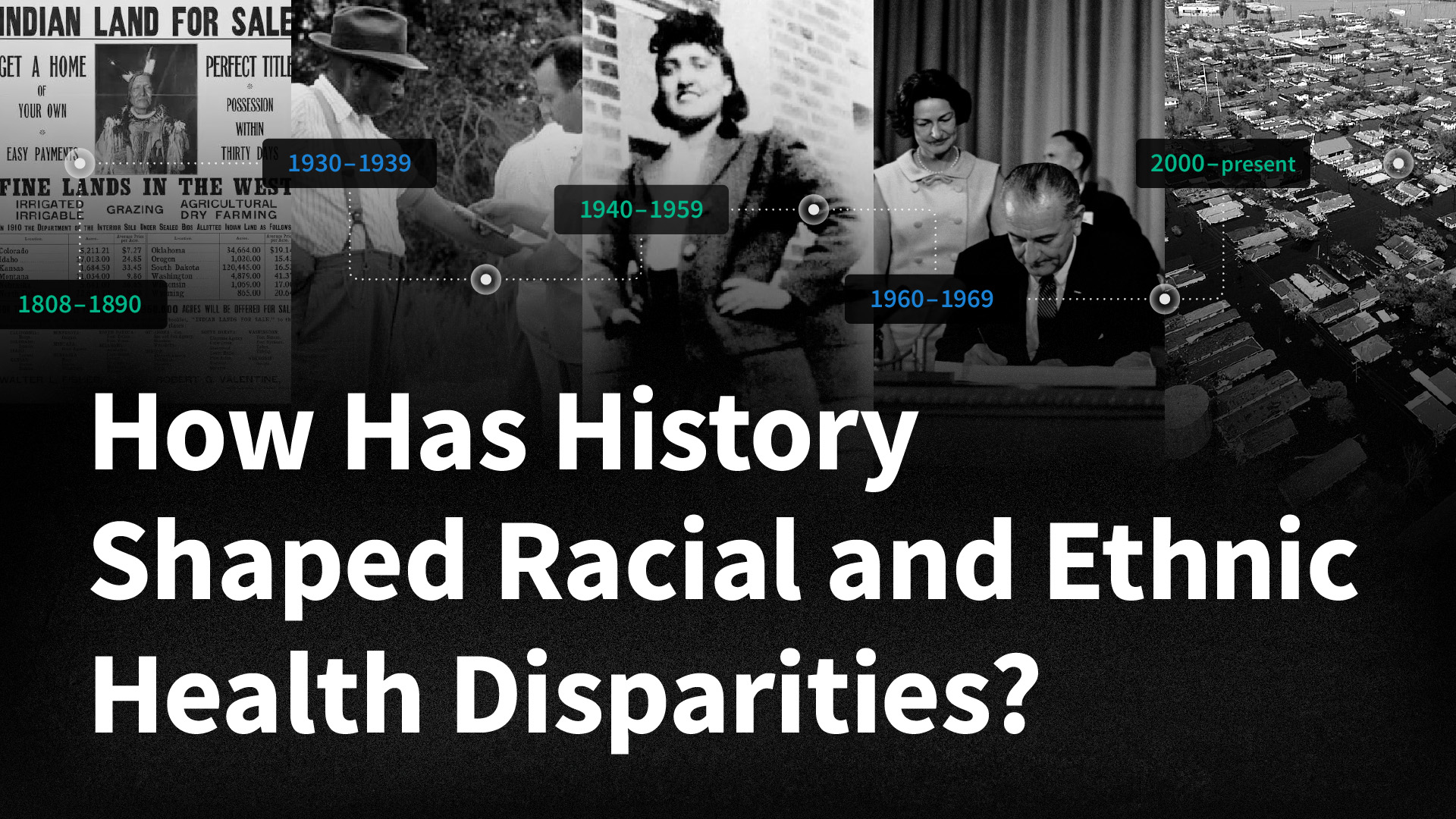
  • Timeline: How History Has Shaped Racial and Ethnic Health Disparities

    This timeline offers a historical view of significant U.S. federal policies and events spanning the early 1800s to today that have influenced present-day health disparities.
  • Health Policy 101: Chapter on Race, Inequality and Health

    Addressing persistent racial and ethnic disparities in health and health care is important for improving the nation’s health and economic prosperity. KFF explains such disparities and the factors that drive them, examines the actions to address them, and outlines future considerations.
  • Key Data on Health and Health Care by Race and Ethnicity

    Racial and ethnic disparities in health and health care remain a persistent challenge in the United States. An updated KFF resource examines how people of color fare compared to White people across 64 measures of health, health care, and social determinants of health.

Survey of Immigrants

KFF-New York Times Survey: Immigrants Report Rising Fear, Negative Economic and Health Impacts, and Changing Political Views During the First Year of President Trump’s Second Term

The 2025 Survey of Immigrants, a partnership between KFF and The New York Times, takes an in-depth look at the experiences of immigrants during the first year of President Trump’s second term, including their worries related to increased immigration enforcement, their health and economic wellbeing, and the political views and preferences of immigrant voters. The survey paints a portrait of families under strain — where fear of detention and economic instability are negatively impacting immigrants’ health and reshaping immigrant families’ daily lives and views of U.S. political parties.

Read the News Release | Explore The New York Times’ Reporting
Stay informed.

Stay informed.

Filter

341-350 of 608 results

  • What’s the Diagnosis? Latinos, Media & Health: A Series of Three Reports – Report

    Report

    What's the Diagnosis? A Series of Three Reports on Latinos, Media & Health Summary of Key Findings June 1998 Overview: A Series of 3 Reports Latinos are disproportionately affected by some of the most serious health problems facing our country. They are more likely to be uninsured and face problems getting health care when needed. Young Latinos, in particular, are confronting very high rates of unintended pregnancy and sexually transmitted diseases (STDs). Latinos have also…

  • Medicare’s Role for Latinos

    Fact Sheet

    Medicare's Role for Latinos Fact Sheet: The Medicare Program: Medicare's Role For Latinos

  • Medicaid’s Role for Hispanic Americans

    Fact Sheet

    This fact sheet examines Medicaid's role for Hispanic Americans. It includes data on Medicaid's coverage of Hispanic Americans and the program's impact on their access to care, as well as the impacts of the recent recession and the coming expansion of Medicaid under health reform on enrollment in Medicaid among Hispanic Americans. The fact sheet also has a chart showing state-by-state data on health insurance coverage of Hispanic Americans. Fact Sheet (.pdf)

  • Health Care Coverage and Access for Hispanics: How Does It Differ Across America

    Event Date:
    Event

    A new report from the Foundation's Kaiser Commission on Medicaid and the Uninsured finds that as the Hispanic population grows and moves beyond urban centers, Hispanics in "new growth communities" face greater barriers to health care than those in cities considered "major Hispanic centers." By 2003, the uninsured rate for Hispanics in new growth communities rose to a level equal to that of Hispanics in major centers. However, less than half (43%) of the Hispanic…

  • Survey of Asians In the Bay Area – Toplines

    Poll Finding

    This document includes the toplines from a survey exploring the attitudes and experiences of the Asian community in the Bay Area, which has the largest Asian population in the country. The Kaiser Family Foundation and San Jose Mercury News collaborated on the survey. Survey Toplines (.pdf)

  • The Role of Employer-Sponsored Health Coverage for Immigrants: A Primer

    Issue Brief

    Access to employer-sponsored health insurance is declining for all families living in the United States, and this problem is especially acute for immigrant families. Employer-sponsored coverage is a particularly important source of insurance for immigrant families since their eligibility for public coverage through Medicaid and the State Children’s Health Insurance Program (SCHIP) is restricted. This primer examines the role of employer-based coverage for immigrants and the specific hurdles they face in obtaining this coverage. Issue…

  • Health Care Experiences – 2002 National Survey of Latinos Survey Brief

    Poll Finding

    This survey brief of new analysis from the 2002 National Survey of Latinos examines Latinos experiences with health care in the United States. Topics discussed include coverage, accessing health care services, and communicating with health care providers. Survey Brief (.pdf)

  • What’s the Diagnosis? Latinos, Media & Health

    Report

    Three reports examining how health issues are handled by the Latino-oriented media today and how Latinos use the media as an information source on health issues. The three new studies were released at the National Association of Hispanic Journalists (NAHJ) conference. The studies are also available separately: A National and Three Region Survey of Latinos on the Media and Health, conducted by Princeton Survey Research Associates (#1410), A Study of Health Coverage in Latino Newspapers,…