Racial Equity and Health Policy

Survey of Immigrants

KFF-New York Times Survey: Immigrants Report Rising Fear, Negative Economic and Health Impacts, and Changing Political Views During the First Year of President Trump’s Second Term

The 2025 Survey of Immigrants, a partnership between KFF and The New York Times, takes an in-depth look at the experiences of immigrants during the first year of President Trump’s second term, including their worries related to increased immigration enforcement, their health and economic wellbeing, and the political views and preferences of immigrant voters. The survey paints a portrait of families under strain — where fear of detention and economic instability are negatively impacting immigrants’ health and reshaping immigrant families’ daily lives and views of U.S. political parties.

Read the News Release | Explore The New York Times’ Reporting
the Essentials
  • Disparities in Health and Health Care: 5 Key Questions and Answers

    This brief provides an introduction to what health and health care disparities are, why it is important to address them, what the status of disparities is today, recent federal actions to address disparities, and key issues related to addressing disparities in the future.
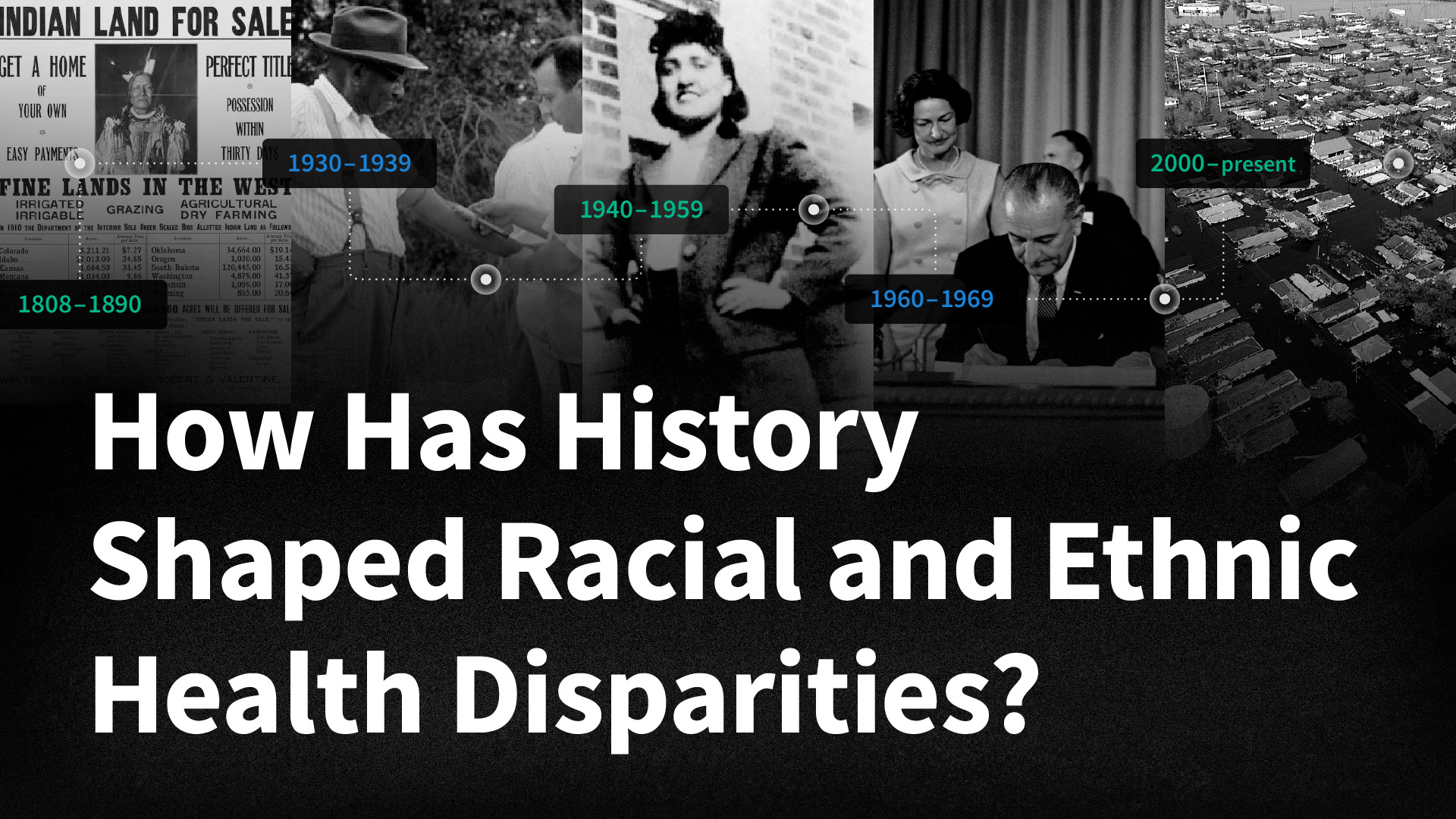
  • Timeline: How History Has Shaped Racial and Ethnic Health Disparities

    This timeline offers a historical view of significant U.S. federal policies and events spanning the early 1800s to today that have influenced present-day health disparities.
  • Health Policy 101: Chapter on Race, Inequality and Health

    Addressing persistent racial and ethnic disparities in health and health care is important for improving the nation’s health and economic prosperity. KFF explains such disparities and the factors that drive them, examines the actions to address them, and outlines future considerations.
  • Key Data on Health and Health Care by Race and Ethnicity

    Racial and ethnic disparities in health and health care remain a persistent challenge in the United States. An updated KFF resource examines how people of color fare compared to White people across 64 measures of health, health care, and social determinants of health.

Subscribe to KFF Emails

Choose which emails are best for you.
Sign up here

Filter

331 - 340 of 598 Results

  • Unwinding of the PHE: Maintaining Medicaid for People with Limited English Proficiency

    Issue Brief

    Provisions in the Families First Coronavirus Response Act (FFCRA) require states to maintain continuous Medicaid enrollment for enrollees until the end of the month when the COVID-19 public health emergency (PHE) ends. When the continuous enrollment requirements end and states resume redeterminations and disenrollments, individuals with LEP may be at increased risk of losing Medicaid coverage or experiencing a gap in coverage due to barriers completing these processes, even if they remain eligible for coverage.

  • Health Care Access and Coverage for the Lesbian, Gay, Bisexual, and Transgender (LGBT) Community in the United States: Opportunities and Challenges in a New Era

    Perspective

    This Policy Insight looks at the challenges and questions surrounding recent policy changes that are expected to increase health insurance coverage and access to care for lesbian, gay, bisexual and transgender (LGBT) individuals and their families, including the impact of the Affordable Care Act (ACA) and the Supreme Court's DOMA decision.

  • The Medicare Program: Panorama General De Medicare

    Fact Sheet

    Que Es El Medicare Y Como Se Financia? Medicare es un programa de seguro medico nacional que atiende a 39 millones de ancianos y discapacitados. Antes de la existencia del Medicare, menos de la mitad de todos los norteamericanos de edad avanzada contaban con un seguro medico.

  • The AIDS Epidemic at 20 Years: THE VIEW FROM AMERICA Survey

    Report

    Twenty years into the AIDS epidemic, the Kaiser Family Foundation conducted its most recent survey of Americans about HIV/AIDS. This report summarizes the key findings from the survey, including analysis of trends over time and across race/ethnicity, age, and gender. It describes Americans' concerns about HIV/AIDS as a personal, national, and global issue.

  • Estimates of Eligibility for ACA Coverage among the Uninsured by Race and Ethnicity

    Issue Brief

    This analysis provides national estimates of eligibility for ACA coverage options by race/ethnicity, including Whites, Blacks, and Hispanics. We estimate coverage and eligibility as of early 2015, which is prior to the end of the 2015 Marketplace open enrollment period. Overall, this analysis finds that more than half (55%) of the total 32.3 million nonelderly uninsured are people of color, including 34% who identify as Hispanic, 14% who identify as Black, and 8% who identify as another group or mixed race.

  • Health Care and the 2004 Elections

    Other Post

    ** Update: For information on health care and the 2008 election, visit www.health08.org. ** Health care issues continue to be important for many Americans and a vital part of the policy debates in Washington and around the country.

  • Survey of Asians In the Bay Area – Summary and Chartpack

    Poll Finding

    The summary and chartpack highlights key findings from a survey exploring the attitudes and experiences of the Asian community in the Bay Area, which has the largest Asian population in the country. The Kaiser Family Foundation and San Jose Mercury News collaborated on the survey. Summary and Chartpack (.

  • Key Facts: Latinos and HIV/AIDS

    Report

    This report provides an overview of the impact of the HIV/AIDS epidemic on Latinos in the United States.

  • Navigating Recovery: Health Care Financing and Delivery Systems in Puerto Rico and US Virgin Islands

    Issue Brief

    This brief identifies key issues and short and long-term options for recovery around the health care financing and delivery systems in Puerto Rico and the U.S. Virgin Islands following Hurricanes Irma and Maria, which caused significant physical damage to the territories. It draws on insights from a Nov. 30 roundtable discussion with leaders and experts representing a variety of perspectives on Medicaid policy, health insurance and care delivery systems, and disaster recovery.