Racial Equity and Health Policy

the Essentials
  • How Experiencing Racial Discrimination Impacts Health

    This brief highlights research examining mechanisms underlying health outcomes linked to self-reported experiences of racial discrimination, including biological changes, chronic stress, mental health, substance use, pregnancy-related outcomes, and sleep.
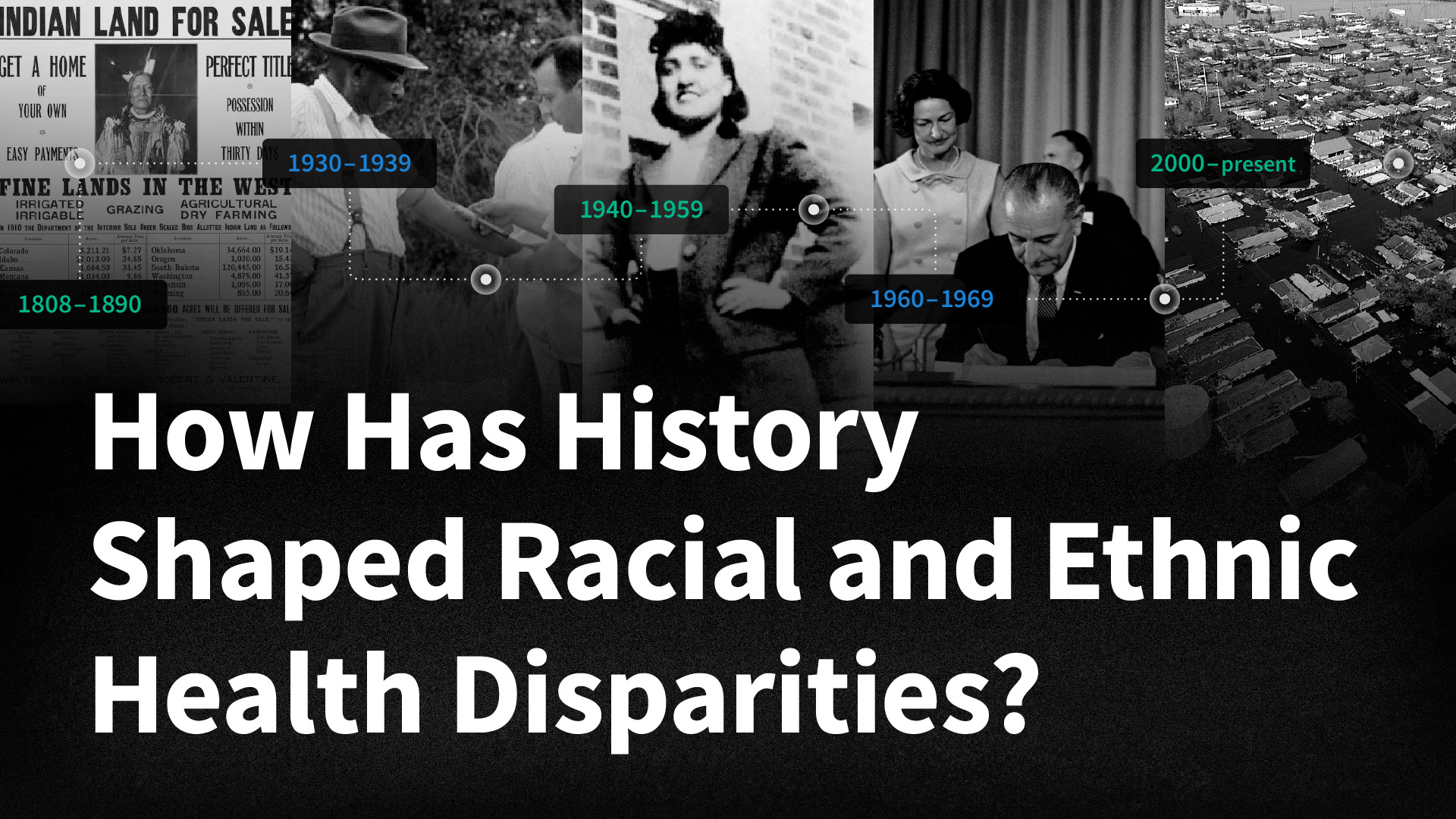
  • Timeline: How History Has Shaped Racial and Ethnic Health Disparities

    This timeline offers a historical view of significant U.S. federal policies and events spanning the early 1800s to today that have influenced present-day health disparities.
  • Health Policy 101: Chapter on Race, Inequality and Health

    Addressing persistent racial and ethnic disparities in health and health care is important for improving the nation’s health and economic prosperity. KFF explains such disparities and the factors that drive them, examines the actions to address them, and outlines future considerations.
  • Key Data on Health and Health Care by Race and Ethnicity

    Racial and ethnic disparities in health and health care remain a persistent challenge in the United States. An updated KFF resource examines how people of color fare compared to White people across 64 measures of health, health care, and social determinants of health.

Survey of Immigrants

KFF-New York Times Survey: Immigrants Report Rising Fear, Negative Economic and Health Impacts, and Changing Political Views During the First Year of President Trump’s Second Term

The 2025 Survey of Immigrants, a partnership between KFF and The New York Times, takes an in-depth look at the experiences of immigrants during the first year of President Trump’s second term, including their worries related to increased immigration enforcement, their health and economic wellbeing, and the political views and preferences of immigrant voters. The survey paints a portrait of families under strain — where fear of detention and economic instability are negatively impacting immigrants’ health and reshaping immigrant families’ daily lives and views of U.S. political parties.

Read the News Release | Explore The New York Times’ Reporting
Stay informed.

Stay informed.

Filter

261 - 270 of 602 Results

  • Family Consequences of Detention/Deportation: Effects on Finances, Health, and Well-Being

    Issue Brief

    This report examines the direct consequences to family finances, health, and well-being when a member of the household is detained or deported. It is based on 20 in-person interviews with families who recently had a family member detained or deported and 12 telephone interviews with health centers, legal services providers, educators, and community organizations serving immigrant families in California, Texas, and the Washington, DC area.

  • Key Health Implications of Separation of Families at the Border (as of June 27, 2018)

    Fact Sheet

    This fact sheet examines key health implications of separating immigrant children from their parents at the border, as of June 27, 2018. The practice came to light after implementation of the Trump Administration's zero tolerance policy for individuals entering into the U.S. without authorization. Research shows that separating children from their parents exposes them to trauma and toxic stress that can have lifelong impacts on their health.

  • The AIDS Epidemic at 20 Years: THE VIEW FROM AMERICA Survey

    Report

    Twenty years into the AIDS epidemic, the Kaiser Family Foundation conducted its most recent survey of Americans about HIV/AIDS. This report summarizes the key findings from the survey, including analysis of trends over time and across race/ethnicity, age, and gender. It describes Americans' concerns about HIV/AIDS as a personal, national, and global issue. It also assesses Americans' knowledge about HIV/AIDS, their information needs, and their perspective on important policy issues and spending priorities. Report (.pdf) Timeline (.pdf)…

  • Capitol Hill Briefing on Latinos and HIV/AIDS

    Event Date:
    Event

    As part of the Kaiser Family Foundation’s ongoing effort to raise awareness about critical issues related to HIV/AIDS, we co-hosted a Capitol Hill briefing with the National Alliance of State and Territorial AIDS Directors (NASTAD) on Latinos and HIV/AIDS. Honorary co-sponsors of the briefing included Representatives Hilda Solis (D-CA), Ciro Rodriquez (D-TX), and Ileana Ros-Lehtinen (R-FL). At the briefing, facts on the impact of the epidemic were presented that were based on a new chartbook…

  • Profile of Medicare Beneficiaries by Race and Ethnicity: A Chartpack

    Report

    This chartpack draws on data and analysis from a variety of sources to profile the Medicare population through the lens of race and ethnicity, describing life expectancy, demographic characteristics, income and savings, health status and chronic conditions, supplemental coverage, selected measures of access to care, and service utilization.

  • Puerto Rico: Fast Facts

    Fact Sheet

    Puerto Rico: Fast Facts provides a quick snapshot of the island's demographic, health, and economic characteristics. It also provides some information on federal Medicaid rules, infrastructure, and fiscal challenges ahead.

  • How Pending Health-Related Lawsuits Could be Impacted by the Incoming Trump Administration

    Issue Brief

    This brief provides an overview of current lawsuits in health policy including preventive services, abortion care, gender affirming care, Medicare drug price negotiations, nursing home staffing rules, private coverage consumer protections, and protections and health coverage for Deferred Action for Childhood Arrivals (DACA) recipients; how they may be affected by the incoming Trump administration; and the implications of their potential outcomes.

  • Key Data on Health and Health Care for Native Hawaiian or Pacific Islander People

    Issue Brief

    Among NHPI people, there is significant variation in key factors that influence health, including health coverage, income, and homeownership, with Marshallese people faring the worst across all examined measures. Data gaps prevent the ability to fully identify and understand health disparities for NHPI people. Among available data, NHPI people fare worse than White people for the majority of measures.