Racial Equity and Health Policy

the Essentials
  • How Experiencing Racial Discrimination Impacts Health

    This brief highlights research examining mechanisms underlying health outcomes linked to self-reported experiences of racial discrimination, including biological changes, chronic stress, mental health, substance use, pregnancy-related outcomes, and sleep.
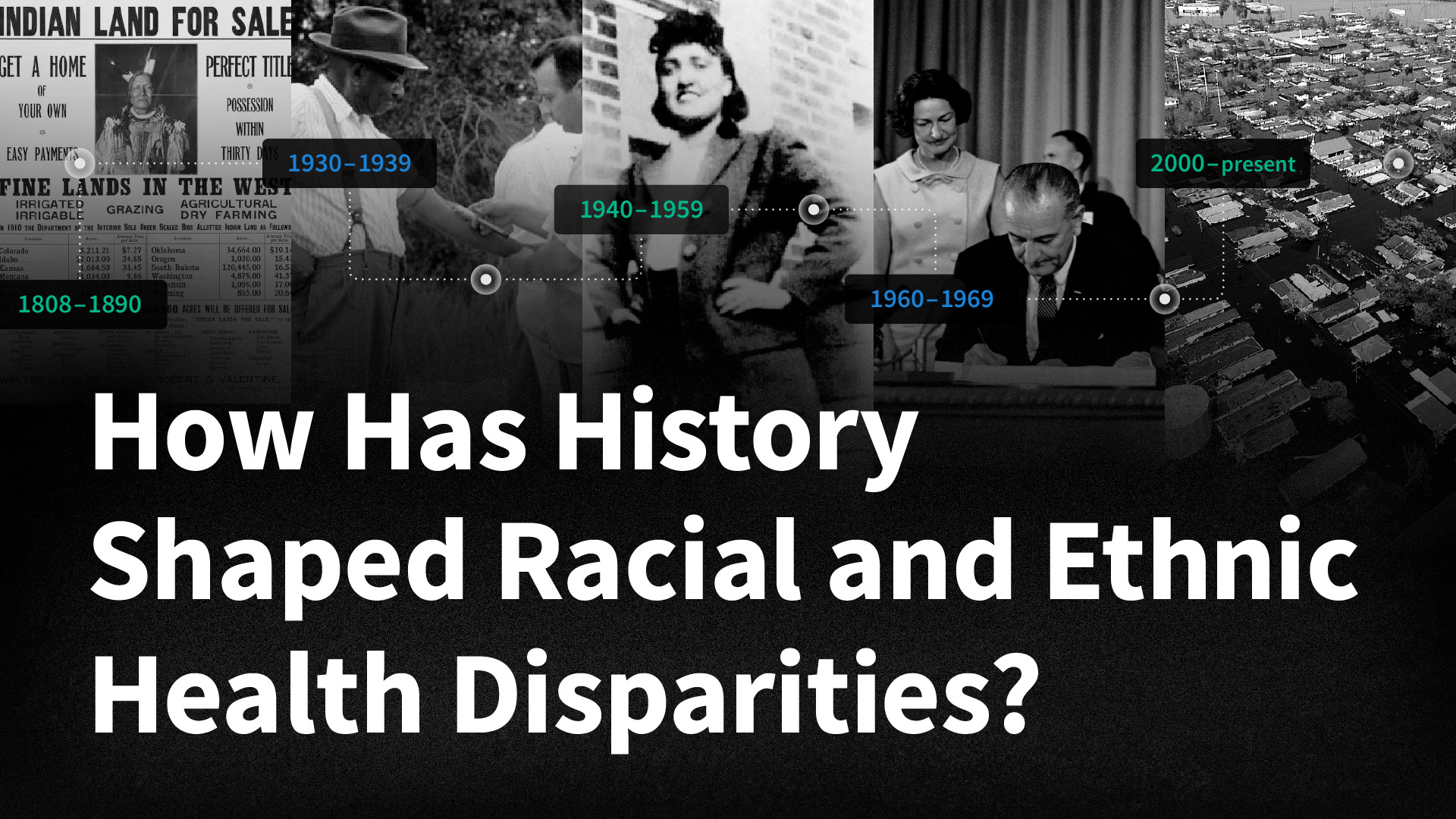
  • Timeline: How History Has Shaped Racial and Ethnic Health Disparities

    This timeline offers a historical view of significant U.S. federal policies and events spanning the early 1800s to today that have influenced present-day health disparities.
  • Health Policy 101: Chapter on Race, Inequality and Health

    Addressing persistent racial and ethnic disparities in health and health care is important for improving the nation’s health and economic prosperity. KFF explains such disparities and the factors that drive them, examines the actions to address them, and outlines future considerations.
  • Key Data on Health and Health Care by Race and Ethnicity

    Racial and ethnic disparities in health and health care remain a persistent challenge in the United States. An updated KFF resource examines how people of color fare compared to White people across 64 measures of health, health care, and social determinants of health.

Survey of Immigrants

KFF-New York Times Survey: Immigrants Report Rising Fear, Negative Economic and Health Impacts, and Changing Political Views During the First Year of President Trump’s Second Term

The 2025 Survey of Immigrants, a partnership between KFF and The New York Times, takes an in-depth look at the experiences of immigrants during the first year of President Trump’s second term, including their worries related to increased immigration enforcement, their health and economic wellbeing, and the political views and preferences of immigrant voters. The survey paints a portrait of families under strain — where fear of detention and economic instability are negatively impacting immigrants’ health and reshaping immigrant families’ daily lives and views of U.S. political parties.

Read the News Release | Explore The New York Times’ Reporting
Stay informed.

Stay informed.

Filter

261 - 270 of 603 Results

  • Key Facts: Latinos and HIV/AIDS

    Report

    This report provides an overview of the impact of the HIV/AIDS epidemic on Latinos in the United States. It presents current snapshots and trends over time, drawing from recent data and research on the epidemiology of HIV/AIDS among Latinos, including data on AIDS cases and deaths; health services use and coverage; and attitudinal data from a recent national survey. 6008

  • Survey of Asians in the Bay Area

    Report

    Survey of Asians In the Bay Area This survey explores the attitudes and experiences of the Asian community in the Bay Area, which has the largest Asian population in the country. The Kaiser Family Foundation and San Jose Mercury News collaborated on the survey. The Bay Area is home to the largest Asian population in the continental United States. In 2002, the census estimated that roughly one in five Bay Area adults was of Asian…

  • Welfare Reform and Elderly Legal Immigrants – Report

    Report

    Welfare Reform and Elderly Legal Immigrants Prepared by: Robert B. Friedland and Veena Pankaj National Academy on Aging, Washington DC July 1997 Prepared for: The Henry J. Kaiser Family Foundation The Henry J. Kaiser Family Foundation, based in Menlo Park, California, is an independentnational health philanthropy and is not associated with Kaiser Permanente or Kaiser Industries. Established in 1948 by industrialist Henry J. Kaiser and his wife Bess, the Foundation focusesits work on four main…

  • Kaiser Family Foundation National Survey of Latinos on HIV/AIDS

    Poll Finding

    A random-sample national survey of 802 Latino adults, 18 years and older. The survey, designed by staff at the Foundation and conducted by telephone in both English and Spanish by Princeton Survey Research Associates (PSRA), examines Latino's knowledge, values and beliefs with respect to HIV and AIDS. The survey data is also broken down into subgroups within the Latino community including women, young adults, parents, opinion leaders, and those with less education and lower incomes.…

  • Mobilizing to Fight HIV/AIDS in the African American Community

    Other Post

    This supplement to the journal Minority Health Today includes a set of papers commissioned by the Joint Center for Political and Economic Studies and the Kaiser Family Foundation for a national forum on HIV/AIDS. Included within the journal are articles on the impact of the epidemic on African American community, focusing specifically on the epidemiology of the disease, patterns of access to and utilization of HIV/AIDS treatment, and the financing of HIV/AIDS care. The journal…

  • New Publications on Immigrant Health Care and Linguistic Access

    Fact Sheet

    In 2000, there were over 32 million foreign-born residents in the U.S. Immigrants often face barriers to health coverage and health services. The disparities confronting immigrants can be similar to those faced by low-income working families generally, but immigrants also face other barriers, including linguistic issues and eligibility changes that have limited their ability to qualify for Medicaid. These new or updated publications address issues related to how race, immigration status, and language affect insurance…

  • Explainer: How States Are Using Medicaid Waivers to Help Incarcerated Individuals Get Care and Transition Back into Their Communities 

    News Release

    Compared to the general population, individuals who are incarcerated have higher rates of mental illness, substance use disorder, and chronic disease. However, the federal “inmate exclusion” policy prohibits Medicaid coverage for people who are incarcerated (except for limited inpatient hospital services). When people leave incarceration, they are at greater risk of overdose death and suicide, as well as hospitalization and emergency department use.  In a new explainer, KFF examines a new waiver opportunity that allows…

  • The Biden Administration’s Final Rule on Section 1557 Non-Discrimination Regulations Under the ACA

    Issue Brief

    This brief overviews the Biden Administration’s 2024 final rule implementing Section 1557 of the ACA, which is home to the law’s major nondiscrimination provisions. It provides a brief background on 1557 rulemaking and identifies key differences between this rule and the 2020 rule from the Trump Administration. It highlights two areas of growing interest impacted by the rule – nondiscrimination protections related to pregnancy and nondiscrimination protections for transgender people. Table 2 summarizes the major…