Racial Equity and Health Policy

the Essentials
  • How Experiencing Racial Discrimination Impacts Health

    This brief highlights research examining mechanisms underlying health outcomes linked to self-reported experiences of racial discrimination, including biological changes, chronic stress, mental health, substance use, pregnancy-related outcomes, and sleep.
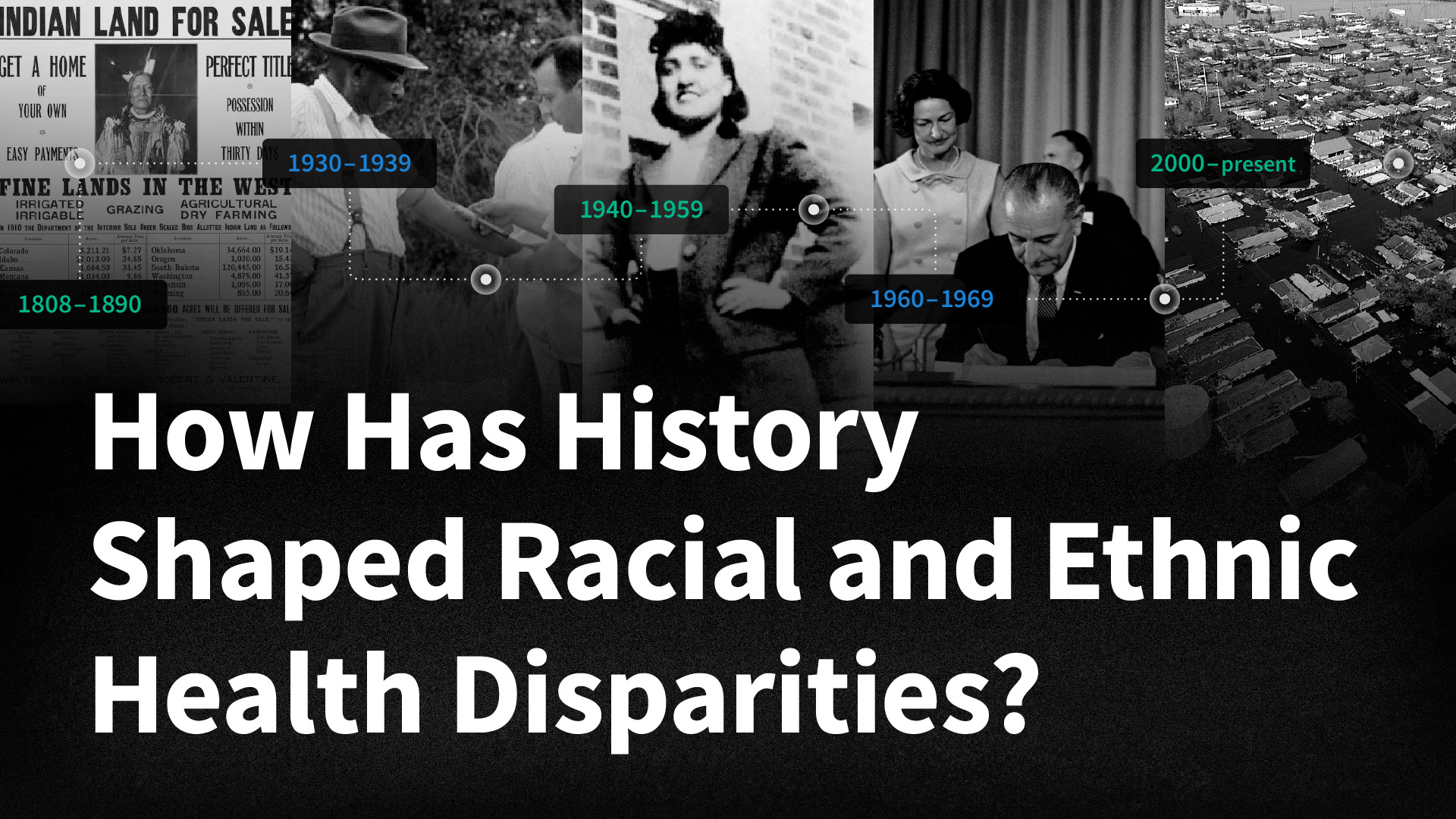
  • Timeline: How History Has Shaped Racial and Ethnic Health Disparities

    This timeline offers a historical view of significant U.S. federal policies and events spanning the early 1800s to today that have influenced present-day health disparities.
  • Health Policy 101: Chapter on Race, Inequality and Health

    Addressing persistent racial and ethnic disparities in health and health care is important for improving the nation’s health and economic prosperity. KFF explains such disparities and the factors that drive them, examines the actions to address them, and outlines future considerations.
  • Key Data on Health and Health Care by Race and Ethnicity

    Racial and ethnic disparities in health and health care remain a persistent challenge in the United States. An updated KFF resource examines how people of color fare compared to White people across 64 measures of health, health care, and social determinants of health.

Survey of Immigrants

KFF-New York Times Survey: Immigrants Report Rising Fear, Negative Economic and Health Impacts, and Changing Political Views During the First Year of President Trump’s Second Term

The 2025 Survey of Immigrants, a partnership between KFF and The New York Times, takes an in-depth look at the experiences of immigrants during the first year of President Trump’s second term, including their worries related to increased immigration enforcement, their health and economic wellbeing, and the political views and preferences of immigrant voters. The survey paints a portrait of families under strain — where fear of detention and economic instability are negatively impacting immigrants’ health and reshaping immigrant families’ daily lives and views of U.S. political parties.

Read the News Release | Explore The New York Times’ Reporting
Stay informed.

Stay informed.

Filter

251 - 260 of 603 Results

  • Analysis: Workers Increasingly Have Access to Same-Sex Spousal Benefits 

    News Release

    While workplace health benefits for married same-sex spouses are becoming more common, new data from KFF’s 2018 Employer Health Benefits Survey shows they still lag behind benefits available to opposite sex-spouses. In 2018, nearly two-thirds (63%) of employers offering health insurance coverage to opposite-sex spouses also provided coverage to same-sex spouses – up significantly from 2016, when fewer than half (43%) did. Few (6%) say they do not offer same-sex spousal benefits, while others, mostly…

  • Gaps Between Average Income of the Richest and Poorest Households in the United States

    Feature

    Gaps Between Average Income of the Richest and Poorest Households in the United States Download Source Economic Policy Institute/Center on Budget and Policy Priorities analysis of U.S. Census Bureau Data. Income is post-federal. tax and includes the value of the EITC, food stamps, and housing subsidies. Income is adjusted for inflation (to 2009 dollars) and for household size. Pulling Apart, A State-by-State Analysis of Income Trends, November 15, 2012, http://www.cbpp.org/cms/index.cfm?fa=view&id=3860  

  • Infant Mortality by Race/Ethnicity, 2007

    Feature

    Infant Mortality by Race/Ethnicity, 2007 Download Source Centers for Disease Control and Prevention. National Center for Health Statistics. June 2011. http://www.cdc.gov/nchs/data/nvsr/nvsr59/nvsr59_06.pdf   

  • Nonelderly Uninsured Non-Citizens, by Income, 2011

    Feature

    Nonelderly Uninsured Non-Citizens, by Income, 2011 Download Source KCMU/Urban Institute analysis of March 2011 Current Population Survey, Annual Social and Economic  Supplement  

  • Nearly Half of Those Likely Eligible for DACA are Uninsured

    News Release

    Yesterday, the Biden Administration announced a plan to expand eligibility for Medicaid and ACA Marketplace health coverage to Deferred Action for Childhood Arrivals (DACA) recipients. A KFF analysis finds 47% of individuals likely eligible for DACA are uninsured compared to 10% of U.S. born individuals in their age group. The analysis estimates that among those likely eligible for DACA: 84% are in a family with at least one full-time worker, 54% of adults work full-time,…

  • Survey Brief: Views and Experiences with HIV Testing Among African Americans in the U.S.

    Issue Brief

    This survey brief, based on the 2009 Survey of Americans on HIV/AIDS, examines African Americans' reported views and experiences with HIV testing. The U.S. AIDS epidemic has disproportionately affected African Americans, who account for nearly half of new infections, while representing just 12 percent of the U.S. population. The brief highlights trends and differences among African Americans by age and gender when noteworthy. Survey Brief (.pdf)

  • The Role of Race and Ethnicity in Health Services

    Other Post

    This is a special issue of Health Services Research on the role of race and ethnicity in health services research. Based on a December 1992 conference sponsored by the Association of American Medical Colleges, the issue contains eight papers and as editorial preface by Mark Smith and Pancho Chang. Note: This publication is no longer in circulation. However, a few copies may still exist in the Foundation's internal library that could be xeroxed. Please email…

  • Children and Oral Health: Assessing Needs, Coverage and Access

    Issue Brief

    This policy brief highlights the prevalence of dental problems among children and examines gaps in oral health coverage and access to dental care, as well as disparities by income and race/ethnicity. It also looks at out-of-pocket costs for dental care, explains the role of Medicaid and CHIP in dental care, coverage and access for children and describes the expansion of oral health coverage for children under the Affordable Care Act. Issue Brief (.pdf)

  • Survey of Asians In the Bay Area – Summary and Chartpack

    Poll Finding

    The summary and chartpack highlights key findings from a survey exploring the attitudes and experiences of the Asian community in the Bay Area, which has the largest Asian population in the country. The Kaiser Family Foundation and San Jose Mercury News collaborated on the survey. Summary and Chartpack (.pdf)