Racial Equity and Health Policy

the Essentials
  • How Experiencing Racial Discrimination Impacts Health

    This brief highlights research examining mechanisms underlying health outcomes linked to self-reported experiences of racial discrimination, including biological changes, chronic stress, mental health, substance use, pregnancy-related outcomes, and sleep.
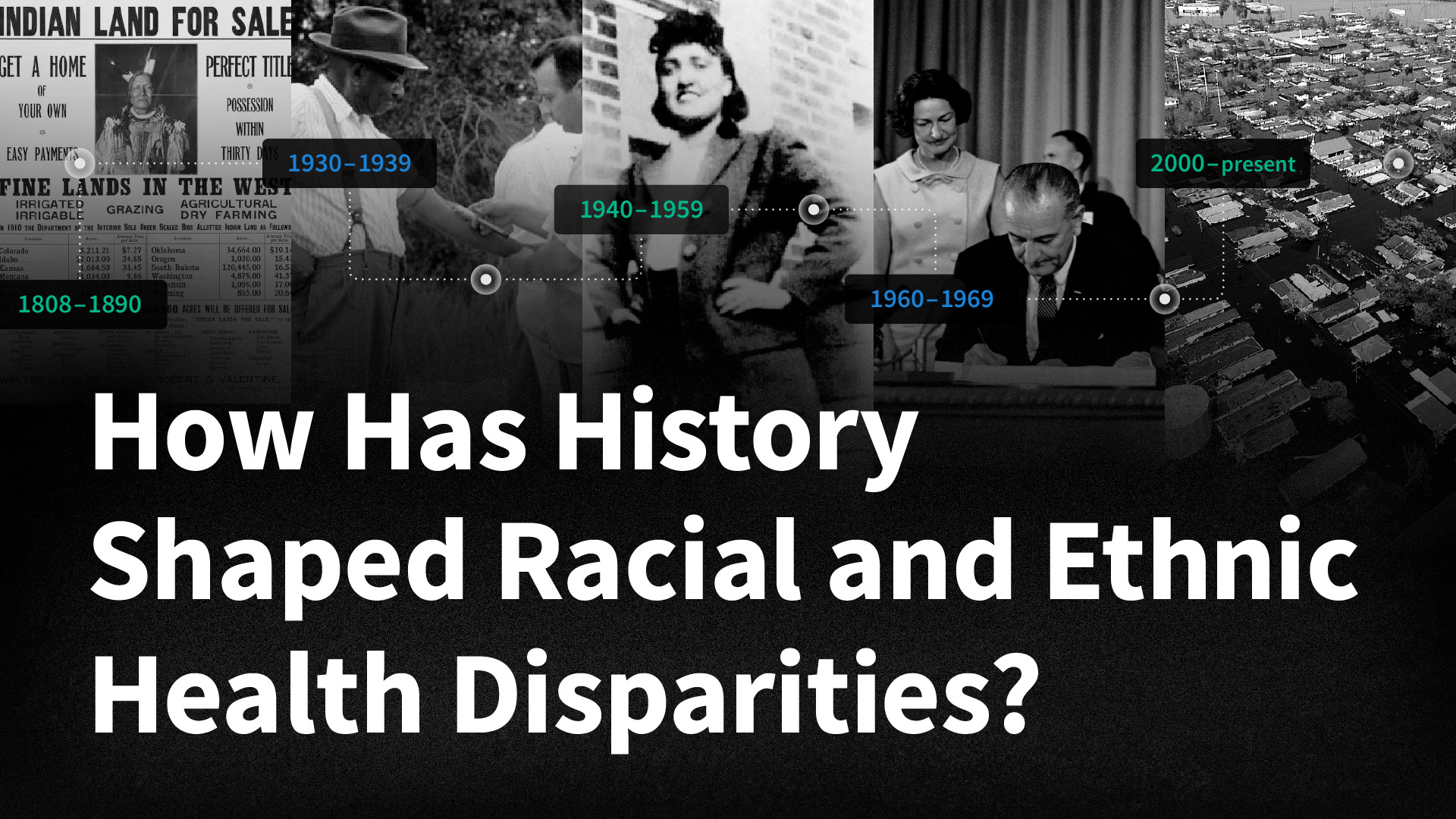
  • Timeline: How History Has Shaped Racial and Ethnic Health Disparities

    This timeline offers a historical view of significant U.S. federal policies and events spanning the early 1800s to today that have influenced present-day health disparities.
  • Health Policy 101: Chapter on Race, Inequality and Health

    Addressing persistent racial and ethnic disparities in health and health care is important for improving the nation’s health and economic prosperity. KFF explains such disparities and the factors that drive them, examines the actions to address them, and outlines future considerations.
  • Key Data on Health and Health Care by Race and Ethnicity

    Racial and ethnic disparities in health and health care remain a persistent challenge in the United States. An updated KFF resource examines how people of color fare compared to White people across 64 measures of health, health care, and social determinants of health.

Survey of Immigrants

KFF-New York Times Survey: Immigrants Report Rising Fear, Negative Economic and Health Impacts, and Changing Political Views During the First Year of President Trump’s Second Term

The 2025 Survey of Immigrants, a partnership between KFF and The New York Times, takes an in-depth look at the experiences of immigrants during the first year of President Trump’s second term, including their worries related to increased immigration enforcement, their health and economic wellbeing, and the political views and preferences of immigrant voters. The survey paints a portrait of families under strain — where fear of detention and economic instability are negatively impacting immigrants’ health and reshaping immigrant families’ daily lives and views of U.S. political parties.

Read the News Release | Explore The New York Times’ Reporting
Stay informed.

Stay informed.

Filter

231 - 240 of 602 Results

  • Medicaid Enrollees by Race/ Ethnicity, 2011

    Feature

    Medicaid Enrollees by Race/ Ethnicity, 2011 Download Source Urban Institute and KCMU estimates based on the Census Bureau's March 2012 Current Population Survey  Annual Social and Economic Supplement.  

  • Encuesta Nacional de Kaiser Family Foundation sobre los Latinos y el VIH/SIDA

    Report

    En encuestas anteriores, la atencion se ha concentrando en captar las impresiones de la poblacion general, incluyendo sus opiniones sobre la epidemia; su preocupacion personal en cuanto a infectarse con el VIH; sus conocimientos sobre la transmision, curso y tratamiento del VIH y el SIDA; sus experiencias con la prueba de anticuerpos; su punto de vista sobre los esfuerzos nacionales y locales para detener la epidemia; y sus fuentes de informacion sobre el VIH/SIDA. En…

  • Survey of Americans on HIV/AIDS — Part Three: Experiences and Opinions by Race/Ethnicity and Age

    Poll Finding

    These findings are the third part of a national survey of Americans’ views on HIV/AIDS, “Survey of Americans on HIV/AIDS,” conducted in spring 2004. It explores the views and experiences of, as well as the key differences among, African Americans, Latinos, Whites, and young people. The first part of the survey, on global HIV/AIDS, was released on June 2, 2004. The second part of the survey, on HIV Testing, was released on June 15, 2004.…

  • Survey of Americans on HIV/AIDS – Part Three: Experiences and Opinions by Race/Ethnicity and Age Summary and Chartpack

    Poll Finding

    These findings are the third part of a national survey of Americans’ views on HIV/AIDS, “Survey of Americans on HIV/AIDS,” conducted in spring 2004. It explores the views and experiences of, as well as the key differences among, African Americans, Latinos, Whites, and young people. The first part of the survey, on global HIV/AIDS, was released on June 2, 2004. The second part of the survey, on HIV Testing, was released on June 15, 2004.…

  • An Overview of HIV/AIDS in Black America

    Report

    Black Americans account for more HIV and AIDS cases, people estimated to be living with AIDS, and HIV-related deaths than any other racial/ethnic group in the U.S. Today, Black Americans make up about 12 percent of the U.S. population, but account for half of all new AIDS cases. And, despite medical advances which have sharply reduced HIV-related mortality rates for all racial/ethnic groups, HIV death rates are still significantly higher for Black Americans than other…

  • Key Data on Health and Health Care by Race and Ethnicity

    Issue Brief

    This analysis examines how people of color fare compared to White people across 64 measures of health, health care, and social determinants of health using the most recent data available from federal surveys and administrative sets as well as the 2023 KFF Survey on Racism, Discrimination, and Health.

  • Potential Impacts of Increased Immigration Enforcement on School Attendance and Funding

    Issue Brief

    This brief presents research on the impacts of immigration enforcement on children, including school attendance and performance; provides data on the share and number of school-aged children by state who live in immigrant families based on KFF analysis of the 2023 American Community Survey (ACS); and discusses potential implications of declines in school enrollment and/or attendance among these children on school funding.

  • Five Key Facts About Black Immigrants’ Experiences in the United States

    Issue Brief

    Black immigrants come to the U.S. seeking more opportunities for themselves and their children, and most report improved educational opportunities and employment and financial situations as a result of moving to the U.S. However, Black immigrants report disproportionate levels of unfair treatment and discrimination in their workplaces, communities, and when seeking health care, reflecting the intersectional impacts of racism and anti-immigrant sentiment.