Racial Equity and Health Policy

the Essentials
  • How Experiencing Racial Discrimination Impacts Health

    This brief highlights research examining mechanisms underlying health outcomes linked to self-reported experiences of racial discrimination, including biological changes, chronic stress, mental health, substance use, pregnancy-related outcomes, and sleep.
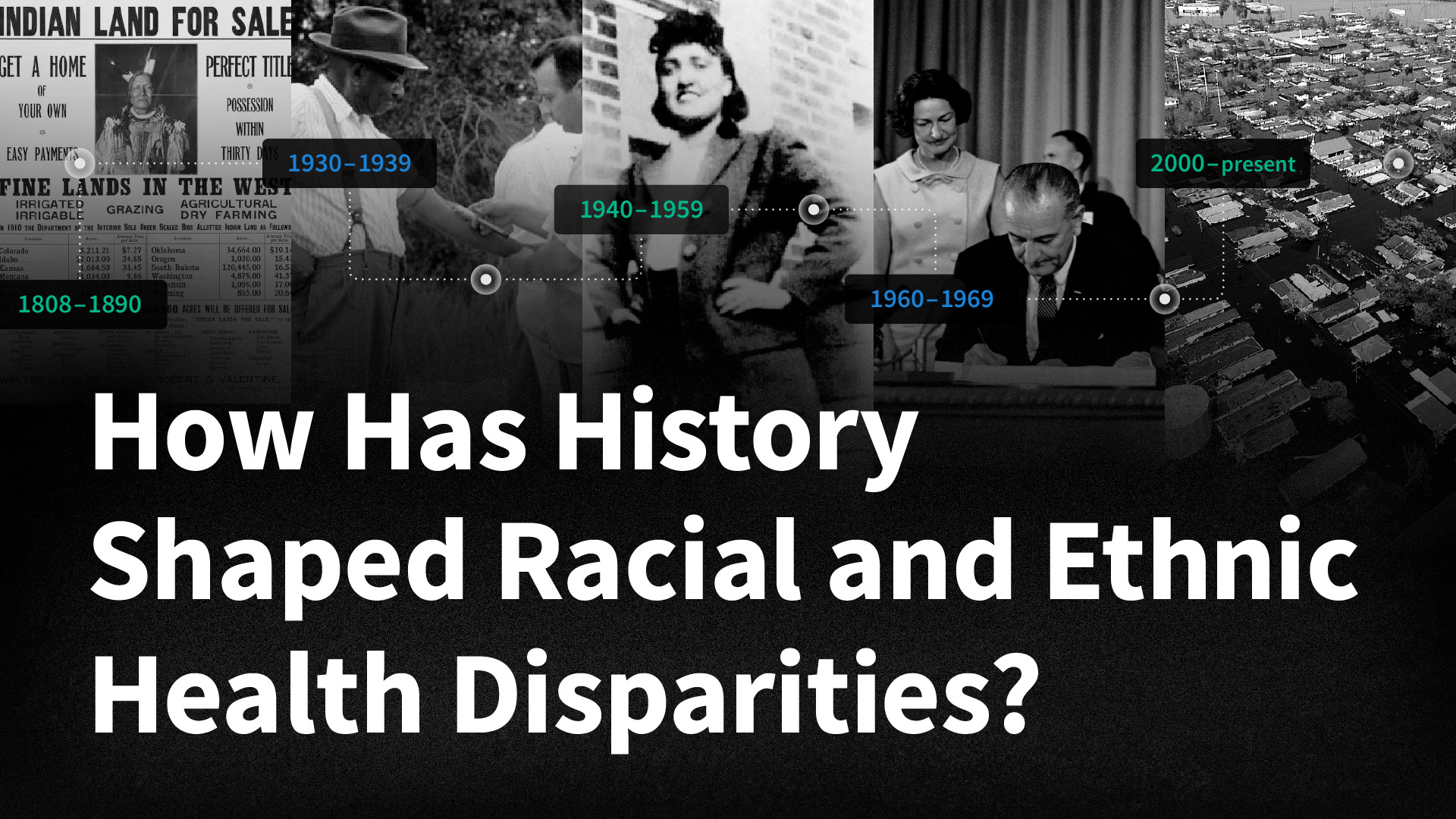
  • Timeline: How History Has Shaped Racial and Ethnic Health Disparities

    This timeline offers a historical view of significant U.S. federal policies and events spanning the early 1800s to today that have influenced present-day health disparities.
  • Health Policy 101: Chapter on Race, Inequality and Health

    Addressing persistent racial and ethnic disparities in health and health care is important for improving the nation’s health and economic prosperity. KFF explains such disparities and the factors that drive them, examines the actions to address them, and outlines future considerations.
  • Key Data on Health and Health Care by Race and Ethnicity

    Racial and ethnic disparities in health and health care remain a persistent challenge in the United States. An updated KFF resource examines how people of color fare compared to White people across 64 measures of health, health care, and social determinants of health.

Survey of Immigrants

KFF-New York Times Survey: Immigrants Report Rising Fear, Negative Economic and Health Impacts, and Changing Political Views During the First Year of President Trump’s Second Term

The 2025 Survey of Immigrants, a partnership between KFF and The New York Times, takes an in-depth look at the experiences of immigrants during the first year of President Trump’s second term, including their worries related to increased immigration enforcement, their health and economic wellbeing, and the political views and preferences of immigrant voters. The survey paints a portrait of families under strain — where fear of detention and economic instability are negatively impacting immigrants’ health and reshaping immigrant families’ daily lives and views of U.S. political parties.

Read the News Release | Explore The New York Times’ Reporting
Stay informed.

Stay informed.

Filter

221 - 230 of 602 Results

  • Survey of Americans on HIV/AIDs – Part Three: Experiences and Opinions by Race/Ethnicity and Age: Toplines

    Poll Finding

    These findings are the third part of a national survey of Americans’ views on HIV/AIDS, “Survey of Americans on HIV/AIDS,” conducted in spring 2004. It explores the views and experiences of, as well as the key differences among, African Americans, Latinos, Whites, and young people. The first part of the survey, on global HIV/AIDS, was released on June 2, 2004. The second part of the survey, on HIV Testing, was released on June 15, 2004.…

  • Adult Children of Immigrants Make Outsized Contributions to the U.S. Health Care Workforce

    News Release

    Adult children of immigrants make up a disproportionately large share of physicians, surgeons and other health care practitioners in the U.S. -- just one reflection of their comparatively high employment, educational attainment and income levels, according to a new KFF analysis. The analysis of 2023 Current Population Survey data shows that U.S.-born nonelderly adults whose parents were both born outside the U.S. comprise 13% of physicians, surgeons, and other health care practitioners. That amounts to…

  • Race, Ethnicity, and Health Care Tutorial

    Interactive

    This tutorial was produced for kaiserEDU.org, a Kaiser Family Foundation website that ceased production in September 2013. The kaiserEDU.org tutorials are no longer being updated but have been made available on kff.org due to demand by professors who are using the tutorials in class assignments. You may search for other tutorials to view on kff.org. To download this or other tutorials, visit the tutorials archive page.  Slides are available for download using the “Download Slides” link within the…

  • National Survey of Physicians Part I: Doctors on Disparities in Medical Care

    Other Post

    Selected findings from the Kaiser Family Foundation's forthcoming National Survey of Physicians reveal that most physicians are aware of racial disparities in medical treatment for specific conditions, but they don't believe it is a widespread problem. In sharp contrast, African American physicians disagree with their fellow physicians with nearly eight in ten (77%) believing race and ethnicity impact how people are treated at least somewhat often. Physicians see insurance status as a key determinate of…

  • 2011 Survey of DC Residents

    Poll Finding

    The Washington Post and the Kaiser Family Foundation partnered to conduct a survey examining the opinions of Washington, D.C., residents on a wide range of issues including health care. This survey is the 22nd in a series of surveys dating back to 1995 that have been conducted as part of The Washington Post/Kaiser Family Foundation Survey Project. Toplines (.pdf) Data Note: Black Residents' Views on HIV/AIDS in the District of Columbia Read The Washington Post…

  • Black Residents' Views on HIV/AIDS in the District of Columbia

    Poll Finding

    This data note examines public opinion among Washington, D.C.’s black residents about HIV/AIDS through a new analysis of the findings of the May 2011 Washington Post/Kaiser Family Foundation 2011 Survey of District of Columbia Residents. The District of Columbia has one of the highest AIDS rates in the nation, and black residents have been especially hard hit by the epidemic, accounting for about three-quarters of people living with HIV/AIDS in the city. Yet experiences and…

  • Addressing Health and Social Needs of Immigrant Families: Lessons from Local Communities

    Issue Brief

    This brief presents findings from discussions with service providers across sectors (including health, legal, and education), local officials, and parents in immigrant families in the San Francisco Bay Area and San Diego about issues facing immigrant families and providers in the current environment, how the local communities have responded to growing needs, and key priorities and opportunities identified for serving immigrant communities.

  • Coverage and Access of Adults 18-64 in the District of Columbia: Key Facts

    Fact Sheet

    This fact sheet summarizes the findings of the DC Health Access Survey, released in the Fall of 2003. It includes information on topics including: the demographics of the uninsured adults in the District of Columbia, findings about where and to what extent uninsured adults in the District of Columbia get medical care, and financial barriers to care. Fact Sheet (.pdf) Survey Highlights, Chartpack, and Toplines

  • Medicaid’s Role for Black Americans

    Fact Sheet

    This fact sheet examines Medicaid's role for black Americans. It includes data on Medicaid's coverage of black Americans and the program's impact on their access to care, as well as the impacts of the recent recession and the coming expansion of Medicaid under health reform on enrollment in Medicaid among black Americans. The fact sheet also has a chart showing state-by-state data on health insurance coverage of black Americans. Fact Sheet (.pdf)

  • Survey of Asians In the Bay Area – Toplines

    Poll Finding

    This document includes the toplines from a survey exploring the attitudes and experiences of the Asian community in the Bay Area, which has the largest Asian population in the country. The Kaiser Family Foundation and San Jose Mercury News collaborated on the survey. Survey Toplines (.pdf)