Racial Equity and Health Policy

Survey of Immigrants

KFF-New York Times Survey: Immigrants Report Rising Fear, Negative Economic and Health Impacts, and Changing Political Views During the First Year of President Trump’s Second Term

The 2025 Survey of Immigrants, a partnership between KFF and The New York Times, takes an in-depth look at the experiences of immigrants during the first year of President Trump’s second term, including their worries related to increased immigration enforcement, their health and economic wellbeing, and the political views and preferences of immigrant voters. The survey paints a portrait of families under strain — where fear of detention and economic instability are negatively impacting immigrants’ health and reshaping immigrant families’ daily lives and views of U.S. political parties.

Read the News Release | Explore The New York Times’ Reporting
the Essentials
  • Disparities in Health and Health Care: 5 Key Questions and Answers

    This brief provides an introduction to what health and health care disparities are, why it is important to address them, what the status of disparities is today, recent federal actions to address disparities, and key issues related to addressing disparities in the future.
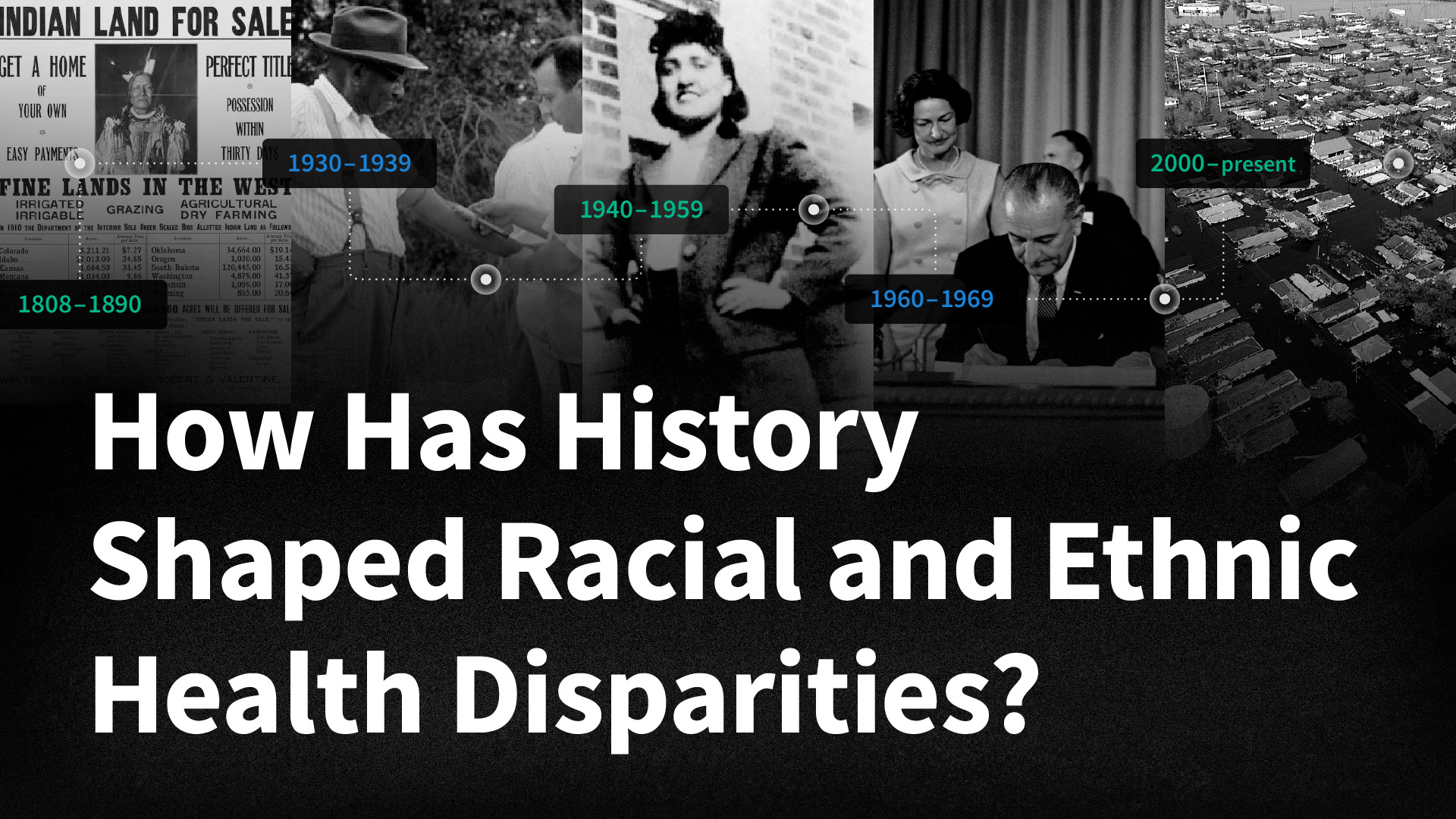
  • Timeline: How History Has Shaped Racial and Ethnic Health Disparities

    This timeline offers a historical view of significant U.S. federal policies and events spanning the early 1800s to today that have influenced present-day health disparities.
  • Health Policy 101: Chapter on Race, Inequality and Health

    Addressing persistent racial and ethnic disparities in health and health care is important for improving the nation’s health and economic prosperity. KFF explains such disparities and the factors that drive them, examines the actions to address them, and outlines future considerations.
  • Key Data on Health and Health Care by Race and Ethnicity

    Racial and ethnic disparities in health and health care remain a persistent challenge in the United States. An updated KFF resource examines how people of color fare compared to White people across 64 measures of health, health care, and social determinants of health.

Subscribe to KFF Emails

Choose which emails are best for you.
Sign up here

Filter

221 - 230 of 591 Results

  • KFF/theGrio Survey of Black Voters

    Report

    This partnership survey with theGrio examines the mood and views of Black voters ahead of the 2022 midterm election, including their motivation to vote, experiences with voter suppression, and key issues including inflation and abortion. With a large sample of Black voters, it includes breakdowns by age, gender, education, and party identification.

  • A Look at Key Maternal and Infant Health Disparities Among Black People

    Feature

    Due to systemic and overt discrimination, Black people are disproportionately affected by high maternal and infant morbidities and mortality. In addition to legislation, addressing systemic discrimination, implicit bias and racism will be integral to achieving equity in maternal health outcomes.

  • Racial Disparities in Flu Vaccination: Implications for COVID-19 Vaccination Efforts

    Policy Watch

    With planning beginning for an eventual COVID-19 vaccine, one important consideration is making sure that distribution processes and outreach and communication strategies reach people of color. Analysis of seasonal flu vaccination rates provides some insight into the potential barriers and issues to be addressed as part of COVID-19 vaccination efforts.

  • Racial Disparities in Cancer Outcomes, Screening, and Treatment

    Issue Brief

    This brief provides an overview of recent data on cancer incidence and mortality, risk factors, screening, treatment, and outcomes by race and ethnicity. Racial disparities in cancer incidence and outcomes are well-documented, with research showing that they are driven by a combination of structural, economic, and socioenvironmental inequities that are rooted in racism and discrimination, as well as genetic and hereditary factors that may be influenced by the environment.

  • The Biden Administration’s Final Rule on Section 1557 Non-Discrimination Regulations Under the ACA

    Issue Brief

    This brief overviews the Biden Administration’s 2024 final rule implementing Section 1557 of the ACA, which is home to the law’s major nondiscrimination provisions. It provides a brief background on 1557 rulemaking and identifies key differences between this rule and the 2020 rule from the Trump Administration. It highlights two areas of growing interest impacted by the rule – nondiscrimination protections related to pregnancy and nondiscrimination protections for transgender people. Table 2 summarizes the major provisions of the new final rule with side-by-side comparison to the Obama (2016) and Trump (2020) administration rules.

  • 3 Charts: Hispanic Immigrants’ Experiences in the United States

    News Release

    Hispanic immigrants comprise the largest group of immigrants in the United States, and one in three Hispanic or Latino adults in the U.S. are immigrants. Most report a higher quality of life in the U.S. than in their countries of birth and believe their children’s lives will be better than their own.

  • Millions of Seniors Live In Households with School-Age Children

    Issue Brief

    About 3.3 million adults age 65 or older live in a household with school-age children, a factor that state and local officials may want to take into account when deciding when and how fully to re-open schools this fall, a new KFF analysis finds.
    These older adults, who represent roughly 6 percent of all seniors in the U.S., live with 4.1 million school age children, who comprise about seven percent of all kids ages 5 to 18, the analysis finds. And the data show that older people of color are significantly more likely to live with a school-age child compared to their White counterparts.