Racial Equity and Health Policy

Survey of Immigrants

KFF-New York Times Survey: Immigrants Report Rising Fear, Negative Economic and Health Impacts, and Changing Political Views During the First Year of President Trump’s Second Term

The 2025 Survey of Immigrants, a partnership between KFF and The New York Times, takes an in-depth look at the experiences of immigrants during the first year of President Trump’s second term, including their worries related to increased immigration enforcement, their health and economic wellbeing, and the political views and preferences of immigrant voters. The survey paints a portrait of families under strain — where fear of detention and economic instability are negatively impacting immigrants’ health and reshaping immigrant families’ daily lives and views of U.S. political parties.

Read the News Release | Explore The New York Times’ Reporting
the Essentials
  • Disparities in Health and Health Care: 5 Key Questions and Answers

    This brief provides an introduction to what health and health care disparities are, why it is important to address them, what the status of disparities is today, recent federal actions to address disparities, and key issues related to addressing disparities in the future.
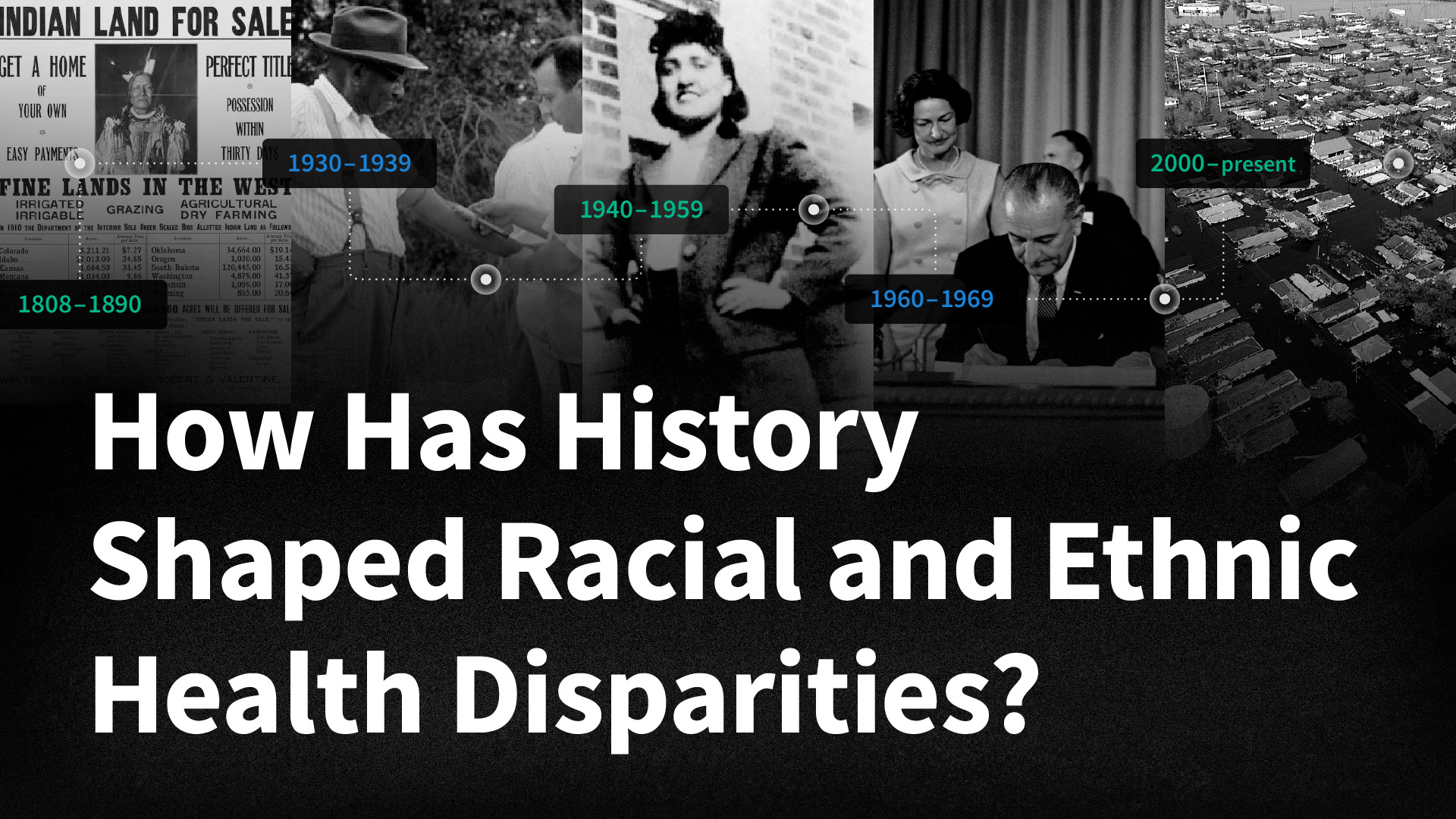
  • Timeline: How History Has Shaped Racial and Ethnic Health Disparities

    This timeline offers a historical view of significant U.S. federal policies and events spanning the early 1800s to today that have influenced present-day health disparities.
  • Health Policy 101: Chapter on Race, Inequality and Health

    Addressing persistent racial and ethnic disparities in health and health care is important for improving the nation’s health and economic prosperity. KFF explains such disparities and the factors that drive them, examines the actions to address them, and outlines future considerations.
  • Key Data on Health and Health Care by Race and Ethnicity

    Racial and ethnic disparities in health and health care remain a persistent challenge in the United States. An updated KFF resource examines how people of color fare compared to White people across 64 measures of health, health care, and social determinants of health.

Subscribe to KFF Emails

Choose which emails are best for you.
Sign up here

Filter

141 - 150 of 597 Results

  • Summary of HHS’s Final Rule on Nondiscrimination in Health Programs and Activities

    Issue Brief

    On May 18, 2016, the Department of Health and Human Services (HHS) published a final rule to implement Section 1557 of the Affordable Care Act (ACA), which prohibits discrimination in health coverage and care based on race, color, national origin, age or disability, and, for the first time sex. This Issue Brief provides a technical summary of Section 1557 and the final rule and highlights new protections and provisions included in the law and rule. Notably, Section 1557 is the first federal civil rights law to prohibit discrimination on the basis of sex in health care. Moreover, the proposed rule extends the definition of sex discrimination to include discrimination on the basis of gender identity. In addition, the final rule establishes regulations related to the provision of language assistance services based on long-standing HHS policy guidance.

  • A Look at Key Maternal and Infant Health Disparities Among Black People

    Feature

    Due to systemic and overt discrimination, Black people are disproportionately affected by high maternal and infant morbidities and mortality. In addition to legislation, addressing systemic discrimination, implicit bias and racism will be integral to achieving equity in maternal health outcomes.

  • KFF/theGrio Survey of Black Voters

    Report

    This partnership survey with theGrio examines the mood and views of Black voters ahead of the 2022 midterm election, including their motivation to vote, experiences with voter suppression, and key issues including inflation and abortion. With a large sample of Black voters, it includes breakdowns by age, gender, education, and party identification.

  • The COVID-19 Outbreak and Food Production Workers: Who is at Risk?

    Issue Brief

    The federal government has deemed workers in the food and agricultural sector part of the essential critical infrastructure workforce. Moreover, under recent a Presidential Executive Order, meat and poultry processing plants must continue operations to prevent disruption in the food supply chain. Workers in these industries face risk for coronavirus exposure due to their continued work outside the home, with many facing increased risks due to close quarters in their working environment. The Centers for Disease Control and Prevention (CDC) and other analysis have identified coronavirus outbreaks in meatpacking facilities. This data note analyzes key characteristics of food production workers to provide insight into who these risks affect and the health and financial implications of the COVID-19 outbreak for these workers and their communities.

  • Health Disparities are a Symptom of Broader Social and Economic Inequities

    Policy Watch

    Health disparities are symptoms of broader social and economic challenges that are rooted in structural and systemic barriers across sectors. the increased recognition and understanding of disparities could provide a catalyst for the challenging work required to address them.

  • Section 1115 Waiver Watch: Medicaid Pre-Release Services for People Who Are Incarcerated

    Issue Brief

    In April 2023, the Centers for Medicare and Medicaid Services (CMS) released guidance encouraging states to apply for a new Section 1115 demonstration opportunity to test transition-related strategies to support community reentry for people who are incarcerated. As of August 19, 2024, CMS has approved Section 1115 reentry waiver requests from 11 states, while 13 additional reentry waivers remain pending.