Racial Equity and Health Policy

Survey of Immigrants

KFF-New York Times Survey: Immigrants Report Rising Fear, Negative Economic and Health Impacts, and Changing Political Views During the First Year of President Trump’s Second Term

The 2025 Survey of Immigrants, a partnership between KFF and The New York Times, takes an in-depth look at the experiences of immigrants during the first year of President Trump’s second term, including their worries related to increased immigration enforcement, their health and economic wellbeing, and the political views and preferences of immigrant voters. The survey paints a portrait of families under strain — where fear of detention and economic instability are negatively impacting immigrants’ health and reshaping immigrant families’ daily lives and views of U.S. political parties.

Read the News Release | Explore The New York Times’ Reporting
the Essentials
  • Disparities in Health and Health Care: 5 Key Questions and Answers

    This brief provides an introduction to what health and health care disparities are, why it is important to address them, what the status of disparities is today, recent federal actions to address disparities, and key issues related to addressing disparities in the future.
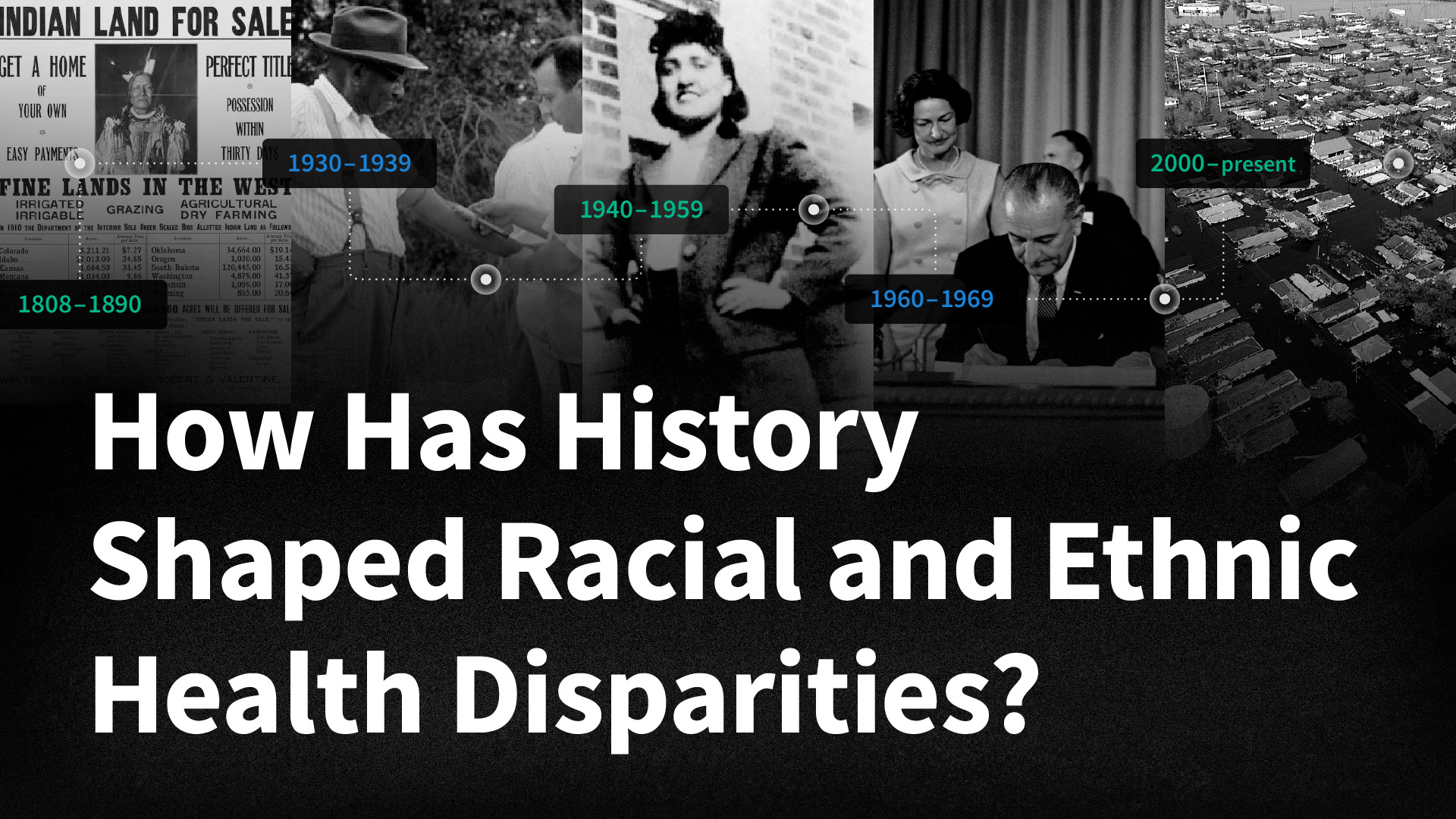
  • Timeline: How History Has Shaped Racial and Ethnic Health Disparities

    This timeline offers a historical view of significant U.S. federal policies and events spanning the early 1800s to today that have influenced present-day health disparities.
  • Health Policy 101: Chapter on Race, Inequality and Health

    Addressing persistent racial and ethnic disparities in health and health care is important for improving the nation’s health and economic prosperity. KFF explains such disparities and the factors that drive them, examines the actions to address them, and outlines future considerations.
  • Key Data on Health and Health Care by Race and Ethnicity

    Racial and ethnic disparities in health and health care remain a persistent challenge in the United States. An updated KFF resource examines how people of color fare compared to White people across 64 measures of health, health care, and social determinants of health.

Subscribe to KFF Emails

Choose which emails are best for you.
Sign up here

Filter

121 - 130 of 599 Results

  • The COVID-19 Outbreak and Food Production Workers: Who is at Risk?

    Issue Brief

    The federal government has deemed workers in the food and agricultural sector part of the essential critical infrastructure workforce. Moreover, under recent a Presidential Executive Order, meat and poultry processing plants must continue operations to prevent disruption in the food supply chain. Workers in these industries face risk for coronavirus exposure due to their continued work outside the home, with many facing increased risks due to close quarters in their working environment. The Centers for Disease Control and Prevention (CDC) and other analysis have identified coronavirus outbreaks in meatpacking facilities. This data note analyzes key characteristics of food production workers to provide insight into who these risks affect and the health and financial implications of the COVID-19 outbreak for these workers and their communities.

  • Health Disparities are a Symptom of Broader Social and Economic Inequities

    Policy Watch

    Health disparities are symptoms of broader social and economic challenges that are rooted in structural and systemic barriers across sectors. the increased recognition and understanding of disparities could provide a catalyst for the challenging work required to address them.

  • Section 1115 Waiver Watch: Medicaid Pre-Release Services for People Who Are Incarcerated

    Issue Brief

    In April 2023, the Centers for Medicare and Medicaid Services (CMS) released guidance encouraging states to apply for a new Section 1115 demonstration opportunity to test transition-related strategies to support community reentry for people who are incarcerated. As of August 19, 2024, CMS has approved Section 1115 reentry waiver requests from 11 states, while 13 additional reentry waivers remain pending.

  • Putting Women’s Health Care Disparities On The Map: Examining Racial and Ethnic Disparities at the State Level

    Report

    This Kaiser Family Foundation report documents the persistence of disparities between white women and women of color across the country. It provides a rare and comprehensive state-level look at disparities among women of different races and ethnicities on a broad range of indicators of health and well-being, including rates of diseases such as diabetes, heart disease, AIDS and cancer, and access to health insurance and health screenings.

  • Millions of Seniors Live In Households with School-Age Children

    Issue Brief

    About 3.3 million adults age 65 or older live in a household with school-age children, a factor that state and local officials may want to take into account when deciding when and how fully to re-open schools this fall, a new KFF analysis finds.
    These older adults, who represent roughly 6 percent of all seniors in the U.S., live with 4.1 million school age children, who comprise about seven percent of all kids ages 5 to 18, the analysis finds. And the data show that older people of color are significantly more likely to live with a school-age child compared to their White counterparts.

  • Women at Risk: A View from the Safety Net

    Video

    This video provides a snapshot of the Arlington (Va.) Free Clinic where, four times a month, medical personnel provide care and screenings exclusively to women. The video explores the hurdles that uninsured women face in accessing health care and the social issues, including work and family responsibilities, that create challenges for them. It is a companion to the report, “Putting Women’s Health Care Disparities On The Map: Examining Racial and Ethnic Disparities at the State Level.”

  • Health Policy 101 Introduction

    Feature

    Health Policy 101 is a comprehensive guide covering fundamental aspects of U.S. health policy and programs, including Medicare, Medicaid, the Affordable Care Act, employer-sponsored insurance, the uninsured population, health care costs and affordability, women's health issues, and health care politics. It includes overviews of private health insurance regulation, racial and ethnic disparities, public health, international comparison of health systems, U.S. global health policy, and the federal role in health policy. The chapters can be downloaded in a PDF format for faculty and student use, and the information will be updated annually or as data and circumstances change.