Racial Equity and Health Policy

Survey of Immigrants

KFF-New York Times Survey: Immigrants Report Rising Fear, Negative Economic and Health Impacts, and Changing Political Views During the First Year of President Trump’s Second Term

The 2025 Survey of Immigrants, a partnership between KFF and The New York Times, takes an in-depth look at the experiences of immigrants during the first year of President Trump’s second term, including their worries related to increased immigration enforcement, their health and economic wellbeing, and the political views and preferences of immigrant voters. The survey paints a portrait of families under strain — where fear of detention and economic instability are negatively impacting immigrants’ health and reshaping immigrant families’ daily lives and views of U.S. political parties.

Read the News Release | Explore The New York Times’ Reporting
the Essentials
  • Disparities in Health and Health Care: 5 Key Questions and Answers

    This brief provides an introduction to what health and health care disparities are, why it is important to address them, what the status of disparities is today, recent federal actions to address disparities, and key issues related to addressing disparities in the future.
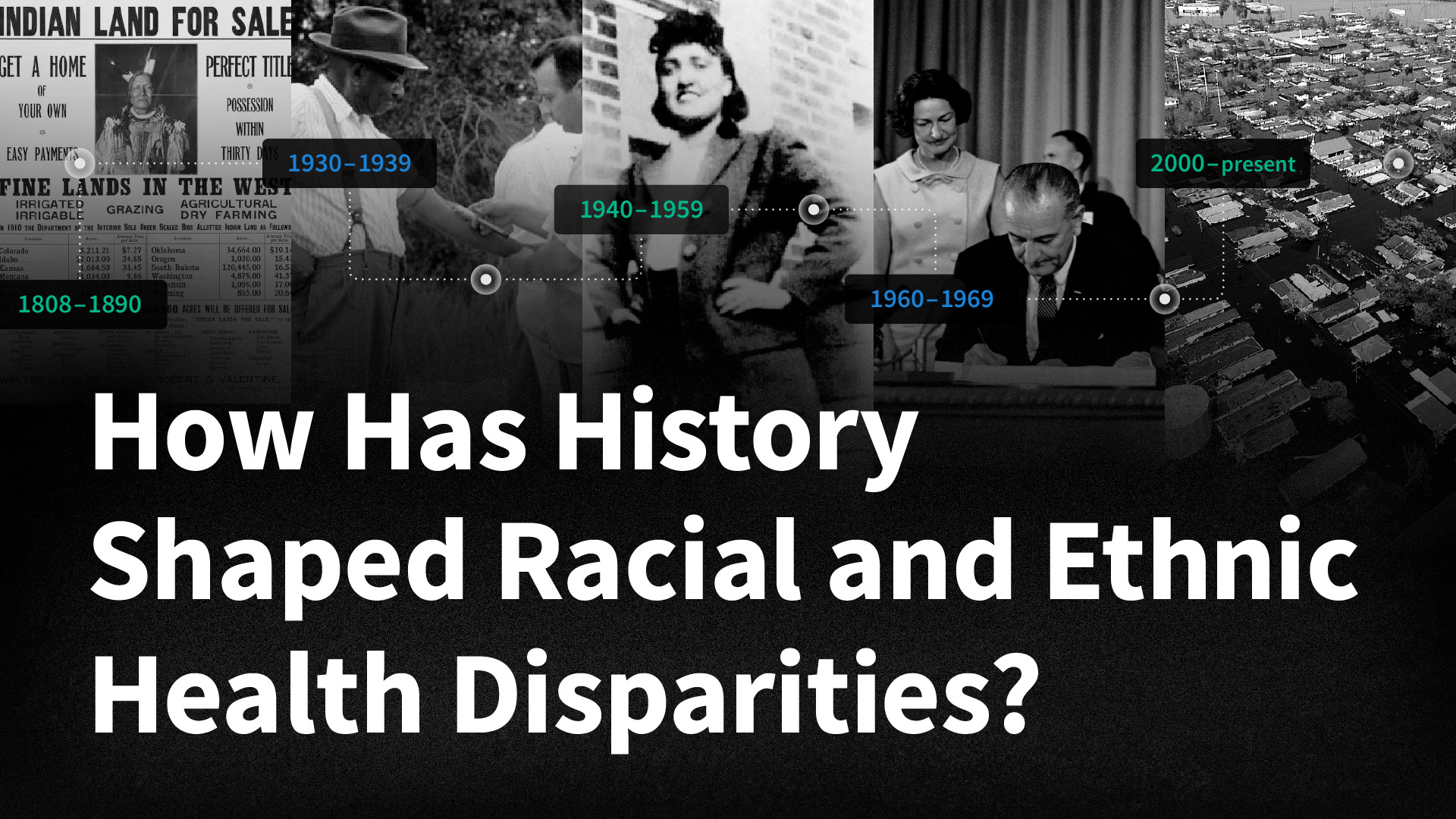
  • Timeline: How History Has Shaped Racial and Ethnic Health Disparities

    This timeline offers a historical view of significant U.S. federal policies and events spanning the early 1800s to today that have influenced present-day health disparities.
  • Health Policy 101: Chapter on Race, Inequality and Health

    Addressing persistent racial and ethnic disparities in health and health care is important for improving the nation’s health and economic prosperity. KFF explains such disparities and the factors that drive them, examines the actions to address them, and outlines future considerations.
  • Key Data on Health and Health Care by Race and Ethnicity

    Racial and ethnic disparities in health and health care remain a persistent challenge in the United States. An updated KFF resource examines how people of color fare compared to White people across 64 measures of health, health care, and social determinants of health.

Subscribe to KFF Emails

Choose which emails are best for you.
Sign up here

Filter

461 - 470 of 601 Results

  • Key Facts: HIV/AIDS and African Americans

    Other Post

    provides an overview of recent data and research on the impact of the HIV/AIDS epidemic on African Americans. The Key Facts document also presents trends in the HIV/AIDS epidemic over time, racial differences in the access to and quality of HIV/AIDS services and includes the attitudes toward and perceptions of HIV/AIDS by race. Report

  • Welfare Reform and Elderly Legal Immigrants – Report

    Report

    Welfare Reform and Elderly Legal Immigrants Prepared by: Robert B. Friedland and Veena Pankaj National Academy on Aging, Washington DC July 1997 Prepared for: The Henry J. Kaiser Family Foundation The Henry J. Kaiser Family Foundation, based in Menlo Park, California, is an independentnational health philanthropy and is not associated with Kaiser Permanente or Kaiser Industries. Established in 1948 by industrialist Henry J. Kaiser and his wife Bess, the Foundation focusesits work on four main…

  • 1998 National Survey of Latinos on HIV/AIDS – Report (HTML version)

    Report

    1998 National Survey of Latinos on HIV/AIDSThis Report is also available in PDF in English (.pdf) en Espanol (.pdf) CONTENTS Introduction The Latino Population in the United States Epidemiology and Transmission of HIV/AIDS The Health Gap and Access to Care Latino's Perceptions of the HIV/AIDS Epidemic Methodology Findings Language and Perceptions of HIV/AIDS Regional Location and Perceptions of HIV/AIDS among Latinos Income, Education and Attitudes Towards/Knowledge of HIV/AIDS Among Latinos Religion and Perceptions of HIV/AIDS among Latinos…

  • Racial/Ethnic Disparities in Access to Care Among Children: How Does Medicaid do in Closing the Gaps?

    Other Post

    While Medicaid and the Children's Health Insurance Program (CHIP) have become increasingly important sources of health coverage for low-income children in all racial and ethnic groups, the program plays an especially large role for children of color, who are more likely than white children to be low-income. In 2007, Medicaid and CHIP covered nearly one in five white children, but roughly two in five African American and Hispanic children. As policymakers engaged in health reform…

  • Kaiser’s Monthly Update on Health Disparities

    Other Post

    Kaiser's Disparities Research Roundup This Kaiser Disparities Research Roundup is a regularly updated summary of new research on health care disparities. It includes selected academic research and policy papers that focus on a broad range of disparities in health care, including disparities in health insurance coverage, access to care, utilization of care, quality of care, and health status. .header {FONT-WEIGHT: bold;FONT-SIZE: 12px;COLOR: #000000;FONT-FAMILY: Verdana, Arial, Helvetica, sans-serif;text-transform: uppercase;}.text {FONT-WEIGHT: normal;FONT-SIZE: 12px;COLOR: #000000;FONT-FAMILY: Verdana, Arial, Helvetica,…

  • 2011 Survey of DC Residents

    Poll Finding

    The Washington Post and the Kaiser Family Foundation partnered to conduct a survey examining the opinions of Washington, D.C., residents on a wide range of issues including health care. This survey is the 22nd in a series of surveys dating back to 1995 that have been conducted as part of The Washington Post/Kaiser Family Foundation Survey Project. Toplines (.pdf) Data Note: Black Residents' Views on HIV/AIDS in the District of Columbia Read The Washington Post…

  • Key Facts: Race, Ethnicity and Medical Care

    Report

    The Kaiser Family Foundation's updated version of Key Facts: Race, Ethnicity and Medical Care, 2007 Update, serves as a quick reference source on health disparities, presenting the best available data and analysis. This report includes data on the uninsured and access to care by race/ethnicity as well as information about the disproportionate effect that specific conditions such as diabetes, HIV/AIDS, and asthma have on racial and ethnic minority populations in the U.S. New in the 2007…

  • Putting Men’s Health Care Disparities on the Map: Health Status Highlights

    Report

    This fact sheet provides a brief overview of racial disparities in health status among men of different races in the United States. It draws findings from the report, Putting Men’s Health Care Disparities On the Map, which uses national data sources from multiple years to generate state-level estimates on a range of indicators of health status, access, and well-being for men of different racial and ethnic backgrounds. Women and men of different races and ethnicities…

  • Indian Health Care in the 21st Century: A Case Study in Disparities

    Report

    The Kaiser Family Foundation, in conjunction with the Morris K. Udall Foundation and the American Public Health Association hosted an event on May 9, 2005 which focused on key Indian health issues, including the availability of mental health services, the adequacy of federal funding, and priorities for Indian health. Agenda (.pdf)Speaker Biographies (.pdf) A webcast of this event is available. The event highlighted research that appears in the May 2005 issue of the American Journal…