Racial Equity and Health Policy

Survey of Immigrants

KFF-New York Times Survey: Immigrants Report Rising Fear, Negative Economic and Health Impacts, and Changing Political Views During the First Year of President Trump’s Second Term

The 2025 Survey of Immigrants, a partnership between KFF and The New York Times, takes an in-depth look at the experiences of immigrants during the first year of President Trump’s second term, including their worries related to increased immigration enforcement, their health and economic wellbeing, and the political views and preferences of immigrant voters. The survey paints a portrait of families under strain — where fear of detention and economic instability are negatively impacting immigrants’ health and reshaping immigrant families’ daily lives and views of U.S. political parties.

Read the News Release | Explore The New York Times’ Reporting
the Essentials
  • Disparities in Health and Health Care: 5 Key Questions and Answers

    This brief provides an introduction to what health and health care disparities are, why it is important to address them, what the status of disparities is today, recent federal actions to address disparities, and key issues related to addressing disparities in the future.
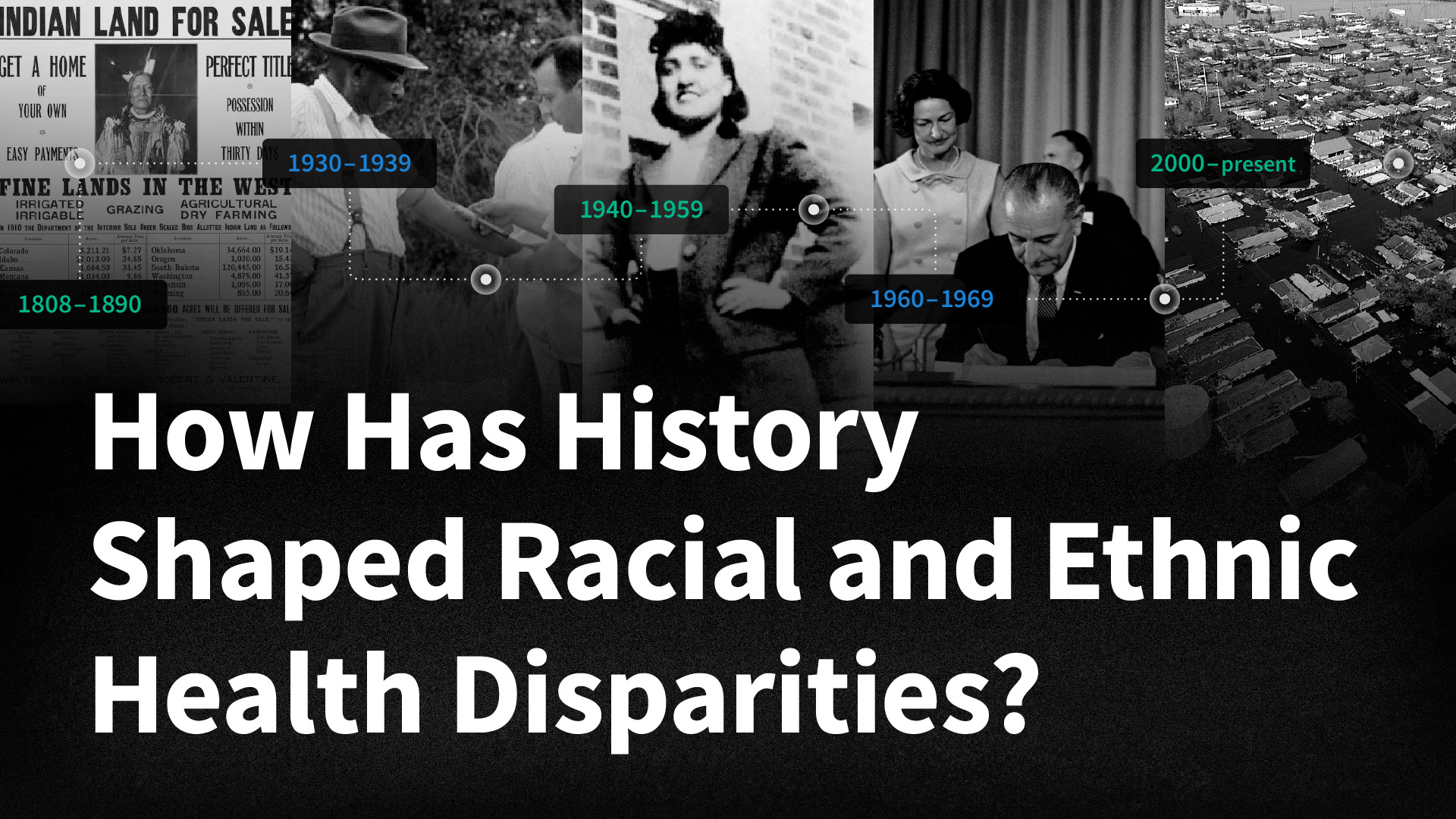
  • Timeline: How History Has Shaped Racial and Ethnic Health Disparities

    This timeline offers a historical view of significant U.S. federal policies and events spanning the early 1800s to today that have influenced present-day health disparities.
  • Health Policy 101: Chapter on Race, Inequality and Health

    Addressing persistent racial and ethnic disparities in health and health care is important for improving the nation’s health and economic prosperity. KFF explains such disparities and the factors that drive them, examines the actions to address them, and outlines future considerations.
  • Key Data on Health and Health Care by Race and Ethnicity

    Racial and ethnic disparities in health and health care remain a persistent challenge in the United States. An updated KFF resource examines how people of color fare compared to White people across 64 measures of health, health care, and social determinants of health.

Subscribe to KFF Emails

Choose which emails are best for you.
Sign up here

Filter

361 - 370 of 601 Results

  • Testimony: The Status of Health and Health Care Disparities in the United States

    Issue Brief

    On March 8, 2017, Kaiser Family Foundation Director of the Disparities Policy Project Samantha Artiga testified before the House Subcommittee on Labor, Health and Human Services, Education and Related Agencies. She presented on the status of health and health care disparities in the United States.

  • Under the Affordable Care Act, People of Color Have Seen Greater Gains in Health Coverage But Remain More Likely Than Whites to Be Uninsured

    News Release

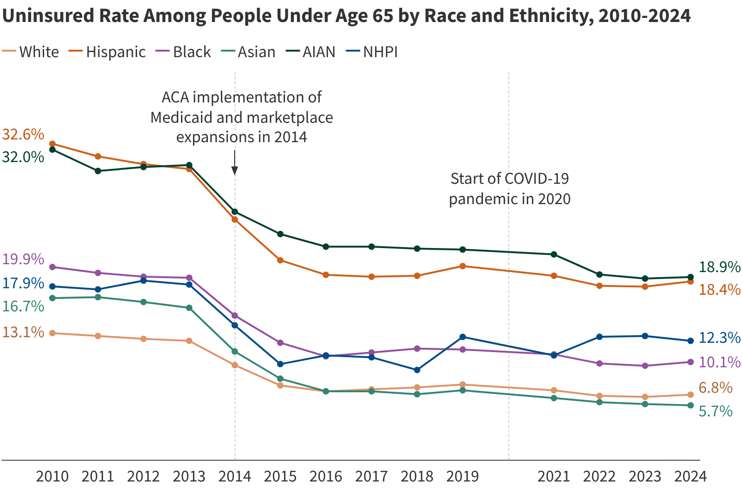
    The uninsured rate has fallen among all racial and ethnic groups under the Affordable Care Act with steeper declines among people of color compared to Whites, according to a new analysis by the Kaiser Family Foundation. The findings for Hispanics were especially striking. Between 2013 and 2015, the uninsured rate for Hispanics fell from 26 percent to 17 percent – a sharper decline than for any other group. Nationally, the total number of nonelderly uninsured…

  • More than 8 in 10 Workers With Spousal Health Benefits Have Access to Same-Sex Spousal Benefits, Analysis Finds

    News Release

    Following two major Supreme Court rulings on same-sex marriage, a new Kaiser Family Foundation data note finds that in 2016, 84 percent of employees who worked at firms offering spousal health benefits also had access to same-sex spousal benefits. Eight percent did not have access, while another 8 percent worked at firms who reported they had not encountered this benefits issue. The data note draws from responses to the Kaiser/Health Research & Educational Trust (Kaiser/HRET)…

  • Puerto Rico: Medicaid, Fiscal Issues and the Zika Challenge

    Fact Sheet

    Roughly one in two Puerto Ricans (49%) are enrolled in the island’s Medicaid program. This fact sheet provides an overview of the Medicaid program in Puerto Rico and emerging fiscal issues facing its health care system as Zika cases on the island continue to mount.

  • 8 Questions & Answers about Puerto Rico

    Fact Sheet

    These slides provide a quick snapshot of Puerto Rico’s population, as well as current and upcoming issues that are impacting the island’s health care system.

  • Summary of HHS’s Final Rule on Nondiscrimination in Health Programs and Activities

    Issue Brief

    On May 18, 2016, the Department of Health and Human Services (HHS) published a final rule to implement Section 1557 of the Affordable Care Act (ACA), which prohibits discrimination in health coverage and care based on race, color, national origin, age or disability, and, for the first time sex. This Issue Brief provides a technical summary of Section 1557 and the final rule and highlights new protections and provisions included in the law and rule.…

  • In Wake of Dallas, Minnesota and Baton Rouge Shootings, an Opening for Local Leaders

    From Drew Altman

    In this The Wall Street Journal Think Tank column, Drew Altman discusses how incidents in Dallas, Baton Rouge and Minnesota create opportunities for local leaders to take steps to reduce police-involved violence, citing data from the KFF-CNN survey of Americans on Race and KFF-New York Times Survey of Chicago Residents.

  • 8 Preguntas & Respuestas sobre Puerto Rico

    Fact Sheet

    La crisis de $73 mil millones de Puerto Rico ha sido tema de los medios de comunicación nacionales, y de debate en el Congreso en los últimos meses. Además, varios de los principales medios de prensa han reportado sobre una inminente crisis de la atención de salud relacionada con cuestiones demográficas y del financiamiento del cuidado de salud, y exacerbada por la actual situación económica y el aumento de casos de trasmisión del virus del…

  • Puerto Rico: Datos Básicos

    Fact Sheet

    Puerto Rico: Datos Básicos provee una descripción general del las características demográficas, y estadísticas de salud y la economía. También se da alguna informacion del gobierno, reglas federales de Medicaid, y asuntos corrientes que estan afectando el territorio, incluyendo a Zika.