Medicaid

What to Watch

Medicaid: What to Watch in 2026

Medicaid: What to Watch in 2026

In this brief, KFF explores how state fiscal pressures are likely to converge with the implementation of the 2025 reconciliation law to affect Medicaid coverage, financing, and access to care over the next year, especially leading up to the midterm elections.

Work Requirements

Challenges with Implementing Work Requirements

Many states are anticipating a variety of implementation challenges, including the need for complex system changes, a compressed implementation timeline, and limited staff capacity.

What is the Medicaid Hardship Exception?

The number of Medicaid expansion enrollees who ultimately qualify for the high unemployment hardship exception will depend on how the exception is implemented and how unemployment rates changes.

Tracking Implementation of the 2025 Reconciliation Law: Medicaid Work Requirements

KFF’s interactive tracks key data and policies that will affect how states implement Medicaid work requirements, which are required under the 2025 budget reconciliation law starting in January 2027. The tracker includes state-level data on Medicaid enrollment and renewal outcomes as well as current state enrollment and renewal policies.

2025 Medicaid Home Care survey

Payment Rates Ahead of 2025 Reconciliation Law

This issue brief describes Medicaid payment rates for home care and other workforce supports that are in place in 2025, before the majority of the 2025 reconciliation law provisions start taking effect.

Home Care Support for Family Caregivers in 2025
number of responding states, including DC, that allow payments for family caregivers by type of home care program and type of caregiver.

This issue brief describes the availability of self-directed services and supports for family caregivers in Medicaid home care in 2025, before most provisions in the reconciliation law take effect.

States’ Management of Home Care Spending

This issue brief describes the mechanisms states are currently using to limit Medicaid spending on home care and their plans for adopting new mechanisms in state fiscal year (FY) 2026.

Waiting Lists for Medicaid Home Care, 2016 to 2025
A Look at Waiting Lists for Medicaid Home- and Community-Based Services from 2016 to 2025

This data note provides new information about waiting lists in Medicaid home care before many of the provisions in the 2025 reconciliation law go into effect.

The Essentials
  • 5 Facts: Medicaid and Provider Taxes

    This brief describe states’ current provider taxes and how the 2025 reconciliation law changed the federal rules governing them, including potential impacts across states.
  • Medicaid Financing: The Basics

    Medicaid is a major source of financing for states to provide health coverage and long-term services and supports for low-income residents. This brief examines key questions about Medicaid financing and how it works.
  • 5 Facts: Immigrants and Medicaid

    This brief provides five key facts on Medicaid and immigrants as context for understanding the potential impacts of policy changes under the Trump administration.
  • 5 Facts: Medicaid and Hospitals

    This brief explains the role of Medicaid for hospitals, including how much spending on hospital care comes from Medicaid, the share of births covered by the program, and how Medicaid expansion has impacted hospital finances.
  • 5 Facts: Medicaid and Nursing Facilities

    The substantial Medicaid savings in the reconciliation bill could have major implications for nearly 15,000 federally certified nursing facilities and the 1.2 million people living in them.
Eligibility and coverage
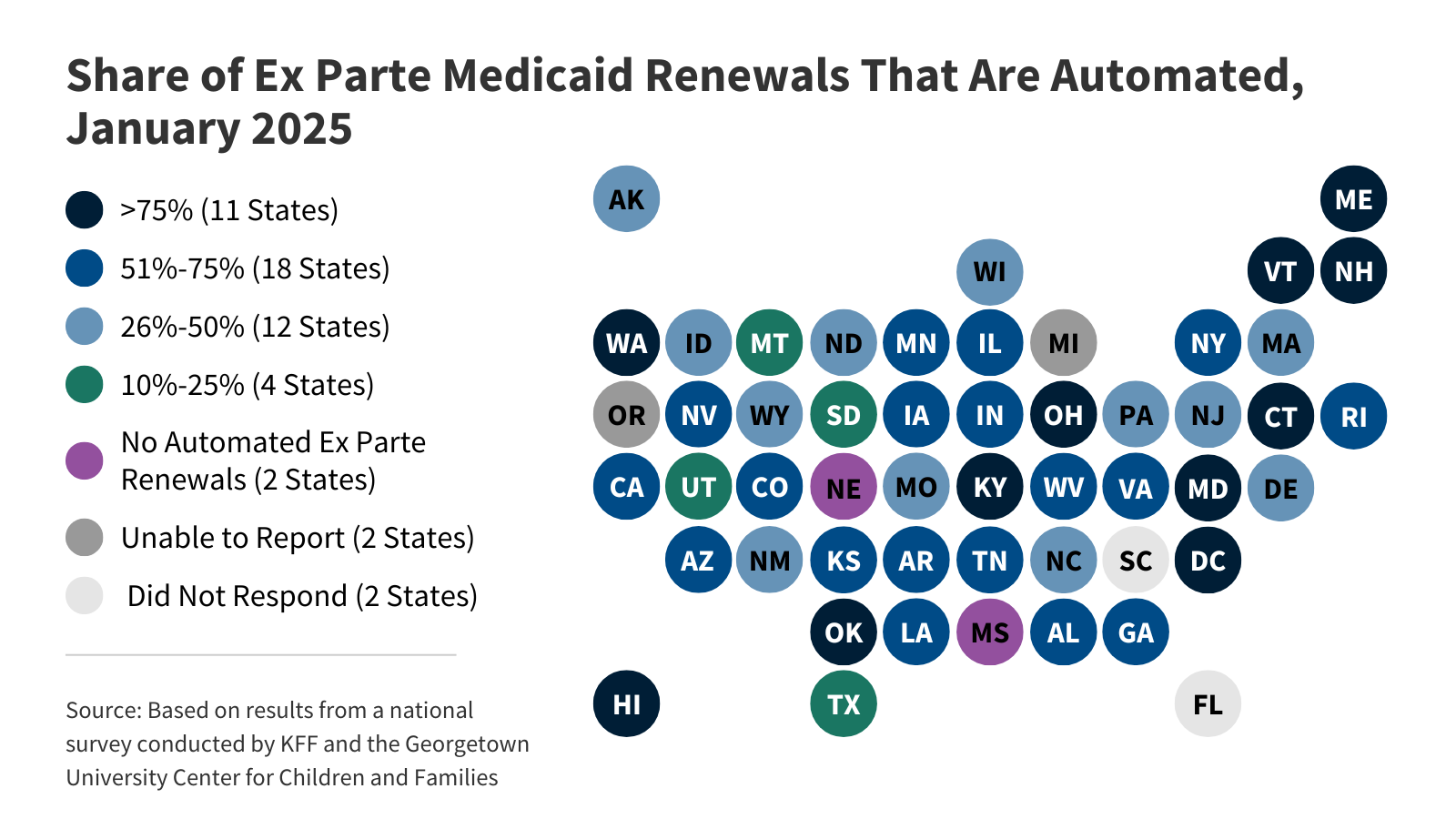
  • Eligibility, Enrollment, and Renewal Policies

    KFF's survey findings capture state actions that seek to improve the accuracy and efficiency of Medicaid and CHIP enrollment and renewal processes, as of January 2025.
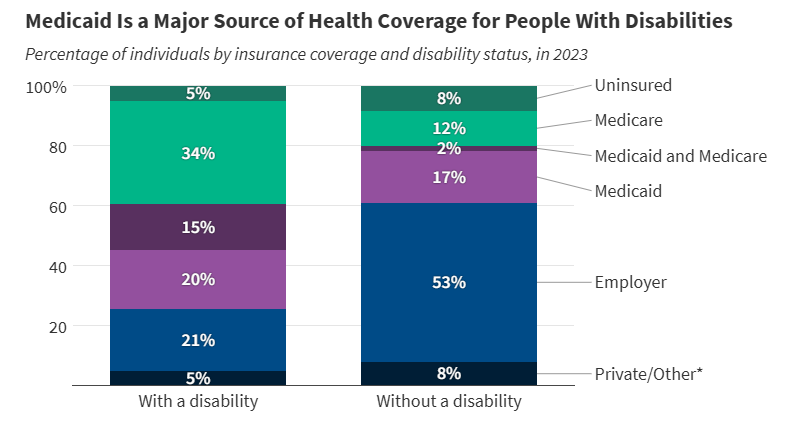
  • Seniors and People with Disabilities

    More than 1 in 3 people with disabilities (15 million) have Medicaid (35%). In comparison, only 19% of people without disabilities have Medicaid.
  • Children with Special Needs

    Amid debates about proposed cuts to federal Medicaid spending, this brief analyzes key characteristics of children with special health care needs and explores how Medicaid provides them with coverage.
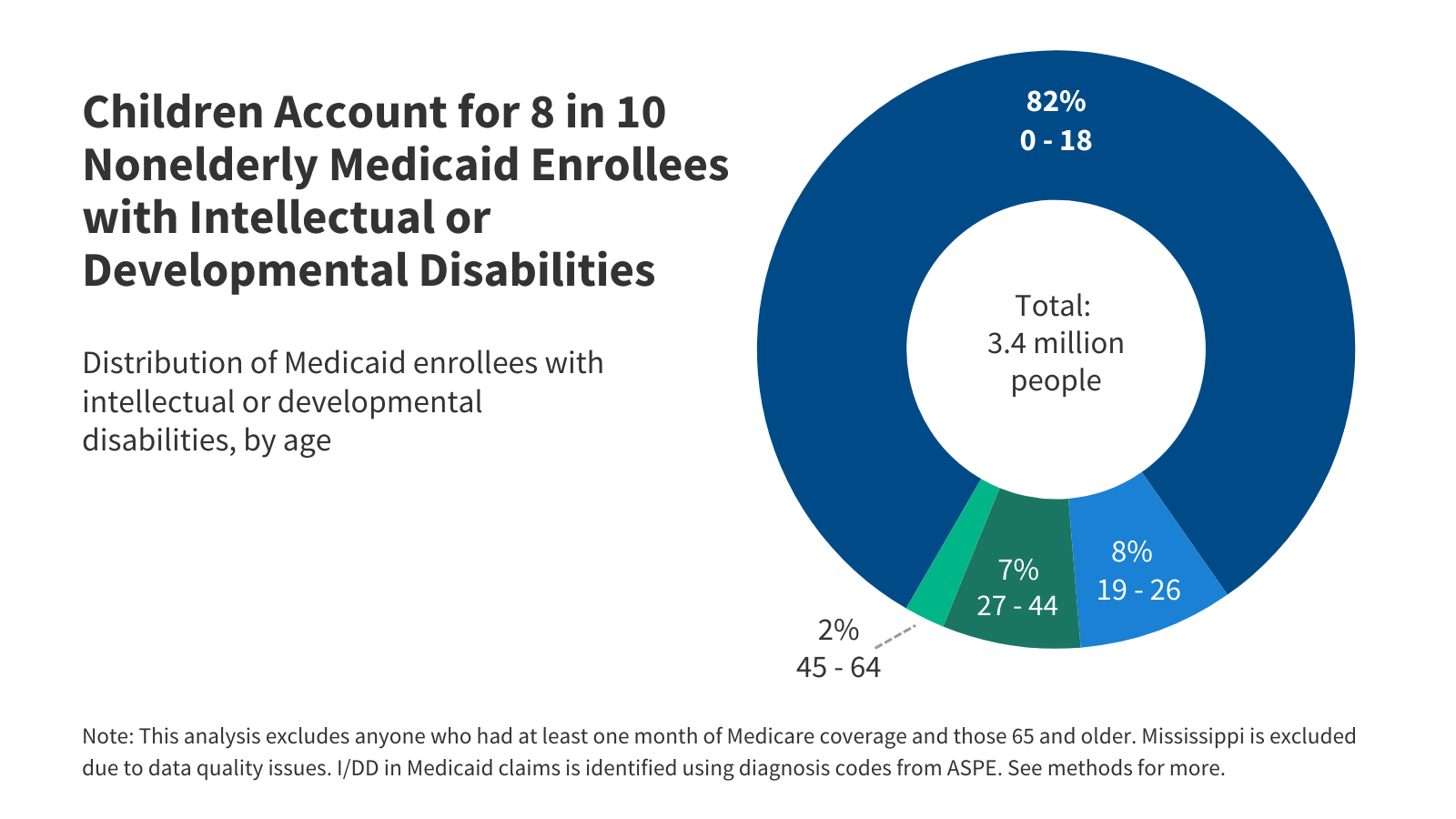
  • People With Intellectual and Developmental Disabilities

    Among the estimated 8 million people with intellectual and developmental disabilities (I/DD), over three million have Medicaid coverage.
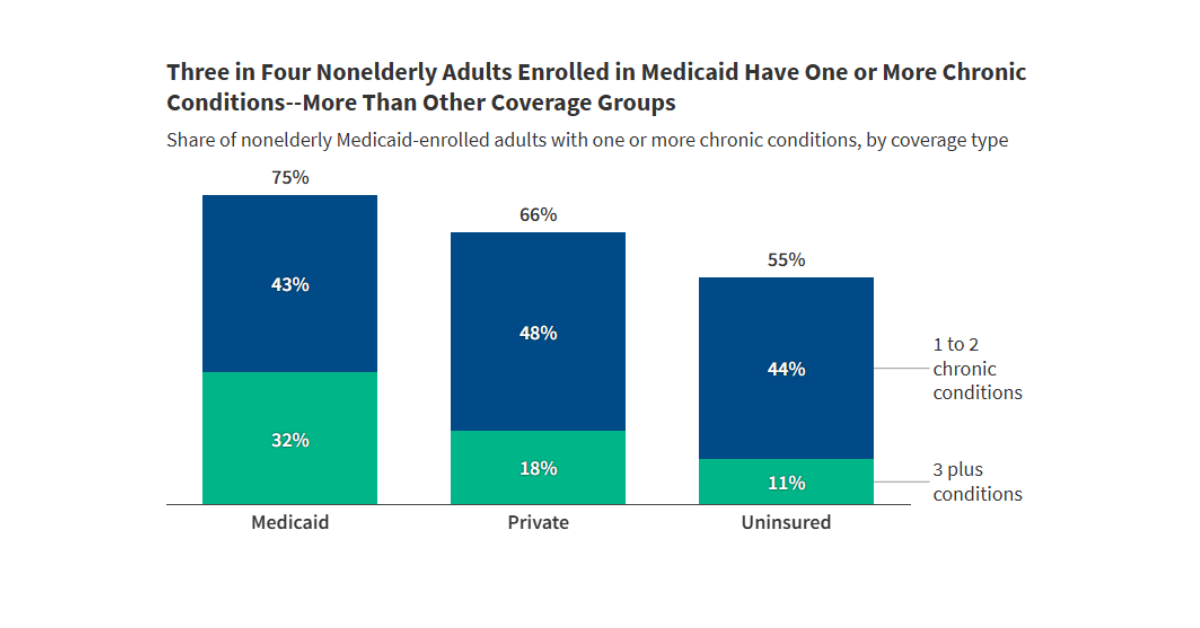
  • Adults with Chronic Conditions

    Among working age adults enrolled in Medicaid, approximately three quarters have one or more chronic conditions, and nearly one-third have three or more.

Subscribe to KFF Emails

Choose which emails are best for you.
Sign up here
Filter

931 - 940 of 2,682 Results

  • Medicaid Work Requirements in Arkansas: Experience and Perspectives of Enrollees

    Issue Brief

    This brief presents perspectives of enrollees and safety net providers about Arkansas' new Section 1115 Medicaid waiver work and reporting requirements based on focus groups and interviews. The discussions examine enrollees’ awareness of the new requirements and ability to set up online accounts for monthly reporting; the effect of the new requirements on enrollees’ work and common barriers to work; enrollees’ experience with monthly reporting; impacts on particular populations, such as those with disabilities or who are homeless; and the anticipated effects of coverage losses resulting from the new requirements.

  • Re-approval of Kentucky Medicaid Demonstration Waiver

    Issue Brief

    On January 12, 2018, the Centers for Medicare and Medicaid Services (CMS) approved a Section 1115 demonstration waiver in Kentucky, entitled “Kentucky Helping to Engage and Achieve Long Term Health” or KY HEALTH. On the same day that CMS approved Kentucky’s waiver, Governor Bevin issued an executive order directing the state to terminate the Medicaid expansion if a court decides that one or more of the waiver provisions are illegal and cannot be implemented. This fact sheet summarizes key provisions of Kentucky’s approved waiver.

  • The New Health Care Agenda: Gridlock, Lots of Hearings

    From Drew Altman

    In an Axios column, Drew Altman analyzes what the midterm election means for the health policy agenda between now and 2020--mostly political positioning and gridlock in Congress, with most of the action affecting people in the states. 

  • What Does the Outcome of the Midterm Elections Mean for Medicaid Expansion?

    Fact Sheet

    While not typically an election issue, Medicaid — particularly the Medicaid expansion created under the Affordable Care Act (ACA) — was an important issue in the 2018 midterm elections in a number of campaigns throughout the country. This fact sheet highlights key states in which the results of the 2018 midterm elections have implications for Medicaid adoption or implementation. States examined include those that had Medicaid expansion ballot initiatives as well as states that have not yet adopted or implemented expansion but elected governors who support Medicaid expansion. In these states that had gubernatorial races with implications for Medicaid expansion, it will be important to monitor changes in the composition of state legislatures, as governors in most states will need to work with their legislatures in order to adopt the expansion.

  • Medicaid Enrollment & Spending Growth: FY 2018 & 2019

    Issue Brief

    This issue brief provides an overview of Medicaid spending and enrollment growth with a focus on state fiscal years 2018 and 2019. Findings are based on interviews and data provided by state Medicaid directors as part of the 18th annual survey of Medicaid directors in all 50 states and the District of Columbia conducted by the Kaiser Family Foundation (KFF) survey and Health Management Associates (HMA). Findings examine changes in overall enrollment and spending growth.

  • States Focus on Quality and Outcomes Amid Waiver Changes: Results from a 50-State Medicaid Budget Survey for State Fiscal Years 2018 and 2019

    Report

    This report provides an in-depth examination of the changes taking place in Medicaid programs across the country. Report findings are drawn from the annual budget survey of Medicaid officials in all 50 states and the District of Columbia. This report examines the reforms, policy changes, and initiatives that occurred in FY 2018 and those adopted for implementation for FY 2019 (which began for most states on July 1, 2018). Key areas covered include changes in eligibility, managed care and delivery system reforms, long-term services and supports, provider payment rates and taxes, covered benefits, and pharmacy and opioid strategies.