Medicaid

new and noteworthy

5 Facts: Medicaid Fraud, Waste, Abuse and Improper Payments

Program integrity efforts work to prevent and detect fraud, waste, and abuse; increase program transparency and accountability; and recover improper payments. This brief explains what we know about these issues and efforts to address program integrity.

Medicaid: What to Watch in 2026

Medicaid: What to Watch in 2026

In this brief, KFF explores how state fiscal pressures are likely to converge with the implementation of the 2025 reconciliation law to affect Medicaid coverage, financing, and access to care over the next year, especially leading up to the midterm elections.

Medicaid Watch

Featuring policy research, polling and news about how Medicaid is changing, and the impact of those changes due to the tax and spending cuts law

Medicaid and work

Tracking Medicaid Work Requirements:
Data and Policies

To implement Medicaid work requirements, states will need to make important policy and operational decisions, implement needed system upgrades or changes, develop new outreach and education strategies, and hire and train staff, all within a relatively short timeframe. The information tracked here can serve as a resource to understand Medicaid work requirements and state options, gauge readiness, and track implementation of the requirements.

understanding medicaid

5 Facts: Provider Taxes

All states except Alaska cover some state Medicaid costs with taxes on health care providers. This brief uses data from KFF’s 2024-2025 survey of Medicaid directors to describe current practices and the federal rules governing them.

5 Facts: Medicaid and Hospitals

Absorbing reductions in Medicaid spending could be challenging for hospitals, particularly for those that are financially vulnerable. This brief provides data on the reach of Medicaid across hospitals, patients, and charity care.

5 Facts: Medicaid and Immigrants

Confusion persists about immigrants’ eligibility for federal programs. This brief helps readers understand how current Medicaid policy affects immigrants as well as the potential impacts of policy changes under the Trump administration.

5 Facts: Medicaid and Rural Areas

Approximately 66 million people live in rural areas – about 20% of the U.S. population. Nearly 1 in 4 of them have Medicaid, a higher share than in urban areas (24% vs 21%).

5 Facts: Nursing Facilities

The substantial Medicaid savings in the reconciliation bill that has been passed by the House could have major implications for nearly 15,000 federally certified nursing facilities and the 1.2 million people living in them.

2025 Medicaid Home Care survey

Payment Rates Ahead of 2025 Reconciliation Law

This issue brief describes Medicaid payment rates for home care and other workforce supports that are in place in 2025, before the majority of the 2025 reconciliation law provisions start taking effect.

Home Care Support for Family Caregivers in 2025
number of responding states, including DC, that allow payments for family caregivers by type of home care program and type of caregiver.

This issue brief describes the availability of self-directed services and supports for family caregivers in Medicaid home care in 2025, before most provisions in the reconciliation law take effect.

States’ Management of Home Care Spending

This issue brief describes the mechanisms states are currently using to limit Medicaid spending on home care and their plans for adopting new mechanisms in state fiscal year (FY) 2026.

Waiting Lists for Medicaid Home Care, 2016 to 2025
A Look at Waiting Lists for Medicaid Home- and Community-Based Services from 2016 to 2025

This data note provides new information about waiting lists in Medicaid home care before many of the provisions in the 2025 reconciliation law go into effect.

Eligibility and coverage
  • Eligibility, Enrollment, and Renewal Policies

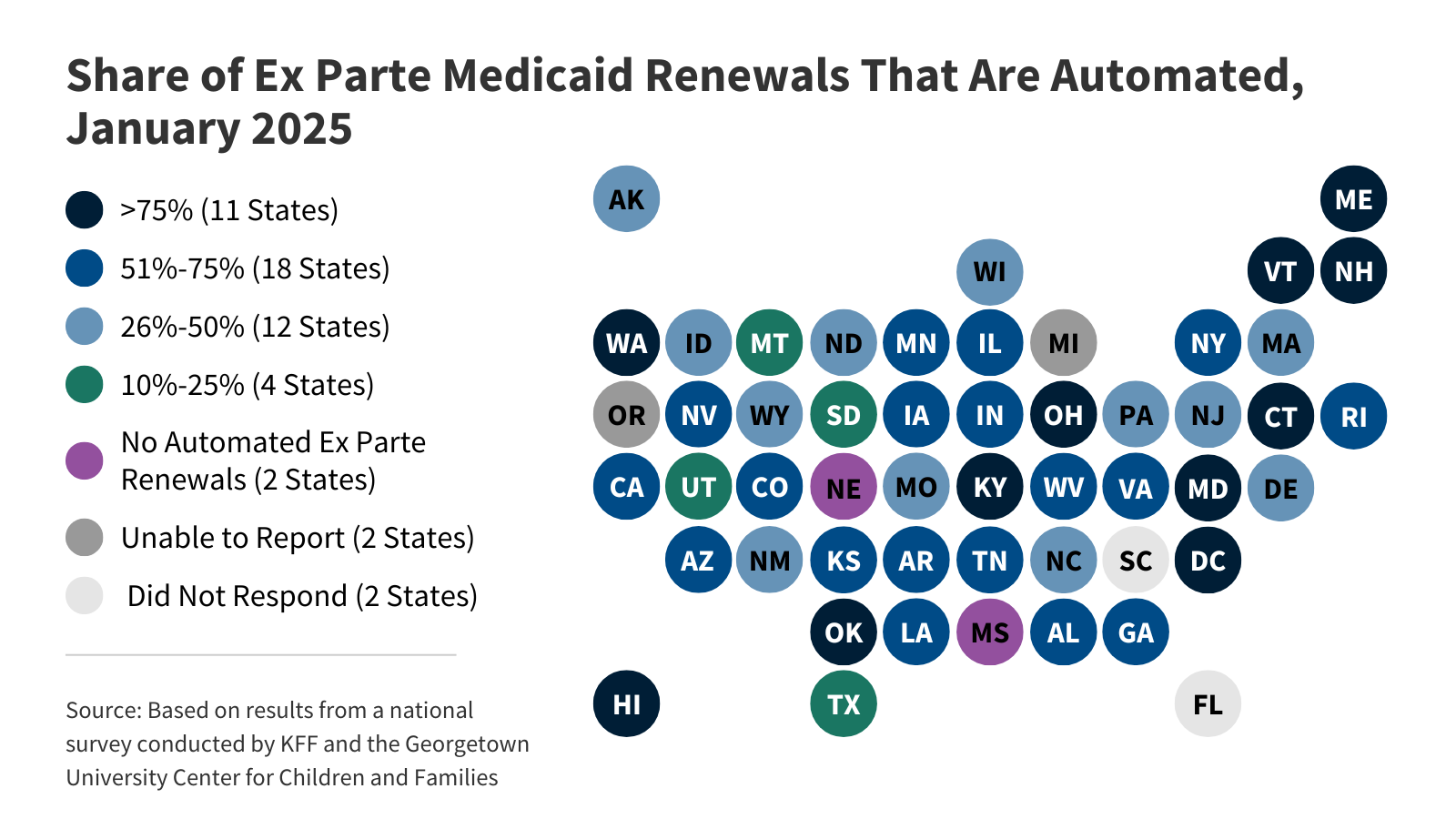
    KFF's survey findings capture state actions that seek to improve the accuracy and efficiency of Medicaid and CHIP enrollment and renewal processes, as of January 2025.
  • Seniors and People with Disabilities

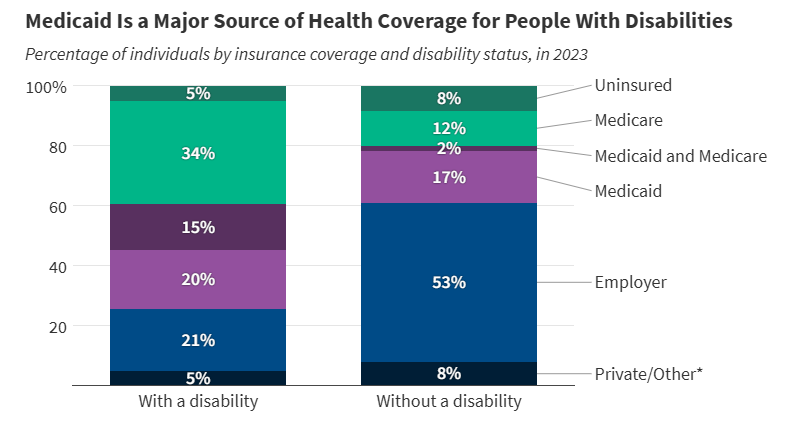
    More than 1 in 3 people with disabilities (15 million) have Medicaid (35%). In comparison, only 19% of people without disabilities have Medicaid.
  • Children with Special Needs

    Amid debates about proposed cuts to federal Medicaid spending, this brief analyzes key characteristics of children with special health care needs and explores how Medicaid provides them with coverage.
  • People With Intellectual and Developmental Disabilities

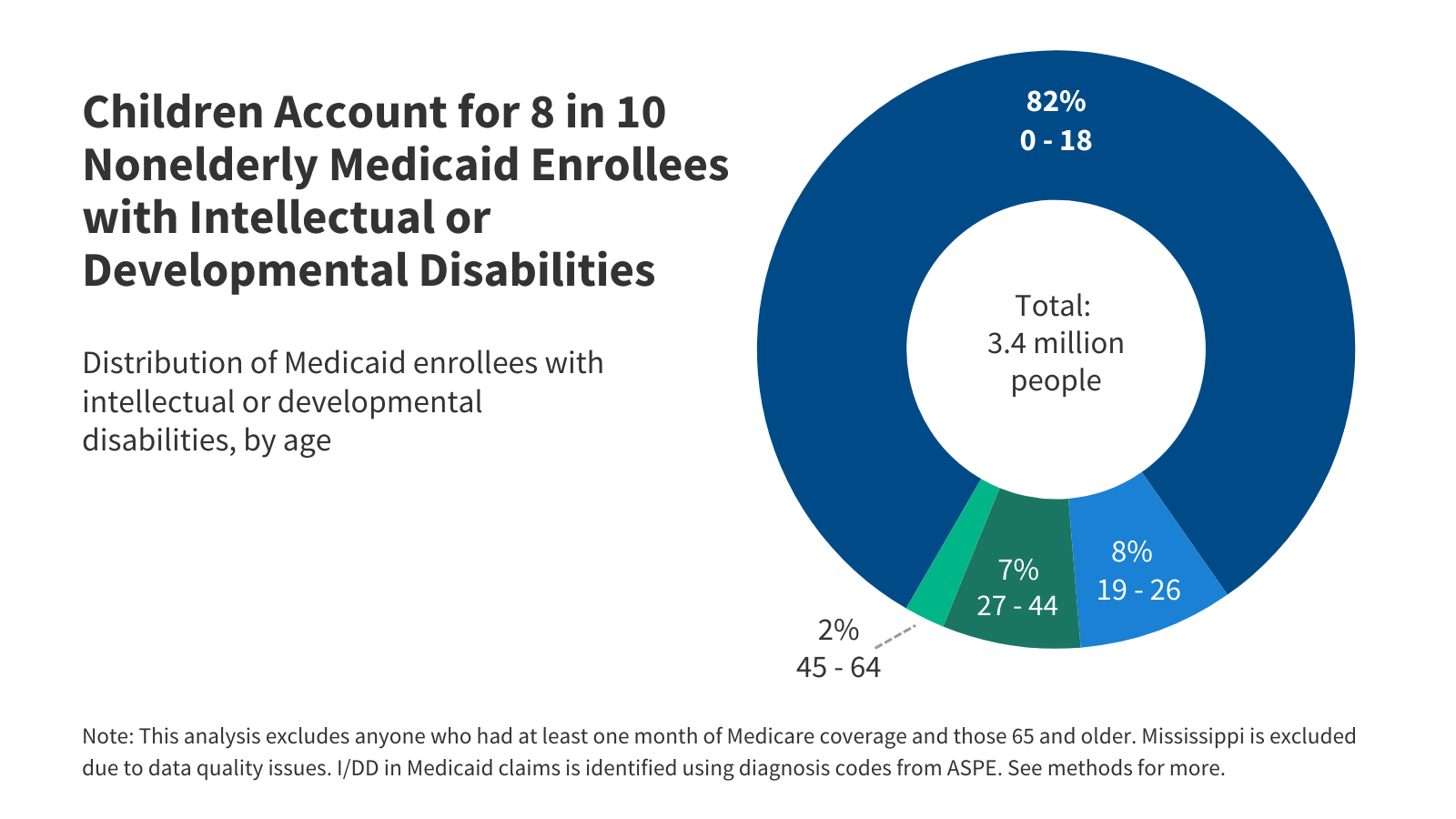
    Among the estimated 8 million people with intellectual and developmental disabilities (I/DD), over three million have Medicaid coverage.
  • Adults with Chronic Conditions

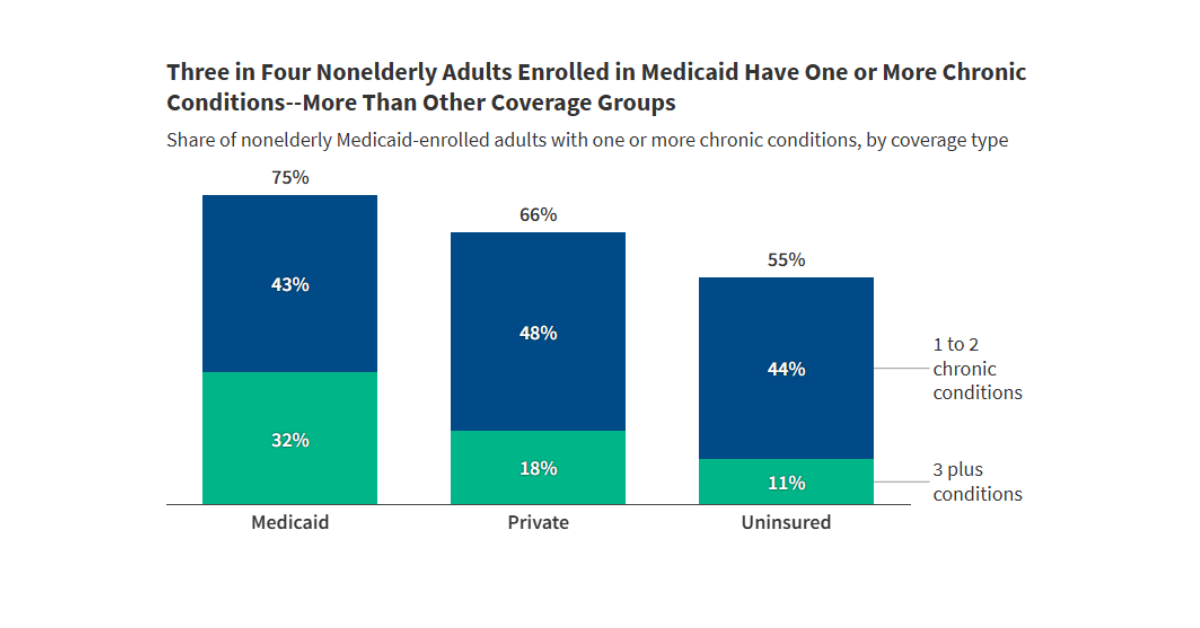
    Among working age adults enrolled in Medicaid, approximately three quarters have one or more chronic conditions, and nearly one-third have three or more.

Subscribe to KFF Emails

Choose which emails are best for you.
Sign up here
Filter

401 - 410 of 2,685 Results

  • Who Uses Medicaid Long-Term Services and Supports?

    Issue Brief

    This analysis examines the characteristics of Medicaid enrollees who use Medicaid long-term services and supports (LTSS), how enrollees who use LTSS differ from those who do not use these services, and how enrollees who use different types of LTSS differ from each other.

  • A Look at State Take-Up of ARPA Mobile Crisis Services in Medicaid

    Issue Brief

    Rising concerns about mental health and substance use disorder have led to new policy initiatives and funding to improve access and quality of services to address mental health crisis. While crisis call centers are accessible nationwide, the availability and characteristics of other components of the crisis continuum--mobile crisis units and stabilization centers--vary across and within states, as does the financing of these systems. The American Rescue Plan Act (ARPA), passed in 2021, had several Medicaid-focused provisions to improve and expand access to crisis systems in Medicaid. Medicaid programs can access the 85% enhanced federal match for ARPA mobile crisis services for eligible Medicaid enrollees. As of November 2023, 13 states obtained CMS approval for state plans amendments to cover ARPA community-based mobile crisis intervention services, making them eligible for enhanced federal matching funds under the American Rescue Plan Act (ARPA) option. Beyond the ARPA incentives, recent Department of Justice (DOJ) investigations into police handling of mental health calls could spur expansion of mobile crisis.

  • A Look at Navigating the Health Care System: Medicaid Consumer Perspectives

    Issue Brief

    This brief gauges Medicaid enrollees’ perspectives on their health insurance, based on findings from KFF’s Survey of Consumer Experiences with Health Insurance, fielded February 21 through March 14, 2023. This brief provides an overview of the survey findings, describes Medicaid enrollees’ views of their health and health coverage, explores problems those with Medicaid experience, compares how Medicaid performs relative to Medicare and private coverage, and reviews variation in Medicaid experiences.