Medicaid

What to Watch

Medicaid: What to Watch in 2026

Medicaid: What to Watch in 2026

In this brief, KFF explores how state fiscal pressures are likely to converge with the implementation of the 2025 reconciliation law to affect Medicaid coverage, financing, and access to care over the next year, especially leading up to the midterm elections.

Work Requirements

Challenges with Implementing Work Requirements

Many states are anticipating a variety of implementation challenges, including the need for complex system changes, a compressed implementation timeline, and limited staff capacity.

What is the Medicaid Hardship Exception?

The number of Medicaid expansion enrollees who ultimately qualify for the high unemployment hardship exception will depend on how the exception is implemented and how unemployment rates changes.

Tracking Implementation of the 2025 Reconciliation Law: Medicaid Work Requirements

KFF’s interactive tracks key data and policies that will affect how states implement Medicaid work requirements, which are required under the 2025 budget reconciliation law starting in January 2027. The tracker includes state-level data on Medicaid enrollment and renewal outcomes as well as current state enrollment and renewal policies.

2025 Medicaid Home Care survey

Payment Rates Ahead of 2025 Reconciliation Law

This issue brief describes Medicaid payment rates for home care and other workforce supports that are in place in 2025, before the majority of the 2025 reconciliation law provisions start taking effect.

Home Care Support for Family Caregivers in 2025
number of responding states, including DC, that allow payments for family caregivers by type of home care program and type of caregiver.

This issue brief describes the availability of self-directed services and supports for family caregivers in Medicaid home care in 2025, before most provisions in the reconciliation law take effect.

States’ Management of Home Care Spending

This issue brief describes the mechanisms states are currently using to limit Medicaid spending on home care and their plans for adopting new mechanisms in state fiscal year (FY) 2026.

Waiting Lists for Medicaid Home Care, 2016 to 2025
A Look at Waiting Lists for Medicaid Home- and Community-Based Services from 2016 to 2025

This data note provides new information about waiting lists in Medicaid home care before many of the provisions in the 2025 reconciliation law go into effect.

The Essentials
  • 5 Facts: Medicaid and Provider Taxes

    This brief describe states’ current provider taxes and how the 2025 reconciliation law changed the federal rules governing them, including potential impacts across states.
  • Medicaid Financing: The Basics

    Medicaid is a major source of financing for states to provide health coverage and long-term services and supports for low-income residents. This brief examines key questions about Medicaid financing and how it works.
  • 5 Facts: Immigrants and Medicaid

    This brief provides five key facts on Medicaid and immigrants as context for understanding the potential impacts of policy changes under the Trump administration.
  • 5 Facts: Medicaid and Hospitals

    This brief explains the role of Medicaid for hospitals, including how much spending on hospital care comes from Medicaid, the share of births covered by the program, and how Medicaid expansion has impacted hospital finances.
  • 5 Facts: Medicaid and Nursing Facilities

    The substantial Medicaid savings in the reconciliation bill could have major implications for nearly 15,000 federally certified nursing facilities and the 1.2 million people living in them.
Eligibility and coverage
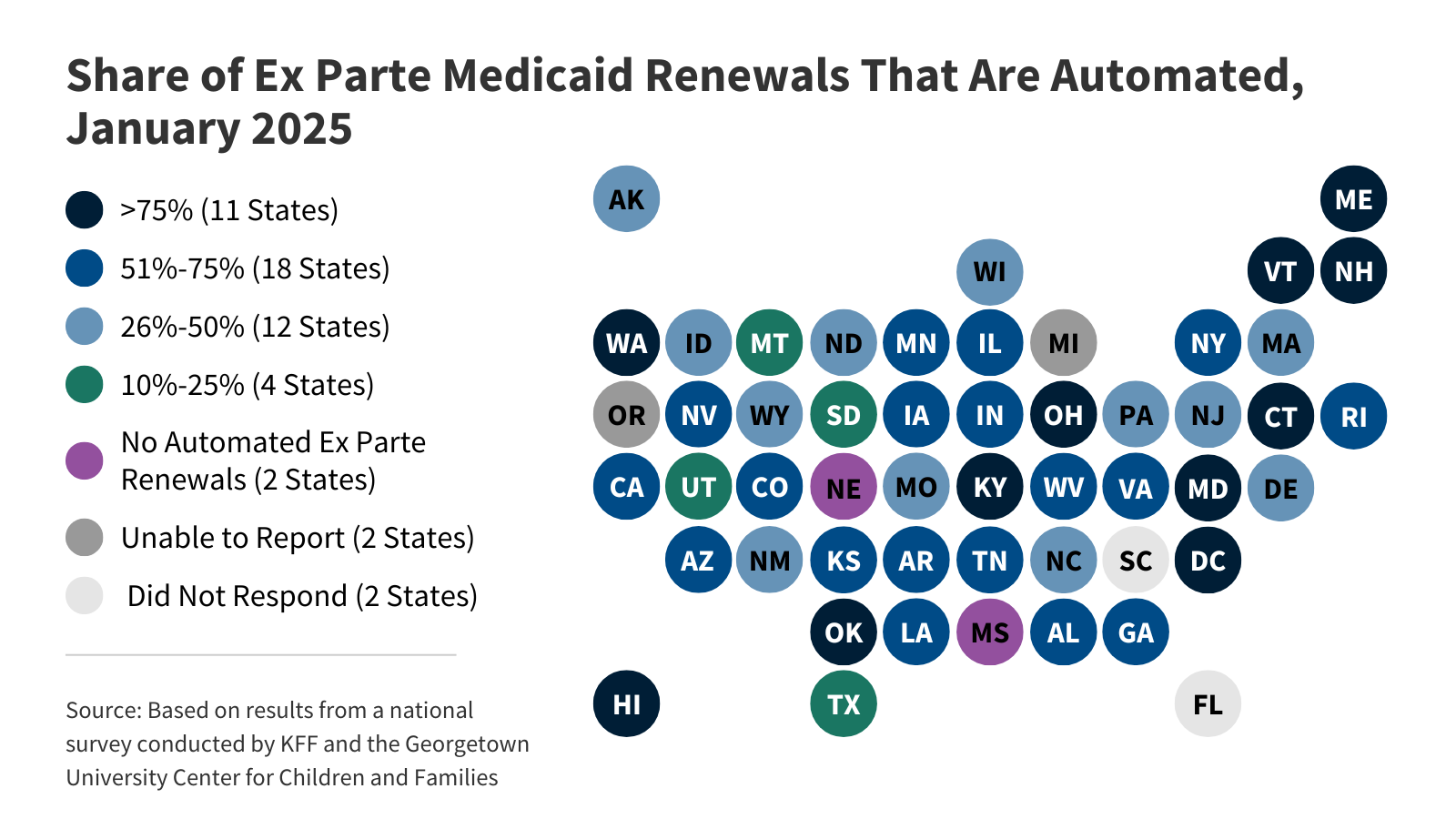
  • Eligibility, Enrollment, and Renewal Policies

    KFF's survey findings capture state actions that seek to improve the accuracy and efficiency of Medicaid and CHIP enrollment and renewal processes, as of January 2025.
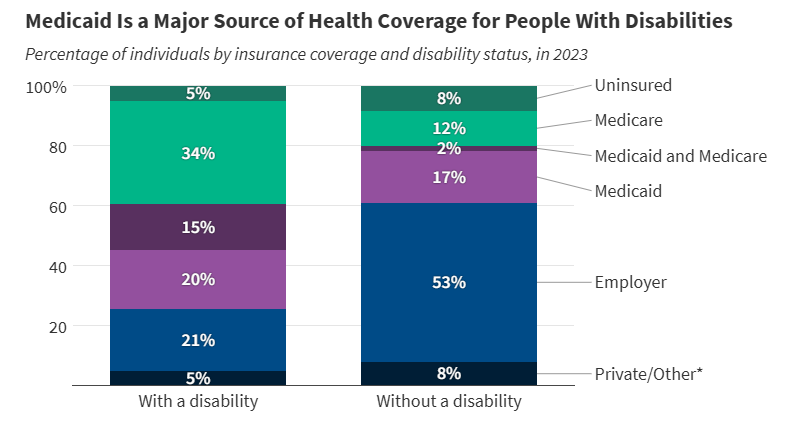
  • Seniors and People with Disabilities

    More than 1 in 3 people with disabilities (15 million) have Medicaid (35%). In comparison, only 19% of people without disabilities have Medicaid.
  • Children with Special Needs

    Amid debates about proposed cuts to federal Medicaid spending, this brief analyzes key characteristics of children with special health care needs and explores how Medicaid provides them with coverage.
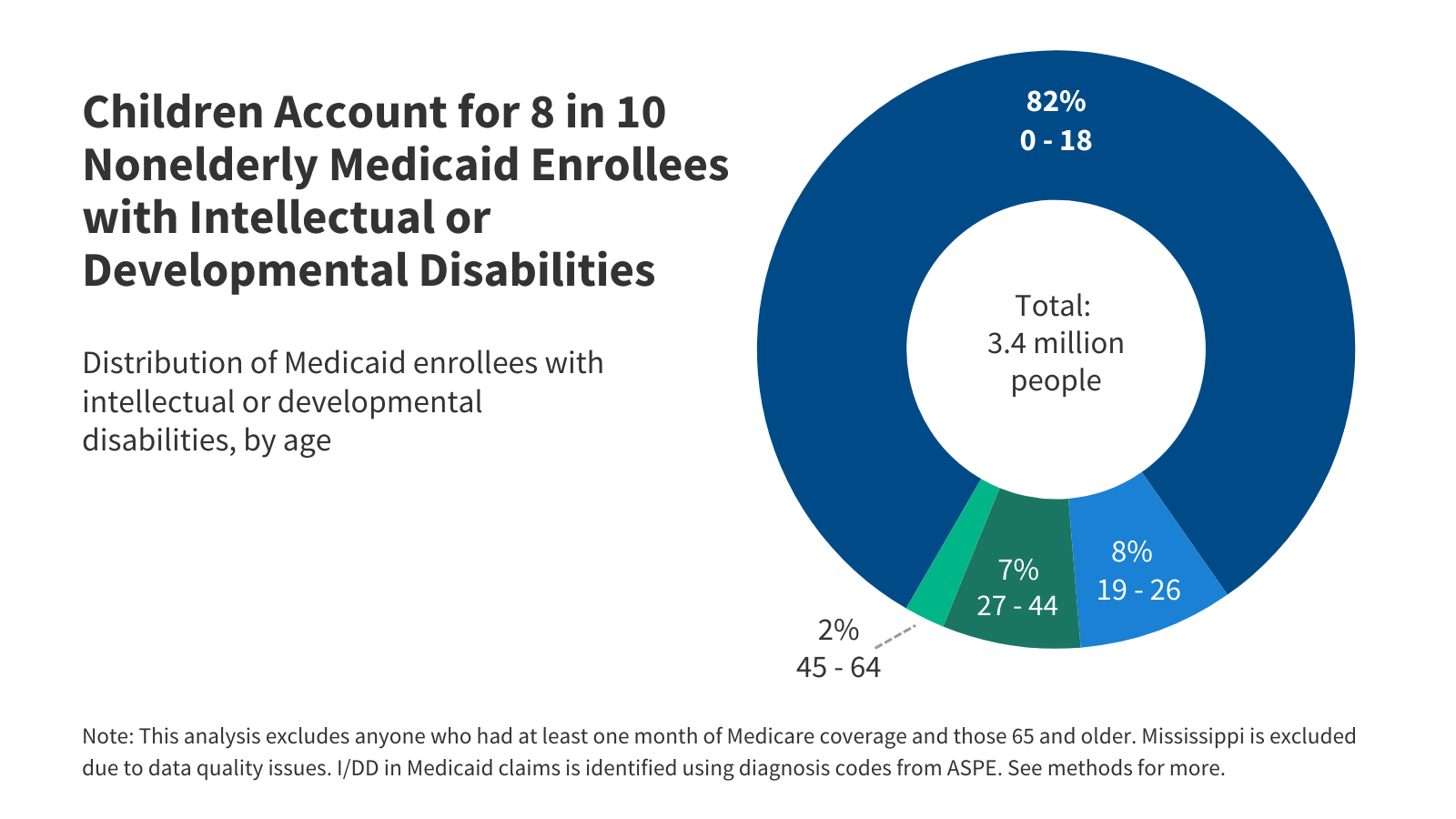
  • People With Intellectual and Developmental Disabilities

    Among the estimated 8 million people with intellectual and developmental disabilities (I/DD), over three million have Medicaid coverage.
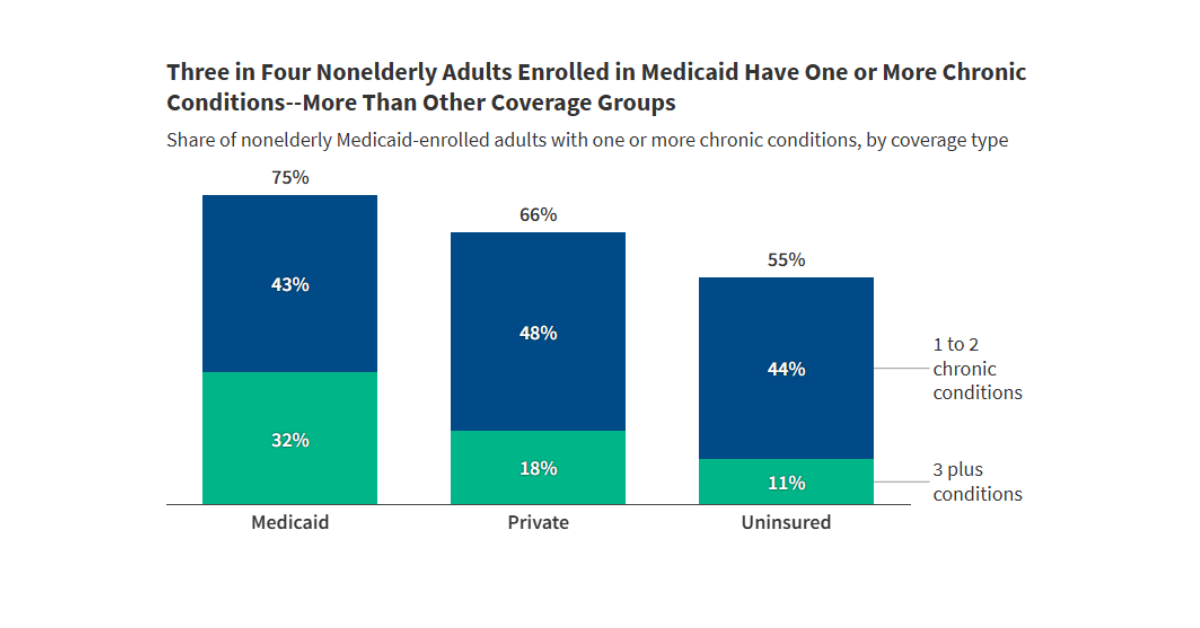
  • Adults with Chronic Conditions

    Among working age adults enrolled in Medicaid, approximately three quarters have one or more chronic conditions, and nearly one-third have three or more.

Subscribe to KFF Emails

Choose which emails are best for you.
Sign up here
Filter

2,311 - 2,320 of 2,684 Results

  • Medicaid:  Fiscal Challenges to Coverage

    Other Post

    Medicaid: Fiscal Challenges to Coverage This brief policy analysis outlines key points about the current state fiscal crisis and its impact on Medicaid's health coverage role. Policy Brief (.

  • SCHIP Program Enrollment: December 2002 Update

    Report

    This report presents information on the number of children enrolled in SCHIP for each state, for specific months from 1998 to December 2002. As of December 2002, the SCHIP program covered 3.7 million low-income children. An increase of 280,000 children during 2002.

  • Medicaid Enrollment in the 50 States: A June 2002 Data Update

    Report

    This publication provides state-by-state enrollment information and identifies national trends from the data. The report focuses on the five-year period from June 1997 to June 2002. In June 2002,total Medicaid enrollment in the United States reached over 38.1 million persons. This was an increase of nearly 3.

  • Preserving Recent Progress for Health Coverage of Children and Parents: New Tensions Emerge

    Report

    The latest survey of eligibility rules and enrollment and renewal procedures in all 50 states and the District of Columbia in their Medicaid and SCHIP programs for children and parents. It reflects changes states implemented between January 2002 and April 2003. The current survey also solicited information about states premiums and cost-sharing practices.

  • Section 1115 Waivers at a Glance:  Summary of Recent Medicaid and SCHIP Waiver Activity

    Other Post

    Section 1115 Waivers at a Glance: Summary of Recent Medicaid and SCHIP Waiver Activity This summary of waiver activity is part of the Commission's monitoring to provide information on how waivers are affecting the uninsured and the coverage provided to low-income Medicaid and SCHIP beneficiaries. It covers Section 1115 waivers submitted since August 2001.

  • Section 1115 Medicaid and SCHIP Waivers: Policy Implications of Recent Activities

    Issue Brief

    This policy brief provides an overview of recent Section 1115 waivers and a discussion of key issues. The HIFA initiative, combined with state fiscal pressures, have led to an increase in the number of states seeking Section 1115 waivers. Many of these recent waivers stake out new ground in terms of the scope of changes in coverage that they permit.

  • The Cost of Not Covering the Uninsured: Project Highlights

    Other Post

    The Cost of Not Covering the Uninsured: Project Highlights This brief summarizes the Cost of Not Covering the Uninsured Project's first three analyses and reports by Jack Hadley and John Holahan of The Urban Institute.

  • Dual Enrollees: Medicaid’s Role for Low-Income Medicare Beneficiaries

    Fact Sheet

    Dual Enrollees: Medicaid's Role for Low-Income Medicare Beneficiaries This fact sheet describes the low-income elderly population that is eligible for both Medicaid and Medicare, why they need Medicaid, what services they receive from Medicaid, and the current policy challenges related to this population. Fact Sheet (.