Medicaid

Work Requirements

Challenges with Implementing Work Requirements

Many states are anticipating a variety of implementation challenges, including the need for complex system changes, a compressed implementation timeline, and limited staff capacity.

What is the Medicaid Hardship Exception?

The number of Medicaid expansion enrollees who ultimately qualify for the high unemployment hardship exception will depend on how the exception is implemented and how unemployment rates changes.

Tracking Implementation of the 2025 Reconciliation Law: Medicaid Work Requirements

KFF’s interactive tracks key data and policies that will affect how states implement Medicaid work requirements, which are required under the 2025 budget reconciliation law starting in January 2027. The tracker includes state-level data on Medicaid enrollment and renewal outcomes as well as current state enrollment and renewal policies.

2025-2026 Medicaid Budget Survey

2025 Medicaid Home Care survey

Payment Rates Ahead of 2025 Reconciliation Law

This issue brief describes Medicaid payment rates for home care and other workforce supports that are in place in 2025, before the majority of the 2025 reconciliation law provisions start taking effect.

Home Care Support for Family Caregivers in 2025
number of responding states, including DC, that allow payments for family caregivers by type of home care program and type of caregiver.

This issue brief describes the availability of self-directed services and supports for family caregivers in Medicaid home care in 2025, before most provisions in the reconciliation law take effect.

States’ Management of Home Care Spending

This issue brief describes the mechanisms states are currently using to limit Medicaid spending on home care and their plans for adopting new mechanisms in state fiscal year (FY) 2026.

Waiting Lists for Medicaid Home Care, 2016 to 2025
A Look at Waiting Lists for Medicaid Home- and Community-Based Services from 2016 to 2025

This data note provides new information about waiting lists in Medicaid home care before many of the provisions in the 2025 reconciliation law go into effect.

Eligibility and coverage
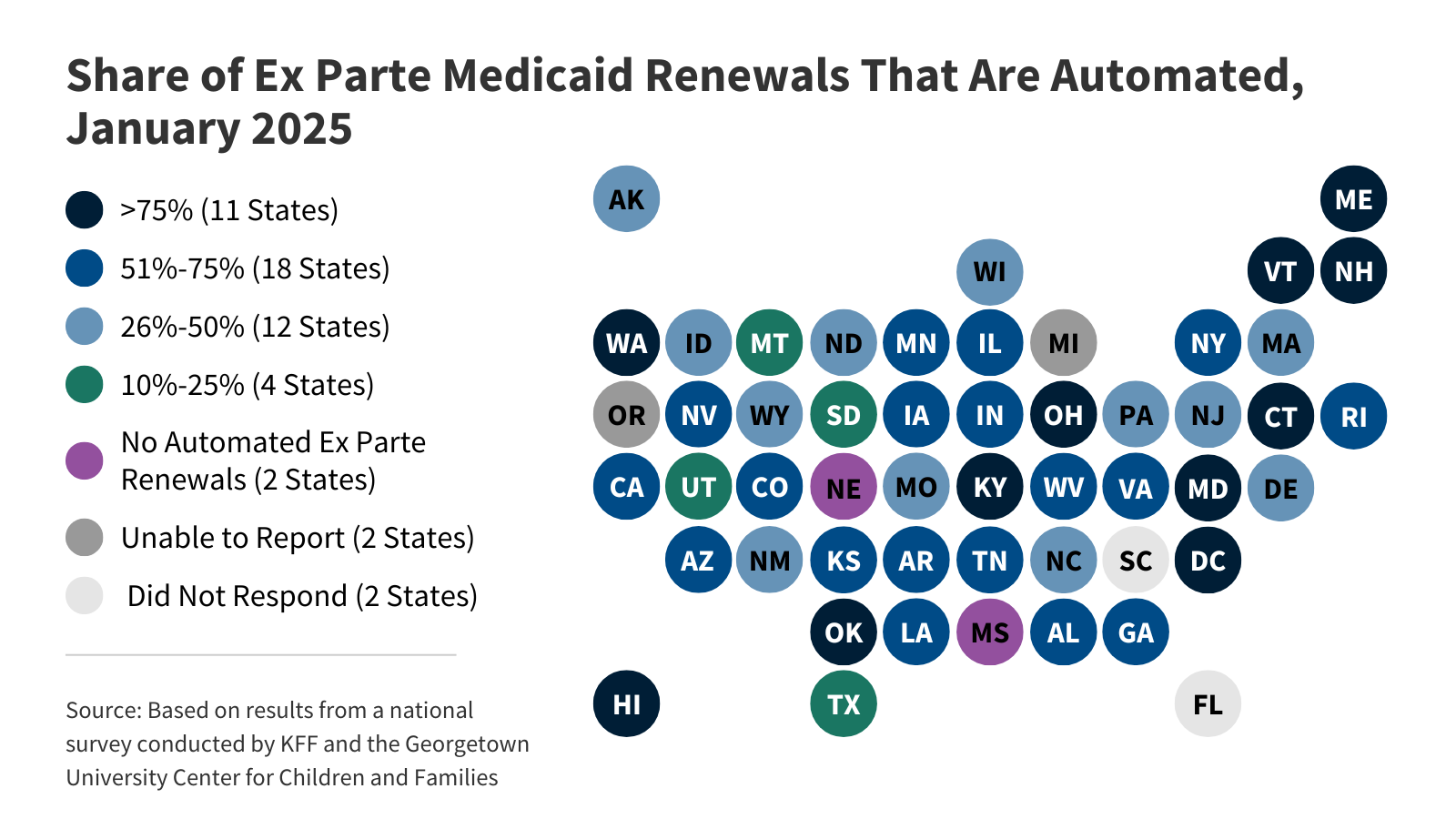
  • Eligibility, Enrollment, and Renewal Policies

    KFF's survey findings capture state actions that seek to improve the accuracy and efficiency of Medicaid and CHIP enrollment and renewal processes, as of January 2025.
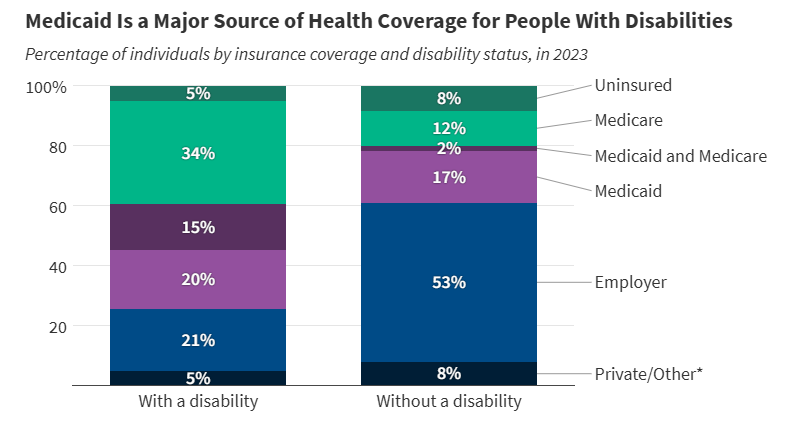
  • Seniors and People with Disabilities

    More than 1 in 3 people with disabilities (15 million) have Medicaid (35%). In comparison, only 19% of people without disabilities have Medicaid.
  • Children with Special Needs

    Amid debates about proposed cuts to federal Medicaid spending, this brief analyzes key characteristics of children with special health care needs and explores how Medicaid provides them with coverage.
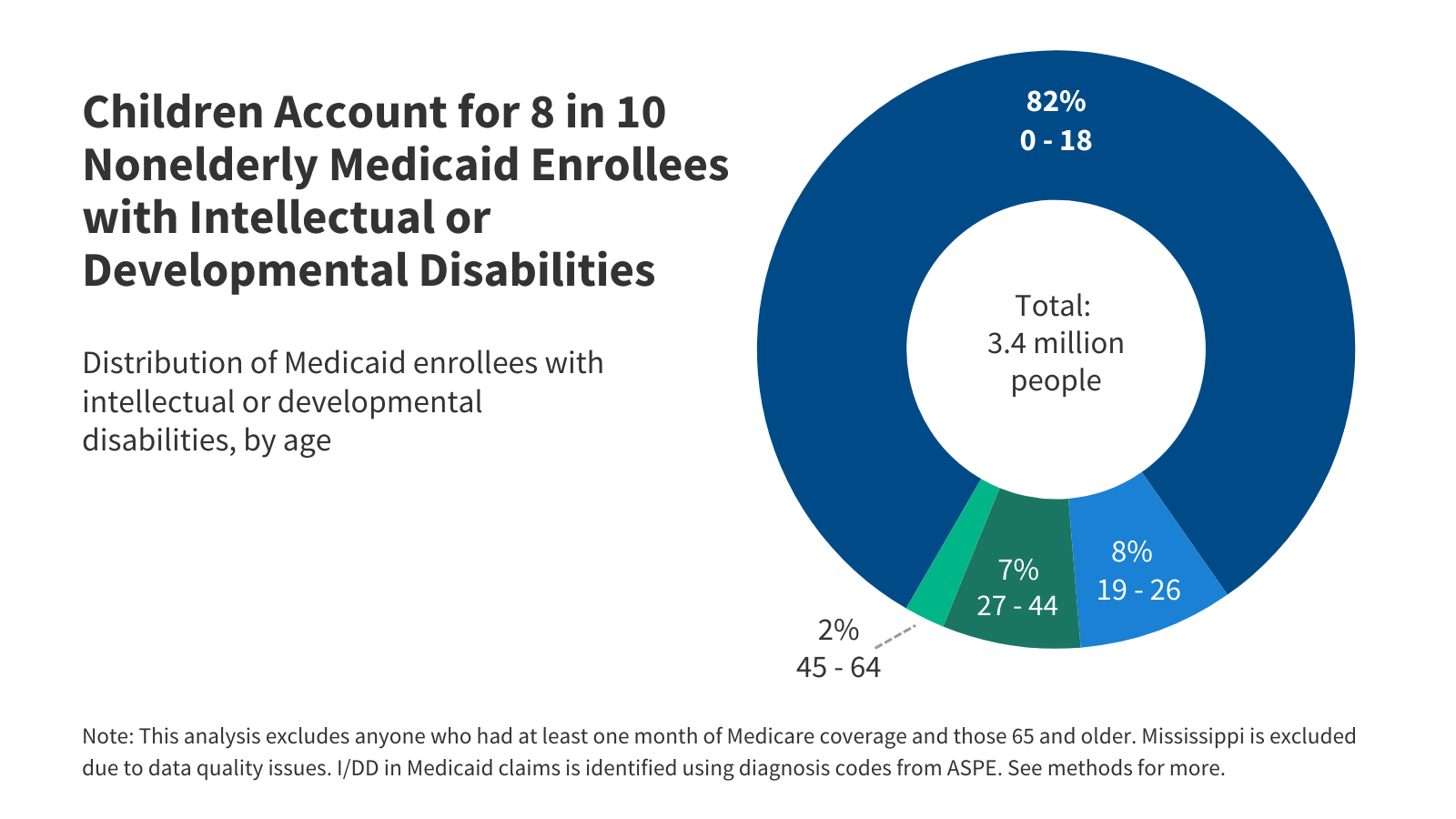
  • People With Intellectual and Developmental Disabilities

    Among the estimated 8 million people with intellectual and developmental disabilities (I/DD), over three million have Medicaid coverage.
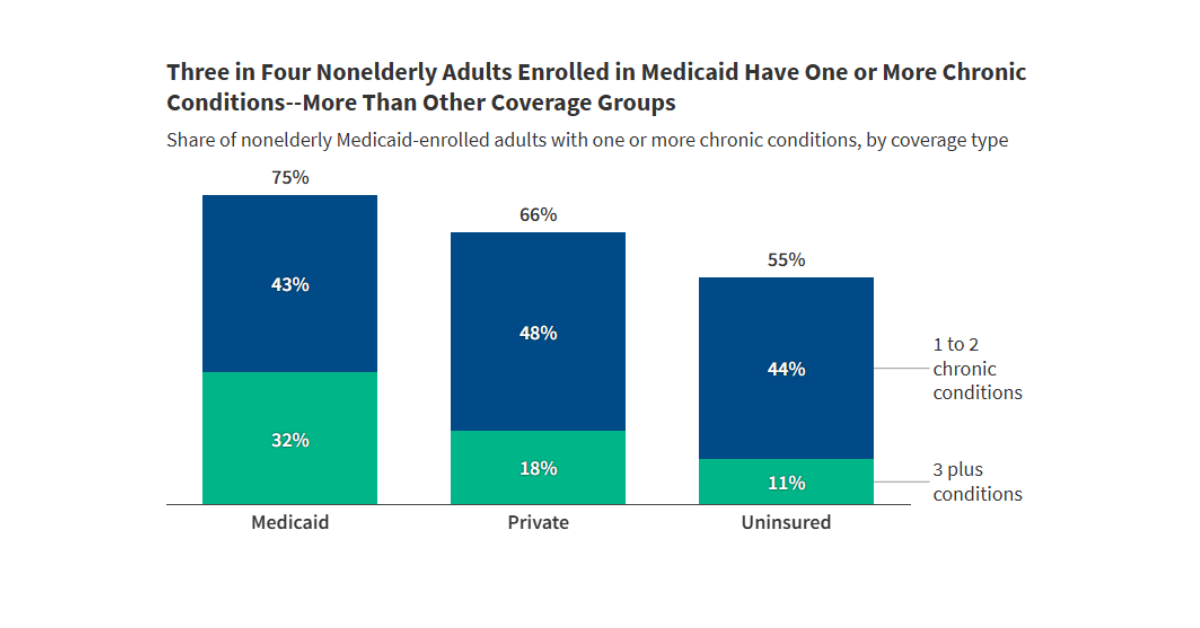
  • Adults with Chronic Conditions

    Among working age adults enrolled in Medicaid, approximately three quarters have one or more chronic conditions, and nearly one-third have three or more.

The Essentials
  • 5 Facts: Immigrants and Medicaid

    This brief provides five key facts on Medicaid and immigrants as context for understanding the potential impacts of policy changes under the Trump administration.
  • 5 Facts: Medicaid and Hospitals

    This brief explains the role of Medicaid for hospitals, including how much spending on hospital care comes from Medicaid, the share of births covered by the program, and how Medicaid expansion has impacted hospital finances.
  • Medicaid Financing: The Basics

    Medicaid is a major source of financing for states to provide health coverage and long-term services and supports for low-income residents. This brief examines key questions about Medicaid financing and how it works.
  • 5 Facts: Medicaid’s Share of National Health Spending

    This brief explores how Medicaid spending contributes to national health spending and how different service areas contribute to Medicaid costs.
  • 5 Facts: Medicaid and Nursing Facilities

    The substantial Medicaid savings in the reconciliation bill could have major implications for nearly 15,000 federally certified nursing facilities and the 1.2 million people living in them.

Subscribe to KFF Emails

Choose which emails are best for you.
Sign up here
Filter

2,231 - 2,240 of 2,678 Results

  • Striving to Make Ends Meet:  Low-Income Families’ Finances and Health Coverage

    Other Post

    Striving to Make Ends Meet: Low-Income Families’ Finances and Health Coverage The Kaiser Commission on Medicaid and the Uninsured released new reports and held a policy briefing on the challenges and tradeoffs low-income families face when dealing with their budgets and the implications for health coverage.

  • Financing the Medicaid Program: The Impact of Federal Fiscal Relief, April 2004 Fact Sheet

    Fact Sheet

    Financing the Medicaid Program: The Impact of Federal Fiscal Relief, April 2004 This fact sheet summarizes why federal fiscal relief to states was granted in 2003, including additional money for Medicaid; the impact of the relief in easing state budgetary pressure; and what may occur in the states after the fiscal relief expires in June…

  • Medicaid Financing Briefing – April 19, 2004

    Other Post

    On April 19, 2004 the Kaiser Commission on Medicaid and the Uninsured held a Washington policy briefing on the basics of Medicaid financing. A webcast and transcript of the briefing are available. Presentation Slides (.pdf) The publications below provide background information on Medicaid financing and the latest on Medicaid waiver activity.

  • Dual Eligibles: Medicaid’s Role in Filling Medicare’s Gaps

    Issue Brief

    Dual Eligibles: Medicaid's Role in Filling Medicare's Gaps - Issue Brief This paper presents a profile of dual eligible beneficiaries (those qualifying for both Medicare and Medicaid), describes their health care expenditures, and analyzes the distribution of spending on the population. Issue Paper (.

  • 2002 State and National Medicaid Spending Data

    Report

    (CMS-64) This set of tables, prepared by the Urban Institute for the Kaiser Commission on Medicaid and the Uninsured, presents the most current state-by-state information on Medicaid spending by services using data from the Centers on Medicaid and Medicare Services (CMS) Form 64 for Federal Fiscal Year (FFY) 2002.